
Yes! You can use AI to fill out Form 1099-DIV, Dividends and Distributions
Don't type 140 fields by hand. Tell our AI about yourself, or upload your W-2 or last year's return, and it fills every field in seconds. You check it, then download, print or sign.
The AI does the filling. You just check it.
No typing into boxes, nothing to install.
What this form asks for
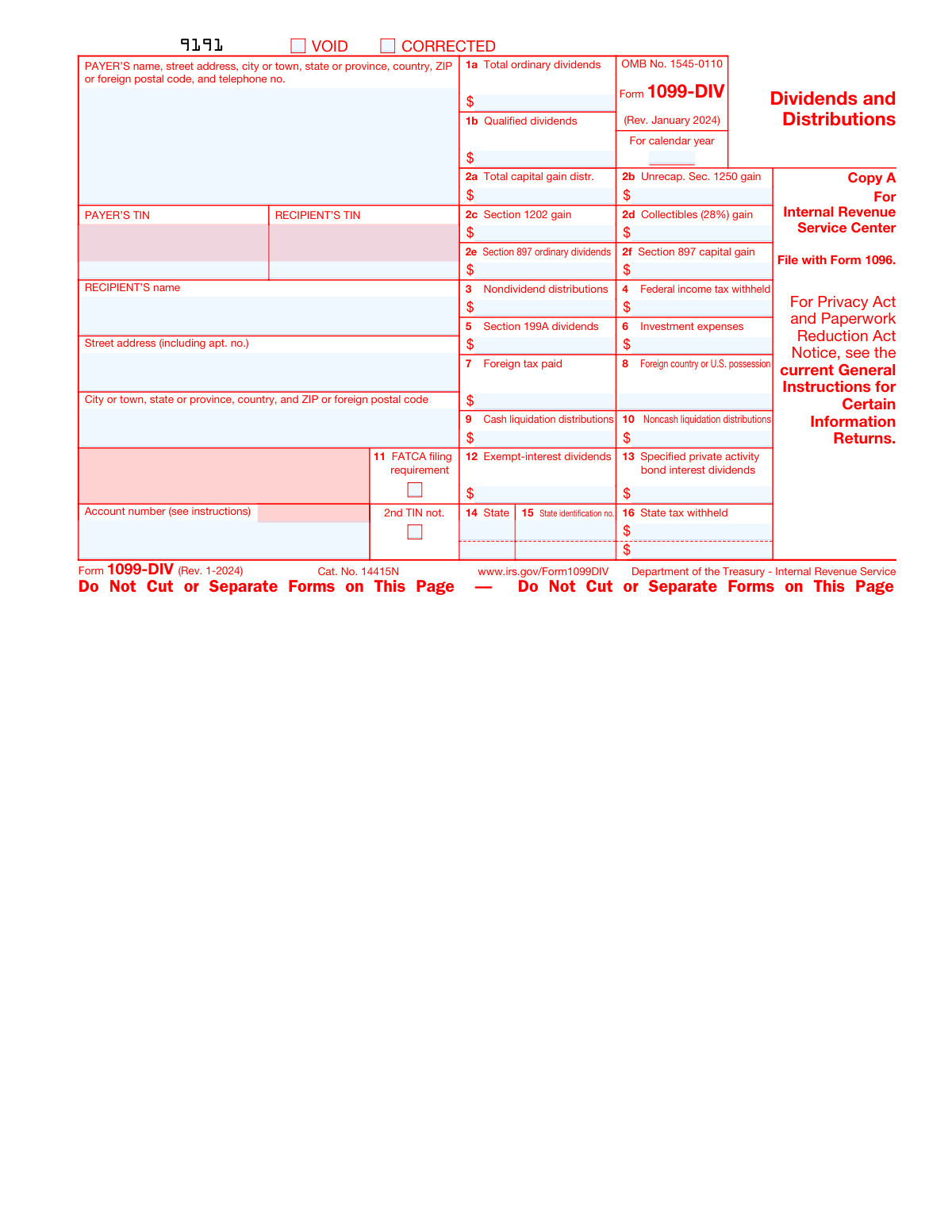
The AI fills all of it, from your answers or your documents.
The AI checks your answers before you download
15 checks built for this form, so a wrong date or a missing answer is caught before anyone else sees it.
The system ensures that the 'VOID' box on Form 1099-DIV is marked only when necessary. If the form is being used as a placeholder or for testing purposes, the 'VOID' box should be checked to indicate that the form should not be processed. The AI verifies that this box is not checked during the submission of an actual, valid form. It also alerts the user if the 'VOID' box is marked when it should not be, to prevent any accidental voiding of the form.
The system confirms that the 'CORRECTED' box is checked on Form 1099-DIV in cases where the form is being submitted to correct previously submitted information. It ensures that this box is not checked on the initial submission of the form. The AI cross-references previous submissions to determine if the 'CORRECTED' status is warranted and prompts the user to verify if a correction is indeed being made, thereby maintaining the accuracy of the filing.
The system verifies that the payer's full name is accurately entered on Form 1099-DIV. It checks against the payer's legal documentation or previously verified information to ensure that the name matches exactly, including any middle initials or suffixes. The AI also looks for common typing errors or misspellings and suggests corrections if discrepancies are found, thus ensuring the name is reported correctly to the IRS.
The system checks that the payer's complete address is provided on Form 1099-DIV, including the street address, city or town, state or province, country, and ZIP or foreign postal code. It validates the format of the address against postal standards and may use external databases to confirm the accuracy of the address details. The AI alerts the user if any part of the address is missing or appears to be incorrect, ensuring that the IRS can contact the payer if needed.
The system validates that the payer's telephone number is entered correctly on Form 1099-DIV. It checks the format of the phone number to ensure it includes the correct country code, area code, and local number as applicable. The AI may also compare the number against contact information on file to confirm its validity. If an error is detected, the system prompts the user to correct the telephone number to ensure clear communication channels with the payer.
This validation check ensures that the payer's Taxpayer Identification Number (TIN) is present on Form 1099-DIV and is correctly formatted according to IRS standards. It verifies that the TIN is a nine-digit number, without any alphabetic characters, and is typically in the format of an Employer Identification Number (EIN), Social Security Number (SSN), or Individual Taxpayer Identification Number (ITIN). The check also confirms that the TIN is not missing any digits and does not contain invalid sequences or characters.
And 9 more checks
- Confirms that the recipient's Taxpayer Identification Number (TIN) is correctly entered and formatted
- Verifies that the recipient's full name is entered correctly
- Checks that the recipient's complete address is provided, including street address, city or town, state or province, country, and ZIP or foreign postal code
- Validates that the account number is entered if applicable
- Ensures that the '2nd TIN not.' box is checked if applicable
- Confirms that all amounts for 'Dividends and Distributions' sections (1a through 16) are entered and formatted correctly
- Verifies that the 'FATCA filing requirement' box is checked if applicable
- Checks for consistency across all copies of Form 1099-DIV (Copy A, Copy 1, Copy B, and Copy 2)
- Validates that the state information, including '14 State', '15 State identification no.', and '16 State tax withheld', is entered correctly if applicable
Let AI fill out your 1099-DIV
No typing. Every field filled in seconds, checked, ready to sign.
How to Fill Out 1099-DIV Online for Free in 2026
What the AI walks you through.
- Visit instafill.ai site and select 1099-DIV
- Enter payer's information
- Input recipient's TIN and name
- Fill in recipient's address and account number
- Report dividends and distributions amounts
- Add tax withheld and foreign tax paid
- Sign and date the form electronically
- Check for accuracy and submit form
Common Mistakes in Completing 1099-DIV
The ones the AI is built to catch.
Not checking the VOID box when applicable
Not checking the CORRECTED box when applicable
Incomplete or incorrect payer's full name
Incomplete or incorrect payer's address
Omitting the payer's telephone number
Incorrect payer's Taxpayer Identification Number (TIN)
Incorrect recipient's Taxpayer Identification Number (TIN)
Incomplete or incorrect recipient's full name
Incomplete or incorrect recipient's address
Omitting the recipient's city, state, country, or postal code
Failing to enter the account number if applicable
Not checking the 2nd TIN not. box when applicable
Incorrect total amount of ordinary dividends (1a)
Incorrect amount of qualified dividends (1b)
Incorrect total capital gain distributions (2a)
Incorrect unrecaptured Section 1250 gain (2b)
Incorrect Section 1202 gain (2c)
Incorrect collectibles (28%) gain (2d)
Incorrect Section 897 ordinary dividends (2e)
Incorrect Section 897 capital gain (2f)
Incorrect nondividend distributions
Incorrect federal income tax withheld
Incorrect Section 199A dividends
Incorrect investment expenses
Incorrect foreign tax paid
Omitting the foreign country or U.S. possession (8)
Incorrect cash liquidation distributions (9)
Incorrect noncash liquidation distributions (10)
Not checking the FATCA filing requirement box when applicable (11)
Incorrect exempt-interest dividends (12)
Incorrect specified private activity bond interest dividends (13)
Incomplete or incorrect state information (14)
Incorrect state identification number (15)
Incorrect state tax withheld (16)
Using Copy A instead of Copy B for recipient's records
Using incorrect copy for state tax department filing
Frequently Asked Questions About 1099-DIV
Is it really free for 7 days?
Can I fill other forms too?
How do I cancel?
How does the AI fill out 1099-DIV?
What happens to my information?
How complex is 1099-DIV to fill out?
What is Form 1099-DIV used for?
Who should receive a Form 1099-DIV?
What should I do if I receive a Form 1099-DIV?
What are 'Total ordinary dividends' as reported in Box 1a of Form 1099-DIV?
What are 'Qualified dividends' as reported in Box 1b of Form 1099-DIV?
What is reported in Box 2a 'Total capital gain distr.' on Form 1099-DIV?
How is 'Unrecap. Sec. 1250 gain' in Box 2b of Form 1099-DIV calculated?
What is the significance of 'Section 1202 gain' in Box 2c on Form 1099-DIV?
What does 'Collectibles (28%) gain' in Box 2d on Form 1099-DIV refer to?
What are 'Section 897 ordinary dividends' and 'Section 897 capital gain' reported in Boxes 2e and 2f on Form 1099-DIV?
How should 'Nondividend distributions' reported in Box 3 of Form 1099-DIV be treated for tax purposes?
What does 'Federal income tax withheld' in Box 4 indicate on Form 1099-DIV?
What are 'Section 199A dividends' reported in Box 5 of Form 1099-DIV?
Are 'Investment expenses' in Box 6 of Form 1099-DIV deductible?
How can I claim 'Foreign tax paid' reported in Box 7 of Form 1099-DIV?
What should I do with the information in Boxes 9 and 10 regarding 'Cash liquidation distributions' and 'Noncash liquidation distributions'?
What does the 'FATCA filing requirement' checkbox in Box 11 on Form 1099-DIV indicate?
Are 'Exempt-interest dividends' in Box 12 of Form 1099-DIV taxable?
What are 'Specified private activity bond interest dividends' reported in Box 13 of Form 1099-DIV?
What should I do if I am a nominee recipient who received a Form 1099-DIV with amounts belonging to another person?
Get your 1099-DIV filled out by AI
$0 today. Cancel before Nov 1 and you pay nothing.
Other forms like this one
1099 forms: Form 1099-NEC, Nonemployee Compensation, Form 4852, Substitute for Form W-2 or 1099-R, Form 1099-MISC, Miscellaneous Information, Form 1099-INT, Interest Income, Form 1099-R, Distributions From Pensions etc., Form 1099-S, Proceeds From Real Estate Transactions, Form 1099-G, Certain Government Payments, Form 1099-C, Cancellation of Debt, Form 1099-K, Payment Card and Third Party Network Transactions, Form 1099-OID, Original Issue Discount, Form 1099-PATR, Taxable Distributions from Cooperatives, Form 1099-Q, Payments From Qualified Education Programs, Form 1099-SA, Distributions from HSA/MSA, Form 1099-B, Proceeds From Broker Transactions, Form 1099-NEC, Nonemployee Compensation, Form 1099-NEC, Nonemployee Compensation, Form 1099-NEC, Nonemployee Compensation, Form 1099-NEC, Nonemployee Compensation, Instructions for Forms 1099-R and 5498, Form 1099-MISC, Miscellaneous Information
distribution forms: Fischer Homes Request for In-Service Distribution, Form 1099-R, Distributions From Pensions etc., Form 1099-PATR, Taxable Distributions from Cooperatives, Form 1099-SA, Distributions from HSA/MSA, Nationwide Retirement Solutions Participant Distribution Request Form (PNF-0875M9, TRAC Version, 01/2025), Nationwide Retirement Solutions Participant Distribution Request Form (PNF-0875M9, TRAC Version, 01/2025), Fidelity Advisor 403(b) Distribution Request Form, Fidelity Advisor IRA Distribution Request for Automatic Rollover Accounts, Fidelity NetBenefits Distribution - Recurring Payments, Fidelity Investments® Beneficiary Distribution Form, Fidelity Investments Distribution Form, Fidelity IRA Beneficiary Distribution — Charity, Foundation, or a University, IRA Distribution Form, New York State Deferred Compensation Plan Benefit Distribution Request, Individual 401(k) Distribution Request Form, Fidelity Distribution—Rollover, Charles Schwab IRA Distribution Form, Sample IRA Distribution Letter for a Qualified Charitable Distribution (QCD), Vanguard IRA Distribution Kit (including IRA Distribution Form RRDFT and Form W-4R), Vanguard Required Minimum Distribution Service Form
dividend distribution forms: Dividend and/or Capital Gain Distributions Authorization Form (G27569-13)
Let AI fill out your 1099-DIV
Your trial starts once a card is added. You pay nothing before Nov 1.
Our AI already knows this form, all 140 fields of it. Skip the typing: tell it about yourself, or upload what you have, and it fills the whole form in seconds.
- AI fills every field on all 6 pages, tables and checkboxes included
- No typing into boxes: answer a few questions, or upload your W-2 or last year's return, an old copy of this form, a photo of a document
- The AI checks the answers; you review and change anything before you download
- Download the finished PDF, print it, or sign it online
- Encrypted, and never used to train AI
Cancel before Nov 1 and you pay nothing.
A card is needed to start the trial. Cancel in two clicks from your account.
Terms · Privacy