
Yes! You can use AI to fill out Form 1099-INT, Interest Income
Don't type 127 fields by hand. Tell our AI about yourself, or upload your W-2 or last year's return, and it fills every field in seconds. You check it, then download, print or sign.
The AI does the filling. You just check it.
No typing into boxes, nothing to install.
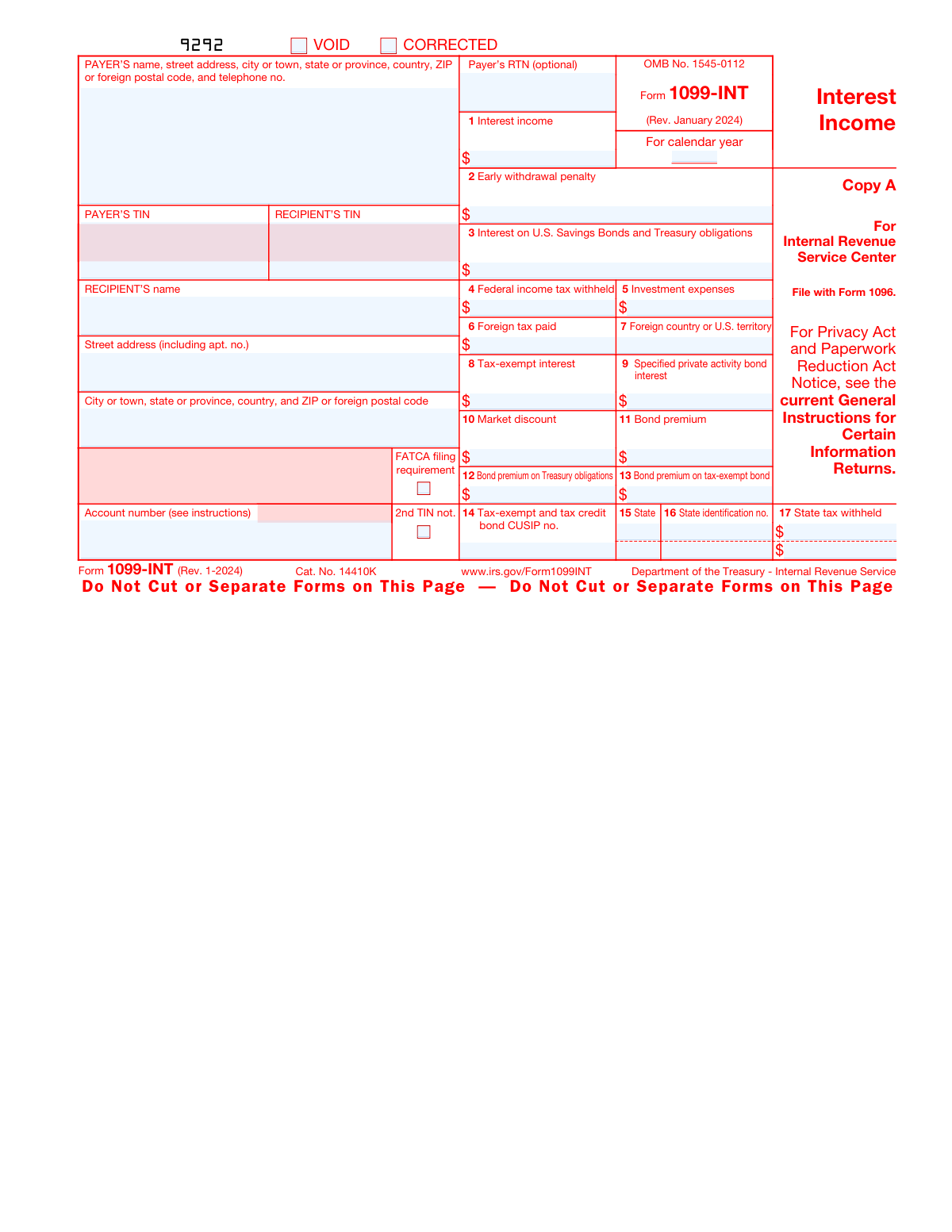
What this form asks for
The AI fills all of it, from your answers or your documents.
The AI checks your answers before you download
15 checks built for this form, so a wrong date or a missing answer is caught before anyone else sees it.
This validation check ensures that the PAYER'S name and address fields on Form 1099-INT are fully completed. It verifies the accuracy of the information provided, including the street address, city, state, and ZIP code. The check also includes validation of the telephone number, confirming that it is present and correctly formatted. This is crucial for maintaining accurate records and ensuring that the payer can be contacted if necessary.
This validation check confirms that the Taxpayer Identification Number (TIN) for the payer on Form 1099-INT is correctly entered. It ensures that the TIN is properly formatted, adhering to IRS standards, which typically require a nine-digit number without any dashes or spaces. This check is essential for tax reporting purposes and helps prevent errors that could lead to processing delays or incorrect tax assessments.
This validation check verifies that the recipient's Taxpayer Identification Number (TIN) on Form 1099-INT is provided and correctly formatted. It checks for the standard nine-digit format and ensures that there are no extraneous characters or missing digits. This is a critical step in tax form processing, as an incorrect or missing TIN can result in penalties for the recipient and complications with the IRS.
This validation check ensures that the recipient's name on Form 1099-INT is fully entered and accurately matches the associated TIN. It involves cross-referencing the name with the TIN to confirm that they correspond correctly. This step is vital for the integrity of the tax document, as discrepancies between the name and TIN can lead to issues with the IRS and may impact the recipient's tax obligations.
This validation check validates the completeness and accuracy of the recipient's full address on Form 1099-INT. It ensures that all parts of the address are present, including the street address, city, state, and ZIP code, as well as the apartment number if applicable. This check is important for ensuring that the recipient receives any necessary correspondence from the payer or the IRS and that the address is recorded correctly for tax purposes.
The AI ensures that the FATCA filing requirement box on Form 1099-INT is checked if the criteria for Foreign Account Tax Compliance Act (FATCA) reporting apply to the filer. It assesses the filer's information against FATCA requirements and prompts the user to check the box if necessary. This validation is crucial for compliance with international tax laws and helps avoid potential penalties for failing to indicate FATCA filing status.
And 9 more checks
- Ensures that the account number associated with the interest income is entered if applicable.
- Verifies the optional entry of the Payer’s RTN when provided.
- Checks for the correct dollar amounts entered in Boxes 1 through 17, ensuring each category is accurately reported.
- Validates that the VOID box is checked only if the form is being voided and that all other information is disregarded in this case.
- Ensures that the CORRECTED box is checked if the form is correcting a previously filed Form 1099-INT and that the corrected information is accurately provided.
- Confirms that the correct copy of the form is used for each specific purpose (IRS, recipient, State Tax Department).
- Verifies that Copy A is the official scannable IRS version if it is being filed on paper.
- Checks if e-filing is required based on the number of information returns being submitted (mandatory for 10 or more).
- Ensures that the recipient is provided with Copy B for their records and understands the need to report this information on their tax return.
Let AI fill out your Form 1099-INT
No typing. Every field filled in seconds, checked, ready to sign.
How to Fill Out Form 1099-INT Online for Free in 2026
What the AI walks you through.
- Visit instafill.ai site and select Form 1099-INT
- Enter payer's information
- Input recipient's TIN and name
- Fill in interest income details
- Report any tax withheld or expenses
- Sign and date the form electronically
- Check for accuracy and submit form
Common Mistakes in Completing Form 1099-INT
The ones the AI is built to catch.
Using incorrect copy of Form 1099-INT for filing
Failing to include full payer's name and address
Omitting or incorrectly entering payer's TIN
Omitting or incorrectly entering recipient's TIN
Failing to include full recipient's name
Omitting or incorrectly entering recipient's address
Not checking FATCA filing requirement box when applicable
Leaving account number blank if applicable
Omitting payer's RTN when provided
Entering incorrect amounts in Boxes 1 through 17
Not checking VOID box when voiding the form
Not checking CORRECTED box when correcting a form
Printing and filing Copy A from the website
Not e-filing when required for 10 or more returns
Recipient not retaining Copy B for their records
Not referring to IRS General Instructions for guidance
Incorrectly reporting state tax withheld information
Mixing up payer and recipient information
Failing to use official scannable IRS version of Copy A
Not reporting interest income on recipient's tax return
Frequently Asked Questions About Form 1099-INT
Is it really free for 7 days?
Can I fill other forms too?
How do I cancel?
How does the AI fill out Form 1099-INT?
What happens to my information?
How complex is Form 1099-INT to fill out?
What is Form 1099-INT used for?
Who should receive a Form 1099-INT?
What should I do if I receive a Form 1099-INT?
How do I know if my Form 1099-INT is a Copy A, Copy B, or Copy 1?
Can I print and file Copy A of Form 1099-INT from the IRS website?
What are the penalties for filing a Form 1099-INT that cannot be scanned by the IRS?
Where can I find the General Instructions for Certain Information Returns?
What is the deadline for filing Form 1099-INT with the IRS?
What should I do if I have 10 or more information returns to file?
Is it mandatory to e-file Form 1099-INT if I have fewer than 10 information returns?
How can I order official IRS information returns forms?
What is the OMB No. for Form 1099-INT?
What information is reported in Box 1 of Form 1099-INT?
What does Box 2 on Form 1099-INT indicate?
Is the interest reported in Box 3 of Form 1099-INT taxable?
What should I do with the amount reported in Box 4 for federal income tax withheld?
Can I deduct the investment expenses reported in Box 5 of Form 1099-INT?
How do I report foreign tax paid as shown in Box 6 of Form 1099-INT?
What is the significance of the FATCA filing requirement box on Form 1099-INT?
Where can I find more information about the requirements and instructions for Form 1099-INT?
Get your Form 1099-INT filled out by AI
$0 today. Cancel before Nov 1 and you pay nothing.
Other forms like this one
income forms: Form SSA-44, Medicare Income-Related Monthly Adjustment Amount - Life-Changing Event, Form 1040-X, Amended U.S. Individual Income Tax Return, Form 1040-C, U.S. Departing Alien Income Tax Return, Form 4137, Social Security and Medicare Tax on Unreported Tip Income, Form 8960, Net Investment Income Tax, Form 1042-S, Foreign Person’s U.S. Income, Form 990-T, Exempt Org Business Income Tax Return, Form 945, Annual Return of Withheld Federal Income Tax, Form 568, LLC Income Return, Form FTB 3514, California Earned Income Tax Credit, Form 1120-S, U.S. Income Tax Return for an S Corporation, Form 1065, U.S. Return of Partnership Income, Form 1040, U.S. Individual Income Tax Return, Form FL-150, Income and Expense Declaration, Form 122A-1, Chapter 7 Statement of Current Monthly Income, Arizona Form 285-I, Individual Income Tax Disclosure/Representation Authorization Form, Form SSA-8000-BK, Application for Supplemental Security Income (SSI), Judicial Council of California Form FL-150, Income and Expense Declaration, Form 1120-S (2025), U.S. Income Tax Return for an S Corporation, California Form 568 (2024), Limited Liability Company Return of Income
1099 forms: Form 1099-NEC, Nonemployee Compensation, Form 4852, Substitute for Form W-2 or 1099-R, Form 1099-MISC, Miscellaneous Information, Form 1099-DIV, Dividends and Distributions, Form 1099-R, Distributions From Pensions etc., Form 1099-S, Proceeds From Real Estate Transactions, Form 1099-G, Certain Government Payments, Form 1099-C, Cancellation of Debt, Form 1099-K, Payment Card and Third Party Network Transactions, Form 1099-OID, Original Issue Discount, Form 1099-PATR, Taxable Distributions from Cooperatives, Form 1099-Q, Payments From Qualified Education Programs, Form 1099-SA, Distributions from HSA/MSA, Form 1099-B, Proceeds From Broker Transactions, Form 1099-NEC, Nonemployee Compensation, Form 1099-NEC, Nonemployee Compensation, Form 1099-NEC, Nonemployee Compensation, Form 1099-NEC, Nonemployee Compensation, Instructions for Forms 1099-R and 5498, Form 1099-MISC, Miscellaneous Information
Let AI fill out your Form 1099-INT
Your trial starts once a card is added. You pay nothing before Nov 1.
Our AI already knows this form, all 127 fields of it. Skip the typing: tell it about yourself, or upload what you have, and it fills the whole form in seconds.
- AI fills every field on all 6 pages, checkboxes included
- No typing into boxes: answer a few questions, or upload your W-2 or last year's return, an old copy of this form, a photo of a document
- The AI checks the answers; you review and change anything before you download
- Download the finished PDF, print it, or sign it online
- Encrypted, and never used to train AI
Cancel before Nov 1 and you pay nothing.
A card is needed to start the trial. Cancel in two clicks from your account.
Terms · Privacy