
Yes! You can use AI to fill out Form 1099-R, Distributions From Pensions etc.
Don't type 192 fields by hand. Tell our AI about yourself, or upload your W-2 or last year's return, and it fills every field in seconds. You check it, then download, print or sign.
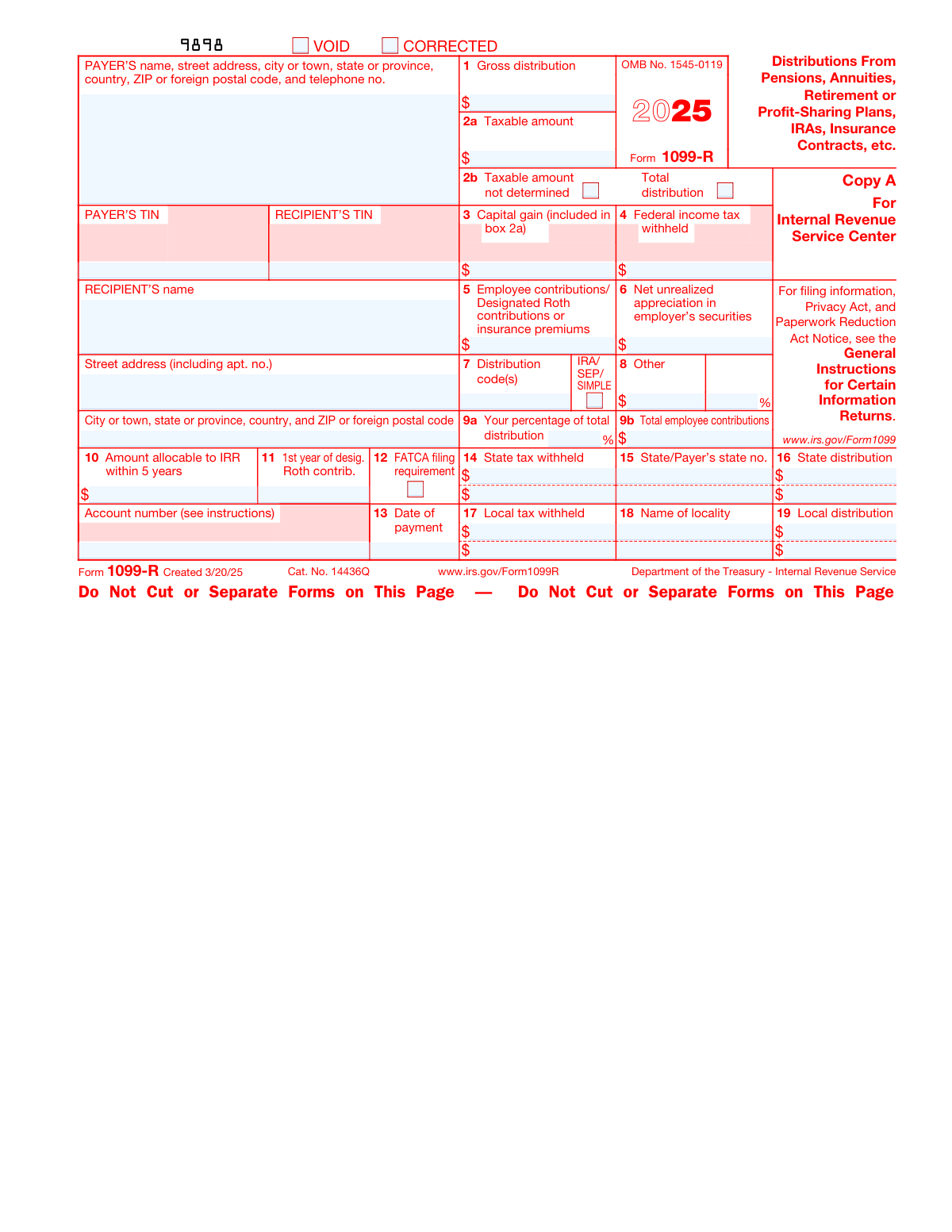
The AI does the filling. You just check it.
No typing into boxes, nothing to install.
What this form asks for
The AI fills all of it, from your answers or your documents.
The AI checks your answers before you download
15 checks built for this form, so a wrong date or a missing answer is caught before anyone else sees it.
The AI ensures that Copy A of Form 1099-R is not printed and filed with the IRS, as this copy is intended for informational purposes only. It alerts the user if an attempt is made to file this copy, thereby preventing incorrect submissions. The AI maintains compliance with IRS regulations by differentiating between the various copies of the form and their specific purposes. It also guides the user to the correct copies of the form that should be filed and retained.
The AI confirms that the official printed version of Copy A of Form 1099-R is used when filing with the IRS. It verifies that the form is scannable and meets the IRS's requirements for machine readability. The AI checks for the correct paper quality and ink to ensure that the form can be processed without errors. It also advises the user against using non-official or non-scannable versions of the form to avoid processing delays or penalties.
The AI verifies that Copy B of Form 1099-R is correctly filled out for the recipient's federal tax return reporting. It checks for accurate reporting of distributions and taxes withheld, as well as the recipient's personal information. The AI ensures that all required fields are completed to prevent errors or omissions that could lead to IRS inquiries. It also provides guidance on how to properly report pension and retirement distributions on the federal tax return.
The AI checks that Copy C of Form 1099-R is retained for the recipient's personal records. It reminds the user of the importance of keeping this copy for future reference, especially in the case of any discrepancies or audits. The AI assists in organizing and storing tax documents securely, ensuring that the recipient maintains a complete and accessible record of their pension and retirement distributions.
The AI validates that Copy 1 of Form 1099-R is provided to the State, City, or Local Tax Department when required. It checks the recipient's state and local tax filing obligations and ensures that the appropriate copy of the form is submitted to the relevant tax authorities. The AI helps the user navigate the complexities of multi-jurisdictional tax reporting and prevents potential non-compliance issues by confirming that all necessary tax documents are distributed correctly.
The system ensures that Copy 2 of Form 1099-R is properly filed with the relevant state, city, or local income tax return if it is mandated by the jurisdiction. It checks for the necessity of filing based on the address and tax information provided within the form. The AI confirms that the form is prepared for submission to the appropriate tax authority and alerts the user if additional steps are required to comply with local tax filing requirements.
And 9 more checks
- Confirms that the payer's and recipient's information is complete and accurate, including TINs and addresses.
- Verifies that the account number is included if applicable.
- Checks that the gross distribution in Box 1 is entered correctly.
- Validates that the taxable amount in Box 2a is entered if known, or the appropriate box in 2b is checked.
- Ensures that any capital gain included in Box 2a is reported in Box 3.
- Confirms that federal income tax withheld is reported in Box 4.
- Verifies that employee contributions or insurance premiums are reported in Box 5.
- Checks for the entry of net unrealized appreciation in employer's securities in Box 6.
- Validates that the correct distribution code(s) are entered in Box 7 and the IRA/SEP/SIMPLE box is checked if applicable.
Let AI fill out your 1099-R
No typing. Every field filled in seconds, checked, ready to sign.
How to Fill Out 1099-R Online for Free in 2026
What the AI walks you through.
- Visit instafill.ai site and select 1099-R
- Enter payer's information
- Input recipient's TIN and name
- Fill in distribution amounts and codes
- Add state and local tax information
- Sign and date the form electronically
- Check for accuracy and submit form
Common Mistakes in Completing 1099-R
The ones the AI is built to catch.
Filing Copy A with the IRS instead of the official printed version
Printing and filing Copy A instead of using the scannable version
Not using Copy B for federal tax return reporting
Failing to keep Copy C for personal records
Omitting Copy 1 for State, City, or Local Tax Department
Neglecting to file Copy 2 with state, city, or local income tax return
Not including payer's complete information in PAYER'S section
Missing or incorrect PAYER'S TIN and RECIPIENT'S TIN
Incomplete RECIPIENT'S information, such as missing apartment number
Forgetting to include the account number if applicable
Entering incorrect amount in Box 1 for Gross distribution
Not checking the box in 2b if the taxable amount is not determined
Failing to enter capital gain in Box 3 when included in Box 2a
Incorrectly reporting federal income tax withheld in Box 4
Not entering recoverable tax-free employee contributions in Box 5
Omitting net unrealized appreciation in employer's securities in Box 6
Using incorrect distribution code(s) in Box 7
Leaving Box 8 blank when other relevant amounts should be entered
Not entering the percentage of total distribution in Box 9a if applicable
Forgetting to enter total employee contributions in Box 9b
Not entering the amount allocable to IRR within 5 years in Box 10
Omitting the first year of designated Roth contributions in Box 11
Failing to check the FATCA filing requirement in Box 12 when applicable
Entering the wrong date of payment for reportable death benefits in Box 13
Incorrect state and local tax information in Boxes 14-19
Not referring to Instructions for Recipient for taxable amount determination
Ignoring IRS publications and forms for specific reporting instructions
Frequently Asked Questions About 1099-R
Is it really free for 7 days?
Can I fill other forms too?
How do I cancel?
How does the AI fill out 1099-R?
What happens to my information?
How complex is 1099-R to fill out?
What is Form 1099-R used for?
Who should receive a Form 1099-R?
What should I do if I receive a Form 1099-R?
What does the 'Gross distribution' amount in Box 1 of Form 1099-R represent?
How do I determine the taxable amount of my distribution if Box 2a is blank?
What does it mean if Box 2b 'Taxable amount not determined' is checked?
What should I report if Box 2b 'Total distribution' is checked?
What is reported in Box 3 'Capital gain' on Form 1099-R?
How is federal income tax withholding reported on Form 1099-R?
What are 'Employee contributions/Designated Roth contributions or insurance premiums' in Box 5?
What is 'Net unrealized appreciation in employer’s securities' in Box 6?
What do the distribution codes in Box 7 of Form 1099-R indicate?
What does the 'IRA/SEP/SIMPLE' checkbox indicate on Form 1099-R?
What is the 'FATCA filing requirement' checkbox in Box 12?
What should I do if I have state or local tax withheld as shown in Boxes 14-19?
How do I report a direct rollover indicated by Code G in Box 7?
What is the significance of the '1st year of desig. Roth contrib.' in Box 11?
What does 'Amount allocable to IRR within 5 years' in Box 10 mean?
What are the implications of receiving a Form 1099-R with Code 2 'Early distribution, exception applies'?
Where can I find more information or assistance for filling out my tax return with Form 1099-R?
Get your 1099-R filled out by AI
$0 today. Cancel before Nov 1 and you pay nothing.
Other forms like this one
insurance forms: Form 1095-A, Health Insurance Marketplace Statement, Form SSA-4-BK, Application for Child's Insurance Benefits, Form SSA-10, Application for Widow's or Widower's Insurance Benefits, Form 1095-C, Employer-Provided Health Insurance Offer and Coverage, National Integrity Life Insurance Company Ownership Change Request Form (NI-77-0039-2505), Record of Advice and Needs Analysis (Non-Life Insurance — Personal and Commercial Lines), Form 7206 (2025), Self-Employed Health Insurance Deduction, Continental American Insurance Company (CAIC) / Aflac Group Critical Illness Claim Form (with Attending Physician’s Statement, HIPAA Authorization to Obtain Information, and Electronic Funds Transaction Authorization), Prudential Group Disability Insurance – Education and Employment History Form (GL.2009.009, Ed. 06/2017), acord-25-201603-certificate-of-liability-insurance-1, Brotherhood Mutual Insurance Company Ministry Driver Screening Form (A99), Assurity Life Insurance Company Disability Claim Form — Attending Physician’s Statement, Amateur Sports / Activities Accident Insurance Quote Request Form (Philadelphia Insurance Companies), Martial Arts Studio General Liability and Property Application (Fitness and Wellness Insurance / Philadelphia Insurance Companies) (03/2011), The Prudential Insurance Company of America Group Disability Insurance – Education and Employment History Form (GL.2009.009, Ed. 06/2017), VA Form 29-357, Claim for Disability Insurance Benefits (Government Life Insurance), CMS-1500 (02-12), Health Insurance Claim Form (NUCC Approved) (OMB 0938-1197), Prudential Group Disability Insurance – Education and Employment History Form (GL.2009.009, Ed. 06/2017), HDFC ERGO General Insurance Company Limited – Request for Cashless Hospitalisation for Health Insurance (Policy Part – C), Beneficiary Designation/Change - Principal Life Insurance Company
tax forms: W-9, Request for Taxpayer Identification Number and Certification, Form W-2, Wage and Tax Statement, Form 1040-X, Amended U.S. Individual Income Tax Return, Form 130, Taxpayer's Notice to Initiate an Appeal, Form 1040-C, U.S. Departing Alien Income Tax Return, Form 940, Employer’s Annual FUTA Tax Return, Form 720, Quarterly Federal Excise Tax Return, Form 982, Reduction of Tax Attributes, Form 4137, Social Security and Medicare Tax on Unreported Tip Income, Form 911, Request for Taxpayer Advocate Service Assistance, Form 8960, Net Investment Income Tax, Form 8959, Additional Medicare Tax, Form 8919, Uncollected Social Security and Medicare Tax, Form 8801, Credit for Prior Year Minimum Tax, Form 990-T, Exempt Org Business Income Tax Return, Form 945, Annual Return of Withheld Federal Income Tax, Form 5330, Return of Excise Taxes, Form FTB 3514, California Earned Income Tax Credit, Form 100, CA Corp Tax Return, Form 8288, U.S. Withholding Tax Return
IRS forms: Form 5405, Repayment of First-Time Homebuyer Credit, Form 8879, IRS e-file Signature Authorization, Form 107, Statement of Financial Affairs, State of Hawaii Department of Commerce and Consumer Affairs (DCCA) Contractors License Board – Application for Contractor's License (Sole Proprietor) (CT-36) with supporting forms (Experience Certificate CT-03, Contractors Financial Statement CT-02, and Chronological History of Projects/Project List), Department of Home Affairs — Appointment or cessation of a registered migration agent, legal practitioner or exempt person providing immigration assistance (Appointment notification form), Australian Department of Home Affairs — Application for a Protection visa (subclass 866) (Form 866), Form 1399 – Declaration of Service (Department of Home Affairs, Australia), Ohio Department of Commerce Table of Heirship (Division of Unclaimed Funds), Ohio Department of Commerce – Table of Heirship (Unclaimed Funds Claim, Claims Less Than $3,000), DWC001S, Employer’s first report of injury or illness, DWC Form-001, Employer’s first report of injury or illness, First Republic Securities Company, LLC Entity Account Application (FRSC 778 E 7/19), Congressional Record - Proceedings and Debates of the Sixty-sixth Congress, First Session, Form 1040-X, Amended U.S. Individual Income Tax Return, Form 3115, Application for Change in Accounting Method, Form 8606, Nondeductible IRAs, Form 8850, Pre-Screening Notice and Certification Request for the Work Opportunity Credit, Form 911, Request for Taxpayer Advocate Service Assistance (And Application for Taxpayer Assistance Order), Form W-2, Wage and Tax Statement, Form W-4P (2026), Withholding Certificate for Periodic Pension or Annuity Payments
retirement forms: Form SSA-1-BK, Application for Retirement Benefits, Form 8880, Credit for Qualified Retirement Savings Contributions, Nationwide Retirement Solutions Participant Distribution Request Form (PNF-0875M9, TRAC Version, 01/2025), Nationwide Retirement Solutions Participant Distribution Request Form (PNF-0875M9, TRAC Version, 01/2025), Momentum Wealth Retirement Income Option Application (WIS060E), Fidelity Investment-Only (Non-Prototype) Retirement Account Application, One-Time Withdrawal — Defined Contribution Retirement Plan, Fidelity One-Time Withdrawal Form — Nonretirement, One-Time Withdrawal – Investment-Only (Non-Prototype) Retirement Account, Automatic Withdrawals—Defined Contribution Retirement Plan, Fidelity Automatic Withdrawals — Nonretirement, Beneficiaries — Nonretirement Transfer on Death, The Church of the Nazarene 403(b) Retirement Savings Plan Beneficiary Designation Form, Beneficiaries – Defined Contribution Retirement Plan, Transfer Shares as a Gift — Nonretirement, Schwab Personal Choice Retirement Account® (PCRA) Limited Power of Attorney (LPOA) Form For a Participant, Vanguard Asset Transfer Authorization Form for the Emory University Retirement Plan, Retirement Transfer Between Existing Vanguard Accounts, Gift of Nonretirement Assets to Existing Vanguard Account Form, Vanguard Taking a Loan from Your Retirement Plan
1099 forms: Form 1099-NEC, Nonemployee Compensation, Form 4852, Substitute for Form W-2 or 1099-R, Form 1099-MISC, Miscellaneous Information, Form 1099-INT, Interest Income, Form 1099-DIV, Dividends and Distributions, Form 1099-S, Proceeds From Real Estate Transactions, Form 1099-G, Certain Government Payments, Form 1099-C, Cancellation of Debt, Form 1099-K, Payment Card and Third Party Network Transactions, Form 1099-OID, Original Issue Discount, Form 1099-PATR, Taxable Distributions from Cooperatives, Form 1099-Q, Payments From Qualified Education Programs, Form 1099-SA, Distributions from HSA/MSA, Form 1099-B, Proceeds From Broker Transactions, Form 1099-NEC, Nonemployee Compensation, Form 1099-NEC, Nonemployee Compensation, Form 1099-NEC, Nonemployee Compensation, Form 1099-NEC, Nonemployee Compensation, Instructions for Forms 1099-R and 5498, Form 1099-MISC, Miscellaneous Information
pension forms: Form N245, Application for suspension of a warrant and/or variation of an order, Anmeldung zum R+V-Firmenportal Vorsorge (Registration for the R+V Company Portal for Pensions), The Principal Pension Plan Summary Plan Description: Cash Balance Formula for Employees and Individual Field, The Principal Pension Plan Summary Plan Description: Traditional and Cash Balance Formulas for Employees and Individual Field, Form SC ISP-1300, Canada Pension Plan Survivor's Pension and Surviving Child's Benefit Application, Form SC ISP-1300, Application for CPP Survivor's Pension and Surviving Child's Benefit, United Kingdom (UK) State Pension claim form, Form W-4P (2026), Withholding Certificate for Periodic Pension or Annuity Payments, Bakery and Confectionery Pension Fund Pension Application, ABA Retirement Funds Program Distribution Request Form, Beneficiary Designation Form for Plans Subject to QJSA (Form F11607), Form F6776, Authorization of Interest-Only Payments (ERISA), Form F7381, Authorization of Interest-Only Payments (Non ERISA), New York State Comptroller Form RS 5127, Designation of Beneficiary with Contingent Beneficiaries, Qualified Retirement Plan Designation of Beneficiary, VA Form 21P-0969, Income and Asset Statement in Support of Claim for Pension or Parents' Dependency and Indemnity Compensation (D.I.C.), VA Form 21P-534EZ, Application for D.I.C., Survivors Pension, and/or Accrued Benefits, VA Form 21-0966, Intent to File a Claim for Compensation and/or Pension, or Survivors Pension and/or DIC, Form SA474, Claim for an Australian Survivor Pension for a person living outside Australia, Form SY029 - Claim for Pensioner Education Supplement
retirement plan forms: One-Time Withdrawal — Defined Contribution Retirement Plan, Automatic Withdrawals—Defined Contribution Retirement Plan, The Church of the Nazarene 403(b) Retirement Savings Plan Beneficiary Designation Form, Beneficiaries – Defined Contribution Retirement Plan, Vanguard Asset Transfer Authorization Form for the Emory University Retirement Plan, Vanguard Taking a Loan from Your Retirement Plan, Vanguard 403(b)(7) ERISA Retirement Plan Distribution Request (Retirement / Severance from Employment / Disability), Vanguard Termination Request Form - Officer, SS, SSA Retirement Plan, Vanguard Retirement Plan Beneficiary Designation - Phillips 66 Savings Plan, Instructions for Changing Your Beneficiary on your Emory Retirement Plan, BNSF Investment and Retirement Plan [401(k) Plan for Salaried Employees], Vanguard Rollover Form for Retirement Plans, Incoming Rollover Election for Elevator Constructors Annuity and 401(k) Retirement Plan, Incoming Rollover Election for The Heritage Group Retirement Savings Plan, Empower Retirement Plan Withdrawal Request Form, Incoming Rollover Election Form for International Dairy Queen, Inc. Retirement Savings Plan, Account Reduction Loan Application 401(a) Plan, Electrical Workers Local Union No. 369 Retirement Plan, TE Connectivity Retirement Savings and Investment Plan (RSIP) Transition Frequently Asked Questions, Inotiv, Inc. Retirement Plan Rollover Investment Direction Form, Principal Retirement Plan Beneficiary Designation
IRA forms: Form 5498, IRA Contribution Information, SIRA Allied health treatment request (Catalogue no. SIRA09191), Transfer Due to Divorce — IRA/HSA/529, One-Time Withdrawal – IRA, Fidelity Investments, Fidelity Advisor IRA Distribution Request for Automatic Rollover Accounts, Fidelity Beneficiaries — IRA /HSA, Fidelity Advisor IRA Beneficiary Designation, IRA/HSA Beneficiary Designation, Fidelity IRA Beneficiary Distribution — Charity, Foundation, or a University, Form 8606, Nondeductible IRAs, Fidelity Investments Earnings Automatic Withdrawal Plan — IRA, Inherited IRA Application for Individual Beneficiaries, SIMPLE IRA Contribution Transmittal Form, IRA Distribution Form, Open a Schwab IRA, New York State Deferred Compensation Plan Direct Rollover to a Roth IRA, Charles Schwab IRA Distribution Form, Sample IRA Distribution Letter for a Qualified Charitable Distribution (QCD), Beneficiary Designation Form For IRA and 403(b)(7) Accounts, IRA Beneficiary Designation Form
distribution forms: Fischer Homes Request for In-Service Distribution, Form 1099-DIV, Dividends and Distributions, Form 1099-PATR, Taxable Distributions from Cooperatives, Form 1099-SA, Distributions from HSA/MSA, Nationwide Retirement Solutions Participant Distribution Request Form (PNF-0875M9, TRAC Version, 01/2025), Nationwide Retirement Solutions Participant Distribution Request Form (PNF-0875M9, TRAC Version, 01/2025), Fidelity Advisor 403(b) Distribution Request Form, Fidelity Advisor IRA Distribution Request for Automatic Rollover Accounts, Fidelity NetBenefits Distribution - Recurring Payments, Fidelity Investments® Beneficiary Distribution Form, Fidelity Investments Distribution Form, Fidelity IRA Beneficiary Distribution — Charity, Foundation, or a University, IRA Distribution Form, New York State Deferred Compensation Plan Benefit Distribution Request, Individual 401(k) Distribution Request Form, Fidelity Distribution—Rollover, Charles Schwab IRA Distribution Form, Sample IRA Distribution Letter for a Qualified Charitable Distribution (QCD), Vanguard IRA Distribution Kit (including IRA Distribution Form RRDFT and Form W-4R), Vanguard Required Minimum Distribution Service Form
retirement distribution forms: 403(b) Distribution Form - Davis Funds, Nationwide Retirement Solutions Participant Distribution Request Form (PNF-0875M9, TRAC Version, 01/2025), Nationwide Retirement Solutions Participant Distribution Request Form (PNF-0875M9, TRAC Version, 01/2025), Vanguard 403(b)(7) ERISA Retirement Plan Distribution Request (Retirement / Severance from Employment / Disability), Transamerica Retirement Solutions Distribution Request Form, Transamerica Retirement Distribution Request Form and Special Tax Notice, The Housing Agency Retirement Trust 457(b) Deferred Compensation Plan Request For Distribution Form, Request for Recurring Required Minimum Distributions From Your Retirement Investments (Non-ERISA), Request for a Qualified Charitable Distribution (QCD) from a Brokerage Individual Retirement Account (IRA), Request for qualified charitable distribution from individual retirement account, Form F11489, Request for Recurring Required Minimum Distributions From Your Retirement Investments, Request for a Charitable Distribution from an Individual Retirement Account (IRA), Individual Retirement Account (IRA) Distribution Request Form, SIMPLE Individual Retirement Account (IRA) Distribution Request Form, ABA Retirement Funds Program Distribution Request Form, Distribution Request Form Local No. 1 Retirement Savings Plan #241805, Merrill Lynch One-Time Non-Retirement Distribution Form, Qualified Retirement Plan and 403(b)(7) Custodial Account Distribution Request Form, Individual Retirement Account (IRA) — Qualified Charitable Distribution Form, Form F11489, Request for Recurring Required Minimum Distributions From Your Retirement Investments
pension distribution forms: Distribution Request Form Local No. 1 Retirement Savings Plan #241805
pension plan forms: Fidelity Advisor Investment-Only Retirement Plan Master Application, The Principal Pension Plan Summary Plan Description: Cash Balance Formula for Employees and Individual Field, The Principal Pension Plan Summary Plan Description: Traditional and Cash Balance Formulas for Employees and Individual Field, Form SC ISP-1300, Canada Pension Plan Survivor's Pension and Surviving Child's Benefit Application, SC ISP-2519, Medical Report for Canada Pension Plan Disability Benefits (2025-05-08), SC ISP-2519, Medical Report for Canada Pension Plan Disability Benefits (2024-05-17)
IRA distribution forms: Fidelity Automatic Withdrawals — RMD/Life Expectancy, Fidelity Advisor IRA Distribution Request for Automatic Rollover Accounts, Fidelity IRA Beneficiary Distribution — Charity, Foundation, or a University, IRA Distribution Form, Charles Schwab IRA Distribution Form, Sample IRA Distribution Letter for a Qualified Charitable Distribution (QCD), Vanguard IRA Distribution Kit (including IRA Distribution Form RRDFT and Form W-4R), IRA Distribution to Charitable Beneficiary, IRA Distribution to Charitable Beneficiary, IRA Distribution Form, Transamerica Distribution Request (Distribution of Traditional 401(k) to Roth IRA), TIAA Brokerage IRA Distribution Request (Form F11025), TIAA-CREF Funds IRA Distribution Form (Retail Class Only), Request for a Qualified Charitable Distribution (QCD) from a Brokerage Individual Retirement Account (IRA), Request for a Charitable Distribution from an Individual Retirement Account (IRA), Individual Retirement Account (IRA) Distribution Request Form, SIMPLE Individual Retirement Account (IRA) Distribution Request Form, Merrill IRA/IRRA®/Roth IRA/SEP/SRA One Time Distribution Form, IRA/IRRA®/Roth IRA/SEP/SRA Distribution Form For Standing Letters, IRA/IRRA®/ROTH IRA/SEP/SRA Beneficiary Distribution Form
contract forms: Memorandum of Contract, Form WH-347, Payroll for Contractors, Form 0896A, Report of Subcontracts to Small and Veteran-Owned Business, Form 1449, Solicitation/Contract/Order for Commercial Products and Services, application-and-contract-for-electric-facilities-w, Texas Real Estate Commission (TREC) One to Four Family Residential Contract (Resale) (TREC No. 20-18), DBPR CILB 6-B, Application for Certified Building Contractor Who is Qualifying a Business, State of Hawaii Department of Commerce and Consumer Affairs (DCCA) Contractors License Board – Application for Contractor's License (Sole Proprietor) (CT-36) with supporting forms (Experience Certificate CT-03, Contractors Financial Statement CT-02, and Chronological History of Projects/Project List), NJ Department of Labor & Workforce Development Form MW-562, Payroll Certification for Public Works Projects (Contractor and Subcontractor’s Weekly and Final Certification), DBPR CILB 6-A, Application for Certified General Contractor Who is Qualifying a Business, Proposal Form 3, Attestation Regarding County Contract, TIAA Trust, N.A. Private Asset Management, Request for a Direct Transfer From IRA Contracts, Contrato de Trabajo en Prácticas (Código 420), Professional Practice Employment Contract, State of California Department of Transportation Darfur Contracting Act Certification, Form DOT ADM-0077, State of California Department of Transportation, Contract Requirements, State of California Department of Transportation Subcontractor List, DCMA Guidebook for Government Contract Property Administration, Official Form 106G, Schedule G: Executory Contracts and Unexpired Leases, Form ADR-106, Petition to Confirm, Correct, or Vacate Contractual Arbitration Award, Newly Contracted Provider Training Attestation Form
Let AI fill out your 1099-R
Your trial starts once a card is added. You pay nothing before Nov 1.
Our AI already knows this form, all 192 fields of it. Skip the typing: tell it about yourself, or upload what you have, and it fills the whole form in seconds.
- AI fills every field on all 8 pages, checkboxes included
- No typing into boxes: answer a few questions, or upload your W-2 or last year's return, an old copy of this form, a photo of a document
- The AI checks the answers; you review and change anything before you download
- Download the finished PDF, print it, or sign it online
- Encrypted, and never used to train AI
Cancel before Nov 1 and you pay nothing.
A card is needed to start the trial. Cancel in two clicks from your account.
Terms · Privacy