
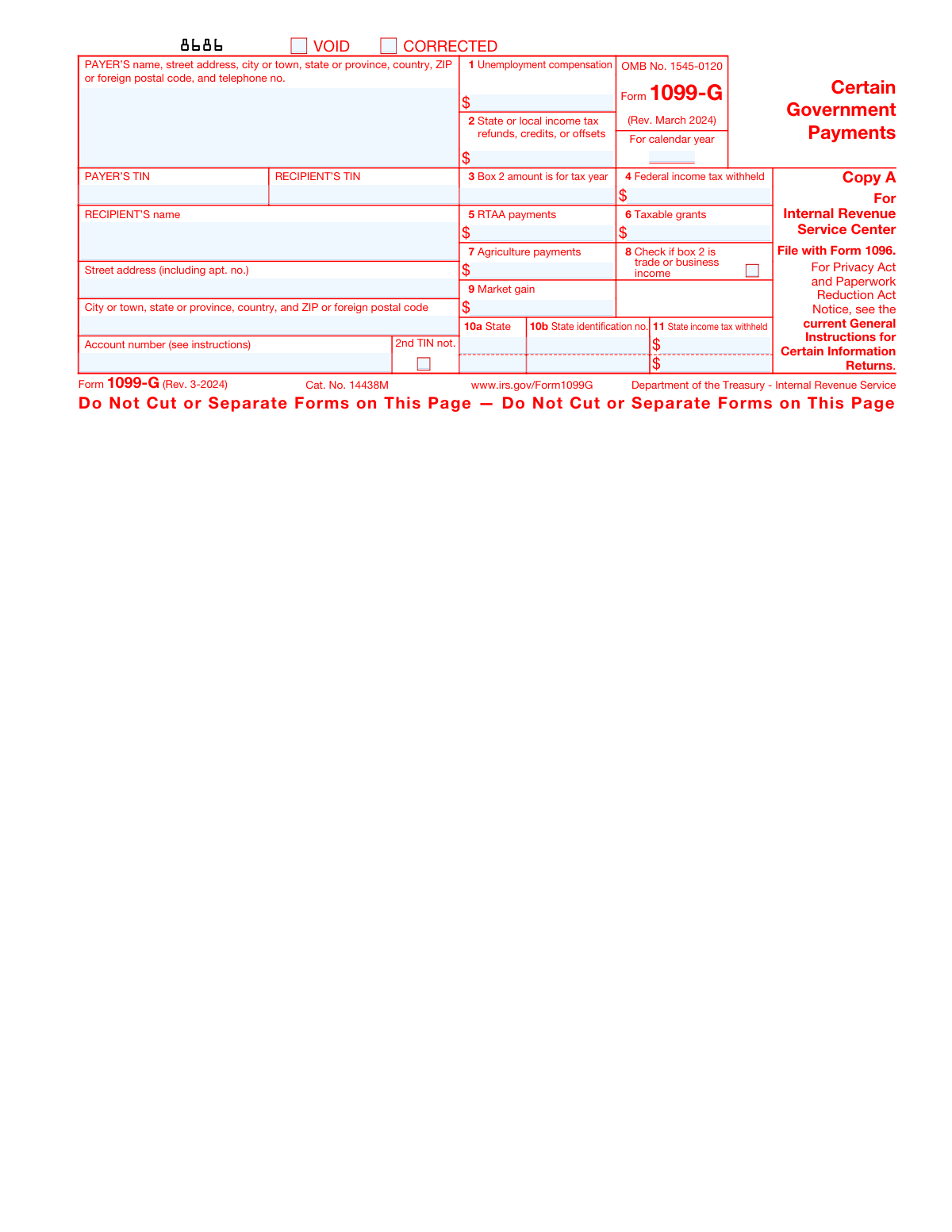
Yes! You can use AI to fill out Form 1099-G, Certain Government Payments
Don't type 100 fields by hand. Tell our AI about yourself, or upload your W-2 or last year's return, and it fills every field in seconds. You check it, then download, print or sign.
The AI does the filling. You just check it.
No typing into boxes, nothing to install.
What this form asks for
The AI fills all of it, from your answers or your documents.
The AI checks your answers before you download
20 checks built for this form, so a wrong date or a missing answer is caught before anyone else sees it.
The software ensures that the calendar year entered on the Form 1099-G corresponds with the tax year for which the form is intended. It checks the year against the current processing date to prevent the filing of outdated or future forms. The validation includes confirming that the year format is correct and that it is a valid year in the Gregorian calendar. This is crucial as the tax information must align with the correct fiscal period for accurate reporting to the IRS.
The software confirms that the 'VOID' checkbox on Form 1099-G is marked exclusively when the form is intended to be nullified. It ensures that this checkbox is not marked in cases where the form is valid and being filed for the first time. If the 'VOID' checkbox is marked, the software will treat the form as invalid for submission purposes and may prompt the user to confirm the void action. This check is essential to prevent the accidental voiding of a legitimate form.
The software verifies that the 'CORRECTED' checkbox is marked solely when the Form 1099-G contains updates or corrections to previously submitted information. It ensures that this checkbox is left unmarked for initial submissions. If the 'CORRECTED' checkbox is marked, the software will process the form as an amendment to an earlier submission and may require additional information to reference the original document. This verification is important to distinguish between original filings and corrections.
The software checks that the payer's information on Form 1099-G, including the name, address, telephone number, and Taxpayer Identification Number (TIN), is accurately entered and formatted correctly. It validates that the TIN is in the proper format and that the address adheres to postal standards. The software may cross-reference the payer's details with a database to ensure accuracy. Accurate payer information is critical for the IRS to identify the source of the government payment.
The software validates that the recipient's details on Form 1099-G are correctly filled in, including the name, address, Taxpayer Identification Number (TIN), and account number if applicable. It checks that the TIN is valid and properly formatted, and that the address complies with postal formatting standards. The software may also verify the recipient's information against external records for accuracy. Correct recipient information is essential for the IRS to attribute the government payment to the right individual or entity.
The AI ensures that the total unemployment compensation reported in Box 1 of Form 1099-G matches the records provided by the government or the payer. It cross-references the amount with the recipient's documentation to confirm accuracy. The AI also checks for any discrepancies between the reported amount and the recipient's expected compensation, alerting the user to any potential errors. This validation is crucial as it affects the recipient's taxable income and must be reported correctly on their tax return.
And 14 more checks
- Confirms the amount of state or local income tax refunds, credits, or offsets in Box 2 is correct.
- Verifies the tax year in Box 3 for which the amount in Box 2 was made.
- Checks for any federal income tax withheld and enters the amount in Box 4.
- Validates the total RTAA payments entered in Box 5.
- Ensures the amount of taxable grants in Box 6 is accurately reported.
- Confirms the amount of agriculture payments entered in Box 7.
- Verifies that Box 8 is checked if the amount in Box 2 is trade or business income.
- Checks for any market gain associated with CCC loans and enters the amount in Box 9.
- Validates the state and state identification number entered in Boxes 10a and 10b, respectively.
- Ensures that the amount of state income tax withheld is correctly entered in Box 11.
- Confirms that the correct copy of the form is used for its intended purpose (Copy A for the IRS, Copy B for the recipient, etc.).
- Verifies that Copy A is not downloaded from the website and filed with the IRS, to avoid penalties.
- Checks if e-filing is applicable based on the number of information returns to be filed (mandatory for 10 or more).
- Validates that all necessary copies are filed with the IRS and state tax departments as required.
Let AI fill out your Form 1099-G
No typing. Every field filled in seconds, checked, ready to sign.
How to Fill Out Form 1099-G Online for Free in 2026
What the AI walks you through.
- Visit instafill.ai site and select Form 1099-G
- Enter payer's information
- Input recipient's TIN and name
- Fill in recipient's address details
- Report unemployment compensation
- Include state tax refunds or offsets
- Add federal income tax withheld
- Enter other government payments
- Sign and date the form electronically
- Check for accuracy and submit form
Common Mistakes in Completing Form 1099-G
The ones the AI is built to catch.
Using non-scannable Copy A from the website for IRS filing
Failing to order official IRS forms for paper filing
Not e-filing when required for 10 or more returns
Incorrectly entering the calendar year for the form
Forgetting to check the VOID box when voiding the form
Omitting the CORRECTED checkbox on a corrected form
Entering incorrect payer's TIN or omitting it
Providing incomplete or incorrect payer's information
Entering recipient's TIN incorrectly or not at all
Failing to provide recipient's account number if applicable
Not entering the total unemployment compensation in Box 1
Leaving Box 2 blank or entering incorrect refund amounts
Forgetting to specify the tax year for Box 2 amounts in Box 3
Omitting federal income tax withheld in Box 4
Failing to report RTAA payments in Box 5
Incorrectly reporting taxable grants in Box 6
Not reporting agriculture payments in Box 7
Failing to check Box 8 when Box 2 amount is trade/business income
Forgetting to enter market gain associated with CCC loans in Box 9
Leaving state identification number blank in Box 10b
Not entering the amount of state income tax withheld in Box 11
Mixing up copies intended for different recipients or agencies
Recipient not retaining Copy B for their records
Payer not following specific filing instructions for each copy
Ignoring IRS Publications 1141, 1167, and 1179 for detailed guidance
Frequently Asked Questions About Form 1099-G
Is it really free for 7 days?
Can I fill other forms too?
How do I cancel?
How does the AI fill out Form 1099-G?
What happens to my information?
How complex is Form 1099-G to fill out?
What is Form 1099-G used for?
What should I do if I receive a Form 1099-G?
Is unemployment compensation reported on Form 1099-G taxable?
How do I report state or local income tax refunds from Form 1099-G on my tax return?
What does box 3 on Form 1099-G indicate?
What should I include in my income tax return from box 4 of Form 1099-G?
What are RTAA payments reported in box 5 of Form 1099-G?
Are taxable grants reported in box 6 of Form 1099-G considered income?
How do I report agriculture payments from box 7 of Form 1099-G?
What does it mean if box 8 on Form 1099-G is checked?
How do I report market gain from box 9 of Form 1099-G?
What are the state income tax withheld reporting boxes on Form 1099-G?
Can I file Form 1099-G electronically?
What are the penalties for filing a scannable Copy A of Form 1099-G downloaded from the website?
Where can I find the official IRS information returns including a scannable Copy A for filing with the IRS?
What should I do if I suspect identity theft from the information on Form 1099-G?
What is the purpose of the account number on Form 1099-G?
Where can I find more information about developments related to Form 1099-G?
Does the IRS offer a Free File Program for filing taxes that include Form 1099-G?
What should I do with Copy 2 of Form 1099-G?
Get your Form 1099-G filled out by AI
$0 today. Cancel before Nov 3 and you pay nothing.
Other forms like this one
government forms: Town of Horizon City Public Information Request (Texas Government Code, Chapter 552), National Apartment Association (NAA) Rental Application for Residents and Occupants (Virginia) and Supplemental Rental Application for Units Under Government Regulated Affordable Housing Programs, VA Form 29-357, Claim for Disability Insurance Benefits (Government Life Insurance), Z83, Application for Employment in the Republic of South Africa Government Department, Incoming Transfer/Direct Rollover Governmental 457(b) Plan, Incoming Transfer/Direct Rollover Governmental 457(b) Plan, City of Torrance Deferred Compensation Plan, Oklahoma Pathfinder 457 Plan Incoming Transfer/Rollover Request Governmental 457(b) Plan, Beneficiary Account Withdrawal Request Governmental 457(b) Plan, Empower Beneficiary Designation Governmental 457(b) Plan, Request for Distribution from Your 457(b) Governmental Plan, DCMA Guidebook for Government Contract Property Administration, Application for Special Leave of Absence without Pay, Central Registry Reporting Form, Form SSA-3379-BK, Function Report - Child Age 12 to 18th Birthday, Form SSA-820-BK, Work Activity Report - Self-Employment, Alcoholic Beverages License Application, Unified Government of Athens-Clarke County, Georgia
1099 forms: Form 1099-NEC, Nonemployee Compensation, Form 4852, Substitute for Form W-2 or 1099-R, Form 1099-MISC, Miscellaneous Information, Form 1099-INT, Interest Income, Form 1099-DIV, Dividends and Distributions, Form 1099-R, Distributions From Pensions etc., Form 1099-S, Proceeds From Real Estate Transactions, Form 1099-C, Cancellation of Debt, Form 1099-K, Payment Card and Third Party Network Transactions, Form 1099-OID, Original Issue Discount, Form 1099-PATR, Taxable Distributions from Cooperatives, Form 1099-Q, Payments From Qualified Education Programs, Form 1099-SA, Distributions from HSA/MSA, Form 1099-B, Proceeds From Broker Transactions, Form 1099-NEC, Nonemployee Compensation, Form 1099-NEC, Nonemployee Compensation, Form 1099-NEC, Nonemployee Compensation, Form 1099-NEC, Nonemployee Compensation, Instructions for Forms 1099-R and 5498, Form 1099-MISC, Miscellaneous Information
payment forms: Form 5405, Repayment of First-Time Homebuyer Credit, Form 1127, Application for Extension of Time for Payment of Tax Due to Undue Hardship, Form 1099-K, Payment Card and Third Party Network Transactions, Form 1099-Q, Payments From Qualified Education Programs, Form SSA-8, Application for Lump-Sum Death Payment, Form 1845-0163, Borrower Defense to Repayment Application, application-and-contract-for-electric-facilities-w, Carer Payment and Carer Allowance – Medical Report (SA431) for a child under 16 years, Income-Driven Repayment (IDR) Plan Request (PAYE, IBR, and ICR) — William D. Ford Federal Direct Loan (Direct Loan) Program and Federal Family Education Loan (FFEL) Programs (OMB No. 1845-0102), Fidelity NetBenefits Distribution - Recurring Payments, Electronic Dividend and Interest Payment Authorization Form, Vanguard Super Apply for a financial hardship payment, Special Tax Notice Regarding Plan Payments, Empower Loan Payment Change Request Form, Empower Retirement Payment Request Form, Empower 401(k) Loan Prepayment Request Form, Special Tax Notice Regarding Plan Payments, Transamerica Automatic Payment Authorization, Excess Withdrawal Request and Form W-4R, Withholding Certificate for Nonperiodic Payments and Eligible Rollover Distributions, Form F6776, Authorization of Interest-Only Payments (ERISA)
government ID forms: Form 40-5122, Travel License / Identification Application, Town of Horizon City Public Information Request (Texas Government Code, Chapter 552), National Apartment Association (NAA) Rental Application for Residents and Occupants (Virginia) and Supplemental Rental Application for Units Under Government Regulated Affordable Housing Programs, VA Form 29-357, Claim for Disability Insurance Benefits (Government Life Insurance), Z83, Application for Employment in the Republic of South Africa Government Department, Incoming Transfer/Direct Rollover Governmental 457(b) Plan, Incoming Transfer/Direct Rollover Governmental 457(b) Plan, City of Torrance Deferred Compensation Plan, Oklahoma Pathfinder 457 Plan Incoming Transfer/Rollover Request Governmental 457(b) Plan, Beneficiary Account Withdrawal Request Governmental 457(b) Plan, Empower Beneficiary Designation Governmental 457(b) Plan, Request for Distribution from Your 457(b) Governmental Plan, DCMA Guidebook for Government Contract Property Administration, Alcoholic Beverages License Application, Unified Government of Athens-Clarke County, Georgia
government HR forms: OPM Form 71, Request for Leave or Approved Absence, Town of Horizon City Public Information Request (Texas Government Code, Chapter 552), National Apartment Association (NAA) Rental Application for Residents and Occupants (Virginia) and Supplemental Rental Application for Units Under Government Regulated Affordable Housing Programs, VA Form 29-357, Claim for Disability Insurance Benefits (Government Life Insurance), Z83, Application for Employment in the Republic of South Africa Government Department, Incoming Transfer/Direct Rollover Governmental 457(b) Plan, Incoming Transfer/Direct Rollover Governmental 457(b) Plan, City of Torrance Deferred Compensation Plan, Oklahoma Pathfinder 457 Plan Incoming Transfer/Rollover Request Governmental 457(b) Plan, Beneficiary Account Withdrawal Request Governmental 457(b) Plan, Empower Beneficiary Designation Governmental 457(b) Plan, Request for Distribution from Your 457(b) Governmental Plan, DCMA Guidebook for Government Contract Property Administration, Alcoholic Beverages License Application, Unified Government of Athens-Clarke County, Georgia
UK government forms: United Kingdom (UK) State Pension claim form, Town of Horizon City Public Information Request (Texas Government Code, Chapter 552), National Apartment Association (NAA) Rental Application for Residents and Occupants (Virginia) and Supplemental Rental Application for Units Under Government Regulated Affordable Housing Programs, VA Form 29-357, Claim for Disability Insurance Benefits (Government Life Insurance), Z83, Application for Employment in the Republic of South Africa Government Department, Incoming Transfer/Direct Rollover Governmental 457(b) Plan, Incoming Transfer/Direct Rollover Governmental 457(b) Plan, City of Torrance Deferred Compensation Plan, Oklahoma Pathfinder 457 Plan Incoming Transfer/Rollover Request Governmental 457(b) Plan, Beneficiary Account Withdrawal Request Governmental 457(b) Plan, Empower Beneficiary Designation Governmental 457(b) Plan, Request for Distribution from Your 457(b) Governmental Plan, DCMA Guidebook for Government Contract Property Administration, Alcoholic Beverages License Application, Unified Government of Athens-Clarke County, Georgia
Let AI fill out your Form 1099-G
Your trial starts once a card is added. You pay nothing before Nov 3.
Our AI already knows this form, all 100 fields of it. Skip the typing: tell it about yourself, or upload what you have, and it fills the whole form in seconds.
- AI fills every field on all 6 pages, checkboxes included
- No typing into boxes: answer a few questions, or upload your W-2 or last year's return, an old copy of this form, a photo of a document
- The AI checks the answers; you review and change anything before you download
- Download the finished PDF, print it, or sign it online
- Encrypted, and never used to train AI
Cancel before Nov 3 and you pay nothing.
A card is needed to start the trial. Cancel in two clicks from your account.
Terms · Privacy