Fill out payment forms
with AI.
Payment forms encompass a wide range of financial documents used to manage transactions, report income, or request funds. This category is essential for maintaining clear financial records and ensuring compliance with tax laws and institutional regulations. Whether you are dealing with government-issued tax documents like the 1099-K for digital transactions or specialized applications like the SSA-8 for death benefits, these forms act as the formal bridge between individuals, businesses, and financial institutions.
By continuing, you acknowledge Instafill's Privacy Policy and agree to get occasional product update and promotional emails.
About payment forms
These forms are typically required by business owners, taxpayers, and individuals navigating significant life events. Small business owners may need them to report third-party network transactions, while individuals might use them to request an extension on tax payments due to financial hardship or to set up recurring distributions from a retirement account. They are also common in the insurance and utility sectors, such as when establishing temporary service with a provider or requesting reimbursement for voluntary payments in workers' compensation cases.
Navigating complex financial paperwork can be time-consuming, but modern tools like Instafill.ai use AI to fill these forms accurately in under 30 seconds. By automating the data entry process, you can ensure your financial documentation is handled securely and efficiently, allowing you to focus on your personal or business finances rather than manual data entry.
Every form on this page can be completed without typing. Instafill is form filling software that reads a PDF and fills it for you — including flat and scanned documents that carry no fillable fields at all.
Forms in This Category
The forms in this category have a median Form Complexity Index of 55/100 (Moderate), measured across 43 forms by field count, input difficulty, length, conditional logic and structure. See how it is calculated.
- Enterprise-grade security & data encryption
- 99%+ accuracy powered by AI
- 1,000+ forms from all industries
- Complete forms in under 60 seconds
How to Choose the Right Form
Navigating payment and financial forms can be complex, as they range from IRS tax reporting to private retirement distributions. To find the correct document, identify whether your transaction is with a government agency, a lending institution, or a retirement plan provider.
Tax Reporting and IRS Compliance
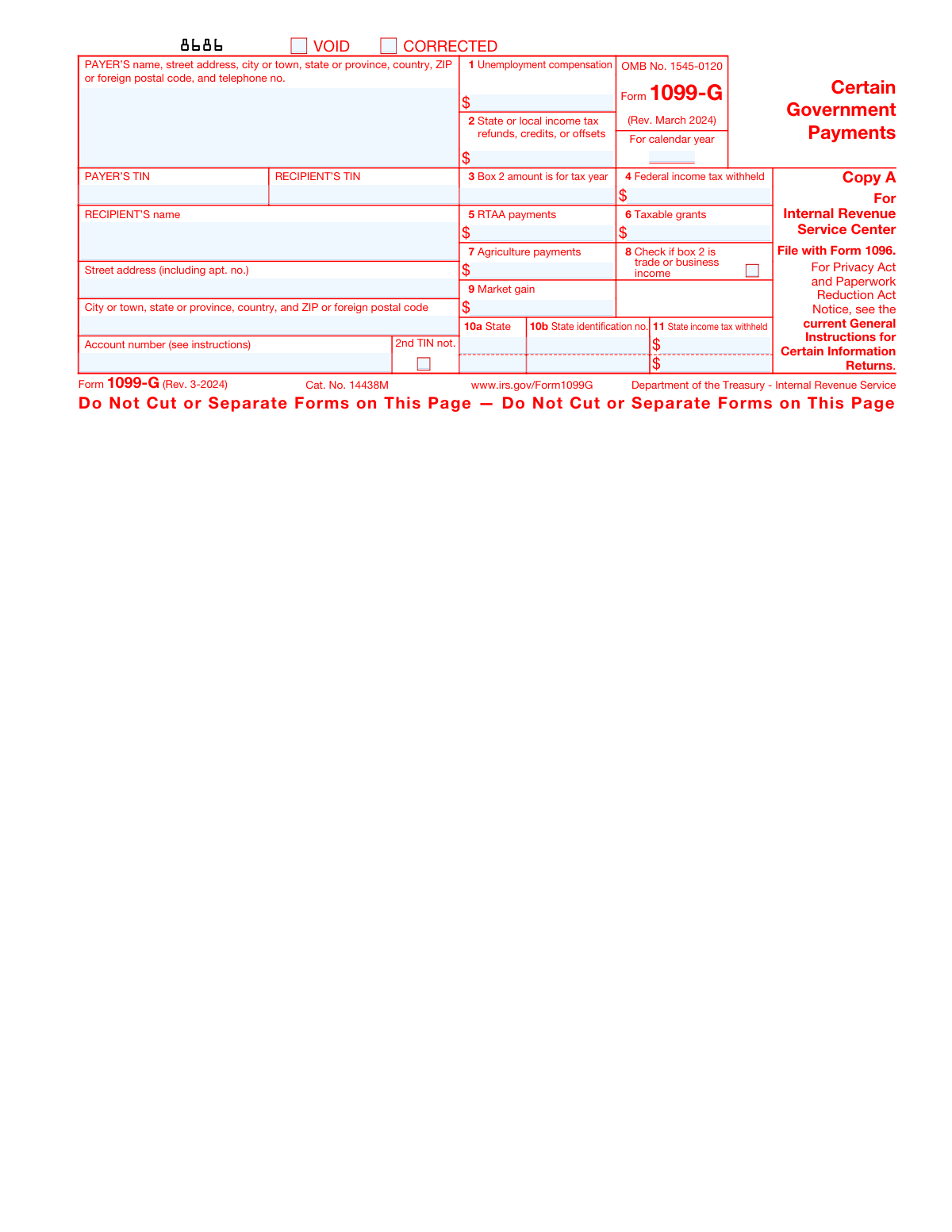
If you are reporting income or managing tax debt, look for official IRS forms. Use Form 1099-K for payment card and third-party network transactions, or Form 1099-G for government payments like unemployment or state refunds. If you need more time to pay your tax bill due to financial difficulty, file Form 1127, Application for Extension of Time for Payment of Tax Due to Undue Hardship. For those who previously claimed the homebuyer credit and now need to report a repayment, use Form 5405.
Retirement and Investment Distributions
Managing funds within a retirement account requires specific provider forms to ensure tax compliance:
- Automating Income: Use the Fidelity NetBenefits Distribution form for recurring 401(k) payments or the Electronic Dividend and Interest Payment Authorization Form for Charles Schwab accounts.
- Loan Management: If you have an outstanding loan against your retirement savings, use the Empower Loan Payment Change Request Form to modify your schedule or the Empower 401(k) Loan Prepayment Request Form to pay it off early.
- Hardship & Excess: For Australian superannuation, use the Vanguard Super Apply for a financial hardship payment. If you over-contributed to your plan, use the Excess Withdrawal Request form.
Student Loans and Government Benefits
For federal student debt, the Income-Driven Repayment (IDR) Plan Request helps lower monthly payments based on your income, while Form 1845-0163 (Borrower Defense to Repayment) is for those seeking relief due to school misconduct. For Social Security survivors, Form SSA-8 is required to claim the lump-sum death payment. If you are an employer in Texas seeking reimbursement for voluntary workers' compensation payments, use Form DWC002.
Tips for payment forms
The most common mistake on payment and ACH forms is transcribing account or routing numbers incorrectly. Even a single-digit error can lead to significant delays, rejected transfers, or funds being sent to the wrong destination. Always verify these details against a voided check or your official banking app before finalizing the document.
Forms related to undue hardship, such as tax extensions or early retirement withdrawals, require substantial evidence to be approved. Before you start filling out the form, collect necessary documents like bank statements, medical reports, or termination notices to ensure your request is processed without being sent back for more information.
Managing multiple financial or tax forms can be overwhelming and prone to manual entry errors. AI-powered tools like Instafill.ai can complete these forms in under 30 seconds with high accuracy, and your sensitive data stays secure during the entire process, making it a major time-saver for complex paperwork.
When requesting distributions or repayments, pay close attention to sections regarding federal and state tax withholding. Selecting the wrong withholding rate on forms like the W-4R can result in a surprise tax bill or penalties at the end of the year, so consult a tax professional if you are unsure of the correct percentage.
Many business and retirement payment forms require a signature from an authorized plan representative or a specific account holder. Ensure you have the legal authority to sign the document, or obtain the necessary co-signatures from your employer or plan administrator before submission to avoid immediate rejection.
For ongoing financial obligations like insurance premiums or loan repayments, prioritize filling out automatic authorization forms. This eliminates the need for manual monthly submissions, ensures your payments are always on time, and helps you avoid late fees or lapses in coverage.
Frequently Asked Questions
This category includes a wide range of financial documents, from IRS tax repayment forms and 1099 information returns to retirement plan distribution requests and student loan repayment applications. You will also find forms for authorizing automatic bank transfers, requesting extensions for tax payments due to hardship, and applying for government-issued death benefits.
Choosing the correct form depends on the organization you are dealing with and the specific financial action you want to take. For example, if you are managing a 401(k), you should look for forms from your specific provider like Empower or Fidelity; if you are reporting income from a side business or digital sales, you likely need a 1099-K.
Several forms in this category are designed specifically for financial relief, such as Form 1127 for tax payment extensions or the Income-Driven Repayment (IDR) request for student loans. These documents allow you to demonstrate undue hardship or adjust your payment schedule based on your current income level.
These are informational forms used to report taxable income to the IRS that did not come from a traditional employer. A 1099-K is typically sent if you received payments via credit cards or third-party apps, while a 1099-G is used for government payments such as unemployment compensation or state tax refunds.
Yes, you can use AI tools like Instafill.ai to complete these forms in under 30 seconds. The AI accurately extracts data from your source documents and places it into the correct fields, ensuring that complex details like account numbers and financial figures are entered correctly.
While manual entry can take 15 to 30 minutes depending on the complexity of the financial data required, using an AI-powered filler can reduce this to less than a minute. Instafill.ai streamlines the process by automatically identifying where your information belongs on the PDF.
You should use these forms when you reach an eligible age or experience a qualifying event, such as leaving a job, that allows you to access your retirement savings. These forms help you set up recurring monthly income, request a one-time withdrawal, or manage the tax withholding on your distributions.
Many providers offer specific 'Automatic Payment Authorization' forms that allow them to withdraw premiums or deposit dividends directly from or to your bank account. Using these forms helps ensure your payments are made on time and eliminates the need to mail physical checks each month.
This specific form is used by federal student loan borrowers who believe their school engaged in misconduct or misled them about their education. If the application is approved, it can lead to the discharge of the borrower's federal student loans and potentially a refund of past payments.
Submission locations vary by form type; IRS forms are generally mailed to a specific service center or filed electronically, while banking and retirement forms must be sent directly to the institution managing your account. Always check the specific instructions provided by the agency or company to ensure your form reaches the correct department.
Glossary
- Form Complexity Index
- Instafill’s 0–100 measure of how much effort a form takes to complete, calculated deterministically from the form’s own structure rather than estimated. It combines the number of fillable fields (the largest factor), how difficult those fields are to complete based on their type, the number of pages that contain fields, the amount of conditional “fill-only-if” logic, and how many sections the form is divided into, then adds modifiers for tables and repeating lists, bundled instruction pages, and dense page layouts. A higher score means the form is harder to fill out by hand. The forms in this category have a median Form Complexity Index of 55/100 (Moderate). See exactly how it is calculated.
- ACH (Automated Clearing House)
- A national electronic network used for financial transactions in the United States, allowing for direct deposits and automated payments between bank accounts without physical checks.
- Direct Rollover
- The process of moving funds directly from one retirement plan or IRA to another, which prevents the payment from being treated as taxable income or being subject to mandatory withholding.
- Withholding
- The portion of a payment or distribution that is taken out and sent directly to the IRS as a prepayment of the recipient's federal income tax liability.
- IDR (Income-Driven Repayment)
- A repayment plan for federal student loans where the monthly payment amount is based on the borrower's income and family size rather than the total loan balance.
- Undue Hardship
- A financial condition where a person cannot meet a payment obligation, such as taxes or loan repayments, without being unable to afford basic living expenses.
- ERISA (Employee Retirement Income Security Act)
- A federal law that sets standards for most voluntarily established retirement and health plans in private industry to protect the interests of plan participants.
- Borrower Defense
- A legal claim used by students to seek discharge of their federal student loans if their school misled them or violated state laws related to their education.
- TPA (Third Party Administrator)
- An outside company or organization that processes claims and handles administrative tasks for an employer-sponsored retirement or health plan.