Yes! You can use AI to fill out Special Tax Notice Regarding Plan Payments
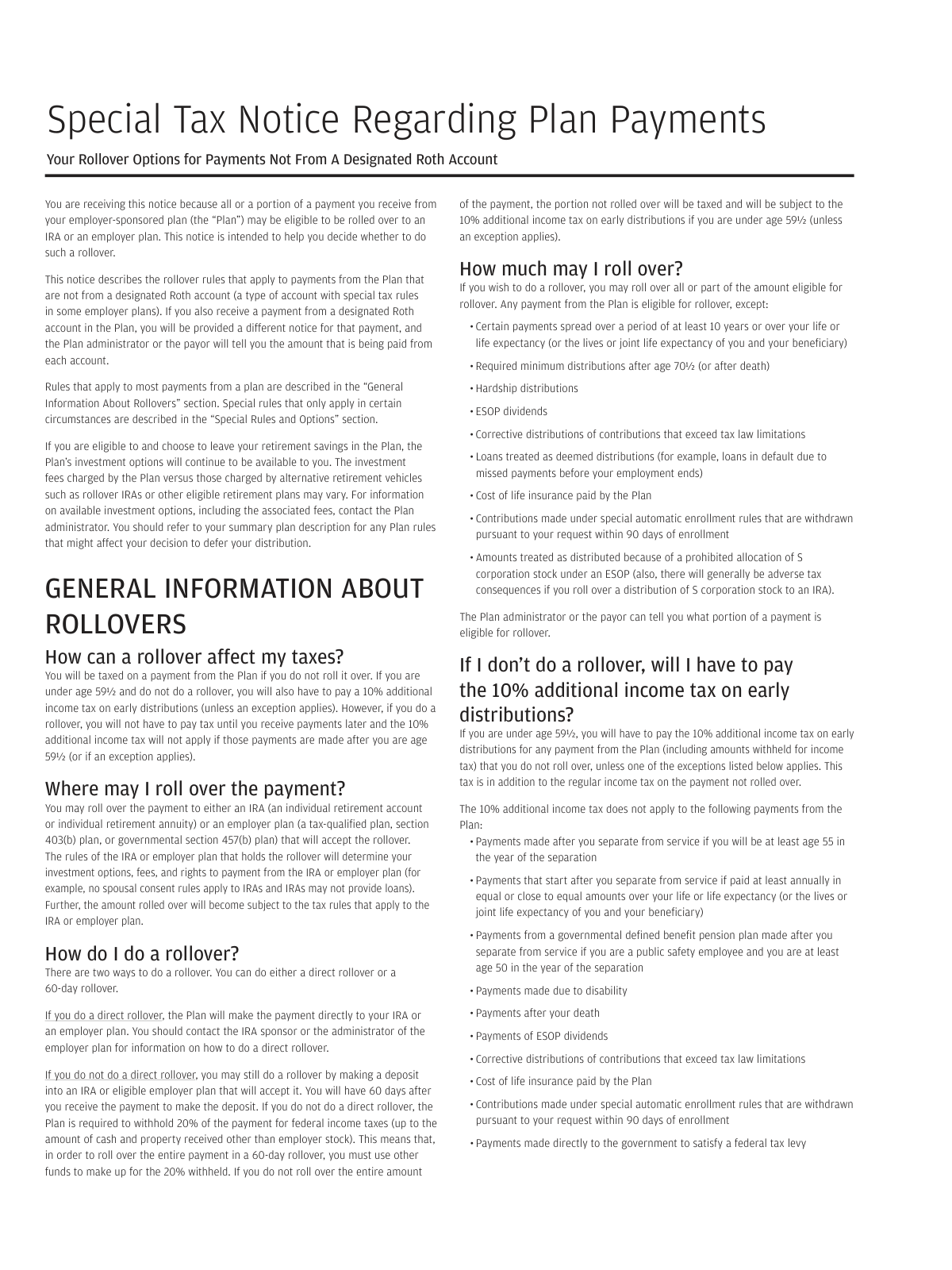
This notice is provided to individuals receiving a payment from an employer-sponsored retirement plan that may be eligible for a rollover. It explains the tax implications of receiving the payment versus rolling it over to an IRA or another eligible plan, helping you make an informed decision to avoid potential taxes and penalties. Today, any accompanying forms can be filled out quickly and accurately using AI-powered services like Instafill.ai, which can also convert non-fillable PDF versions into interactive fillable forms.
DC-BRO-43801-1301 is part of the
payment forms category on Instafill.
Rather not fill this in by hand? Instafill is an online form filler that completes PDF forms automatically — upload the blank form, answer a few questions, and the AI fills every field.
Form specifications
| Form name: | Special Tax Notice Regarding Plan Payments |
| Number of pages: | 1 |
| Language: | English |
Our AI automatically handles information lookup, data retrieval, formatting, and form filling.
It takes less than a minute to fill out DC-BRO-43801-1301 using our AI form filling.
Securely upload your data. Information is encrypted in transit and deleted immediately after the form is filled out.
Instafill Demo: How to fill out PDF forms in seconds with AI
How to Fill Out DC-BRO-43801-1301 Online for Free in 2026
Are you looking to fill out a DC-BRO-43801-1301 form online quickly and accurately? Instafill.ai offers the #1 AI-powered PDF filling software of 2026, allowing you to complete your DC-BRO-43801-1301 form in just 37 seconds or less.
Follow these steps to fill out your DC-BRO-43801-1301 form online using Instafill.ai:
- 1 Navigate to Instafill.ai and upload or select the Special Tax Notice and any related distribution forms.
- 2 Use the AI tool to review the key sections, such as 'General Information About Rollovers' and 'Special Rules and Options', to understand your choices.
- 3 Provide your personal and plan identification information as prompted by the AI assistant.
- 4 Indicate your decision regarding the distribution, such as choosing a direct rollover, a 60-day rollover, or to receive a cash payment.
- 5 If choosing a rollover, input the details of the destination account, such as the financial institution and account number.
- 6 Review all the information populated by the AI and your own entries to ensure accuracy before finalizing the document.
- 7 Securely e-sign and submit the completed forms to your plan administrator as instructed in the notice.
Our AI-powered system ensures each field is filled out correctly, reducing errors and saving you time.
Why Choose Instafill.ai for Your Fillable DC-BRO-43801-1301 Form?
Speed
Complete your DC-BRO-43801-1301 in as little as 37 seconds.
Up-to-Date
Always use the latest 2026 DC-BRO-43801-1301 form version.
Cost-effective
No need to hire expensive lawyers.
Accuracy
Our AI performs 10 compliance checks to ensure your form is error-free.
Security
Your personal information is protected with bank-level encryption.
Frequently Asked Questions About DC-BRO-43801-1301
This notice explains your options for rolling over a payment from your employer-sponsored retirement plan. It details the tax consequences of taking the payment in cash versus moving it to another retirement account like an IRA.
You received this notice because you are eligible to receive a payment from your employer's retirement plan. This document is intended to help you decide whether to roll over that payment to avoid immediate taxes and potential penalties.
A rollover is the process of moving your retirement savings from your employer's plan to another retirement account, like an IRA. Doing a rollover allows you to defer paying income tax on the money until you withdraw it in the future.
In a direct rollover, your plan sends the money directly to your new IRA or plan, and no taxes are withheld. In a 60-day rollover, the payment is made to you minus a mandatory 20% tax withholding, and you have 60 days to deposit the full amount into a new account.
If you don't roll over your payment, it will be considered taxable income for the current year. Additionally, if you are under age 59½, you may have to pay a 10% additional tax penalty for early distribution unless an exception applies.
Yes, you can roll over all or part of the amount that is eligible for rollover. The portion you do not roll over will be subject to income tax and potentially a 10% early withdrawal penalty.
Generally, the 60-day deadline cannot be extended, and the amount you received will become taxable. The IRS has limited authority to waive the deadline in extraordinary circumstances, but this requires filing a private letter ruling request.
If you have an outstanding loan, the balance is often deducted from your benefit, which is treated as a taxable distribution. You can avoid taxes on this 'loan offset' by rolling over an equivalent amount of cash to an IRA or another plan within 60 days.
As a surviving spouse, you have the same rollover options as the original participant, including rolling the funds into your own IRA or an inherited IRA. Each option has different rules regarding required distributions and potential penalties.
This notice only covers the rules for pre-tax or non-Roth money in your plan. If you also have a designated Roth account, you will receive a separate notice explaining the specific rules that apply to that portion of your payment.
Yes, services like Instafill.ai use AI to help you accurately auto-fill the necessary distribution or rollover forms from your plan administrator. This can save you time and help prevent errors on your paperwork.
To complete your forms, you can upload the PDF from your plan administrator to the Instafill.ai platform. The AI will identify the fields and help you fill them out quickly and accurately online.
You can use a service like Instafill.ai to handle this issue. Instafill.ai can convert flat, non-fillable PDFs into interactive forms that you can easily complete and sign online.
Yes, exceptions include payments made after you separate from service in or after the year you turn 55, payments due to disability, and payments under a qualified domestic relations order (QDRO). The notice lists several other specific exceptions.
Compliance DC-BRO-43801-1301
Validation Checks by Instafill.ai
1
Age Verification for Early Distribution Penalty
This check validates the participant's age based on their date of birth. If the participant is under age 59½ and is requesting a taxable distribution (i.e., not a direct rollover), the system must confirm they have acknowledged the potential 10% additional income tax. This is crucial for regulatory compliance and ensures the participant is fully informed of the tax consequences. Failure to acknowledge would prevent the submission of the request for a taxable payment.
2
Non-Spouse Beneficiary Rollover Limitation
This validation restricts the distribution options available to a non-spouse beneficiary. According to the notice, these beneficiaries can only perform a direct rollover to an inherited IRA. The check ensures that options for a 60-day rollover (payment to self) or a rollover to a personal IRA are disabled for this user type. This prevents an invalid and immediately taxable transaction that cannot be reversed.
3
Mandatory 20% Withholding on Taxable Payments
This check ensures that for any eligible rollover distribution paid directly to the participant, a mandatory 20% federal income tax withholding is automatically applied. The notice clearly states this is a legal requirement for non-direct rollovers. This validation prevents the plan administrator from failing their tax withholding obligations and provides the participant with a more accurate estimate of the net payment they will receive.
4
Nonresident Alien Withholding Rate Verification
This validation checks if the participant has identified themselves as a nonresident alien. If so, and they are requesting a payment directly to themselves, the system must apply a 30% withholding rate for federal income taxes instead of the standard 20%. This is a critical compliance check based on IRS rules for payments to foreign persons. An incorrect rate could lead to tax penalties for both the plan and the individual.
5
Required Minimum Distribution (RMD) Rollover Exclusion
This check verifies if the participant is of RMD age and has a required minimum distribution due for the current year. The notice specifies that RMDs are not eligible for rollover. This validation ensures that the RMD amount is correctly calculated and subtracted from the total amount eligible for rollover, preventing a prohibited transaction and potential tax penalties.
6
Surviving Spouse Rollover Options Integrity
This validation ensures that when a user identifies as a surviving spouse, they are presented with the correct, distinct rollover options. The notice explains they can roll funds into their own IRA or an inherited IRA, each with different rules for future distributions. This check guarantees the spouse is shown all legally available choices to make an informed decision that best suits their financial and tax planning needs.
7
QDRO Alternate Payee Rollover Eligibility
This check confirms that a user identified as a spouse or former spouse receiving funds under a Qualified Domestic Relations Order (QDRO) is granted the same rollover options as a plan participant. The validation ensures they can elect a direct rollover to their own IRA or another eligible plan. It also confirms that the system correctly flags the distribution as exempt from the 10% early withdrawal tax, as specified in the notice.
8
Distribution Allocation Completeness
This validation ensures that the sum of all partial distribution elections equals 100% of the total available balance. For example, if a participant requests a 70% direct rollover, the remaining 30% must be allocated to another option, such as a cash payment. This check prevents incomplete or ambiguous instructions that would require manual follow-up and delay processing.
9
Direct Rollover Destination Data Integrity
This check ensures that if a participant elects a direct rollover, all required information for the receiving financial institution is provided and properly formatted. This includes the institution's name, a complete address, and the participant's account number. Missing or invalid information would make the direct rollover impossible to process, so this check is critical for a successful and timely transaction.
10
Roth Conversion Tax Consequence Acknowledgment
This validation triggers if a participant chooses to roll over pre-tax (non-Roth) funds to a Roth IRA or a designated Roth account. The system must require the user to explicitly acknowledge that this is a taxable event and the converted amount will be included in their gross income for the year. This check is vital to ensure the participant understands the significant and immediate tax implications of their choice before finalizing the transaction.
11
Age 55 Separation from Service Exception Check
This check identifies participants who are between age 55 and 59½. If a participant in this age range requests a distribution, the system validates that the reason for distribution is captured. If the reason is 'Separation from Service', the system can correctly determine that the 10% additional tax on early distributions does not apply, a key exception mentioned in the notice.
12
After-Tax Funds Rollover Method Validation
This check validates the rollover method when after-tax contributions are being moved to another employer plan. The notice specifies this can only be accomplished via a direct rollover. The system should therefore prevent a user from selecting a 60-day rollover (payment to self) if the destination for after-tax funds is another employer plan, ensuring the transaction is compliant with tax rules.
Common Mistakes in Completing DC-BRO-43801-1301
People choose a 60-day rollover, receive a check for 80% of their balance, and only roll over that amount, not realizing the withheld 20% is also considered a taxable distribution. This results in unexpected income taxes and a potential 10% early withdrawal penalty on the 20% portion. To avoid this, either choose a direct rollover where no tax is withheld, or if using a 60-day rollover, be prepared to use personal funds to make up the 20% difference to complete a full rollover.
Individuals receive a distribution check and fail to deposit it into a new IRA or employer plan within the strict 60-day period, often due to procrastination or misplacing paperwork. The consequence is that the entire distribution becomes fully taxable for the current year and may be subject to a 10% early withdrawal penalty. Using a direct rollover, which transfers funds directly between institutions, completely avoids this risk and the associated deadlines.
When leaving an employer, many people are surprised to learn that their outstanding 401(k) loan balance is treated as a taxable distribution at the time of separation. They fail to roll over an equivalent amount of money from other sources within 60 days to cover this 'loan offset'. This results in the loan amount being subject to income tax and a 10% penalty if under age 59½.
The notice lists several payment types that are not eligible for rollover, such as Required Minimum Distributions (RMDs) and hardship distributions. Individuals may mistakenly attempt to include these amounts in a rollover, leading to excess contributions to their IRA, which can incur penalties. Before initiating a rollover, it's crucial to confirm with the plan administrator exactly which portion of the payment is eligible.
A beneficiary who is not the deceased participant's spouse may not understand their limited options and attempt a 60-day rollover or try to roll funds into their own existing IRA. The rules only permit a direct rollover to a specifically titled 'inherited IRA.' Failure to do this correctly can make the entire distribution immediately taxable and forfeit the ability to stretch distributions over their lifetime.
The notice lists several exceptions to the 10% penalty, such as the 'age 55 rule' for separation from service, but people often misapply them. For example, one might think the age 55 rule applies to IRA withdrawals (it doesn't) or not realize it only applies if they separate from service in the year they turn 55 or later. This misunderstanding leads to an unexpected 10% tax penalty on their distribution.
When rolling pre-tax plan funds into a Roth IRA, the entire amount rolled over (less any after-tax contributions) becomes taxable income for that year. Individuals often make this choice without planning for the significant, immediate tax liability it creates. This can lead to a large, unexpected tax bill and potential underpayment penalties if estimated taxes aren't adjusted accordingly.
A surviving spouse has the unique option to roll over funds into their own IRA or into an inherited IRA, each with different rules for RMDs and early withdrawal penalties. A younger surviving spouse might benefit from an inherited IRA to access funds penalty-free before 59½, while an older spouse might prefer treating it as their own to delay RMDs. Rushing this decision without understanding the long-term implications can lead to lost flexibility and unnecessary taxes.
The rules for rolling over after-tax contributions are complex, especially regarding how they are allocated in partial rollovers. An individual might incorrectly calculate the taxable portion of their distribution or fail to track the basis (the after-tax amount) in their new IRA, leading to paying taxes twice on the same money. When filling out the actual distribution forms, which may be non-fillable PDFs, AI-powered tools like Instafill.ai can convert them to be fillable and help ensure these complex figures are entered correctly.
This federal tax notice explicitly states that it does not cover state or local income tax rules, which can vary significantly and may include separate withholding requirements. Individuals often focus only on the 20% federal withholding and are surprised by an additional state tax bill on the distribution. Failing to research state-specific tax laws for retirement distributions can lead to an incomplete financial picture and unexpected tax liabilities.
Saved over 80 hours a year
“I was never sure if my IRS forms like W-9 were filled correctly. Now, I can complete the forms accurately without any external help.”
Kevin Martin Green
Your data stays secure with advanced protection from Instafill and our subprocessors




Robust compliance program
Transparent business model
You’re not the product. You always know where your data is and what it is processed for.
ISO 27001, HIPAA, and GDPR
Our subprocesses adhere to multiple compliance standards, including but not limited to ISO 27001, HIPAA, and GDPR.
Security & privacy by design
We consider security and privacy from the initial design phase of any new service or functionality. It’s not an afterthought, it’s built-in, including support for two-factor authentication (2FA) to further protect your account.
Fill out DC-BRO-43801-1301 with Instafill.ai
Worried about filling PDFs wrong? Instafill securely fills special-tax-notice-regarding-plan-payments forms, ensuring each field is accurate.
