
Yes! You can use AI to fill out Form 1099-PATR, Taxable Distributions from Cooperatives
Don't type 70 fields by hand. Tell our AI about yourself, or upload your W-2 or last year's return, and it fills every field in seconds. You check it, then download, print or sign.
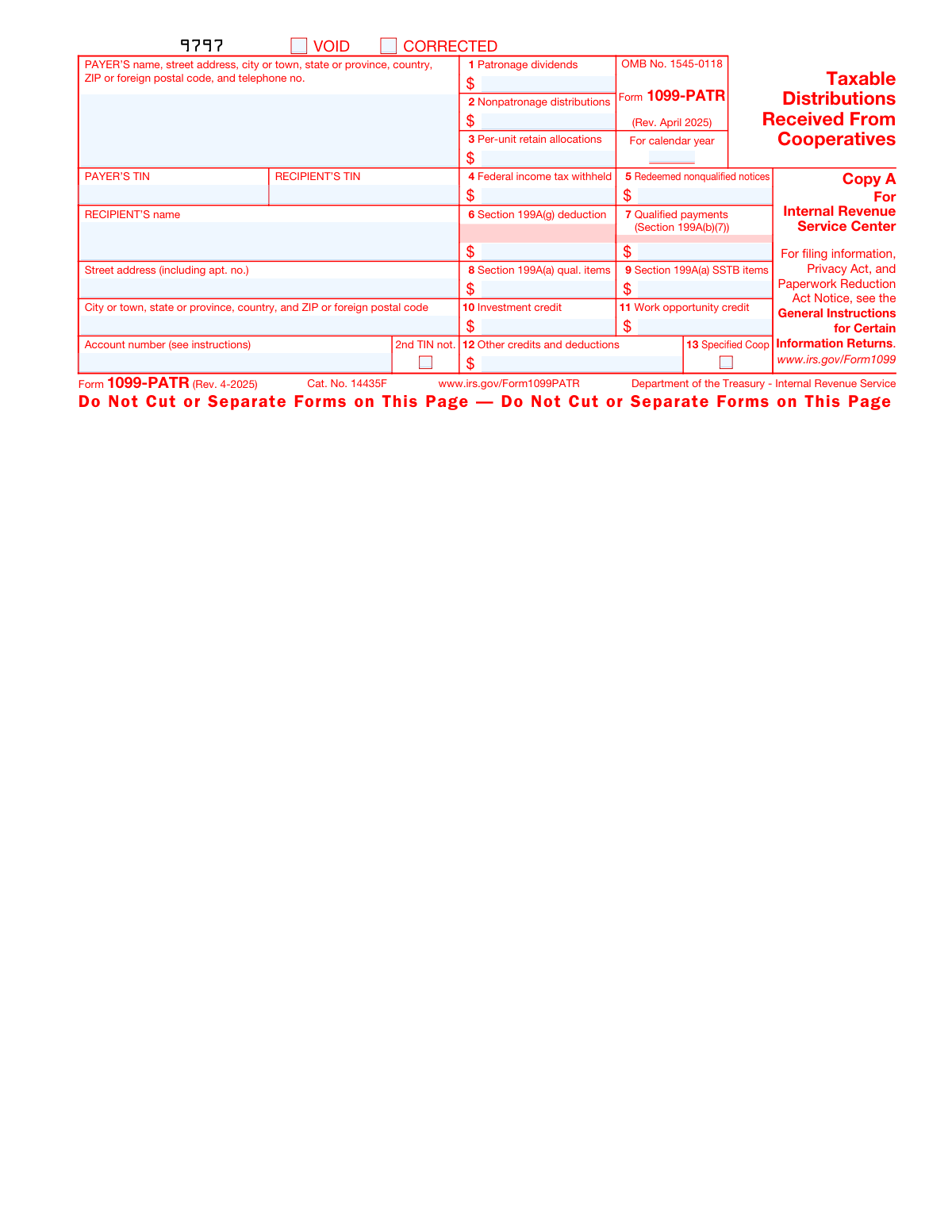
The AI does the filling. You just check it.
No typing into boxes, nothing to install.
What this form asks for
The AI fills all of it, from your answers or your documents.
The AI checks your answers before you download
15 checks built for this form, so a wrong date or a missing answer is caught before anyone else sees it.
This validation check ensures that the payer's information on Form 1099-PATR is entered with precision. It verifies that the payer's name is complete and matches official records. The address is checked for accuracy and is formatted in accordance with United States Postal Service (USPS) standards, which includes the correct use of street names, city, state, and ZIP code. Additionally, the telephone number is validated to ensure it follows the standard 10-digit format, including area code.
This validation check confirms that the Taxpayer Identification Number (TIN) for the payer on Form 1099-PATR is correctly provided. It ensures that the TIN is in the correct format, whether it is an Employer Identification Number (EIN), Social Security Number (SSN), or Individual Taxpayer Identification Number (ITIN). The check involves verifying the number of digits, the presence of any required dashes, and that the sequence of numbers aligns with the IRS's specifications for each type of TIN.
This validation check verifies that the recipient's Taxpayer Identification Number (TIN) on Form 1099-PATR is accurately provided and formatted correctly. It checks that the TIN, whether an SSN, EIN, or ITIN, contains the appropriate number of digits and is structured according to IRS guidelines. The check also includes a review for any typographical errors that could lead to issues with tax processing and reporting.
This validation check ensures that the recipient's name on Form 1099-PATR is fully and accurately entered. It checks that the name is complete and spelled out without any unauthorized abbreviations or initials, except in cases where such abbreviations or initials are legally part of the recipient's name. This is crucial for maintaining the integrity of the tax document and ensuring proper identification of the recipient for tax purposes.
This validation check validates that the recipient's address on Form 1099-PATR is fully provided and formatted correctly. It ensures that all parts of the address, including street name, city, state, and ZIP code, are present. If applicable, it also checks for the inclusion of an apartment or suite number. The formatting is reviewed for compliance with USPS standards, which is essential for accurate and timely delivery of tax-related correspondence.
Ensures that the account number field is populated if it is applicable, verifying its accuracy against the payer's records for the recipient. This check is crucial to maintain the integrity of the taxpayer's information and to facilitate correct reporting to the IRS. It also prevents misallocation of the reported taxable distributions, ensuring that the recipient's financial records align with the cooperative's filings.
And 9 more checks
- 2nd TIN Notification Check
- Dollar Amounts Formatting and Accuracy
- VOID Box Check
- CORRECTED Box Check
- Validates that Copy A is not printed from the website but is an official IRS form for filing purposes.
- Ensures that the correct copy of the form (A, B, or C) is used for its intended purpose (IRS, recipient, or payer).
- Verifies that the form is completed in accordance with the current General Instructions for Certain Information Returns and the Instructions for Form 1099-PATR.
- Confirms that electronic filing, if used, is done through the IRS FIRE system or the IRS AIR program, as appropriate.
- Checks for any additional instructions or guidance provided on Copy B for the recipient, ensuring they are aware of how to report the amounts on their income tax return.
Let AI fill out your Form 1099-PATR
No typing. Every field filled in seconds, checked, ready to sign.
How to Fill Out Form 1099-PATR Online for Free in 2026
What the AI walks you through.
- Visit instafill.ai site and select Form 1099-PATR
- Enter payer's information
- Input recipient's TIN and name
- Fill in distribution amounts
- Add federal income tax withheld
- Sign and date the form electronically
- Check for accuracy and submit form
Common Mistakes in Completing Form 1099-PATR
The ones the AI is built to catch.
Using Copy A printed from the website instead of official IRS forms
Failing to provide the payer's full name and address
Omitting the payer's telephone number
Entering incorrect or missing PAYER'S TIN
Entering incorrect or missing RECIPIENT'S TIN
Not providing the full name of the recipient
Incomplete recipient address information
Neglecting to include an account number if applicable
Not checking the 2nd TIN not. box when applicable
Incorrect dollar amounts in Boxes 1 through 13
Failing to check the VOID box when voiding the form
Failing to check the CORRECTED box when correcting the form
Mixing up information between Copy A, B, and C
Not following electronic filing procedures correctly
Contacting the wrong IRS department for assistance
Frequently Asked Questions About Form 1099-PATR
Is it really free for 7 days?
Can I fill other forms too?
How do I cancel?
How does the AI fill out Form 1099-PATR?
What happens to my information?
How complex is Form 1099-PATR to fill out?
What is Form 1099-PATR?
Who should receive Form 1099-PATR?
What should I do if I receive Form 1099-PATR?
What are patronage dividends as reported in Box 1 of Form 1099-PATR?
How do I report nonpatronage distributions from Box 2 of Form 1099-PATR on my tax return?
What are per-unit retain allocations in Box 3 of Form 1099-PATR?
What does federal income tax withheld in Box 4 of Form 1099-PATR indicate?
What are redeemed nonqualified notices in Box 5 of Form 1099-PATR?
How does the Section 199A(g) deduction in Box 6 of Form 1099-PATR affect my taxes?
What are qualified payments in Box 7 of Form 1099-PATR?
What is the significance of Section 199A(a) qualified items in Box 8 of Form 1099-PATR?
What are Section 199A(a) SSTB items in Box 9 of Form 1099-PATR?
How do I claim the investment credit from Box 10 of Form 1099-PATR?
What is the work opportunity credit in Box 11 of Form 1099-PATR?
How should I report other credits and deductions from Box 12 of Form 1099-PATR?
What does the 'Specified Coop' checkbox in Box 13 of Form 1099-PATR mean?
Can I print and file Copy A of Form 1099-PATR from the IRS website?
Where can I find the official IRS information returns including Form 1099-PATR?
How can I electronically file Form 1099-PATR?
What are the penalties for filing a non-scannable Form 1099-PATR with the IRS?
Get your Form 1099-PATR filled out by AI
$0 today. Cancel before Nov 1 and you pay nothing.
Other forms like this one
tax forms: W-9, Request for Taxpayer Identification Number and Certification, Form W-2, Wage and Tax Statement, Form 1040-X, Amended U.S. Individual Income Tax Return, Form 130, Taxpayer's Notice to Initiate an Appeal, Form 1040-C, U.S. Departing Alien Income Tax Return, Form 940, Employer’s Annual FUTA Tax Return, Form 720, Quarterly Federal Excise Tax Return, Form 982, Reduction of Tax Attributes, Form 4137, Social Security and Medicare Tax on Unreported Tip Income, Form 911, Request for Taxpayer Advocate Service Assistance, Form 8960, Net Investment Income Tax, Form 8959, Additional Medicare Tax, Form 8919, Uncollected Social Security and Medicare Tax, Form 8801, Credit for Prior Year Minimum Tax, Form 990-T, Exempt Org Business Income Tax Return, Form 945, Annual Return of Withheld Federal Income Tax, Form 5330, Return of Excise Taxes, Form FTB 3514, California Earned Income Tax Credit, Form 100, CA Corp Tax Return, Form 8288, U.S. Withholding Tax Return
1099 forms: Form 1099-NEC, Nonemployee Compensation, Form 4852, Substitute for Form W-2 or 1099-R, Form 1099-MISC, Miscellaneous Information, Form 1099-INT, Interest Income, Form 1099-DIV, Dividends and Distributions, Form 1099-R, Distributions From Pensions etc., Form 1099-S, Proceeds From Real Estate Transactions, Form 1099-G, Certain Government Payments, Form 1099-C, Cancellation of Debt, Form 1099-K, Payment Card and Third Party Network Transactions, Form 1099-OID, Original Issue Discount, Form 1099-Q, Payments From Qualified Education Programs, Form 1099-SA, Distributions from HSA/MSA, Form 1099-B, Proceeds From Broker Transactions, Form 1099-NEC, Nonemployee Compensation, Form 1099-NEC, Nonemployee Compensation, Form 1099-NEC, Nonemployee Compensation, Form 1099-NEC, Nonemployee Compensation, Instructions for Forms 1099-R and 5498, Form 1099-MISC, Miscellaneous Information
distribution forms: Fischer Homes Request for In-Service Distribution, Form 1099-DIV, Dividends and Distributions, Form 1099-R, Distributions From Pensions etc., Form 1099-SA, Distributions from HSA/MSA, Nationwide Retirement Solutions Participant Distribution Request Form (PNF-0875M9, TRAC Version, 01/2025), Nationwide Retirement Solutions Participant Distribution Request Form (PNF-0875M9, TRAC Version, 01/2025), Fidelity Advisor 403(b) Distribution Request Form, Fidelity Advisor IRA Distribution Request for Automatic Rollover Accounts, Fidelity NetBenefits Distribution - Recurring Payments, Fidelity Investments® Beneficiary Distribution Form, Fidelity Investments Distribution Form, Fidelity IRA Beneficiary Distribution — Charity, Foundation, or a University, IRA Distribution Form, New York State Deferred Compensation Plan Benefit Distribution Request, Individual 401(k) Distribution Request Form, Fidelity Distribution—Rollover, Charles Schwab IRA Distribution Form, Sample IRA Distribution Letter for a Qualified Charitable Distribution (QCD), Vanguard IRA Distribution Kit (including IRA Distribution Form RRDFT and Form W-4R), Vanguard Required Minimum Distribution Service Form
Let AI fill out your Form 1099-PATR
Your trial starts once a card is added. You pay nothing before Nov 1.
Our AI already knows this form, all 70 fields of it. Skip the typing: tell it about yourself, or upload what you have, and it fills the whole form in seconds.
- AI fills every field on all 5 pages, checkboxes included
- No typing into boxes: answer a few questions, or upload your W-2 or last year's return, an old copy of this form, a photo of a document
- The AI checks the answers; you review and change anything before you download
- Download the finished PDF, print it, or sign it online
- Encrypted, and never used to train AI
Cancel before Nov 1 and you pay nothing.
A card is needed to start the trial. Cancel in two clicks from your account.
Terms · Privacy