
Yes! You can use AI to fill out Form 1099-S, Proceeds From Real Estate Transactions
Don't type 47 fields by hand. Tell our AI about yourself, or upload your W-2 or last year's return, and it fills every field in seconds. You check it, then download, print or sign.
The AI does the filling. You just check it.
No typing into boxes, nothing to install.
What this form asks for
The AI fills all of it, from your answers or your documents.
The AI checks your answers before you download
15 checks built for this form, so a wrong date or a missing answer is caught before anyone else sees it.
The AI ensures that the correct version of Form 1099-S is used for each copy required. For Copy A, which is sent to the IRS, the AI confirms that the official scannable form is utilized. For Copy B, which is provided to the transferor, and any other copies that may be needed, the AI verifies that the black version of the form is used. This check is crucial to maintain compliance with IRS requirements and to ensure proper processing of the form.
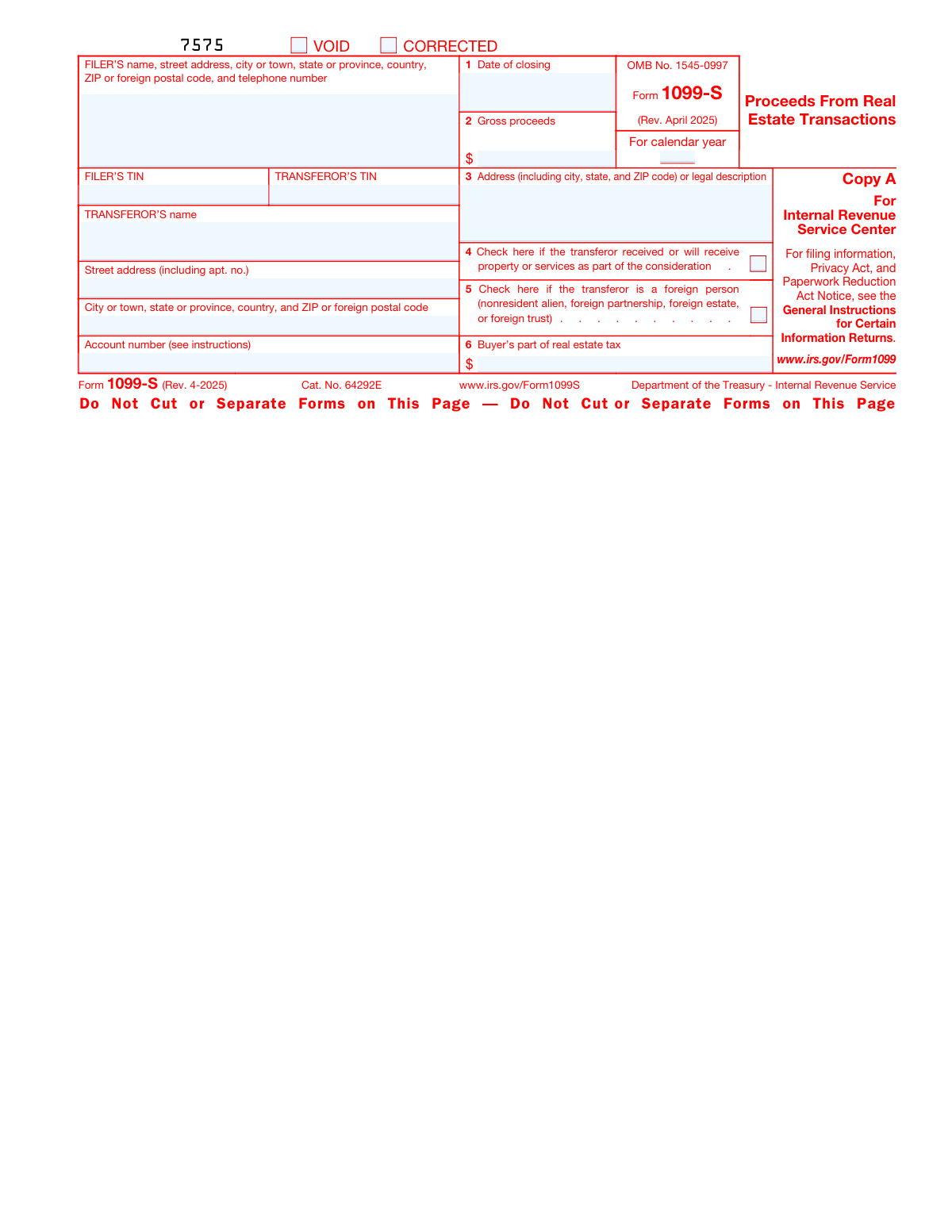
The AI confirms that all required filer information fields on Form 1099-S are fully completed. It checks for the presence of the filer's name, address, city, state, country, ZIP code or foreign postal code, and telephone number. The AI ensures that no essential details are missing and that the information provided is formatted correctly to meet IRS standards. This validation is essential to avoid processing delays or issues with form acceptance.
The AI verifies the inclusion and accuracy of the filer's Taxpayer Identification Number (TIN) on Form 1099-S. It checks that the TIN is correctly entered and matches the filer's official records. The AI also ensures that the TIN format adheres to IRS specifications. This validation is critical to ensure that the IRS can correctly identify the filer and associate the form with the correct tax account.
The AI checks the transferor's Taxpayer Identification Number (TIN) for correctness on Form 1099-S. It ensures that the TIN provided for the transferor is accurate and formatted according to IRS guidelines. This check is important to prevent errors that could result in misreporting or misidentification of the transferor in the IRS system.
The AI validates the transferor's full name and address details on Form 1099-S. It ensures that the name is complete and matches official documents, and that the address includes all necessary components such as the street address, apartment number if applicable, city, state, and ZIP code. This validation is crucial for the IRS to accurately identify the transferor and for any necessary correspondence regarding the real estate transaction.
The AI ensures that an account number or a unique identifier is present on Form 1099-S if the filer has assigned one to the transferor's account. This check is crucial for maintaining accurate records and ensuring that the transaction can be matched to the correct individual or entity. The AI cross-references the provided information with the filer's records to confirm the presence and accuracy of the account or unique number. In the absence of such an identifier, the AI flags the form for further review to prevent potential errors in reporting.
And 9 more checks
- Verifies the date of closing is entered in the correct format and reflects the actual closing date of the real estate transaction.
- Ensures the gross proceeds amount is entered and represents the total gross proceeds from the transaction.
- Checks that the address or legal description of the property is provided accurately.
- Confirms if the 'Property or services as part of the consideration' box is checked when applicable.
- Verifies the 'Foreign person' box is checked if the transferor is a foreign person.
- Ensures the buyer's part of real estate tax is entered and accurate.
- Checks for consistency of information between Copy A and Copy C (For Filer).
- Validates that the form and instructions are the most current versions as per the official IRS website.
- Confirms that electronic filing options are considered, directing to the IRS FIRE or AIR systems if applicable.
Let AI fill out your Form 1099-S
No typing. Every field filled in seconds, checked, ready to sign.
How to Fill Out Form 1099-S Online for Free in 2026
What the AI walks you through.
- Visit instafill.ai site and select Form 1099-S
- Enter FILER'S and TRANSFEROR'S TIN
- Input FILER'S and TRANSFEROR'S name and address
- Fill in the date of closing and gross proceeds
- Provide property address or legal description
- Indicate if transferor received property or services
- Check if transferor is a foreign person
- Enter buyer's part of real estate tax
- Sign and date the form electronically
- Check for accuracy and submit form
Common Mistakes in Completing Form 1099-S
The ones the AI is built to catch.
Using non-scannable Copy A from the website
Failing to use the official IRS scannable form for Copy A
Not providing the filer's complete address and telephone number
Omitting or incorrectly entering the filer's TIN
Incorrectly entering the transferor's TIN
Not fully completing the transferor's name and address
Leaving out the account or unique number if applicable
Entering the wrong date of closing in Box 1
Misreporting the gross proceeds in Box 2
Providing an incomplete address or legal description in Box 3
Failing to check Box 4 when property or services are part of the consideration
Neglecting to check Box 5 if the transferor is a foreign person
Incorrectly entering the buyer's part of real estate tax in Box 6
Not providing the same information on Copy C as on Copy A
Overlooking updates or changes to the form or instructions
Not consulting the General Instructions for Certain Information Returns
Failing to report the transaction correctly on the transferor's tax return
Not using electronic filing options when available
Contacting the wrong IRS service for assistance
Frequently Asked Questions About Form 1099-S
Is it really free for 7 days?
Can I fill other forms too?
How do I cancel?
How does the AI fill out Form 1099-S?
What happens to my information?
How complex is Form 1099-S to fill out?
What is Form 1099-S used for?
Can I print and file Copy A of Form 1099-S from the IRS website?
Where can I find the official scannable Copy A of Form 1099-S for filing with the IRS?
How can I order official IRS information returns including Form 1099-S?
Is it possible to file information returns electronically, and if so, how?
Where can I find more information about printing tax forms like Form 1099-S?
What should I do with Form 1099-S Copy B?
What are the consequences of not reporting information required on Form 1099-S?
What information is reported in Box 1 of Form 1099-S?
What does Box 2 on Form 1099-S represent?
What is shown in Box 3 of Form 1099-S?
What does it mean if Box 4 on Form 1099-S is checked?
What does Box 5 indicate on Form 1099-S?
How is the buyer's part of real estate tax reported on Form 1099-S?
What should I do if I received a federal mortgage subsidy and sold my home?
What is the Transferor's taxpayer identification number (TIN) used for on Form 1099-S?
What is the purpose of the account number on Form 1099-S?
How do I report a real estate transaction if the property was not my main home?
Where can I find the latest developments related to Form 1099-S and its instructions?
Does the IRS offer a Free File Program for filing taxes online?
Get your Form 1099-S filled out by AI
$0 today. Cancel before Nov 1 and you pay nothing.
Other forms like this one
real estate forms: Form 593, Real Estate Withholding, Inland Residential Real Estate Services LLC Application for Lease (Form 4301, Rev. 11/14), New licence application – Form 1–1 (IND), Application for an individual’s licence (Real estate agent, property auctioneer, resident letting agent, motor dealer, chattel auctioneer, field agent), Texas Real Estate Commission (TREC) One to Four Family Residential Contract (Resale) (TREC No. 20-18), City of Harvey Real Estate Transfer Declaration & Application (with Certificate for Exemption), Alaska Residential Real Estate Purchase Agreement, Form 21, Residential Purchase and Sale Agreement, Form L-4260, Property Transfer Affidavit, Form TC201, Income and Expense Schedule for Rent Producing Properties, Memorandum of Contract, Notice of Transfer Forms Packet, Oklahoma Real Estate Commission Tenancy Guidelines (01-01-2026), Oklahoma Real Estate Commission Residential Property Condition Disclosure Exemption Form (RPCD EXEMPTION FORM), Oklahoma Real Estate Commission Residential Lease, Oklahoma Real Estate Commission Tenant Flood Notice (01-01-2026), Oklahoma Real Estate Commission Property Data Form (Residential), Oklahoma Real Estate Commission Pet Addendum, Oklahoma Real Estate Commission Lease Application, Oklahoma Real Estate Commission Keys and Re-Keying Addendum, Oklahoma Real Estate Commission, Disclosure of Broker Duties & Responsibilities
estate forms: Form 593, Real Estate Withholding, Inland Residential Real Estate Services LLC Application for Lease (Form 4301, Rev. 11/14), New licence application – Form 1–1 (IND), Application for an individual’s licence (Real estate agent, property auctioneer, resident letting agent, motor dealer, chattel auctioneer, field agent), Judicial Council of California Form DE-111, Petition for Probate (Probate—Decedents Estates), Texas Real Estate Commission (TREC) One to Four Family Residential Contract (Resale) (TREC No. 20-18), City of Harvey Real Estate Transfer Declaration & Application (with Certificate for Exemption), Judicial Council of California Form DE-120, Notice of Hearing—Decedent's Estate or Trust, Form DE-160/GC-040, Inventory and Appraisal (Declaration of Representative/Guardian/Conservator or Small Estate Claimant and Declaration of Probate Referee), Judicial Council of California Form DE-120, Notice of Hearing—Decedent's Estate or Trust, Fidelity Change of Account Ownership — Mutual Fund Only Accounts (Changing to a Trust, Estate, Guardian, or Conservator Account), Fidelity Change of Account Registration — Changing to a Trust, Estate, Guardian, or Conservator Brokerage Account, Valuing Your Estate Worksheet (from Vanguard's 'Understanding the basics of estate planning' guide), Alaska Residential Real Estate Purchase Agreement, Merrill Edge Self-Directed Trust and Estate Cash Management Account (CMA Account) Account Application Booklet and Agreements, Affidavit for Collection of Personal Property California Probate Code Section 13100, Oklahoma Real Estate Commission Tenancy Guidelines (01-01-2026), Oklahoma Real Estate Commission Residential Property Condition Disclosure Exemption Form (RPCD EXEMPTION FORM), Oklahoma Real Estate Commission Residential Lease, Oklahoma Real Estate Commission Tenant Flood Notice (01-01-2026), Oklahoma Real Estate Commission Property Data Form (Residential)
PA state forms: Form 1095-A, Health Insurance Marketplace Statement, Form W-2, Wage and Tax Statement, Form 593, Real Estate Withholding, Form 8938, Statement of Specified Foreign Financial Assets, Form CMS-2567, Statement of Deficiencies, Form 1098, Mortgage Interest Statement, Form 1098-T, Tuition Statement, Form 1098-E, Student Loan Interest Statement, Form DS-3053, Statement of Consent, Form DS-86, Statement of Non-Receipt of a U.S. Passport, Form DS-86, Statement of Non-Receipt of a U.S. Passport, Form 108, Statement of Intention, Form 107, Statement of Financial Affairs, Form 121, Statement About Your SSNs, Form 122A-1, Chapter 7 Statement of Current Monthly Income, Center for Infertility & Reproductive Surgery – New Patient Questionnaire and Patient/Guarantor Statement (Brigham and Women’s Hospital, Department of Obstetrics and Gynecology), Adult Travel Document Application for Stateless and Protected Persons in Canada (16 years of age or over) (PPTC 190), Form W-8IMY (Rev. October 2021), Certificate of Foreign Intermediary, Foreign Flow-Through Entity, or Certain U.S. Branches for United States Tax Withholding and Reporting, Form W-2, Wage and Tax Statement (2025), State of New Mexico Workers’ Compensation Administration — Workers' Compensation Complaint (Rev. 8/22) (11.4.4.9 NMAC)
1099 forms: Form 1099-NEC, Nonemployee Compensation, Form 4852, Substitute for Form W-2 or 1099-R, Form 1099-MISC, Miscellaneous Information, Form 1099-INT, Interest Income, Form 1099-DIV, Dividends and Distributions, Form 1099-R, Distributions From Pensions etc., Form 1099-G, Certain Government Payments, Form 1099-C, Cancellation of Debt, Form 1099-K, Payment Card and Third Party Network Transactions, Form 1099-OID, Original Issue Discount, Form 1099-PATR, Taxable Distributions from Cooperatives, Form 1099-Q, Payments From Qualified Education Programs, Form 1099-SA, Distributions from HSA/MSA, Form 1099-B, Proceeds From Broker Transactions, Form 1099-NEC, Nonemployee Compensation, Form 1099-NEC, Nonemployee Compensation, Form 1099-NEC, Nonemployee Compensation, Form 1099-NEC, Nonemployee Compensation, Instructions for Forms 1099-R and 5498, Form 1099-MISC, Miscellaneous Information
NJ state forms: Form 1095-A, Health Insurance Marketplace Statement, Form W-2, Wage and Tax Statement, Form 593, Real Estate Withholding, Form 8938, Statement of Specified Foreign Financial Assets, Form CMS-2567, Statement of Deficiencies, Form 1098, Mortgage Interest Statement, Form 1098-T, Tuition Statement, Form 1098-E, Student Loan Interest Statement, Form DS-3053, Statement of Consent, Form DS-86, Statement of Non-Receipt of a U.S. Passport, Form DS-86, Statement of Non-Receipt of a U.S. Passport, Form 108, Statement of Intention, Form 107, Statement of Financial Affairs, Form 121, Statement About Your SSNs, Form 122A-1, Chapter 7 Statement of Current Monthly Income, Center for Infertility & Reproductive Surgery – New Patient Questionnaire and Patient/Guarantor Statement (Brigham and Women’s Hospital, Department of Obstetrics and Gynecology), Adult Travel Document Application for Stateless and Protected Persons in Canada (16 years of age or over) (PPTC 190), Form W-8IMY (Rev. October 2021), Certificate of Foreign Intermediary, Foreign Flow-Through Entity, or Certain U.S. Branches for United States Tax Withholding and Reporting, Form W-2, Wage and Tax Statement (2025), State of New Mexico Workers’ Compensation Administration — Workers' Compensation Complaint (Rev. 8/22) (11.4.4.9 NMAC)
state ID forms: Application for Renewal or Duplicate of Alabama Driver License or ID card, Form 1095-A, Health Insurance Marketplace Statement, Form W-2, Wage and Tax Statement, Form 593, Real Estate Withholding, Form 8938, Statement of Specified Foreign Financial Assets, Form CMS-2567, Statement of Deficiencies, Form 1098, Mortgage Interest Statement, Form 1098-T, Tuition Statement, Form 1098-E, Student Loan Interest Statement, Form DS-3053, Statement of Consent, Form DS-86, Statement of Non-Receipt of a U.S. Passport, Form 108, Statement of Intention, Form 107, Statement of Financial Affairs, Form 121, Statement About Your SSNs, Form 122A-1, Chapter 7 Statement of Current Monthly Income, Center for Infertility & Reproductive Surgery – New Patient Questionnaire and Patient/Guarantor Statement (Brigham and Women’s Hospital, Department of Obstetrics and Gynecology), Adult Travel Document Application for Stateless and Protected Persons in Canada (16 years of age or over) (PPTC 190), Form W-8IMY (Rev. October 2021), Certificate of Foreign Intermediary, Foreign Flow-Through Entity, or Certain U.S. Branches for United States Tax Withholding and Reporting, Form W-2, Wage and Tax Statement (2025), State of New Mexico Workers’ Compensation Administration — Workers' Compensation Complaint (Rev. 8/22) (11.4.4.9 NMAC)
Let AI fill out your Form 1099-S
Your trial starts once a card is added. You pay nothing before Nov 1.
Our AI already knows this form, all 47 fields of it. Skip the typing: tell it about yourself, or upload what you have, and it fills the whole form in seconds.
- AI fills every field on all 5 pages, checkboxes included
- No typing into boxes: answer a few questions, or upload your W-2 or last year's return, an old copy of this form, a photo of a document
- The AI checks the answers; you review and change anything before you download
- Download the finished PDF, print it, or sign it online
- Encrypted, and never used to train AI
Cancel before Nov 1 and you pay nothing.
A card is needed to start the trial. Cancel in two clicks from your account.
Terms · Privacy