Fill out sole proprietorship forms
with AI.
Sole proprietorship forms are the core tax and reporting documents that self-employed individuals and single-owner businesses use to stay compliant with IRS requirements. For most sole proprietors, this means accurately tracking business income and expenses throughout the year and then reporting that financial activity at tax time. Getting these forms right matters — errors or omissions can affect your taxable income, trigger penalties, or cause you to miss out on legitimate deductions.
By continuing, you acknowledge Instafill's Privacy Policy and agree to get occasional product update and promotional emails.
About sole proprietorship forms
The most commonly needed form in this category is Schedule C (Form 1040), Profit or Loss From Business, which sole proprietors attach to their personal tax return to report everything from gross receipts and cost of goods sold to vehicle use and home office expenses. Whether you're a freelancer, independent contractor, or small business owner operating without a formal business entity, Schedule C is typically required if you earn income from self-employment. The net profit or loss calculated on this form directly flows to your Form 1040 and influences your self-employment tax liability, making accuracy essential.
These forms can feel time-consuming, especially when navigating IRS instructions and ensuring every line is completed correctly. Tools like Instafill.ai use AI to fill these forms in under 30 seconds, handling the data accurately and securely — a practical option for sole proprietors who want to spend less time on paperwork and more time running their business.
Every form on this page can be completed without typing. Instafill is form filling software that reads a PDF and fills it for you — including flat and scanned documents that carry no fillable fields at all.
Forms in This Category
The forms in this category have a median Form Complexity Index of 66/100 (Complex), measured across 3 forms by field count, input difficulty, length, conditional logic and structure. See how it is calculated.
| Form Name | Pages | FCI | |
|---|---|---|---|
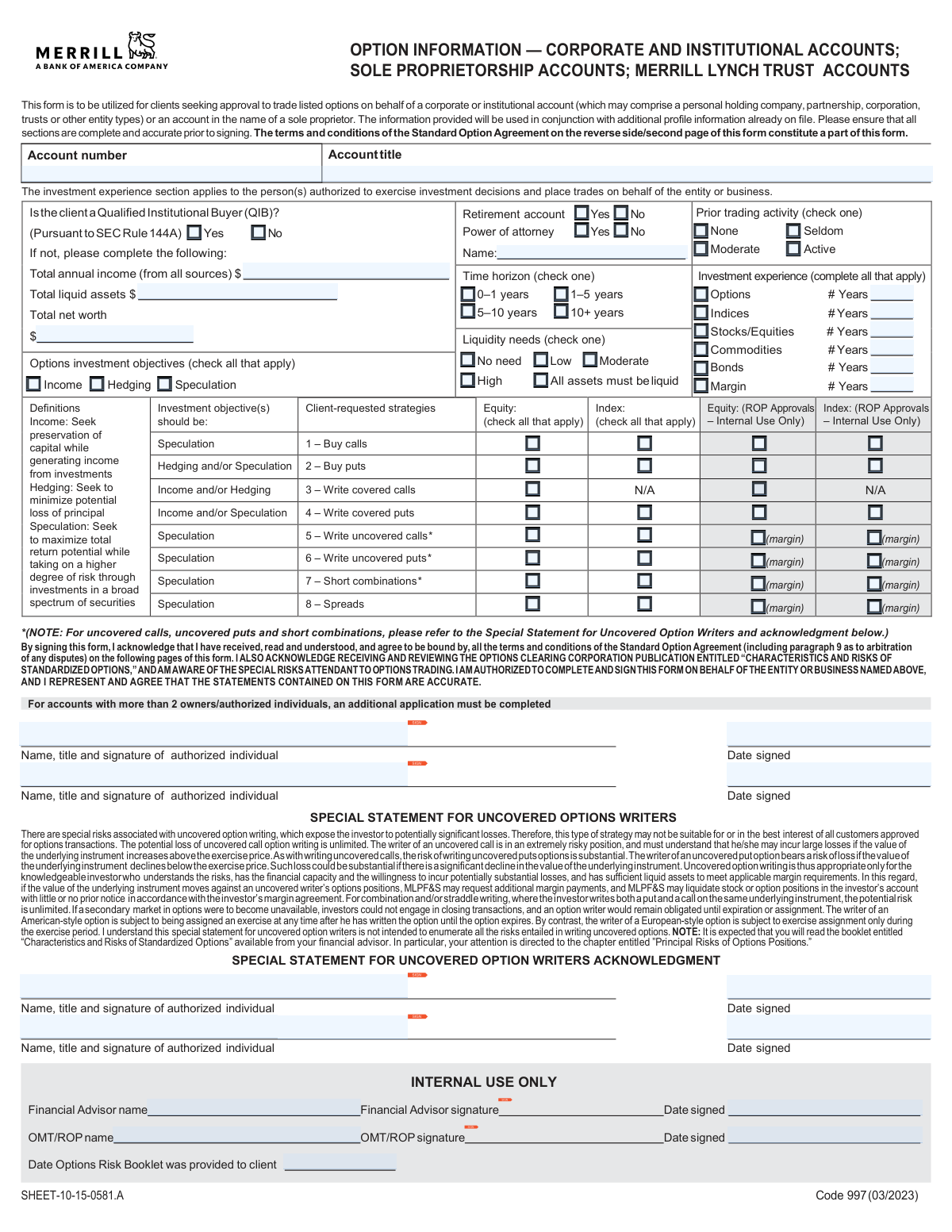
| 1. | Option Information — Corporate and Institutional Accounts; Sole Proprietorship Accounts; Merrill Lynch Trust Accounts | 1 | Moderate 56 |
| 2. | Schedule C (Form 1040), Profit or Loss From Business (Sole Proprietorship) | 2 | Complex 66 |
| 3. | Schedule C (Form 1040), Profit or Loss From Business (Sole Proprietorship) (2017) | 2 | Complex 70 |
- Enterprise-grade security & data encryption
- 99%+ accuracy powered by AI
- 1,000+ forms from all industries
- Complete forms in under 60 seconds
How to Choose the Right Form
Both forms in this category serve the same core purpose — reporting business profit or loss as a sole proprietor — but knowing which version applies to your situation will save you time.
You're Filing Taxes for the 2017 Tax Year
- Choose Schedule C (Form 1040), Profit or Loss From Business (Sole Proprietorship) (2017) if you are filing or amending a federal tax return specifically for the 2017 tax year.
- This version reflects the tax rules, expense limits, and IRS instructions in effect for that year.
- It's also the right pick if you're catching up on back taxes or correcting a prior-year return.
You're Filing Taxes for the Current Tax Year
- Choose Schedule C (Form 1040), Profit or Loss From Business (Sole Proprietorship) (the version without a year label) for your current or most recent tax year filing.
- This is the go-to form for most self-employed individuals, freelancers, independent contractors, and single-member LLC owners filing today.
Who Needs a Schedule C?
Regardless of which version you use, Schedule C is the right form if you:
- Operate a business as a sole proprietor or single-member LLC (treated as a disregarded entity)
- Earn self-employment income from freelancing, gig work, or a side business
- Need to deduct business expenses such as vehicle use, home office costs, or cost of goods sold
Quick Tip
The net profit or loss from Schedule C flows directly into your Form 1040 and affects your self-employment tax (Schedule SE), so choosing the correct year's version ensures your calculations align with the right tax rules. When in doubt, check the tax year printed at the top of your Form 1040.
Form Comparison
| Form | Purpose | Who Files It | When to Use |
|---|---|---|---|
| Schedule C (Form 1040), Profit or Loss From Business (Sole Proprietorship) (2017) | Report business profit or loss for tax year 2017 | Sole proprietors and single-member LLC owners | Filing 2017 federal income tax return |
| Schedule C (Form 1040), Profit or Loss From Business (Sole Proprietorship) | Report business income, expenses, and net profit or loss | Sole proprietors and single-member LLC owners | Filing current year federal income tax return |
Tips for sole proprietorship forms
Schedule C requires detailed reporting of deductible expenses across many categories, from advertising to utilities. Keeping organized records throughout the year — rather than scrambling at tax time — ensures you don't miss legitimate deductions that reduce your taxable income.
Schedule C asks for a principal business activity code that classifies your type of business. Using the wrong code can raise flags with the IRS, so take time to look up the most accurate code in the IRS instructions before filing.
One of the most common mistakes sole proprietors make is mixing personal and business expenses on Schedule C. Only expenses that are ordinary and necessary for your business are deductible — personal costs, even if paid from a business account, should be excluded.
The net profit or loss from Schedule C flows directly into your self-employment tax calculation via Schedule SE. A higher net profit means a higher self-employment tax bill, so accurate expense reporting is critical — not just for income tax, but for your total tax liability.
If you claim vehicle expenses on Schedule C, the IRS requires documentation of business miles driven, dates, and business purposes. A mileage log maintained throughout the year is far more reliable than trying to reconstruct trips after the fact.
AI-powered tools like Instafill.ai can complete Schedule C forms quickly and accurately, pulling the right information into the correct fields without manual data entry errors. Your data stays secure throughout the process, making it a real time-saver especially if you're filing for multiple years or need to compare versions of the form.
Schedule C is updated periodically, and using an outdated version can cause processing issues. Always confirm you're using the correct tax year version — for example, the 2017 form should only be used when amending or filing a 2017 return, not for current-year filings.
Schedule C includes a question about whether you were required to file 1099 forms for contractors or vendors you paid. Answering this incorrectly or overlooking it is a common oversight — review IRS 1099 requirements to ensure you're in compliance before submitting.
Frequently Asked Questions
Sole proprietorship forms are tax and business documents used by individuals who operate a business on their own without forming a separate legal entity. The most common is Schedule C (Form 1040), which any self-employed person, freelancer, independent contractor, or single-member LLC owner treated as a disregarded entity must file with their federal income tax return.
This category includes two versions of Schedule C (Form 1040) — Profit or Loss From Business: the current version and the 2017 version. Both are IRS forms used to report business income and expenses, though taxpayers should generally use the version that corresponds to the tax year they are filing for.
Schedule C is used to report the gross income, cost of goods sold, and deductible business expenses of a sole proprietorship, ultimately calculating the net profit or loss for the year. This net figure flows directly into your Form 1040 and also determines your self-employment tax obligation via Schedule SE.
Generally, if you had any self-employment activity during the year — even with minimal or no income — you may still need to file Schedule C to report any expenses or losses. It's advisable to consult IRS guidelines or a tax professional to determine your specific filing obligation based on your situation.
Schedule C is filed as part of your Form 1040 federal income tax return, which is typically due by mid-April each year (April 15 in most years). If you file for an extension, you generally have until mid-October to submit your return, though any taxes owed are still due by the original deadline.
Schedule C is attached to and submitted with your Form 1040 to the IRS — either electronically through tax software or by mail to the appropriate IRS processing center for your region. There is no separate submission; it travels as part of your complete individual tax return.
You'll typically need records of all business income (such as 1099-NEC or 1099-K forms), receipts for deductible business expenses, records of vehicle mileage if claiming vehicle deductions, and information about your home office if applicable. Having your prior-year Schedule C on hand can also be helpful for reference.
Sole proprietors can deduct a wide range of ordinary and necessary business expenses, including advertising, office supplies, professional fees, travel, vehicle use, utilities, and home office costs. The IRS has specific rules for each category, so it's important to keep thorough records and understand which expenses qualify.
Yes — AI-powered tools like Instafill.ai can fill out Schedule C and other sole proprietorship forms in under 30 seconds by accurately extracting and placing data from your source documents. Instafill.ai can also convert non-fillable PDF versions of these forms into interactive, fillable formats, making the process faster and more accurate.
Manually completing Schedule C can take anywhere from 30 minutes to several hours depending on the complexity of your business finances. However, using AI tools like Instafill.ai, the form can be populated with your data in under 30 seconds, significantly reducing the time and effort involved.
The 2017 and current versions of Schedule C are both used to report sole proprietorship profit or loss, but may differ in line items, deduction categories, or instructions reflecting changes in tax law over the years. You should always use the Schedule C version that corresponds to the specific tax year you are filing for.
Yes — the net profit calculated on Schedule C is used as the basis for computing self-employment tax, which covers Social Security and Medicare contributions for self-employed individuals. This is calculated separately on Schedule SE and added to your total tax liability on Form 1040.
Glossary
- Form Complexity Index
- Instafill’s 0–100 measure of how much effort a form takes to complete, calculated deterministically from the form’s own structure rather than estimated. It combines the number of fillable fields (the largest factor), how difficult those fields are to complete based on their type, the number of pages that contain fields, the amount of conditional “fill-only-if” logic, and how many sections the form is divided into, then adds modifiers for tables and repeating lists, bundled instruction pages, and dense page layouts. A higher score means the form is harder to fill out by hand. The forms in this category have a median Form Complexity Index of 66/100 (Complex). See exactly how it is calculated.
- Sole Proprietorship
- A business owned and operated by a single individual where there is no legal distinction between the owner and the business, meaning the owner is personally responsible for all debts and reports business income on their personal tax return.
- Schedule C
- An IRS tax form attached to Form 1040 that sole proprietors use to report their business's profit or loss for the year; the net result flows directly into the owner's personal taxable income.
- Self-Employment Tax
- A tax covering Social Security and Medicare contributions that sole proprietors must pay on their net business earnings, calculated separately on Schedule SE using the net profit or loss from Schedule C.
- Schedule SE
- An IRS form used to calculate the self-employment tax owed by sole proprietors and other self-employed individuals, based on the net profit reported on Schedule C.
- Net Profit or Loss
- The amount remaining after subtracting all allowable business expenses and cost of goods sold from gross business income; a net profit increases taxable income, while a net loss may reduce it.
- Cost of Goods Sold (COGS)
- The direct costs of producing or purchasing the products a business sells during the year, including inventory, materials, and direct labor, which are deducted from gross receipts to determine gross profit.
- Principal Business Activity Code
- A six-digit code assigned by the IRS that categorizes the primary type of business a sole proprietor operates (e.g., retail, consulting, construction), required on Schedule C to classify the business.
- Disregarded Entity
- A single-member LLC that the IRS treats as if it does not exist separately from its owner for tax purposes, meaning its income and expenses are reported on the owner's Schedule C just like a sole proprietorship.
- Accounting Method
- The system a business uses to record income and expenses, either cash basis (recorded when money changes hands) or accrual basis (recorded when earned or incurred), which must be declared on Schedule C.
- 1099 Filing Requirement
- The IRS obligation for businesses that pay $600 or more to an unincorporated individual or vendor during the year to issue a Form 1099, which Schedule C asks filers to confirm compliance with.