Yes! You can use AI to fill out Vanguard Wholesale Funds – Application Form – Trusts
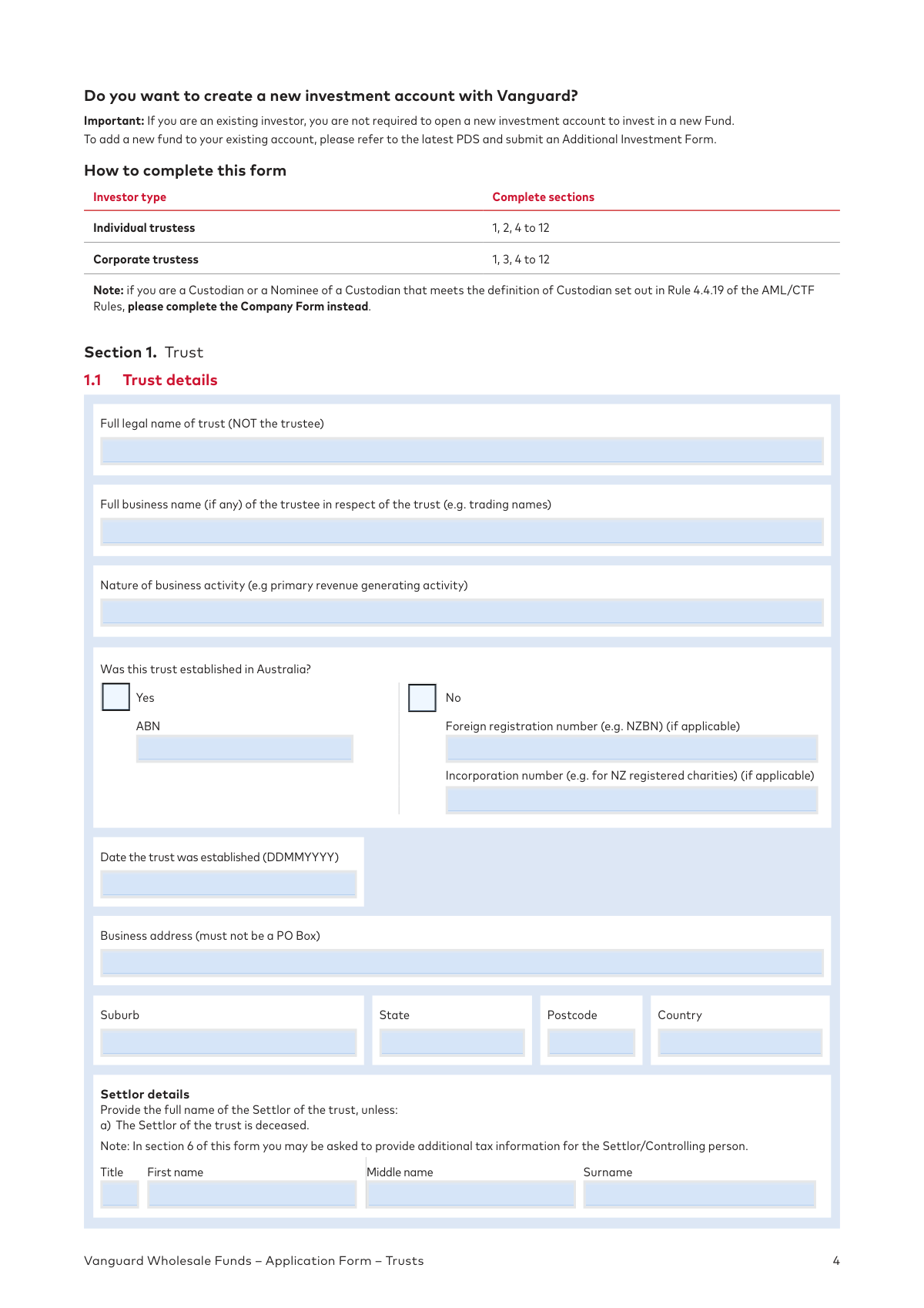
This form is an application for Australian regulated trusts and certain foreign trusts (New Zealand only) to open an investment account in Vanguard Wholesale Funds. It is essential for establishing the legal and financial framework of the investment, collecting detailed information about the trust, trustees, beneficiaries, and controlling persons to comply with Anti-Money Laundering (AML), tax (FATCA/CRS), and other regulatory requirements. Today, this form can be filled out quickly and accurately using AI-powered services like Instafill.ai, which can also convert non-fillable PDF versions into interactive fillable forms.
Our AI automatically handles information lookup, data retrieval, formatting, and form filling.
It takes less than a minute to fill out WSAFCOMP_22026 using our AI form filling.
Securely upload your data. Information is encrypted in transit and deleted immediately after the form is filled out.
Form specifications
| Form name: | Vanguard Wholesale Funds – Application Form – Trusts |
| Number of pages: | 1 |
| Language: | English |
| Categories: | trust forms, Vanguard forms |
Instafill Demo: How to fill out PDF forms in seconds with AI
How to Fill Out WSAFCOMP_22026 Online for Free in 2026
Are you looking to fill out a WSAFCOMP_22026 form online quickly and accurately? Instafill.ai offers the #1 AI-powered PDF filling software of 2026, allowing you to complete your WSAFCOMP_22026 form in just 37 seconds or less.
Follow these steps to fill out your WSAFCOMP_22026 form online using Instafill.ai:
- 1 Navigate to Instafill.ai and upload the Vanguard Wholesale Funds Application Form for Trusts.
- 2 Use the AI assistant to automatically populate Section 1 with the trust's legal name, ABN, establishment date, address, and settlor details.
- 3 Complete the relevant trustee sections (Section 2 for individuals or Section 3 for corporate trustees), providing details for all directors, beneficial owners, or senior managing officials as prompted.
- 4 Fill in the tax information in Sections 4, 5, and 6, including the trust's TFN/ABN and FATCA/CRS status for both the trust and its controlling persons.
- 5 In Section 7, select the specific Vanguard funds for your initial investment and indicate whether you want distributions reinvested or credited to your bank account.
- 6 Provide the trust's Australian bank account details in Section 9 for receiving payments from Vanguard.
- 7 Carefully review all sections, digitally sign the declarations in Section 12, and download the completed application, ready to be mailed with the required certified identification documents.
Our AI-powered system ensures each field is filled out correctly, reducing errors and saving you time.
Why Choose Instafill.ai for Your Fillable WSAFCOMP_22026 Form?
Speed
Complete your WSAFCOMP_22026 in as little as 37 seconds.
Up-to-Date
Always use the latest 2026 WSAFCOMP_22026 form version.
Cost-effective
No need to hire expensive lawyers.
Accuracy
Our AI performs 10 compliance checks to ensure your form is error-free.
Security
Your personal information is protected with bank-level encryption.
Frequently Asked Questions About Form WSAFCOMP_22026
This form is used to open a new investment account with Vanguard Wholesale Funds for an Australian regulated trust or a foreign trust from New Zealand. It allows the trust to make an initial investment into one or more funds.
This form should be completed by trustees on behalf of Australian regulated trusts and foreign trusts (New Zealand only). For other investor types or trusts, you should visit the Vanguard website to find the appropriate application method.
Yes, a minimum initial investment of $500,000 per fund is required for applications using this form. This is a key requirement for investing in Vanguard Wholesale Funds.
You must submit certified copies of identification for all trustees and beneficial owners, along with a certified extract of the trust deed. A detailed checklist of required documents is provided at the end of the form.
You must mail the completed and signed application form, along with all required certified documents, to the Vanguard postal address listed on the form. We recommend keeping a copy for your records.
For a corporate trustee, you must provide the company's details (ACN, ABN, address) and information for all directors. You will also need to identify any beneficial owners, who are individuals that ultimately own or control 25% or more of the company.
Providing a TFN is optional. However, if you choose not to provide a TFN or claim a valid exemption, Vanguard is legally required to deduct tax from any income distributions at the highest marginal tax rate.
After submitting your application, you need to call Client Services on 1300 655 102. They will provide you with the specific instructions on how to transfer your initial investment funds to establish the account.
No, if you have an existing investment account, you are not required to open a new one. You can simply use an 'Additional Investment Form' to add a new fund to your existing account.
You must provide the details of an Australian bank account held in the name of the trust. This account is required for Vanguard to make payments to you, such as distributions or withdrawal proceeds.
Controlling Persons are the individuals who exercise control over the trust, which includes all trustees, the settlor, specified beneficiaries, and any appointors. Their tax residency information is required for compliance with global tax reporting standards.
Yes, services like Instafill.ai use AI to help you accurately auto-fill form fields, which saves time and helps prevent errors. You can upload the form and the AI will assist in populating the necessary information.
You can upload the Vanguard form to the Instafill.ai platform to fill it out digitally. After completing the fields with AI assistance, you can then print the populated form for the required physical signatures before mailing it.
If you have a flat, non-fillable PDF, you can use a service like Instafill.ai to instantly convert it into an interactive, fillable form. This allows you to easily type your information into the fields on your computer.
Compliance WSAFCOMP_22026
Validation Checks by Instafill.ai
1
Minimum Initial Investment per Fund
Verifies that the investment amount entered for each selected fund in Section 7 is at least $500,000. This is a mandatory minimum for Vanguard Wholesale Funds. If the amount for any fund is below the threshold, the application will be flagged as invalid and will require correction before it can be processed.
2
Prohibits PO Box for Physical Addresses
Ensures that address fields requiring a physical location (e.g., 'Business address' in Section 1.1, 'Full residential address' in Sections 1.3, 2, and 3) do not contain 'PO Box'. This is a critical requirement for Anti-Money Laundering (AML) and Counter-Terrorism Financing (CTF) regulations for identity verification. An application with a PO Box in a restricted field will be rejected pending correction.
3
Trustee Section Completion Logic
Validates that the applicant has completed either Section 2 (Individual trustees) or Section 3 (Corporate trustee), but not both, based on the trust's structure. This prevents the submission of conflicting or ambiguous information regarding the trustee. An error will be triggered if both sections are filled, or if neither is completed, halting the application process.
4
Bank Account Name Matches Trust Name
Cross-references the 'Account name' provided in the banking instructions (Section 9) with the 'Full legal name of trust' from Section 1.1. The names must match to ensure compliance with financial regulations and to guarantee payments are directed to the correct legal entity. A mismatch will halt the application and require manual verification or correction to prevent fraud and payment errors.
5
Australian Bank Account Format Validation
Checks that the BSB and Account Number in Section 9 are in a valid format for an Australian financial institution. The BSB must be a 6-digit number corresponding to a registered institution. This validation is essential for the successful electronic processing of distributions and withdrawals; an invalid number will cause payment failure and delay account setup.
6
Date Format and Logical Validity
Confirms that all date fields (e.g., 'Date the trust was established', 'Date of birth') are in the specified DDMMYYYY format and represent a real, logical date. For instance, a date of birth cannot be in the future, and the trust establishment date must precede the application date. This ensures data integrity for legal, tax, and identity verification purposes, and failure will require immediate correction.
7
ABN/ACN Format and Checksum Validation
Validates that any Australian Business Number (ABN) or Australian Company Number (ACN) entered on the form adheres to the official format and passes the respective checksum algorithm. This is a first-level check to catch typographical errors and ensure the identifier is plausible before it is verified against government databases. An invalid number will cause the application to fail AML/CTF checks.
8
Beneficial Ownership Declaration Logic
Verifies that the complex logic in Section 3.5 for a corporate trustee is followed correctly. It ensures that if 'No' is answered for both questions regarding beneficial owners (3.5 A and B), then the details for a 'Senior Managing Official' in Section 3.5.3 must be provided. This is a critical AML/CTF requirement to identify a controlling person; failure to complete this section correctly will result in application rejection.
9
TIN Absence Justification
Ensures that for any non-Australian tax residency declared in Sections 5 or 6, either a Tax Identification Number (TIN) is provided or a valid reason (A, B, or C) is selected for its absence. If Reason B ('unable to obtain a TIN') is chosen, the system must also confirm that the corresponding explanation field is not empty. This is a strict requirement for FATCA and CRS reporting compliance, and incomplete information will cause the application to be rejected.
10
Conditional Requirement for Controlling Person Tax Details
This check ensures that if the trust is identified as a 'Passive Non-Financial Entity' in Section 5, then Section 6 ('Additional tax information – Controlling person') must be completed. This is a core requirement of the Common Reporting Standard (CRS) to identify the tax residencies of the individuals who ultimately control the entity. An application will be rejected if this section is required but left blank.
11
Required Signatures Verification
Checks that the number of signatures provided in Section 12.1 corresponds to the legal requirements for the entity type. For example, it verifies that all individual trustees listed in Section 2 have signed, or that at least two directors have signed for a corporate trustee. A missing signature renders the entire application legally invalid and will cause it to be returned.
12
Distribution Instruction and Bank Details Consistency
Validates that for every fund with an investment amount in Section 7, a distribution method is selected. If 'Credit bank account' is chosen for any fund, this check also confirms that bank account details in Section 9 have been fully completed. This prevents ambiguity in handling distributions and avoids payment failures due to missing bank information.
13
Trust Jurisdiction Eligibility
Validates that if the 'Was this trust established in Australia?' checkbox in Section 1.1 is marked 'No', the country of origin is New Zealand. The form explicitly states it is for 'Australian regulated trusts and foreign trusts (New Zealand only)'. This check prevents ineligible foreign entities from applying through the incorrect channel, ensuring regulatory compliance.
14
Valid Occupation Selection
Verifies that the value entered in any 'Occupation' field (for trustees, directors, beneficial owners, etc.) is one of the specific options listed in Appendix A. This standardizes data collection for risk assessment and reporting. An invalid or free-text entry would be flagged for correction to ensure data quality and consistency.
Common Mistakes in Completing WSAFCOMP_22026
In Section 1.1, applicants are required to enter the 'Full legal name of trust (NOT the trustee)'. A frequent error is entering the name of the individual or corporate trustee instead. This happens because people often use the trustee's name in day-to-day business. An incorrect entity name will cause the application to be rejected as it fails fundamental identity verification against the trust deed.
Section 3.5, which deals with identifying beneficial owners, is extremely complex and a common source of errors. Applicants often misunderstand the requirement to identify any individual who owns or controls 25% or more of the company, especially when ownership is indirect through other entities. This can lead to incomplete or incorrect information, delaying the application due to Anti-Money Laundering (AML) compliance checks. Applicants must carefully trace the ownership structure or nominate a Senior Managing Official if no individual meets the threshold.
The form requires multiple supporting documents, such as a certified copy of the Trust Deed extract and identification for all related parties, as detailed in the final checklist. Common mistakes include forgetting to attach a document, providing a photocopy instead of a certified copy, or using a certifier who is not eligible. These omissions or errors will halt the application process until the correct, properly certified documents are received.
Section 9 explicitly requires Australian bank account details to be in the name of the trust itself, not the trustee or a beneficiary. Applicants may mistakenly provide a personal account or the corporate trustee's main business account out of habit. This will lead to rejection or delays in processing payments and distributions, as the account name must match the investing entity for compliance and security reasons.
Section 7 clearly states that the initial investment must be a minimum of $500,000 per fund. Applicants sometimes overlook this requirement and enter a smaller amount, which will result in the application being rejected. It is crucial to ensure the amount entered for each selected fund meets or exceeds this wholesale investment minimum.
Section 12 has very specific signature requirements: all individual trustees must sign, or for a corporate trustee, at least two directors must sign. A common mistake is having only one person sign when multiple are required, or using a stamped signature which is explicitly forbidden. An incorrect or incomplete signature invalidates the entire legal declaration and will cause the application to be returned.
Multiple sections, including those for the trust's business address and the residential addresses of trustees and directors, explicitly state 'must not be a PO Box'. Applicants often enter a PO Box out of convenience, but this is not acceptable for AML/CTF verification, which requires a physical location. This simple data entry error will require correction and resubmission, delaying account opening.
Sections 5 and 6 require the applicant to self-certify the trust's tax status under FATCA and CRS rules, using terms like 'Active NFE' or 'Passive NFE'. These classifications are technical and often misunderstood, leading to incorrect selections. An error here can lead to incorrect tax reporting to the ATO and other tax authorities, creating future compliance issues for the trust.
When a trust has multiple individual trustees (Section 2) or a corporate trustee has multiple directors (Section 3.3), the form requires details for all of them. Applicants sometimes only provide the details for the primary contact or one director, assuming that is sufficient. This incomplete information will fail verification checks, and the application will be put on hold until details for all required individuals are provided.
The checklist on page 27 outlines a comprehensive list of required documents, including Trust Deed extracts, company extracts from ASIC, and personal identification. A frequent mistake is simply forgetting to collate and attach all the necessary paperwork before mailing the form. Since this form is a non-fillable PDF, ensuring all physical documents are correctly certified and included is a manual process prone to error, which can be simplified using tools like Instafill.ai that can digitize the form and manage document checklists.
Saved over 80 hours a year
“I was never sure if my IRS forms like W-9 were filled correctly. Now, I can complete the forms accurately without any external help.”
Kevin Martin Green
Your data stays secure with advanced protection from Instafill and our subprocessors

Robust compliance program
Transparent business model
You’re not the product. You always know where your data is and what it is processed for.
ISO 27001, HIPAA, and GDPR
Our subprocesses adhere to multiple compliance standards, including but not limited to ISO 27001, HIPAA, and GDPR.
Security & privacy by design
We consider security and privacy from the initial design phase of any new service or functionality. It’s not an afterthought, it’s built-in, including support for two-factor authentication (2FA) to further protect your account.
Fill out WSAFCOMP_22026 with Instafill.ai
Worried about filling PDFs wrong? Instafill securely fills vanguard-wholesale-funds-application-form-trusts forms, ensuring each field is accurate.