
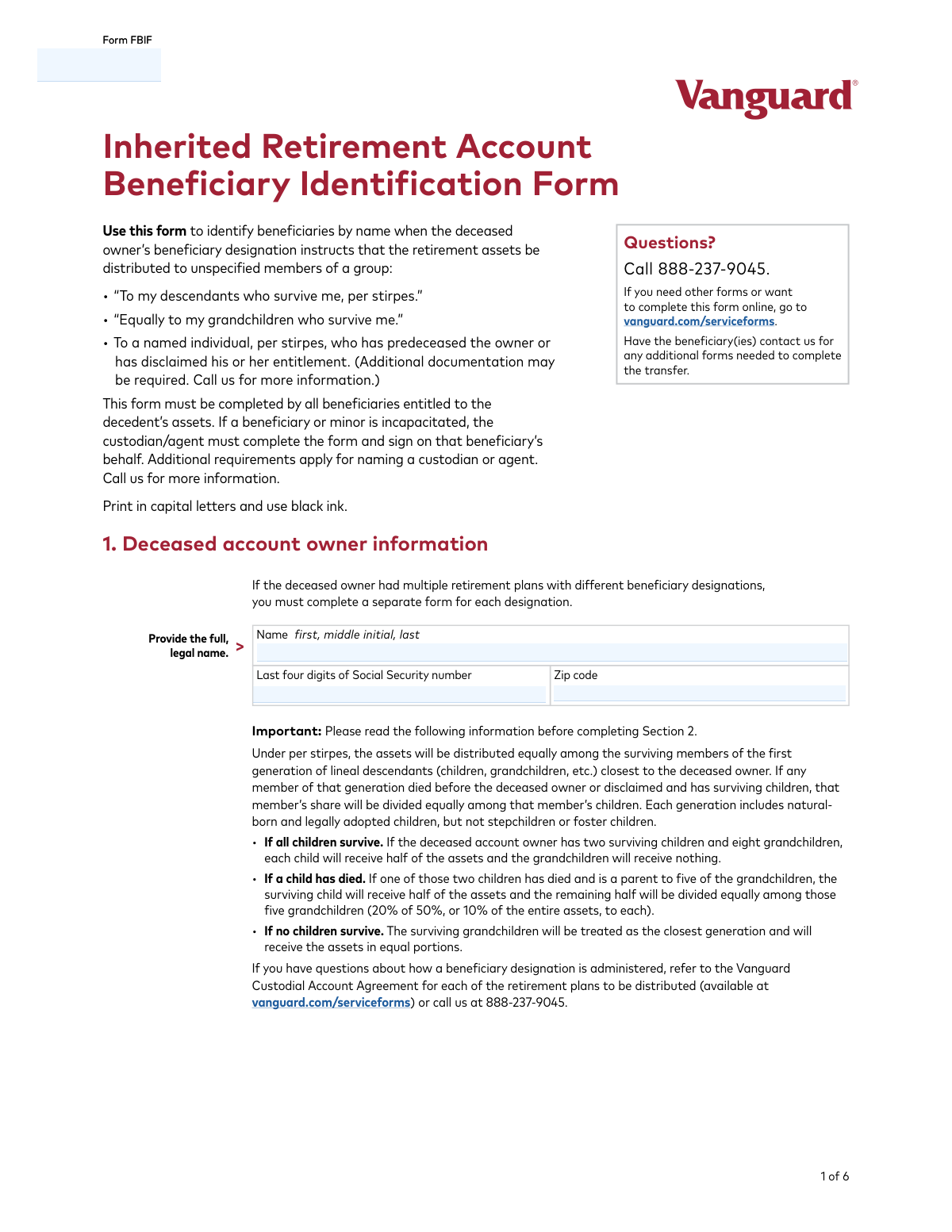
Yes! You can use AI to fill out Inherited Retirement Account Beneficiary Identification Form
Don't type 118 fields by hand. Tell our AI about yourself, or upload a document you already have, and it fills every field in seconds. You check it, then download, print or sign.
The AI does the filling. You just check it.
No typing into boxes, nothing to install.
What this form asks for
The AI fills all of it, from your answers or your documents.
The AI checks your answers before you download
13 checks built for this form, so a wrong date or a missing answer is caught before anyone else sees it.
This check ensures that the 'Last four digits of Social Security number' field in Section 1 contains exactly four numeric digits. This is critical for correctly identifying the deceased owner's account in the system. If the field contains non-numeric characters, or fewer or more than four digits, the form submission will be rejected for correction.
Validates that only one of the three beneficiary identification options (A, B, or C) in Section 2 has been completed. The form's logic requires a single, clear instruction for asset distribution. If more than one section is filled out, it creates ambiguity, and the form will be returned to the sender for clarification.
This check verifies that all date fields on the form (Date of birth, Date of death, Signature date) are entered in the 'mm/dd/yyyy' format and represent a valid calendar date. Incorrect or invalid dates can cause significant processing errors and legal issues. A failure will halt processing until the dates are corrected.
For any individual listed with both a date of birth and a date of death, this validation ensures the date of death is chronologically after the date of birth. This is a fundamental logical check to prevent data entry errors. A discrepancy would render the information invalid and require correction before the form can be processed.
This check determines if a beneficiary is a minor based on their date of birth relative to the submission date. If a beneficiary is identified as a minor, the system verifies that the 'If a minor, name of custodian' field is completed for that beneficiary. This is a legal requirement to ensure assets for a minor are managed by an authorized adult, and failure to provide this information will stop the transfer.
This validation cross-references the living beneficiaries listed in Section 2 with the signatures provided in Section 3. It ensures that every living beneficiary (or their authorized representative) has signed the form. Missing signatures can invalidate the entire certification, so the form will be considered incomplete until all required signatures are present.
And 7 more checks
- Signature Date is Not in the Future
- Per Stirpes Grandchild Table Trigger (Sec 2A/2C)
- Deceased Individual Cannot Be a Signatory
- Parent Name Requirement for Grandchildren
- Section 2C Named Individual Completeness
- Deceased Owner Information Completeness
- Beneficiary List is Not Empty
Let AI fill out your FBIF
No typing. Every field filled in seconds, checked, ready to sign.
How to Fill Out FBIF Online for Free in 2026
What the AI walks you through.
- Navigate to Instafill.ai and upload the FBIF form or select it from their template library.
- Provide the deceased account owner's information in Section 1, including their full name and the last four digits of their Social Security number.
- Use the AI assistant to determine which part of Section 2 to complete (A, B, or C) based on the deceased's specific beneficiary designation.
- Enter the required details for all beneficiaries, including names, dates of birth, and dates of death where applicable. The AI can help structure the information correctly, especially for complex 'per stirpes' distributions.
- Carefully review all the information auto-populated by the AI to ensure every name and date is correct.
- Proceed to Section 3, where all identified beneficiaries must sign and date the certification.
- Download the completed, signed form and mail it to the appropriate Vanguard address provided on the form.
Frequently Asked Questions About FBIF
Is it really free for 7 days?
Can I fill other forms too?
How do I cancel?
How does the AI fill out FBIF?
What happens to my information?
How complex is FBIF to fill out?
What is the purpose of the Inherited Retirement Account Beneficiary Identification Form?
Who is required to complete and sign this form?
The form mentions 'per stirpes'. What does that mean?
How do I know which part of Section 2 (A, B, or C) to fill out?
What information is needed if one of the owner's children is deceased?
How do I fill out the form for a beneficiary who is a minor?
Are other forms required besides this one?
Where do I mail the completed Form FBIF?
What if the deceased had multiple retirement plans with different beneficiaries?
Are stepchildren or foster children considered beneficiaries on this form?
Who needs to sign the certification in Section 3?
Can I use an AI tool to help me fill out this form?
How can I fill out this form online?
The PDF I downloaded from the website is not fillable. What should I do?
Get your FBIF filled out by AI
$0 today. Cancel before Nov 1 and you pay nothing.
Other forms like this one
beneficiary forms: Form I-130A, Supplemental Info for Spouse Beneficiary, Affidavit and Representations Regarding Next of Kin (Preference Beneficiary Affidavit) (The Hartford) – Form LC-7086-17, VA Form 21-0788, Information Regarding Apportionment of Beneficiary's Award, California Schedule K-1 (541) (2025), Beneficiary’s Share of Income, Deductions, Credits, etc., Form I-130A, Supplemental Information for Spouse Beneficiary, Fidelity Investments® Beneficiary Distribution Form, Fidelity Investments 403(b) Beneficiary Designation, Fidelity Advisor IRA Beneficiary Designation, Fidelity Investments Qualified Plan Beneficiary Designation, Fidelity Investments 403(b)/401(a) Beneficiary Designation, The Church of the Nazarene 403(b) Retirement Savings Plan Beneficiary Designation Form, Fidelity Investments Qualified Plan Beneficiary Designation, IRA/HSA Beneficiary Designation, Fidelity IRA Beneficiary Distribution — Charity, Foundation, or a University, Designated Beneficiary Plan Agreement, Designated Beneficiary Plan Agreement, Beneficiary Designation Form For IRA and 403(b)(7) Accounts, Designated Beneficiary Plan Agreement, IRA Beneficiary Designation Form, Stock Power Form For transferring shares, changing names, or adding a beneficiary
identification forms: W-9, Request for Taxpayer Identification Number and Certification, Form W-10, Dependent Care Provider’s Identification, Form SS-4 (Rev. December 2025), Application for Employer Identification Number, ROTC Cadet Academic Plan / Degree and Credit Hour Worksheet (Student Identification, Term-by-Term Courses, GPA Summary, and Completion Certification), Form W-9, Request for Taxpayer Identification Number and Certification, Form 40-5122, Travel License / Identification Application, Form D1, Driver License, Permit or Identification Card Transaction Application, Form W-9, Request for Taxpayer Identification Number and Certification, AML/CTF Investor Identification Information Form, Form 478, Application for Alaska Driver License, Permit or Identification Card, Form 630, Individual Identification Information Record, Form 631, Corporation/Entity Identification Information Record, Form SS241 - Referee's Report - Identification of a claimant, Form W-9, Request for Taxpayer Identification Number and Certification, Form DL 142, Request for Cancellation or Surrender of a Driver License or ID
retirement forms: Form SSA-1-BK, Application for Retirement Benefits, Form 8880, Credit for Qualified Retirement Savings Contributions, Nationwide Retirement Solutions Participant Distribution Request Form (PNF-0875M9, TRAC Version, 01/2025), Nationwide Retirement Solutions Participant Distribution Request Form (PNF-0875M9, TRAC Version, 01/2025), Momentum Wealth Retirement Income Option Application (WIS060E), Fidelity Investment-Only (Non-Prototype) Retirement Account Application, One-Time Withdrawal — Defined Contribution Retirement Plan, Fidelity One-Time Withdrawal Form — Nonretirement, One-Time Withdrawal – Investment-Only (Non-Prototype) Retirement Account, Automatic Withdrawals—Defined Contribution Retirement Plan, Fidelity Automatic Withdrawals — Nonretirement, Beneficiaries — Nonretirement Transfer on Death, The Church of the Nazarene 403(b) Retirement Savings Plan Beneficiary Designation Form, Beneficiaries – Defined Contribution Retirement Plan, Transfer Shares as a Gift — Nonretirement, Schwab Personal Choice Retirement Account® (PCRA) Limited Power of Attorney (LPOA) Form For a Participant, Vanguard Asset Transfer Authorization Form for the Emory University Retirement Plan, Retirement Transfer Between Existing Vanguard Accounts, Gift of Nonretirement Assets to Existing Vanguard Account Form, Vanguard Taking a Loan from Your Retirement Plan
retirement account forms: Fidelity Investment-Only (Non-Prototype) Retirement Account Application, Fidelity Investment-Only (Non-Prototype) Retirement Account Application, One-Time Withdrawal – Investment-Only (Non-Prototype) Retirement Account, Schwab Personal Choice Retirement Account® (PCRA) Limited Power of Attorney (LPOA) Form For a Participant, Retirement Transfer Between Existing Vanguard Accounts, Gift of Nonretirement Assets to Existing Vanguard Account Form, Account Reduction Loan Application 401(a) Plan, Electrical Workers Local Union No. 369 Retirement Plan, 401(k) Retirement Account Conversion to Empower Frequently Asked Questions, Housing Agency Retirement Trust Form #190, Request to Withdraw a Rollover Account, ADP Retirement Services: Your retirement account and the C.A.R.E.S. Act, ADP IMPORTANT INFORMATION: Your retirement account and the C.A.R.E.S. Act, Request for a Qualified Charitable Distribution (QCD) from a Brokerage Individual Retirement Account (IRA), Request for qualified charitable distribution from individual retirement account, Request for a Charitable Distribution from an Individual Retirement Account (IRA), Voya Investment Management Traditional, Roth, Rollover, and SEP Individual Retirement Account (IRA) Application and Adoption Agreement, Individual Retirement Account (IRA) Distribution Request Form, SIMPLE Individual Retirement Account (IRA) Distribution Request Form, Authorization to transfer funds from a bank retirement account, Qualified Retirement Plan and 403(b)(7) Custodial Account Distribution Request Form, Individual Retirement Account (IRA) — Qualified Charitable Distribution Form
Let AI fill out your FBIF
Your trial starts once a card is added. You pay nothing before Nov 1.
Our AI already knows this form, all 118 fields of it. Skip the typing: tell it about yourself, or upload what you have, and it fills the whole form in seconds.
- AI fills every field on all 6 pages, checkboxes included
- No typing into boxes: answer a few questions, or upload a document you already have, an old copy of this form, a photo of a document
- The AI checks the answers; you review and change anything before you download
- Download the finished PDF, print it, or sign it online
- Encrypted, and never used to train AI
Cancel before Nov 1 and you pay nothing.
A card is needed to start the trial. Cancel in two clicks from your account.
Terms · Privacy