Yes! You can use AI to fill out Designated Beneficiary Plan Agreement
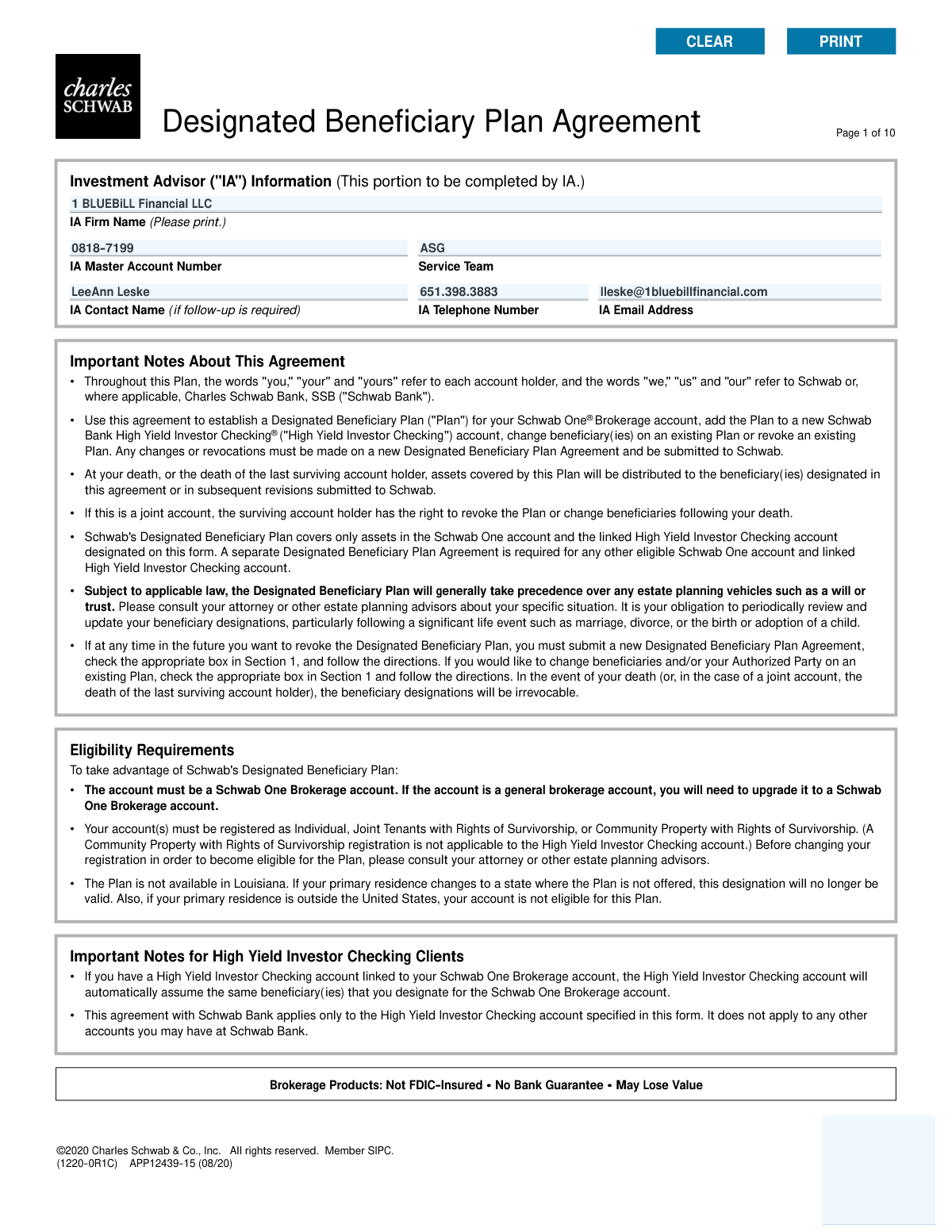
The Designated Beneficiary Plan Agreement is a form provided by Charles Schwab to allow account holders to name beneficiaries for their Schwab One® Brokerage and linked High Yield Investor Checking® accounts. This arrangement, also known as Transfer on Death (TOD) or Payable on Death (POD), facilitates the direct transfer of assets upon the account holder's death, potentially avoiding probate. Today, this form can be filled out quickly and accurately using AI-powered services like Instafill.ai, which can also convert non-fillable PDF versions into interactive fillable forms.
APP12439-15 is part of the
beneficiary forms, estate planning forms, retirement account forms and financial planning forms categories on Instafill.
Rather not fill this in by hand? Instafill is an online form filler that completes PDF forms automatically — upload the blank form, answer a few questions, and the AI fills every field.
Form specifications
| Form name: | Designated Beneficiary Plan Agreement |
| Number of pages: | 1 |
| Language: | English |
Our AI automatically handles information lookup, data retrieval, formatting, and form filling.
It takes less than a minute to fill out APP12439-15 using our AI form filling.
Securely upload your data. Information is encrypted in transit and deleted immediately after the form is filled out.
Instafill Demo: How to fill out PDF forms in seconds with AI
How to Fill Out APP12439-15 Online for Free in 2026
Are you looking to fill out a APP12439-15 form online quickly and accurately? Instafill.ai offers the #1 AI-powered PDF filling software of 2026, allowing you to complete your APP12439-15 form in just 37 seconds or less.
Follow these steps to fill out your APP12439-15 form online using Instafill.ai:
- 1 Navigate to Instafill.ai and upload or select the Designated Beneficiary Plan Agreement form.
- 2 If applicable, have your Investment Advisor (IA) complete the IA Information section at the top of the form.
- 3 In Section 1, check the box corresponding to the action you want to take (e.g., 'Add a new Plan'). Complete Section 2 with your account registration type and personal/account information.
- 4 In Section 5, provide detailed information for your Primary and Contingent Beneficiaries, including their names, relationship, SSN/TIN, and the percentage portion of assets they should receive.
- 5 Optionally, select a 'Per Stirpes' or 'Per Capita' distribution method in Section 5 and designate an 'Authorized Party' in Section 6 to help identify beneficiaries.
- 6 Complete Section 7 to provide directions for the distribution of assets to any minor beneficiaries, including designating a custodian if necessary.
- 7 Review all entered information for accuracy, then proceed to Section 8 to e-sign and date the agreement, authorizing your beneficiary designations.
Our AI-powered system ensures each field is filled out correctly, reducing errors and saving you time.
Why Choose Instafill.ai for Your Fillable APP12439-15 Form?
Speed
Complete your APP12439-15 in as little as 37 seconds.
Up-to-Date
Always use the latest 2026 APP12439-15 form version.
Cost-effective
No need to hire expensive lawyers.
Accuracy
Our AI performs 10 compliance checks to ensure your form is error-free.
Security
Your personal information is protected with bank-level encryption.
Frequently Asked Questions About APP12439-15
This form is used to establish, change, or revoke a Designated Beneficiary Plan for your Schwab One® Brokerage account and a linked High Yield Investor Checking® account. This plan, also known as a Transfer on Death (TOD) or Payable on Death (POD) arrangement, dictates who will inherit the account assets upon your death.
Only Schwab One® Brokerage accounts registered as Individual, Joint Tenants with Rights of Survivorship, or Community Property with Rights of Survivorship are eligible. The plan is not available for residents of Louisiana or those living outside the United States.
To make any changes, including adding, changing, or revoking beneficiaries, you must complete and submit a new Designated Beneficiary Plan Agreement form. This new form will supersede all previous designations for the specified account.
Yes, for the accounts listed on this form, the beneficiary designation will generally take precedence over instructions in your will or trust. It is highly recommended to consult an estate planning advisor to ensure this aligns with your overall wishes.
These options determine how assets are distributed if a beneficiary predeceases you. 'Per stirpes' means a deceased beneficiary's share passes to their children, while 'per capita' can result in a different distribution among descendants if all primary beneficiaries are deceased. Review the examples in Section 4 and consult an attorney for guidance.
An Authorized Party is a person you designate to help Schwab locate and identify your beneficiaries after your death. This person's certification is required if you select a 'per stirpes' or 'per capita' distribution.
Section 7 allows you to appoint a custodian to manage the assets for a minor beneficiary under the Uniform Transfers to Minors Act (UTMA). If you do not appoint a custodian, a court may need to appoint a guardian to manage the minor's inheritance.
You must provide the beneficiary's full name, relationship, Social Security or Tax ID number, date of birth, and contact information. You also need to specify the percentage of assets they will receive, ensuring the total adds up to 100% for each beneficiary type (primary and contingent).
No, life events such as divorce or marriage do not automatically change your beneficiary designations. You must submit a new form to officially remove a former spouse as a beneficiary.
The completed form, signed by all account holders, must be submitted to Charles Schwab to be effective. You can typically provide it to your Investment Advisor or mail it to the address they provide.
Yes, services like Instafill.ai use AI to auto-fill form fields accurately and save time. These tools can help reduce errors by populating your information from various sources.
You can upload the PDF to Instafill.ai, which will make the form interactive. You can then type your information directly into the fields, e-sign, and download the completed document for submission.
If you have a flat, non-fillable PDF, you can use a tool like Instafill.ai to convert it into an interactive form. This allows you to easily type in your information instead of printing and filling it out by hand.
Compliance APP12439-15
Validation Checks by Instafill.ai
1
Exclusive Agreement Action Selection
This check ensures that in Section 1, 'Agreement Action', only one of the four available options is selected. The form explicitly states 'Check only one,' and selecting multiple actions would create ambiguity in how to process the agreement. If more than one option is checked, the form submission should be rejected with an error message prompting the user to select a single action.
2
Primary Residence Eligibility Check
This validation verifies that the account holder's primary residence, as indicated in Section 2, is not in Louisiana or outside the United States. The form's eligibility requirements state that the plan is not available in these locations. If the address is in an ineligible location, the submission must be blocked to prevent the creation of an invalid plan.
3
P.O. Box Address Restriction
This check validates that the 'Home Street Address' for both the account holder in Section 2 and the Authorized Party in Section 6 is a physical address and not a P.O. box. The form explicitly states 'no P.O. boxes, please,' which is a standard requirement for financial accounts for identity verification purposes (CIP). A submission with a P.O. box should be flagged for correction.
4
Primary Beneficiary Portions Sum to 100%
This validation ensures that the sum of all 'Portion %' fields for all designated Primary Beneficiaries in Section 5 equals exactly 100%. This is critical to ensure the complete and unambiguous distribution of account assets. If the total is not 100%, the form is incomplete and must be returned to the user for correction before it can be processed.
5
Contingent Beneficiary Portions Sum to 100%
Similar to the primary beneficiary check, this validation ensures the 'Portion %' fields for all designated Contingent Beneficiaries in Section 5 sum to exactly 100%. This prevents ambiguity in the event that all primary beneficiaries predecease the account holder. A failure to sum to 100% would require user correction to ensure proper asset allocation.
6
Beneficiary SSN/TIN Format Validation
This check verifies that the 'Social Security/Tax ID Number' provided for each beneficiary in Section 5 adheres to the standard format for an SSN (XXX-XX-XXXX) or a Tax ID Number (XX-XXXXXXX). Correct identification numbers are essential for tax reporting and for accurately identifying the beneficiary upon the account holder's death. An invalid format should trigger an error.
7
Beneficiary Date of Birth/Trust Date Format
This validation confirms that the 'Date of Birth/Trust Date' for each beneficiary in Section 5 is a valid date and follows the MM/DD/YYYY format. This date is crucial for identifying the beneficiary, determining if they are a minor, and distinguishing between individuals and trusts. An invalid date format would prevent proper processing.
8
Beneficiary Name vs. Entity Exclusivity
This check ensures that for each beneficiary in Section 5, information is provided for either an individual (First/Last Name) or an entity (Trust/Organization/Estate), but not both. The selection should logically correspond to the 'Relationship' chosen. This prevents data entry conflicts and ensures the beneficiary is clearly and correctly identified as either a person or an entity.
9
Joint Account Holder Signature Requirement
This validation confirms that if the 'Type of Registration' in Section 2 is 'Joint Tenants with Rights of Survivorship' or 'Community Property with Rights of Survivorship,' then the signature and date for the 'Additional Account Holder' in Section 8 are present. The form states 'All account holders must sign,' making this mandatory for joint accounts to be legally valid. A missing signature would render the agreement void.
10
Revocation Action Form Completeness
This check verifies that if 'Revoke an existing Plan' is selected in Section 1, only Section 2 (Account Information) and Section 8 (Account Holder Authorization) are completed, as per the form's instructions. Filling out other sections, like beneficiary designations, would be contradictory to the action of revocation. The system should flag the form if unnecessary sections are filled for a revocation action.
11
Minor Beneficiary Declaration Consistency
This is a logical check that cross-references beneficiary dates of birth in Section 5 with the selection in Section 7. If any beneficiary is identified as a minor based on their DOB, this validation ensures that option A ('None of my designated beneficiaries is a minor') in Section 7 is not selected. This prevents a logical contradiction in the agreement.
12
Custodian Designation for Minor Beneficiaries
This check ensures that if option B is selected in Section 7 ('Please transfer any minor's assets to a Custodial account...'), then the custodian name and the corresponding minor's name are provided. Without this information, Schwab cannot establish the required custodial account, and the instructions for the minor's assets would be incomplete. The form should be rejected if this information is missing.
13
Authorized Party Completeness for Per Stirpes/Capita
This validation ensures that if 'Per Stirpes' or 'Per Capita' is selected in Section 5, then the 'Authorized Party' information in Section 6 is fully completed. The form states that Schwab will require the Authorized Party to identify beneficiaries in this scenario, making their contact information essential for executing the plan. A failure would halt the distribution process.
14
Account Number Validation
This check verifies that the 'Schwab One Brokerage Account Number' in Section 2 is present and conforms to the expected format. This number is the primary key for identifying the account to which the plan applies. If the number is missing or malformed, the entire agreement cannot be linked to the correct account and must be rejected.
Common Mistakes in Completing APP12439-15
Users often make mathematical errors when assigning portions to beneficiaries, resulting in percentages that do not sum to 100% for either the primary or contingent groups. This ambiguity can cause significant delays and legal complications during asset distribution, as Schwab may need to seek legal counsel at the expense of the account. To avoid this, double-check that the percentages for each beneficiary type (Primary and Contingent) add up exactly to 100%. AI-powered tools like Instafill.ai can automatically perform these calculations to prevent summation errors.
Account holders frequently focus only on primary beneficiaries and neglect to designate contingent beneficiaries. If all primary beneficiaries predecease the account holder, the assets will be paid to the account holder's estate, which can trigger a lengthy and costly probate process that this form is designed to avoid. Always designate at least one contingent beneficiary to ensure your assets are distributed according to your wishes without unnecessary legal proceedings. This creates a clear line of succession for your assets.
When naming a minor as a beneficiary, people often overlook Section 7, which requires designating a custodian to manage the assets until the minor reaches the age of majority. Failing to do so means that upon your death, a court-appointed guardian may be required, leading to legal fees, delays, and potential court supervision of the funds. To prevent this, always complete Section 7 and name a trusted custodian for any minor beneficiary. Since this form is a non-fillable PDF, a tool like Instafill.ai can convert it into a fillable version, making it easier to complete all necessary sections accurately.
Simple data entry errors like typos in a beneficiary's name, Social Security Number (SSN), or date of birth are extremely common. This can make it difficult or impossible for Schwab to locate and verify the beneficiary, leading to significant delays in distributing the assets. Always use the beneficiary's full legal name, not a nickname, and carefully verify all identification numbers and dates. Using an AI form filler like Instafill.ai can help by cross-referencing and validating data formats to reduce the chance of such errors.
The form explicitly states in Section 8 that all account holders must sign for the agreement to be valid. On joint accounts, it's a frequent mistake for only one holder to sign, which completely invalidates the beneficiary designation. This oversight means that upon the death of the last account holder, the previous beneficiary designations (or lack thereof) will remain in effect, potentially overriding the intended changes. Ensure all listed account holders provide their signature and date to make the agreement legally binding.
The distinction between 'Per Stirpes' and 'Per Capita' is complex, and the form's two-part selection process in Section 5 is a common point of confusion. Users may check 'Yes' for a beneficiary but forget to select the distribution option at the top of the section, or vice-versa. This can lead to Schwab applying a default rule (per stirpes) that may not match the user's intent. To avoid this, carefully read the definitions and ensure your selections in both parts of Section 5 are consistent and reflect your wishes for how assets should pass to your beneficiaries' children.
In Section 2, users must provide their Schwab One Brokerage Account Number and, if applicable, their High Yield Investor Checking Account Number. Transposing digits or leaving these fields blank is a critical error that will cause the form to be rejected, as Schwab cannot link the beneficiary plan to a specific account. This means your designations will not be put into effect. Always double-check your account statements to ensure the numbers are entered with 100% accuracy. AI tools like Instafill.ai can securely store and accurately populate this repetitive information, preventing such mistakes.
Section 6 asks for an 'Authorized Party' to help identify beneficiaries, which is especially critical if you've chosen a per stirpes or per capita distribution. Many people skip this section, viewing it as optional. However, without a designated Authorized Party, Schwab may have to rely on a court-appointed estate representative to identify heirs, causing delays and legal costs that could have been avoided. Always complete Section 6 to provide a clear point of contact for Schwab.
When designating a trust as a beneficiary, users sometimes enter a shortened or informal name (e.g., 'The Smith Trust') instead of the full, legal name of the trust as it appears on the trust documents. This ambiguity can create legal challenges and require Schwab to request additional documentation to confirm the correct entity, delaying the transfer of assets. It is crucial to enter the full and exact name of the trust and the date the trust was established in the designated fields to ensure a smooth distribution.
The form explicitly states 'no P.O. boxes' for the account holder's home street address in Section 2 and the Authorized Party's address in Section 6. This requirement is for identity verification and legal compliance. Submitting a P.O. Box will lead to the form being rejected, delaying the setup or update of your beneficiary plan. Always provide a valid physical street address where required. Instafill.ai can help by storing address information correctly and flagging fields that have specific format requirements like this.
Saved over 80 hours a year
“I was never sure if my IRS forms like W-9 were filled correctly. Now, I can complete the forms accurately without any external help.”
Kevin Martin Green
Your data stays secure with advanced protection from Instafill and our subprocessors




Robust compliance program
Transparent business model
You’re not the product. You always know where your data is and what it is processed for.
ISO 27001, HIPAA, and GDPR
Our subprocesses adhere to multiple compliance standards, including but not limited to ISO 27001, HIPAA, and GDPR.
Security & privacy by design
We consider security and privacy from the initial design phase of any new service or functionality. It’s not an afterthought, it’s built-in, including support for two-factor authentication (2FA) to further protect your account.
Fill out APP12439-15 with Instafill.ai
Worried about filling PDFs wrong? Instafill securely fills designated-beneficiary-plan-agreement-3 forms, ensuring each field is accurate.
