Yes! You can use AI to fill out Beneficiary Designation 401(a) Plan
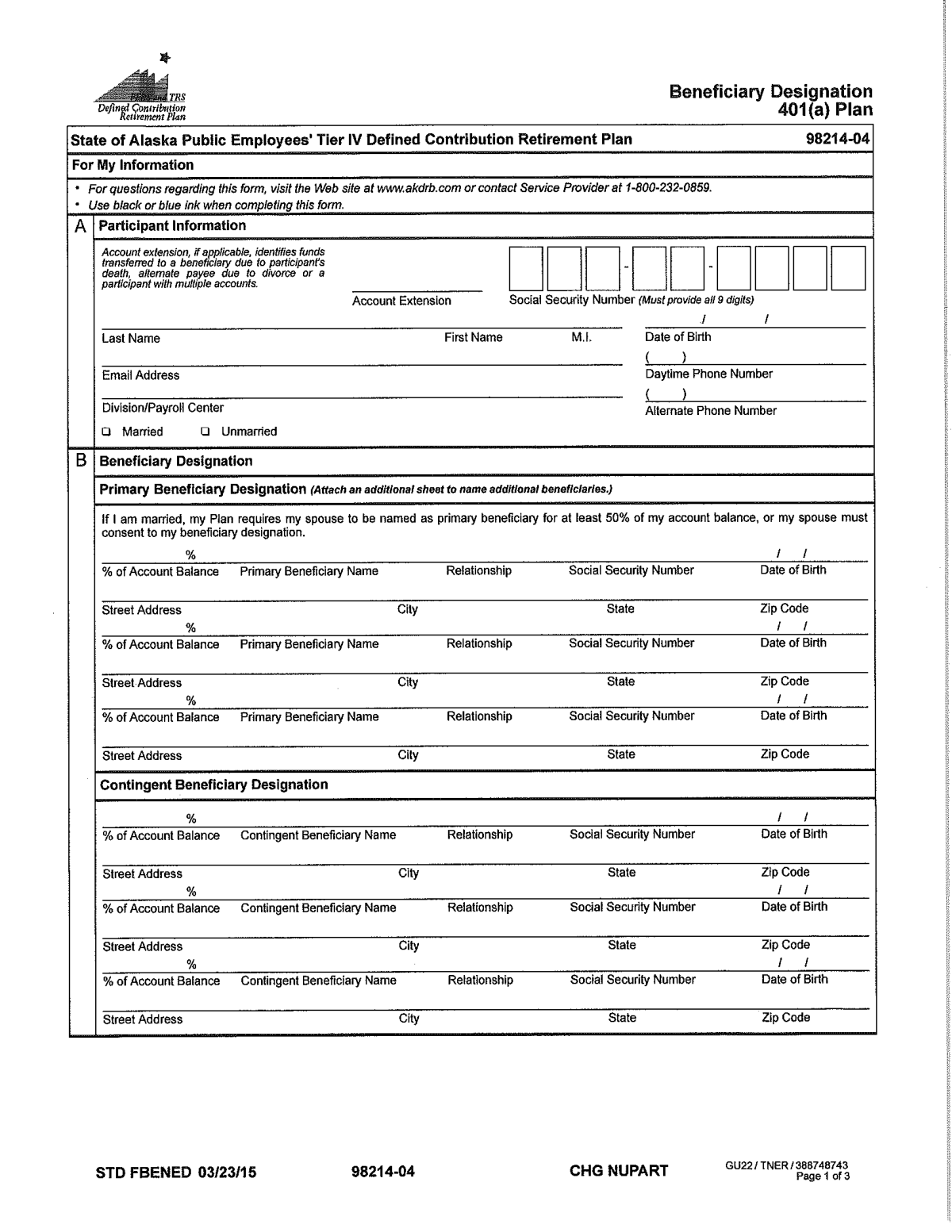
A 401(a) Beneficiary Designation form is a crucial legal document used to officially name the person(s), trust, or entity that will inherit the assets in your 401(a) retirement account upon your death. Properly completing this form ensures your assets are distributed according to your wishes and can help your heirs avoid the complexities and delays of probate court. Today, this form can be filled out quickly and accurately using AI-powered services like Instafill.ai, which can also convert non-fillable PDF versions into interactive fillable forms.
401(a) Beneficiary Designation is part of the
beneficiary forms and beneficiary designation forms categories on Instafill.
Rather not fill this in by hand? Instafill is an online form filler that completes PDF forms automatically — upload the blank form, answer a few questions, and the AI fills every field.
Form specifications
| Form name: | Beneficiary Designation 401(a) Plan |
| Number of pages: | 1 |
| Language: | English |
Our AI automatically handles information lookup, data retrieval, formatting, and form filling.
It takes less than a minute to fill out 401(a) Beneficiary Designation using our AI form filling.
Securely upload your data. Information is encrypted in transit and deleted immediately after the form is filled out.
Instafill Demo: How to fill out PDF forms in seconds with AI
How to Fill Out 401(a) Beneficiary Designation Online for Free in 2026
Are you looking to fill out a 401(A) BENEFICIARY DESIGNATION form online quickly and accurately? Instafill.ai offers the #1 AI-powered PDF filling software of 2026, allowing you to complete your 401(A) BENEFICIARY DESIGNATION form in just 37 seconds or less.
Follow these steps to fill out your 401(A) BENEFICIARY DESIGNATION form online using Instafill.ai:
- 1 Navigate to Instafill.ai and upload your 401(a) Beneficiary Designation form or select it from the template library.
- 2 Provide your personal information, such as your full name, address, and Social Security Number.
- 3 Designate your primary beneficiary(ies), including their full name, relationship, and the percentage of assets each will receive.
- 4 Name your contingent beneficiary(ies), who will receive the assets if the primary beneficiaries are deceased.
- 5 If you are married and not naming your spouse as the primary beneficiary for at least 50% of the balance, complete the spousal consent section, which may require a notary.
- 6 Review all the information entered by the AI for accuracy, then sign and date the form.
- 7 Download, print, and submit the completed form to your plan administrator as instructed.
Our AI-powered system ensures each field is filled out correctly, reducing errors and saving you time.
Why Choose Instafill.ai for Your Fillable 401(a) Beneficiary Designation Form?
Speed
Complete your 401(a) Beneficiary Designation in as little as 37 seconds.
Up-to-Date
Always use the latest 2026 401(a) Beneficiary Designation form version.
Cost-effective
No need to hire expensive lawyers.
Accuracy
Our AI performs 10 compliance checks to ensure your form is error-free.
Security
Your personal information is protected with bank-level encryption.
Frequently Asked Questions About 401(a) Beneficiary Designation
This form allows you to officially name the person(s) or entity who will receive your 401(a) plan assets in the event of your death. Keeping this form updated ensures your assets are distributed according to your wishes.
Every participant in the 401(a) Plan should complete this form to have a valid beneficiary on file. You should submit a new form after major life events like marriage, divorce, or the birth of a child.
Yes, the plan requires that your spouse be named as the primary beneficiary for at least 50% of your account. To designate someone else for that portion, your spouse must provide notarized written consent on the form.
A primary beneficiary is the first in line to receive your account assets. Contingent beneficiaries will only receive the assets if all primary beneficiaries are no longer living at the time of your death.
You will need to provide each beneficiary's full legal name, Social Security Number, date of birth, and relationship to you. This information is critical for ensuring they can be correctly identified.
Yes, you can typically name a trust or your estate as a beneficiary. You will need to provide the full legal name of the trust or estate and its Taxpayer Identification Number (TIN).
A divorce may legally invalidate your designation for your former spouse, but you should not rely on this. It is crucial to submit a new Beneficiary Designation form immediately to reflect your current wishes.
If you do not have a valid beneficiary designation on file, your account balance will be paid out according to the plan's default rules. This usually means payment to your spouse, or if unmarried, to your estate, which may not be what you intended.
After you have completed and signed the form (including any required spousal consent and notarization), you must return it to your plan administrator or HR department. Check the form's instructions for the correct mailing address or submission portal.
Yes, if you are married and are not naming your spouse as the primary beneficiary for at least 50% of your account, your spouse's signature giving consent must be witnessed by a Notary Public.
Yes, services like Instafill.ai use AI to accurately auto-fill form fields, which saves time and helps prevent common errors. This is useful for entering personal details quickly and correctly.
To fill this form online, upload the PDF to the Instafill.ai platform. The AI will make the document interactive, allowing you to type your information, add your e-signature, and download the completed form.
If you have a non-fillable or 'flat' PDF, you can use a tool like Instafill.ai. Simply upload the file, and it will be automatically converted into an interactive, fillable form that you can complete on your device.
Compliance 401(a) Beneficiary Designation
Validation Checks by Instafill.ai
1
Primary Beneficiary Percentage Summation
This check verifies that the percentage shares assigned to all primary beneficiaries sum to exactly 100%. This is critical to ensure the entire account balance is fully and unambiguously allocated upon the participant's death. A failure in this validation would make the designation invalid, requiring correction to prevent legal disputes or processing delays.
2
Spousal Beneficiary Minimum Percentage for Married Participants
Validates that if the participant's marital status is 'Married', their spouse is designated as a primary beneficiary for at least 50% of the account balance. This rule is often a requirement under federal law (ERISA) to protect spousal rights. If this condition is not met, the form is only valid if spousal consent is provided.
3
Spousal Consent Requirement Validation
If a married participant designates less than 50% of the account to their spouse, this check ensures the spousal consent section of the form is properly completed and signed. This signed consent acts as a legal waiver of the spouse's rights to a portion of the assets. Without this consent, the beneficiary designation is legally invalid and cannot be processed.
4
Participant Social Security Number (SSN) Format
Ensures the participant's SSN is present and follows the valid 9-digit format (XXX-XX-XXXX or XXXXXXXXX). The SSN is the primary unique identifier for the participant's account. An invalid or missing SSN would prevent the form from being matched to the correct 401(a) plan account, rendering it unprocessed.
5
Contingent Beneficiary Percentage Summation
This validation confirms that the total percentage shares allocated to all contingent beneficiaries add up to exactly 100%. Contingent beneficiaries only inherit if all primary beneficiaries are deceased, and a 100% total ensures a clear distribution plan in that scenario. An incorrect sum would create ambiguity and require correction.
6
Completeness of Beneficiary Information
For each beneficiary listed (primary or contingent), this check ensures that all required fields such as full name, relationship, and percentage share are filled out. Missing information can make it difficult or impossible to locate and verify a beneficiary when it is time to distribute the assets. This prevents significant processing delays and potential legal challenges.
7
Date of Birth Validity and Plausibility
Verifies that all date of birth fields for the participant, spouse, and all beneficiaries contain a valid calendar date that is in the past. This data helps confirm the identity of each individual and is essential for administrative and compliance purposes. An impossible date, such as one in the future, indicates a data entry error that must be fixed.
8
Participant Signature and Date Presence
Confirms that the participant's signature field is not empty and that the signature date is provided. A signature is a legal attestation that the designations are correct and intentional. A missing signature or date renders the entire document legally invalid and unenforceable.
9
Beneficiary SSN/TIN Format and Presence
This check verifies that a valid Social Security Number (SSN) or Taxpayer Identification Number (TIN) is provided for each named beneficiary. This identifier is crucial for tax reporting purposes and for positively identifying the correct individual. Missing or incorrectly formatted numbers will cause downstream processing and tax compliance failures.
10
Marital Status Declaration Completeness
Validates that the participant has made a selection for their marital status (e.g., 'Married', 'Single'). This field is mandatory because it dictates whether the spousal beneficiary and consent rules apply. Failure to declare a marital status makes it impossible to determine the form's compliance with legal requirements.
11
Uniqueness of Primary and Contingent Beneficiaries
This check ensures that the same individual is not listed as both a primary and a contingent beneficiary. This is a logical error, as contingent beneficiaries only inherit if all primary beneficiaries are unable to. Such a designation creates confusion and must be corrected to clarify the participant's intent for the order of inheritance.
12
Exclusion of Participant as a Beneficiary
This validation ensures the participant has not listed themselves as a primary or contingent beneficiary. An account holder cannot be their own beneficiary, as the assets are distributed upon their death. Listing oneself is a logical error that would make the designation invalid and must be corrected.
Common Mistakes in Completing 401(a) Beneficiary Designation
Married participants often overlook rules requiring their spouse to be the primary beneficiary for a minimum percentage (e.g., 50%) or requiring notarized spousal consent to name someone else. Submitting a form without the required consent will render the designation invalid, leading to legal disputes and the plan administrator potentially overriding the designation in favor of the spouse. Always read the spousal rules carefully and obtain a notarized signature if you are designating less than the required share to your spouse.
A frequent error is assigning percentages to beneficiaries that do not total exactly 100% for each section (primary and contingent). This simple math error can invalidate the entire designation, forcing the plan administrator to follow default distribution rules that may not align with your wishes. To avoid this, double-check your math or use AI-powered form filling tools like Instafill.ai, which can automatically validate percentage totals.
People often leave critical fields like a beneficiary's Social Security Number (SSN), date of birth, or full address blank, especially if the information isn't readily available. This missing data makes it difficult for the plan administrator to locate and verify the beneficiary, causing significant delays and potential legal costs. Before starting, gather all required information, including full legal names, SSNs, dates of birth, and current addresses for all beneficiaries.
Many people only name primary beneficiaries, assuming they will outlive them. If all primary beneficiaries predecease the account holder and no contingent (secondary) beneficiaries are named, the assets may go to the participant's estate. This subjects the funds to the lengthy and public probate process, with distribution dictated by state law, not your wishes. Always name contingent beneficiaries as a backup to ensure a smooth transfer of assets.
Using general terms like 'my children' or 'my issue' instead of full legal names is a critical mistake. Such ambiguity can cause confusion and legal challenges, especially in cases of blended families, adoptions, or estranged relatives. To ensure your assets are distributed correctly and without conflict, always list each beneficiary by their full, legal name.
A beneficiary form is not a 'set it and forget it' document; it must be updated after major life events like marriage, divorce, the birth of a child, or a beneficiary's death. An outdated form can result in assets unintentionally going to an ex-spouse or a deceased person's estate, causing significant legal and emotional distress for your loved ones. Review your designations annually and immediately after any major life change.
Naming a minor directly as a beneficiary creates legal complications, as they cannot own assets outright, often requiring a court-appointed guardian. Similarly, when naming a trust, you must provide its exact legal name, date of creation, and Taxpayer Identification Number (TIN). Failure to follow these specific formatting rules can delay asset distribution and undermine your financial planning goals.
When filling out a physical form, messy or unclear handwriting can lead to critical data entry errors, such as a misspelled name or an incorrect SSN digit. These mistakes can make it nearly impossible for the plan administrator to identify the correct beneficiary, causing major delays. If the form is a non-fillable PDF, tools like Instafill.ai can convert it into an interactive, fillable version, ensuring all entries are typed and perfectly legible.
Forgetting to sign and date the form is a simple but surprisingly common error that completely invalidates the document. An unsigned designation will be rejected, meaning your previous designation (or the plan's default rules) remains in effect, defeating the purpose of the update. Always perform a final review to ensure your signature and the current date are in the correct fields before submission.
Some people misunderstand the difference between primary and contingent beneficiaries, listing the same individuals in both sections or splitting percentages between the two groups. Primary beneficiaries are the first to inherit; contingent beneficiaries only inherit if all primary beneficiaries are unable to. This confusion makes the designation unclear and may require legal clarification, delaying the distribution of your assets.
Saved over 80 hours a year
“I was never sure if my IRS forms like W-9 were filled correctly. Now, I can complete the forms accurately without any external help.”
Kevin Martin Green
Your data stays secure with advanced protection from Instafill and our subprocessors




Robust compliance program
Transparent business model
You’re not the product. You always know where your data is and what it is processed for.
ISO 27001, HIPAA, and GDPR
Our subprocesses adhere to multiple compliance standards, including but not limited to ISO 27001, HIPAA, and GDPR.
Security & privacy by design
We consider security and privacy from the initial design phase of any new service or functionality. It’s not an afterthought, it’s built-in, including support for two-factor authentication (2FA) to further protect your account.
Fill out 401(a) Beneficiary Designation with Instafill.ai
Worried about filling PDFs wrong? Instafill securely fills beneficiary-designation-401a-plan forms, ensuring each field is accurate.
