Yes! You can use AI to fill out Designated Beneficiary Plan Agreement
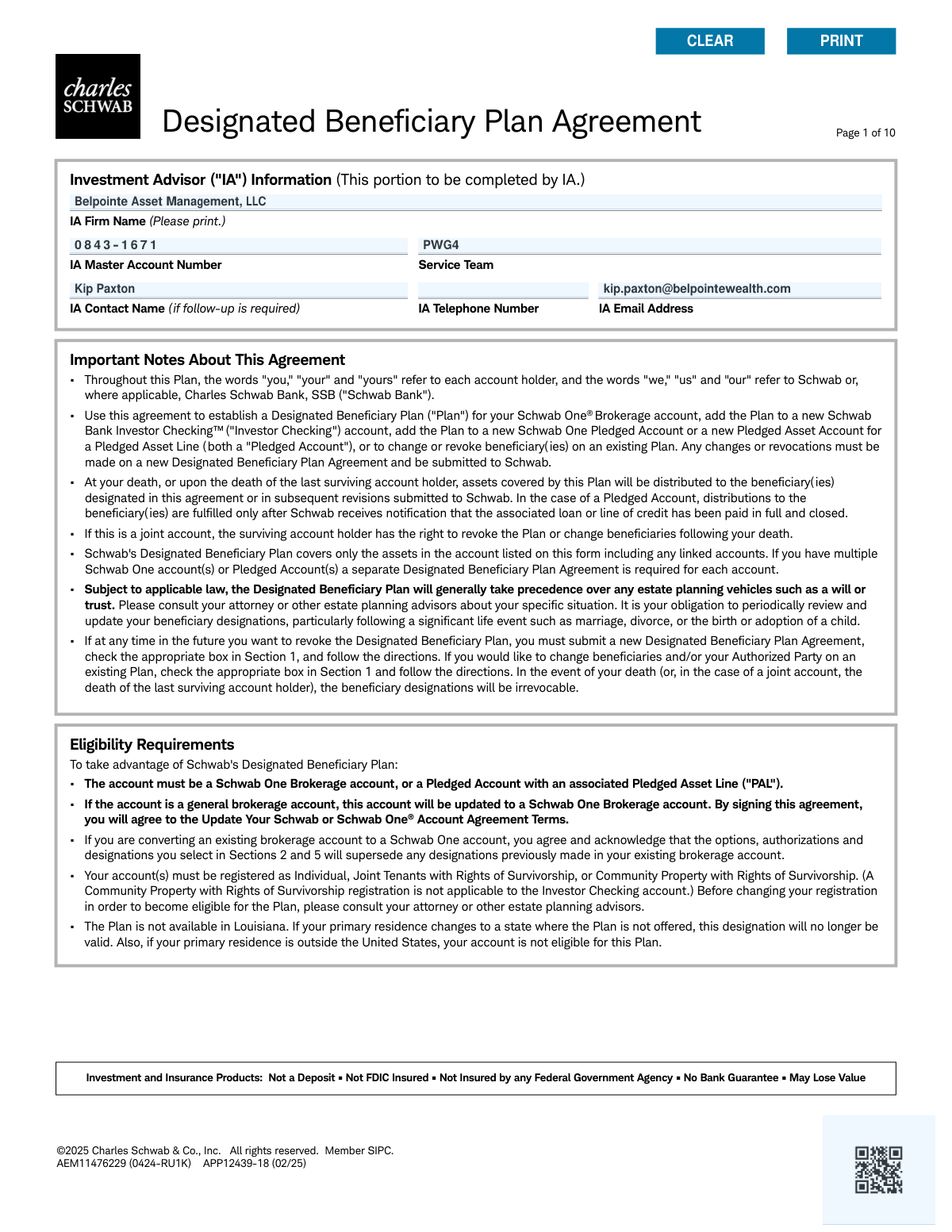
This form is a legal agreement with Charles Schwab & Co., Inc. that allows an account holder to designate primary and contingent beneficiaries for their Schwab One® Brokerage, Investor Checking™, or Pledged Account. This arrangement, also known as a Transfer on Death (TOD) or Payable on Death (POD) plan, dictates how account assets are distributed upon the account holder's death, often taking precedence over a will or trust. Today, this form can be filled out quickly and accurately using AI-powered services like Instafill.ai, which can also convert non-fillable PDF versions into interactive fillable forms.
APP12439-18 is part of the
beneficiary forms, estate planning forms, retirement account forms and financial planning forms categories on Instafill.
Rather not fill this in by hand? Instafill is an online form filler that completes PDF forms automatically — upload the blank form, answer a few questions, and the AI fills every field.
Form specifications
| Form name: | Designated Beneficiary Plan Agreement |
| Number of pages: | 1 |
| Language: | English |
Our AI automatically handles information lookup, data retrieval, formatting, and form filling.
It takes less than a minute to fill out APP12439-18 using our AI form filling.
Securely upload your data. Information is encrypted in transit and deleted immediately after the form is filled out.
Instafill Demo: How to fill out PDF forms in seconds with AI
How to Fill Out APP12439-18 Online for Free in 2026
Are you looking to fill out a APP12439-18 form online quickly and accurately? Instafill.ai offers the #1 AI-powered PDF filling software of 2026, allowing you to complete your APP12439-18 form in just 37 seconds or less.
Follow these steps to fill out your APP12439-18 form online using Instafill.ai:
- 1 Navigate to Instafill.ai and upload or select the Charles Schwab Designated Beneficiary Plan Agreement.
- 2 Use the AI assistant to provide your personal details and account information in Section 2, including account number and registration type.
- 3 In Section 5, enter the full names, contact information, and percentage allocations for your primary and contingent beneficiaries. The AI can help ensure all required fields are completed.
- 4 Designate an Authorized Party in Section 6, who can assist Schwab in identifying your beneficiaries after your death.
- 5 Specify instructions for any minor beneficiaries in Section 7, including appointing a custodian if necessary.
- 6 Carefully review all auto-filled information for accuracy, then proceed to Section 8 to electronically sign and date the agreement, authorizing your beneficiary plan.
- 7 Download, print, or submit your completed and signed agreement directly through the platform.
Our AI-powered system ensures each field is filled out correctly, reducing errors and saving you time.
Why Choose Instafill.ai for Your Fillable APP12439-18 Form?
Speed
Complete your APP12439-18 in as little as 37 seconds.
Up-to-Date
Always use the latest 2026 APP12439-18 form version.
Cost-effective
No need to hire expensive lawyers.
Accuracy
Our AI performs 10 compliance checks to ensure your form is error-free.
Security
Your personal information is protected with bank-level encryption.
Frequently Asked Questions About APP12439-18
This form allows you to establish, change, or revoke a plan that designates who will inherit the assets in your Schwab One Brokerage or Pledged Account upon your death. This is also known as a Transfer on Death (TOD) or Payable on Death (POD) arrangement.
The plan is available for Schwab One Brokerage accounts or Pledged Accounts registered as Individual, Joint Tenants with Rights of Survivorship, or Community Property with Rights of Survivorship. Residents of Louisiana and those living outside the United States are not eligible.
To make any changes, including revoking the plan or updating beneficiaries, you must complete and submit a new Designated Beneficiary Plan Agreement. Simply check the appropriate box in Section 1 and fill out the required sections.
Yes, a separate Designated Beneficiary Plan Agreement is required for each individual Schwab One or Pledged Account you want to include. The plan only covers the specific account listed on the form.
These options determine how assets are distributed if a beneficiary dies before you. Per stirpes passes a deceased beneficiary's share directly to their children, while per capita divides the assets equally among all the living children of all your deceased beneficiaries.
An Authorized Party is a person you designate to help Schwab identify and locate your beneficiaries after your death. This is particularly important if you select a per stirpes or per capita distribution, as this person will be required to certify the beneficiaries' identities.
You can designate a custodian in Section 7 to manage the assets in a custodial account (UTMA/UGMA) for the minor. If you do not designate a custodian, a court-appointed guardian may need to be assigned to manage the minor's inheritance.
Yes, for the specific account listed, this Designated Beneficiary Plan will generally take precedence over instructions in a will or trust. You should consult an attorney to understand how this impacts your overall estate plan.
In a joint account, the surviving account holder gains full control and has the right to change or revoke the beneficiary plan. The assets are only distributed to the designated beneficiaries after the death of the last surviving account holder.
Yes, if your Pledged Account is associated with a Pledged Asset Line (PAL) or other loan, the debt must be paid in full before any assets can be distributed to your beneficiaries.
In Section 5, you can enter the specific percentage for each primary and contingent beneficiary, ensuring the total for each group adds up to 100%. If you leave the percentage fields blank, the assets will be distributed equally among the listed beneficiaries.
Yes, services like Instafill.ai use AI to accurately auto-fill form fields with your information, which can save time and help prevent errors. Always be sure to review the completed form for accuracy before signing.
You can use a service like Instafill.ai to complete this form online. Simply upload the PDF, and the tool will make the fields interactive for you to fill, sign electronically, and download.
If you have a flat or scanned PDF, you can use a service like Instafill.ai to convert it into an interactive, fillable form. This allows you to easily type your information into the fields online.
Compliance APP12439-18
Validation Checks by Instafill.ai
Common Mistakes in Completing APP12439-18
This error occurs when the percentage portions assigned to either the Primary or Contingent beneficiaries in Section 5 do not add up to exactly 100%. People often make simple math errors or misunderstand that each beneficiary category (Primary, Contingent) must total 100% independently. This mistake will cause the form to be rejected, as it creates ambiguity in how assets should be distributed. To avoid this, double-check your math and ensure you are not trying to enter dollar amounts, which the form explicitly prohibits.
Section 5 has a confusing two-step process for selecting per stirpes or per capita distribution, leading to conflicting instructions. A user might select the main option at the top of the section but forget to check 'Yes' for the specific beneficiary, or vice-versa. This ambiguity can alter the intended distribution of assets to future generations. To prevent this, ensure you make a selection at the top of Section 5 and then explicitly mark 'Yes' or 'No' for each individual beneficiary you want the rule to apply to.
For accounts registered as 'Joint Tenants' or 'Community Property', a very common and critical error is having only one account holder sign in Section 8. The form requires signatures from all account holders to be valid. This often happens when one person fills out the form on behalf of both. An incomplete signature section will lead to immediate rejection and require the form to be re-submitted, delaying the implementation of your beneficiary plan.
When designating a trust as a beneficiary in Section 5, people often use a shorthand name like 'Family Trust' instead of the full, legal name as it appears on the trust documents (e.g., 'The John and Jane Doe Revocable Living Trust, dated January 1, 2020'). This vagueness can create significant legal hurdles and delays for your heirs, potentially requiring court intervention to clarify intent. Always provide the complete and exact name of the trust and the date it was established to ensure a smooth transfer of assets.
In Section 7, account holders with minor beneficiaries frequently make errors, such as checking box A ('None of my designated beneficiaries is a minor') by mistake. If they correctly check box B, they often fail to list a specific custodian for each minor child. Failing to properly designate a custodian can force the assets into a court-supervised guardianship, which is a costly and time-consuming process that may not align with the account holder's wishes.
Applicants often leave essential beneficiary details in Section 5 blank, such as the Social Security Number (SSN) or Date of Birth. This usually happens when they don't have the information readily available while filling out the form. Missing this data makes it difficult for the financial institution to locate and verify the beneficiary upon the account holder's death, causing significant delays and potential complications in distributing the assets.
The form explicitly states 'no P.O. boxes' for the account holder's home address in Section 2 and the Authorized Party's address in Section 6. Applicants sometimes overlook this and enter a P.O. Box out of habit. This will cause the form to be rejected, as a physical street address is required for identity verification and compliance with federal law. Always use a valid residential street address in these fields.
An applicant may complete the entire form without realizing their account is ineligible for the Designated Beneficiary Plan. Common reasons for ineligibility include having a primary residence in Louisiana or outside the U.S., or having an ineligible account type like an IRA. This fundamental error renders the entire agreement invalid and is a waste of time and effort. It is crucial to read the 'Eligibility Requirements' on page 1 before starting the form.
Many people skip Section 6, 'Designate an Authorized Party,' not understanding its importance. If you select a per stirpes or per capita distribution, Schwab requires this party to help identify your beneficiaries' heirs. Leaving this section blank can create a major roadblock in the distribution process, forcing your estate to go through additional legal steps to identify the correct inheritors. Always designate a reliable person in this section if you use complex beneficiary options.
In Section 1, users must choose whether they are adding a new plan, changing an existing one, or revoking one. A common mistake is checking the wrong box, such as 'Add a new Plan' when the intent is to 'Change beneficiaries.' This can lead to administrative confusion, potentially overriding previous instructions unintentionally or failing to revoke a plan as desired. Carefully select only one action that matches your intent to ensure your wishes are processed correctly.
Saved over 80 hours a year
“I was never sure if my IRS forms like W-9 were filled correctly. Now, I can complete the forms accurately without any external help.”
Kevin Martin Green
Your data stays secure with advanced protection from Instafill and our subprocessors




Robust compliance program
Transparent business model
You’re not the product. You always know where your data is and what it is processed for.
ISO 27001, HIPAA, and GDPR
Our subprocesses adhere to multiple compliance standards, including but not limited to ISO 27001, HIPAA, and GDPR.
Security & privacy by design
We consider security and privacy from the initial design phase of any new service or functionality. It’s not an afterthought, it’s built-in, including support for two-factor authentication (2FA) to further protect your account.
Fill out APP12439-18 with Instafill.ai
Worried about filling PDFs wrong? Instafill securely fills designated-beneficiary-plan-agreement-4 forms, ensuring each field is accurate.
