
Yes! You can use AI to fill out Affidavit and Representations Regarding Next of Kin (Preference Beneficiary Affidavit) (The Hartford) – Form LC-7086-17
Don't type 84 fields by hand. Tell our AI about yourself, or upload a document you already have, and it fills every field in seconds. You check it, then download, print or sign.
The AI does the filling. You just check it.
No typing into boxes, nothing to install.
What this form asks for
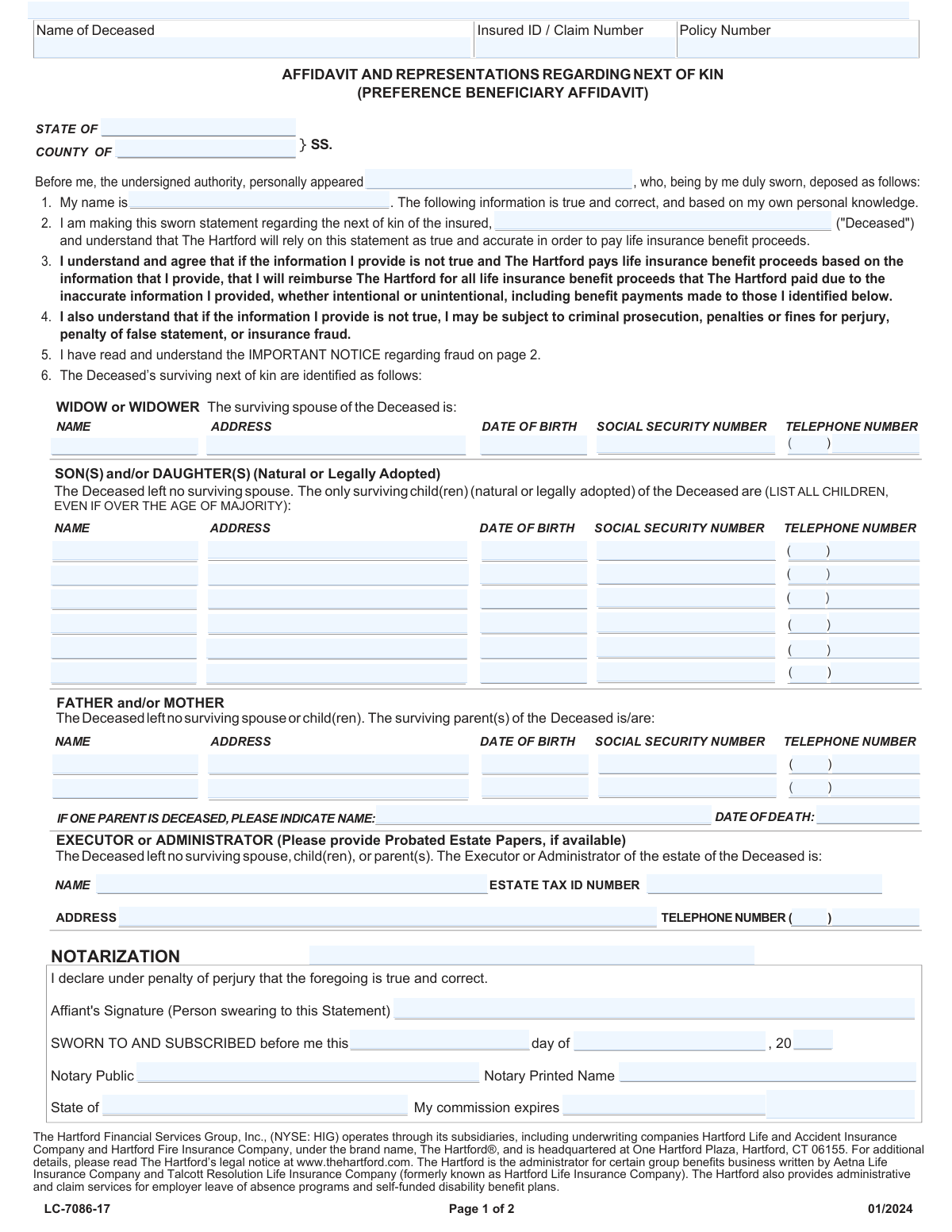
The AI fills all of it, from your answers or your documents.
The AI checks your answers before you download
16 checks built for this form, so a wrong date or a missing answer is caught before anyone else sees it.
Validates that the form includes the Deceased’s name and at least one unique identifier (Insured ID/Claim Number and/or Policy Number). This is required to correctly match the affidavit to the correct claim and policy record and prevent misapplied payments. If missing or incomplete, the submission should be rejected or routed to manual review for claimant outreach before any processing continues.
Checks that the affiant’s name in statement item 1 is completed with a non-empty, non-placeholder value (e.g., not just initials, “N/A,” or whitespace). The affidavit is a sworn statement and must clearly identify who is making the representations. If validation fails, the form should be considered incomplete and returned for correction because the statement cannot be relied upon without an identified affiant.
Ensures the 'STATE OF' and 'COUNTY OF' fields in the affidavit notarization section are completed. This establishes the legal jurisdiction where the oath was administered and is essential for enforceability and compliance. If either field is missing, the notarization is potentially defective and the submission should be flagged for correction or re-notarization.
Validates that the notarization date line ('this day of, 20') is fully completed with a valid day, month, and 4-digit year, and that the date is a real calendar date. Notarization without a complete date can invalidate the affidavit and create legal and audit issues. If invalid or incomplete, the form should be rejected and the claimant instructed to obtain a corrected notarization.
Checks that both the notary public signature and the notary printed name fields are present and not blank. These elements are required to identify the notary who administered the oath and to support verification if needed. If missing, the notarization cannot be authenticated and the submission should be returned for completion.
Validates that the 'My commission expires' field contains a valid date and that the commission expiration is not earlier than the notarization date. A notary must have an active commission at the time of notarization for the affidavit to be valid. If the commission is expired or the date is missing/invalid, the form should be flagged as invalid notarization and require re-notarization.
And 10 more checks
- Affiant Signature and Signature Date Present (Important Notice Page)
- Next-of-Kin Section Exclusivity and Hierarchy Consistency
- Spouse Section Completeness When Spouse Listed
- Children Entries Completeness and 'List All Children' Enforcement
- Parents Section Completeness and Deceased Parent Details
- Executor/Administrator Section Requires Estate Tax ID and Contact Details
- SSN Format Validation for All Listed Individuals
- Date of Birth and Date of Death Format and Plausibility Checks
- Telephone Number Format Validation (Including Area Code)
- Address Completeness for Each Listed Next-of-Kin
Let AI fill out your LC-7086-17
No typing. Every field filled in seconds, checked, ready to sign.
How to Fill Out LC-7086-17 Online for Free in 2026
What the AI walks you through.
- Enter the deceased insured’s identifying information (name, insured ID/claim number, and policy number) and the state/county where the affidavit is executed.
- Provide the affiant’s name and confirm the statements acknowledging the affidavit is based on personal knowledge and will be relied upon for payment of benefits.
- Complete the next-of-kin section in order: list the surviving spouse (if any) with full contact details, date of birth, Social Security number, and phone number.
- If there is no surviving spouse, list all surviving children (including adults) with their addresses, dates of birth, Social Security numbers, and phone numbers; if none, list surviving parent(s) and include deceased parent name/date of death if applicable.
- If there is no spouse, child, or parent, provide the executor/administrator information and include estate tax ID number; attach probated estate papers if available.
- Review the Important Notice/fraud statement applicable to the affiant’s state of residence, then sign and date the form where indicated.
- Complete notarization: sign in the presence of a notary, have the notary complete the venue/date, notary name, commission information, and apply the notary seal as required.
Common Mistakes in Completing LC-7086-17
The ones the AI is built to catch.
Leaving the Deceased identifiers blank or mismatched (Insured ID/Claim Number/Policy Number)
Not completing the venue and notarization section correctly (State/County, date, notary details)
Signing in the wrong place or using inconsistent signatures
Listing next of kin in the wrong priority order (spouse vs. children vs. parents vs. executor)
Failing to list all children (including adults, estranged children, or legally adopted children)
Providing incomplete contact details for next of kin (missing address/phone)
Entering incorrect or improperly formatted dates of birth and dates of death
Missing, incorrect, or improperly handled Social Security Numbers
Not indicating a deceased parent’s information when completing the parent section
Executor/Administrator section completed without required estate documentation or with wrong tax identifier
Skipping the Important Notice acknowledgment (state-specific fraud notice) and signature/date on page 2
Frequently Asked Questions About LC-7086-17
Is it really free for 7 days?
Can I fill other forms too?
How do I cancel?
How does the AI fill out LC-7086-17?
What happens to my information?
How complex is LC-7086-17 to fill out?
What is the “Affidavit and Representations Regarding Next of Kin (Preference Beneficiary Affidavit)” used for?
Who should complete and sign this affidavit?
Does this form have to be notarized?
What identifying information do I need to provide at the top of the form?
What does the Affiant certify by signing this form?
Which relatives must be listed as “next of kin” on this form?
Do I need to list all children, even if they are adults or not financially dependent?
What information is required for each next-of-kin person listed?
What if the deceased had no spouse and no children?
When do I fill out the Executor or Administrator section, and what documents are needed?
What if I don’t know a next of kin’s Social Security number or phone number?
What is the “Important Notice” about fraud, and do I have to sign it?
How do I know which state fraud notice applies to me?
How long does processing take after I submit the notarized affidavit?
Where do I submit this completed form?
Get your LC-7086-17 filled out by AI
$0 today. Cancel before Oct 31 and you pay nothing.
Other forms like this one
The Hartford forms: Account Application for Merrill West Virginia Residents - The Hartford SMART529
beneficiary forms: Form I-130A, Supplemental Info for Spouse Beneficiary, VA Form 21-0788, Information Regarding Apportionment of Beneficiary's Award, California Schedule K-1 (541) (2025), Beneficiary’s Share of Income, Deductions, Credits, etc., Form I-130A, Supplemental Information for Spouse Beneficiary, Fidelity Investments® Beneficiary Distribution Form, Fidelity Investments 403(b) Beneficiary Designation, Fidelity Advisor IRA Beneficiary Designation, Fidelity Investments Qualified Plan Beneficiary Designation, Fidelity Investments 403(b)/401(a) Beneficiary Designation, The Church of the Nazarene 403(b) Retirement Savings Plan Beneficiary Designation Form, Fidelity Investments Qualified Plan Beneficiary Designation, IRA/HSA Beneficiary Designation, Fidelity IRA Beneficiary Distribution — Charity, Foundation, or a University, Designated Beneficiary Plan Agreement, Designated Beneficiary Plan Agreement, Beneficiary Designation Form For IRA and 403(b)(7) Accounts, Designated Beneficiary Plan Agreement, IRA Beneficiary Designation Form, Stock Power Form For transferring shares, changing names, or adding a beneficiary, Distribution Due to Death for Spouse Beneficiary - Elevator Constructors Union Local No. 1 Annuity and 401(k) Fund
HART forms: Account Application for Merrill West Virginia Residents - The Hartford SMART529
Hartford forms: Account Application for Merrill West Virginia Residents - The Hartford SMART529
affidavit forms: Affidavit for Collection of Personal Property California Probate Code Section 13100, Form I-864, Affidavit of Support Under INA, Form DS-5507, Affidavit of Physical Presence, Form 12.902(b), Family Law Financial Affidavit (Short Form), Form E, Affidavit of Personal Service, Form I-361, Affidavit of Financial Support, Form EX550, Affidavit (Order to attend for questioning/suspended committal order), Form CJA-23, Financial Affidavit, Affidavit for Service by Publication/Posting (Circuit Court of Cook County, Illinois) (CCG 0013 A/B), In Forma Pauperis Affidavit/Petition (AOPC 622A) – Pennsylvania Magisterial District Court, In Forma Pauperis Affidavit Petition (AOPC 622A) — Pennsylvania Magisterial District Court, Form P3 (Rule 25-3(2)) — Affidavit of Applicant for Grant of Probate or Grant of Administration with Will Annexed (Short Form) (Supreme Court of British Columbia), Uniform Domestic Relations Form – Affidavit 1 AFFIDAVIT OF BASIC INFORMATION, INCOME, AND EXPENSES, TIAA Brokerage Durable Power Of Attorney Affidavit Of Full Force And Effect, Form L-4260, Property Transfer Affidavit, Affidavit - Supporting Documents Not Attached to Eviction Complaint, Missouri Motion and Affidavit in Support of Request to Proceed As a Poor Person, Form AOC-SP-300, Petition And Affidavit/Affirmation For Involuntary Commitment, Florida Supreme Court Approved Family Law Form 12.902(d), Uniform Child Custody Jurisdiction and Enforcement Act (UCCJEA) Affidavit, Form 35.1A: Affidavit (child protection information)
Let AI fill out your LC-7086-17
Your trial starts once a card is added. You pay nothing before Oct 31.
Our AI already knows this form, all 84 fields of it. Skip the typing: tell it about yourself, or upload what you have, and it fills the whole form in seconds.
- AI fills every field on both pages, tables and checkboxes included
- No typing into boxes: answer a few questions, or upload a document you already have, an old copy of this form, a photo of a document
- The AI checks the answers; you review and change anything before you download
- Download the finished PDF, print it, or sign it online
- Encrypted, and never used to train AI
Cancel before Oct 31 and you pay nothing.
A card is needed to start the trial. Cancel in two clicks from your account.
Terms · Privacy