Yes! You can use AI to fill out FS Form 5179, Legacy Treasury Direct Security Transfer Request

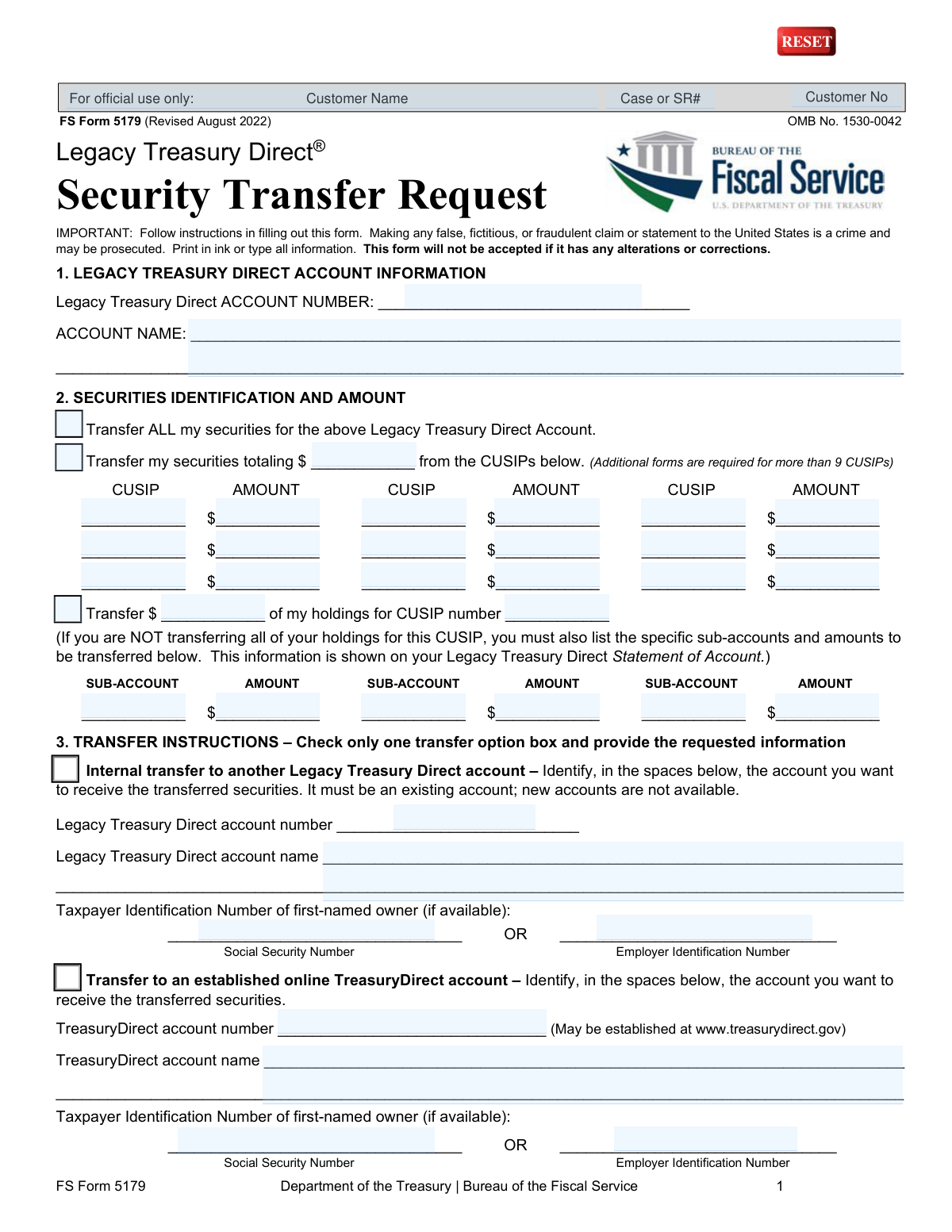
FS Form 5179 is a Department of the Treasury form used by holders of a Legacy Treasury Direct account to request the transfer of their securities. This can be an internal transfer to another Legacy account, a transfer to a modern online TreasuryDirect account, or an external transfer to a financial institution or brokerage firm. Today, this form can be filled out quickly and accurately using AI-powered services like Instafill.ai, which can also convert non-fillable PDF versions into interactive fillable forms.
Our AI automatically handles information lookup, data retrieval, formatting, and form filling.
It takes less than a minute to fill out FS Form 5179 using our AI form filling.
Securely upload your data. Information is encrypted in transit and deleted immediately after the form is filled out.

Form specifications

Form name: FS Form 5179, Legacy Treasury Direct Security Transfer Request
Number of pages: 1
Language: English
Categories: SEC forms, transfer forms
main-image

Instafill Demo: How to fill out PDF forms in seconds with AI

How to Fill Out FS Form 5179 Online for Free in 2026

Are you looking to fill out a FS FORM 5179 form online quickly and accurately? Instafill.ai offers the #1 AI-powered PDF filling software of 2026, allowing you to complete your FS FORM 5179 form in just 37 seconds or less.
Follow these steps to fill out your FS FORM 5179 form online using Instafill.ai:
  1. 1 Navigate to Instafill.ai and upload or select the FS Form 5179.
  2. 2 Use the AI assistant to accurately input your Legacy Treasury Direct account number and name in Section 1.
  3. 3 In Section 2, specify the securities to be transferred by selecting to transfer all securities, or by listing specific CUSIPs and amounts.
  4. 4 Choose your transfer destination in Section 3, providing details for an internal transfer, an online TreasuryDirect account, or an external financial institution.
  5. 5 Carefully review all the information populated by the AI to ensure it matches your account statements and transfer instructions.
  6. 6 Print the completed form. Sign it in the presence of an authorized certifying officer (e.g., at a bank) and have them complete the certification section.
  7. 7 Mail the original, certified form to the Treasury Retail Securities Services address provided in the form's instructions.

Our AI-powered system ensures each field is filled out correctly, reducing errors and saving you time.

Why Choose Instafill.ai for Your Fillable FS Form 5179 Form?

Speed

Complete your FS Form 5179 in as little as 37 seconds.

Up-to-Date

Always use the latest 2026 FS Form 5179 form version.

Cost-effective

No need to hire expensive lawyers.

Accuracy

Our AI performs 10 compliance checks to ensure your form is error-free.

Security

Your personal information is protected with bank-level encryption.

Frequently Asked Questions About Form FS Form 5179

This form, the Security Transfer Request, is used to transfer securities out of a Legacy Treasury Direct account to another account, such as another Legacy account, an online TreasuryDirect account, or an external financial institution.

You need to fill out this form if you are the owner of a Legacy Treasury Direct account and wish to move some or all of your securities to a different account.

You will need your Legacy Treasury Direct account number, the exact account name, and the CUSIP numbers for the specific securities you intend to transfer, all of which are found on your statement.

Select the option that matches your destination: use the 'Internal transfer' for another Legacy account, 'Transfer to an established online TreasuryDirect account' for a modern TreasuryDirect account, or 'External Transfer' for a bank or brokerage firm.

You must sign the form in the presence of an authorized officer at a financial institution, who will verify your identity and apply an official seal or Medallion stamp. Certification by a notary public is not acceptable.

Mail the completed and certified form to Treasury Retail Securities Services, PO Box 9150, Minneapolis, MN 55480-9150. Do not send it to the address listed for comments.

To ensure timely processing, your form must be received at least ten business days before the security's maturity date or an interest payment date.

The form will be rejected if it has any alterations or corrections. If you make an error, you must start over with a new, clean form.

A CUSIP is a unique 9-character identification number for a security. You can find the CUSIP for your holdings on your Legacy Treasury Direct Statement of Account, listed under the 'Security' heading.

You must contact the receiving financial institution or brokerage firm directly to obtain their correct book-entry delivery instructions, which include the ABA routing number and wire name.

Yes, services like Instafill.ai use AI to accurately auto-fill form fields from your profile. This can save time and help reduce the chance of errors that would cause the form to be rejected.

Simply upload the FS Form 5179 PDF to the Instafill.ai platform. The service will make the form interactive, allowing you to easily input your information and auto-fill fields to complete it.

You can use a service like Instafill.ai, which is designed to convert flat, non-fillable PDFs into interactive, fillable forms that you can complete on your computer before printing for signature.

Yes, if the account registration joins two owners with the word 'and', both individuals must sign the form in the presence of a certifying officer.

Compliance FS Form 5179
Validation Checks by Instafill.ai

1
Exclusive Security Transfer Method Selection
Validates that only one of the three primary options in Section 2 (Transfer ALL, Transfer from CUSIPs, Transfer from a specific CUSIP) is selected. This is crucial for preventing ambiguity in the transfer request. If more than one option is selected, the form submission will be rejected, and the user will be prompted to choose only a single method for identifying the securities to be transferred.
2
Exclusive Transfer Destination Selection
Ensures that only one of the three transfer destination options in Section 3 (Internal, TreasuryDirect online, or External) is checked. The form explicitly states to 'Check only one transfer option box'. A failure in this check indicates a conflicting instruction, which would halt processing until the user clarifies the single intended destination for the securities.
3
Source Account Verification
Verifies that the 'LEGACY TREASURY DIRECT ACCOUNT NUMBER' and 'ACCOUNT NAME' in Section 1 correspond to an existing and valid account in the system. This is a fundamental check to ensure the request originates from a legitimate account holder. If the account number and name do not match a record, the transfer cannot proceed and the form will be rejected.
4
CUSIP Format Validation
Checks that all entered CUSIP numbers follow the standard 9-character alphanumeric format (e.g., 912795XXX). CUSIPs are unique identifiers for securities, and an incorrect format will prevent the system from identifying the correct asset. An invalid CUSIP will trigger an error, requiring the user to correct the entry before submission.
5
CUSIP Total Amount Consistency
If the option to 'Transfer my securities totaling $...' is selected, this check ensures the sum of all individual CUSIP 'AMOUNT' fields equals the specified total amount. This validation prevents discrepancies and ensures the user's intent is accurately captured. A mismatch would result in a validation error, forcing the user to reconcile the amounts.
6
Routing Number Format
Validates that the 'Routing Number' provided in the 'External Transfer' section is a valid 9-digit number. This number is essential for correctly directing the transfer to the proper financial institution via the ABA system. An invalid format will cause the transfer to fail, so the form will not be accepted until a valid 9-digit number is entered.
7
Conditional Requirement for External Transfer
Ensures that if the 'External Transfer' option is selected, the 'Routing Number' and 'Financial Institution Wire Name' fields are completed. This information is mandatory for processing a transfer to an outside institution. Failure to provide this data will result in an incomplete request and the form will be rejected until the required fields are filled.
8
Taxpayer Identification Number (TIN) Format
Validates that any 'Social Security Number' or 'Employer Identification Number' entered on the form follows the correct 9-digit format. This applies to both the destination account TIN in Section 3 and the signer's SSN in Section 4. Correct TINs are required for tax reporting and identity verification, and an invalid format will block the submission.
9
Dual Signature Requirement Check
Checks the ownership structure of the source Legacy Treasury Direct account. If the account registration joins two owners with the word 'and', the system will require that both signature blocks in Section 4 are fully completed. This ensures that all required legal owners have authorized the transfer, preventing unauthorized transactions.
10
Signer Information Completeness
Verifies that for each signature provided in Section 4, the corresponding 'Print Name', 'Social Security Number', and full 'Home Address' fields are also completed. This information is necessary for identity verification and record-keeping. An incomplete signature block will cause the form to be rejected for lacking required personal data.
11
Certification Section Completeness
Ensures all fields within the 'I CERTIFY' block for the certifying officer are filled out, including the names of persons who appeared, date, officer's signature, title, and the financial institution's full details. This certification is a mandatory anti-fraud measure. An incomplete certification block will render the entire form invalid.
12
Prohibited Certifying Officer
Checks the 'Title of Certifying Officer' field to ensure it does not contain 'Notary Public'. The form instructions explicitly state that certification by a notary public is not acceptable. If 'Notary Public' is detected, the submission will be rejected, and the user will be informed that they must obtain certification from an authorized officer at a financial institution.
13
Certification Date Validity
Validates that the date entered by the certifying officer is a valid calendar date and is not in the future. This ensures the certification was performed on a legitimate date and contemporaneously with the signature. A future or invalid date would invalidate the certification and cause the form to be rejected.

Common Mistakes in Completing FS Form 5179

Using an Unacceptable Certifying Officer

The form explicitly states that certification by a Notary Public is NOT acceptable, yet many people use them out of habit. This error leads to immediate rejection of the form, as the signature certification is invalid. To avoid this, you must visit a bank, credit union, or brokerage firm and have your signature certified by an authorized employee or by using a Medallion stamp, as detailed in the instructions.

Signing the Form Before Meeting the Certifying Officer

The instructions require the form to be signed 'in the presence of a certifying officer.' A common mistake is to sign the form at home before going to the bank. This invalidates the certification because the officer cannot attest to witnessing a signature they did not see, resulting in form rejection and significant delays. Always bring the form unsigned to the financial institution and sign it only when instructed by the certifying officer.

Submitting a Form with Alterations or Corrections

The form header warns, 'This form will not be accepted if it has any alterations or corrections.' People often try to fix small errors with white-out or by crossing out information. On this strict government form, any visible correction will cause it to be rejected, forcing you to start over. If you make a mistake, print a new, clean copy. Since this is a non-fillable PDF, using a tool like Instafill.ai can convert it into a fillable version, allowing you to correct errors on your computer before printing the final, pristine document.

Providing Incomplete External Transfer Instructions

For an external transfer, Section 3 requires highly specific details like the 'Financial Institution Wire Name' in telegraphic abbreviation and 'Special Handling Instructions' including the final brokerage account number. Filers often provide a standard bank name or omit the final account details, leading to failed or delayed transfers. Before filling out this section, you must contact your brokerage or financial institution and request their exact 'book-entry delivery instructions' for Treasury securities.

Mismatching Legacy Treasury Direct Account Information

In Section 1, the Account Name and Number must perfectly match your Legacy Treasury Direct Statement of Account. People may write a nickname, use an abbreviation, or transpose digits in the account number from memory. Any mismatch will prevent the system from identifying the source account, causing the entire transfer request to be rejected. Always refer directly to your most recent statement when filling out this section to ensure complete accuracy.

Forgetting the Second Signature for Joint 'And' Accounts

The signature instructions mandate that if the account is owned by two people joined by 'and' (e.g., 'John Doe and Mary Doe'), both owners must sign the form. It is a frequent oversight for only one owner to complete and sign the form, which is a critical error. A missing required signature results in an automatic rejection of the request, delaying the transfer. Both owners must be present to sign in front of the certifying officer.

Selecting Conflicting or Multiple Transfer Options

The form presents several choices for identifying securities (Section 2) and instructing the transfer (Section 3). A common error is to check multiple boxes that create ambiguity, such as selecting 'Transfer ALL my securities' while also listing specific CUSIPs and amounts. This confusion will cause the processing agent to halt the request. You must carefully choose only one option in each section that precisely reflects your single intention.

Inaccurately Listing CUSIPs or Sub-Account Details

Section 2 requires precise CUSIP numbers, amounts, and sometimes sub-account details for partial transfers. Data entry errors like transposing digits in a CUSIP, listing an incorrect dollar amount, or failing to specify sub-accounts are common and will cause the request to fail. To prevent this, double-check every number against your Statement of Account. AI-powered form-filling tools like Instafill.ai can help prevent these errors by validating data formats and reducing manual entry mistakes.

Attempting to Transfer Securities to a Checking or Savings Account

The instructions for an 'External Transfer' clearly state that securities CANNOT be transferred to a checking or savings account. Filers may mistakenly provide their personal bank account routing number, assuming this is a valid destination. This will cause the transfer to fail, as these types of accounts are not equipped to hold book-entry securities. The transfer must be directed to a designated brokerage or safekeeping account at a financial institution.

Missing the Submission Deadline Before a Key Date

The instructions warn that the form must be received at least ten business days before a security's maturity or interest payment date. People often underestimate mail and internal processing times, submitting the form too close to these deadlines. A late submission can cause the transfer to be delayed until after the key event, which may have unintended financial consequences. Always mail the form well in advance of any critical dates associated with your securities.
Saved over 80 hours a year

“I was never sure if my IRS forms like W-9 were filled correctly. Now, I can complete the forms accurately without any external help.”

Kevin Martin Green

Your data stays secure with advanced protection from Instafill and our subprocessors

Robust compliance program

Transparent business model

You’re not the product. You always know where your data is and what it is processed for.

ISO 27001, HIPAA, and GDPR

Our subprocesses adhere to multiple compliance standards, including but not limited to ISO 27001, HIPAA, and GDPR.

Security & privacy by design

We consider security and privacy from the initial design phase of any new service or functionality. It’s not an afterthought, it’s built-in, including support for two-factor authentication (2FA) to further protect your account.

Fill out FS Form 5179 with Instafill.ai

Worried about filling PDFs wrong? Instafill securely fills fs-form-5179-legacy-treasury-direct-security-transfer-request forms, ensuring each field is accurate.