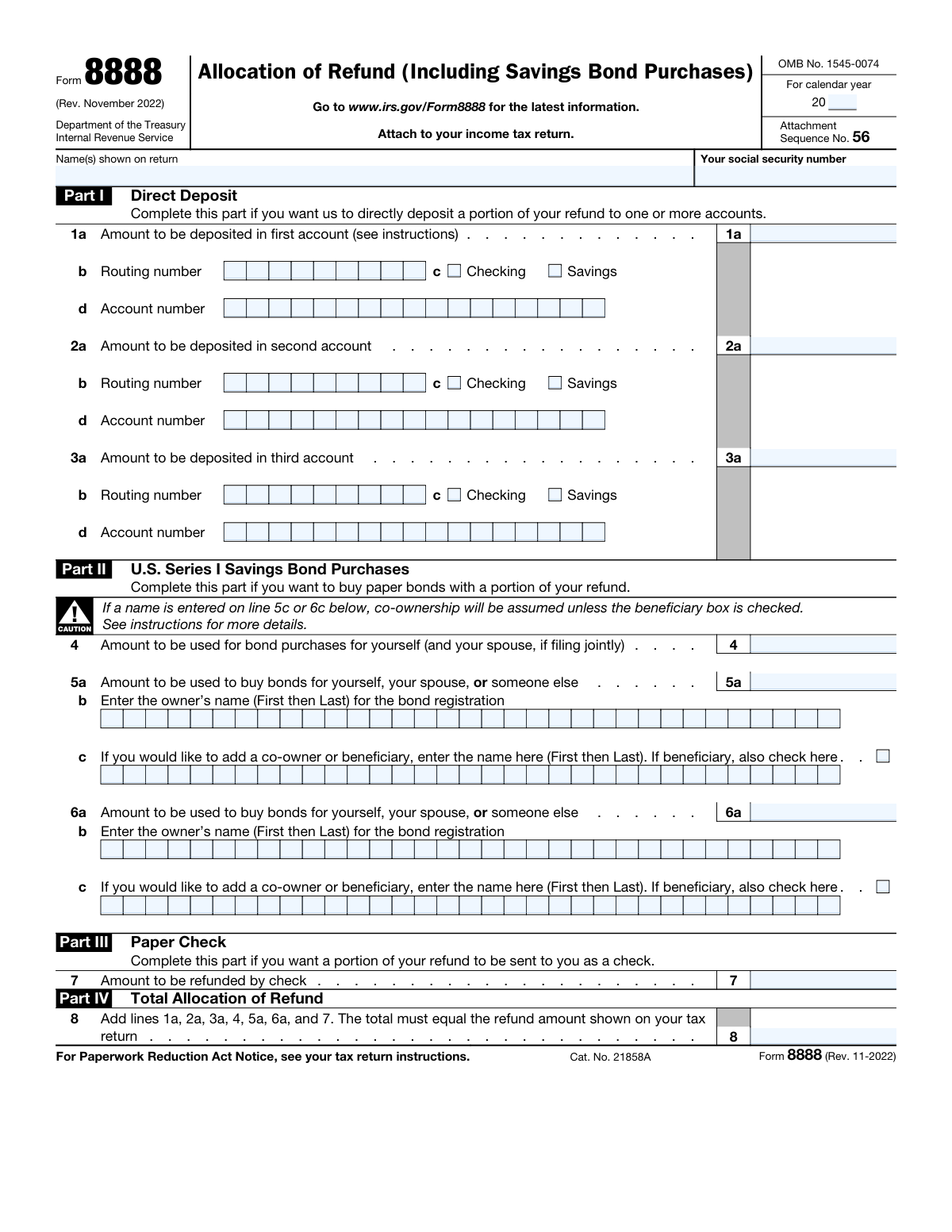
Yes! You can use AI to fill out Form 8888, Allocation of Refund (Including Savings Bond Purchases)
IRS Form 8888, Allocation of Refund, is used by taxpayers to divide their tax refund among multiple destinations. You can direct deposit funds into up to three different accounts, use part of the refund to purchase U.S. Series I Savings Bonds, and receive the remainder as a paper check. This form provides flexibility in managing your tax refund but must be attached to your main income tax return. Today, this form can be filled out quickly and accurately using AI-powered services like Instafill.ai, which can also convert non-fillable PDF versions into interactive fillable forms.
Form 8888 is part of the
savings bond forms category on Instafill.
Our AI automatically handles information lookup, data retrieval, formatting, and form filling.
It takes less than a minute to fill out Form 8888 using our AI form filling.
Securely upload your data. Information is encrypted in transit and deleted immediately after the form is filled out.
Form specifications
| Form name: | Form 8888, Allocation of Refund (Including Savings Bond Purchases) |
| Number of fields: | 29 |
| Number of pages: | 1 |
| Language: | English |
Instafill Demo: How to fill out PDF forms in seconds with AI
How to Fill Out Form 8888 Online for Free in 2026
Are you looking to fill out a FORM 8888 form online quickly and accurately? Instafill.ai offers the #1 AI-powered PDF filling software of 2026, allowing you to complete your FORM 8888 form in just 37 seconds or less.
Follow these steps to fill out your FORM 8888 form online using Instafill.ai:
- 1 Navigate to an AI-powered service like Instafill.ai and upload or select Form 8888.
- 2 Provide your name and Social Security number as they appear on your tax return.
- 3 Complete Part I if you want to direct deposit your refund into one or more accounts. You will need to provide the routing number, account number, and amount for each account.
- 4 Fill out Part II if you wish to use a portion of your refund to purchase U.S. Series I Savings Bonds, specifying the amount and registration details.
- 5 Use Part III to indicate the amount of your refund you want to receive as a paper check.
- 6 Complete Part IV by adding all allocated amounts. Ensure the total on line 8 matches the total refund amount on your tax return.
- 7 Review the completed form for accuracy, then download it to attach to your income tax return.
Our AI-powered system ensures each field is filled out correctly, reducing errors and saving you time.
Why Choose Instafill.ai for Your Fillable Form 8888 Form?
Speed
Complete your Form 8888 in as little as 37 seconds.
Up-to-Date
Always use the latest 2026 Form 8888 form version.
Cost-effective
No need to hire expensive lawyers.
Accuracy
Our AI performs 10 compliance checks to ensure your form is error-free.
Security
Your personal information is protected with bank-level encryption.
Frequently Asked Questions About Form Form 8888
Form 8888 allows you to split your tax refund and have it sent to multiple destinations. You can use it to direct deposit your refund into two or three different accounts, use part of it to buy U.S. Series I savings bonds, or receive a portion as a paper check.
No, you do not need to use this form if you want your entire refund deposited into a single account. In that case, you should enter your direct deposit information directly on your main tax return, such as Form 1040.
Using Part I of Form 8888, you can split your refund and have it directly deposited into as many as three different financial accounts. These can include checking, savings, IRA, HSA, or other types of accounts.
No, the IRS requires that any account used for direct deposit must be in your name, or your spouse's name if filing a joint return. You cannot request a deposit into an account belonging to someone else, such as your tax preparer.
Complete Part II of the form to use a portion of your refund to purchase up to $5,000 in paper Series I savings bonds. The amount requested for bonds must be in multiples of $50.
If your refund is decreased due to an error or offset, the reduction is taken from the last allocation you listed on the form. If your refund is increased, the additional amount will be added to the deposit for the last account listed in Part I.
Your routing and account numbers are located at the bottom of your checks. The routing number is a nine-digit code, and it's best to double-check with your financial institution to ensure you have the correct numbers for direct deposit.
Yes, you can direct deposit your refund into a traditional IRA, Roth IRA, or SEP-IRA. You must have the IRA established before you file, and you should ask your financial institution if you should mark the account as 'Checking' or 'Savings' on the form.
If you enter incorrect account information, your deposit may be rejected, and the IRS is not responsible for a lost refund. If you cross out or use white-out on the form, your allocation requests will be rejected, and you will be sent a single paper check for your entire refund.
Yes, this is possible. After allocating funds for direct deposit in Part I and/or savings bonds in Part II, you can enter the remaining amount you wish to receive as a paper check on line 7 in Part III.
The total amount on line 8 must exactly match the total refund amount shown on your income tax return. If these two figures do not match, the IRS will send your entire refund as a paper check instead of following your Form 8888 instructions.
Yes, services like Instafill.ai use AI to auto-fill form fields accurately and save time. This can help you complete the form more efficiently and with fewer errors.
You can use a service like Instafill.ai to easily fill out your form online. Simply upload the PDF, and the platform will make it an interactive form that you can type into, save, and print.
If you have a non-fillable or 'flat' PDF, you can use a tool like Instafill.ai to help. It can convert the static PDF into an interactive, fillable form that you can complete on your computer.
Compliance Form 8888
Validation Checks by Instafill.ai
1
Total Allocation Summation
This check verifies that the amount on Line 8 is the exact sum of the amounts entered on lines 1a, 2a, 3a, 4, 5a, 6a, and 7. This ensures the form is internally consistent and all allocated portions add up to the declared total. If the sum does not match the total on Line 8, the IRS will reject all allocations and issue the entire refund as a single paper check.
2
Refund Allocation Matches Total Refund
This validation ensures that the total allocation amount on Line 8 of Form 8888 is identical to the total refund amount shown on the taxpayer's main income tax return (e.g., Form 1040). This is a critical cross-form validation to ensure the entire refund is accounted for and properly distributed. A mismatch will cause the Form 8888 to be disregarded, and a paper check will be sent instead.
3
Routing Number 9-Digit Format
This check validates that the routing numbers entered in fields 1b, 2b, and 3b are exactly nine digits long. This specific length is a requirement for the Automated Clearing House (ACH) system to correctly identify the financial institution. Any number that is not exactly nine digits will cause the direct deposit request for that account to fail.
4
Routing Number Prefix Validity
This validation confirms that the first two digits of any entered routing number (fields 1b, 2b, 3b) are within the valid ranges of 01 through 12 or 21 through 32. This is a standard check for ABA routing transit numbers and helps prevent typos or the use of invalid numbers. An invalid prefix will result in a rejected direct deposit.
5
Conditional Requirement for Account Details
This check ensures that if an amount is entered on lines 1a, 2a, or 3a, then the corresponding routing number, account type, and account number fields are all filled out. It is impossible to process a direct deposit without complete account information. If any of these details are missing for a specified amount, that portion of the refund will be sent as a paper check.
6
Exclusive Account Type Selection
For each direct deposit entry (lines 1, 2, and 3), this check verifies that exactly one account type box ('Checking' or 'Savings') is selected. Financial institutions require this information to correctly process the deposit. If zero or both boxes are checked for an account, the deposit request will be rejected.
7
Account Number Maximum Length
This validation ensures that the account numbers entered in fields 1d, 2d, and 3d do not exceed 17 characters. This prevents data truncation and ensures the full, correct account number is processed by the financial institution. An account number that is too long may be rejected, causing the deposit to fail.
8
Bond Purchase Amount in $50 Multiples
This check verifies that any amount entered for purchasing savings bonds (lines 4, 5a, and 6a) is a multiple of $50. This is a strict requirement from the U.S. Treasury for issuing paper bonds. If the amount is not a multiple of $50, the bond request will be rejected, and that portion of the refund will be sent as a check.
9
Total Bond Purchase Limit
This validation confirms that the sum of the amounts on lines 4, 5a, and 6a does not exceed $5,000. This enforces the maximum annual limit for purchasing paper Series I savings bonds via a tax refund. If the total exceeds $5,000, the entire bond purchase request will be rejected.
10
Bond Owner Name Requirement
This check ensures that if an amount is entered on line 5a or 6a to purchase a bond for someone, a corresponding owner's name must be provided on line 5b or 6b. A bond cannot be registered without an owner's name. Failure to provide a name will result in the rejection of that specific bond request.
11
Single Name per Bond Registration Field
This validation checks that only one individual's name is entered in each of the bond registration name fields (5b, 5c, 6b, 6c). The form instructions explicitly state that entering more than one name in any of these fields will cause the bond request to be rejected. This rule ensures clear and unambiguous ownership and beneficiary designations.
12
Social Security Number Format
This check validates that the 'Your social security number' field contains a properly formatted 9-digit number. The SSN is the primary identifier linking this form to the main tax return and the taxpayer. An invalid or missing SSN will prevent the form from being processed.
13
Minimum Direct Deposit Amount
This validation ensures that if an amount is entered for direct deposit on lines 1a, 2a, or 3a, the value is at least $1.00. The instructions specify this minimum to prevent processing of zero-dollar or trivial amounts. Any specified deposit amount less than $1.00 would be considered invalid.
Common Mistakes in Completing Form 8888
This occurs when the total amount on Line 8 does not exactly match the total refund amount shown on the filer's main tax return (e.g., Form 1040). People often make small miscalculations or forget to include one of the allocated amounts in the final sum. If these numbers don't match, the IRS will disregard the entire Form 8888 and issue a single paper check for the full refund, delaying access to the funds and nullifying all direct deposit and bond purchase requests. To avoid this, meticulously add all amounts from Parts I, II, and III before entering the total on Line 8.
This is one of the most frequent and costly errors, often caused by transposing digits or copying the number from a deposit slip instead of a check. A wrong number can cause the refund to be delayed, rejected by the bank, or, in the worst-case scenario, deposited into someone else's account. The IRS is not responsible for recovering funds lost this way. Always verify these numbers with your financial institution or by referencing a voided check, and double-check your entry. AI-powered form-filling tools like Instafill.ai can help by validating routing number formats and storing your verified account information for accurate reuse.
In Part II, the form requires that any amount used to purchase savings bonds (lines 5a and 6a) must be in a multiple of $50. Filers may overlook this rule and enter an arbitrary amount, such as the entire remaining balance of their refund. If the amount is not a multiple of $50, the bond purchase request will be rejected, and that portion of the refund will be mailed as a paper check. To prevent this, ensure any amount designated for bond purchases is divisible by 50 (e.g., $50, $100, $250).
On lines 5c and 6c, filers can add a second person to a savings bond, but they often fail to specify the correct relationship. The form defaults to 'co-owner' unless the 'beneficiary' box is explicitly checked. This mistake can have significant legal and financial consequences, as co-ownership grants immediate ownership rights, while a beneficiary only inherits the bond upon the primary owner's death. To avoid this, carefully consider the intent and ensure you check the beneficiary box if that is the desired designation.
The IRS has specific rules for how it handles changes to your refund amount. If your refund is decreased due to a math error or offset, the reduction is taken from the last account listed on the form first (starting with account 3, then 2, then 1). Many filers are unaware of this and may place a critical, time-sensitive deposit (like an IRA contribution) in the last position, risking its reduction or elimination. To safeguard your most important deposit, list that account first on Line 1.
Some filers mistakenly use Form 8888 when they only want their entire refund sent to a single bank account. The instructions explicitly state that this form is for splitting a refund among multiple accounts or for buying bonds. Using it for a single deposit is unnecessary and can create confusion or processing delays. For a single direct deposit, you should enter the account information directly on your main tax return (Form 1040) and not file Form 8888 at all.
The instructions for bond purchases in Part II are very strict: only one name can be entered on lines 5b, 5c, 6b, and 6c, and nicknames are not allowed. Filers sometimes try to list two owners on the same line or use a shortened name. Any deviation from these rules will cause the bond request to be rejected, and a paper check will be issued for that amount. Always use the full, legal name and enter only one person per designated line.
As a 'continuous-use' form, Form 8888 is not updated annually with a pre-printed year. Filers are now required to manually enter the four-digit calendar year at the top of the form. Forgetting this simple step makes the form incomplete. This can lead to processing delays while the IRS attempts to determine which tax year the refund allocation applies to. Always double-check that you have filled in the correct tax year before submitting.
On lines 1c, 2c, and 3c, you must specify whether the account is 'Checking' or 'Savings'. For non-traditional accounts like an IRA, HSA, or brokerage account, the correct choice may not be obvious. Guessing can lead to the financial institution rejecting the direct deposit if the type is mismatched with their processing requirements. The instructions advise asking your financial institution which box to check for these accounts to ensure the deposit is accepted without issue.
The IRS explicitly warns against submitting a form with crossed-out numbers or information corrected with white-out. Automated scanning equipment may misread these corrections, or the form may be flagged for manual review. To avoid errors, the IRS will simply reject any form with such alterations and send a paper check instead. If you make a mistake on a paper copy, it is essential to start over with a fresh, clean form. Using a tool like Instafill.ai can prevent this by allowing you to make digital corrections easily and can even make a flat PDF fillable.
Saved over 80 hours a year
“I was never sure if my IRS forms like W-9 were filled correctly. Now, I can complete the forms accurately without any external help.”
Kevin Martin Green
Your data stays secure with advanced protection from Instafill and our subprocessors

Robust compliance program
Transparent business model
You’re not the product. You always know where your data is and what it is processed for.
ISO 27001, HIPAA, and GDPR
Our subprocesses adhere to multiple compliance standards, including but not limited to ISO 27001, HIPAA, and GDPR.
Security & privacy by design
We consider security and privacy from the initial design phase of any new service or functionality. It’s not an afterthought, it’s built-in, including support for two-factor authentication (2FA) to further protect your account.
Fill out Form 8888 with Instafill.ai
Worried about filling PDFs wrong? Instafill securely fills form-8888-allocation-of-refund-including-savings-bond-purchases forms, ensuring each field is accurate.