Fill out savings bond forms
with AI.
Managing United States savings bonds often requires specific documentation to ensure that assets are correctly tracked, transferred, or redeemed. This category of forms covers the essential paperwork needed to interact with the U.S. Department of the Treasury, particularly for those managing older legacy accounts or transitioning securities to modern digital platforms. Whether you are adjusting your personal investment portfolio or settling an estate, these forms serve as the official record for moving government-backed debt securities between accounts or financial institutions.
By continuing, you acknowledge Instafill's Privacy Policy and agree to get occasional product update and promotional emails.
About savings bond forms
Investors and legal representatives typically require these forms during major financial transitions, such as moving securities from a Legacy Treasury Direct account to a modern brokerage or a TreasuryDirect online profile. For example, a security transfer request is vital for those looking to consolidate their holdings or ensure that their bonds are properly managed under current financial regulations. Accurate completion of these documents is crucial to avoid delays in processing or potential issues with asset ownership and tax reporting.
Navigating government paperwork can be a meticulous process, but tools like Instafill.ai use AI to fill these forms in under 30 seconds, handling the data accurately and securely. This practical solution simplifies the administrative side of bond management, allowing you to complete necessary filings with confidence and speed.
Every form on this page can be completed without typing. Instafill is form filling software that reads a PDF and fills it for you — including flat and scanned documents that carry no fillable fields at all.
Forms in This Category
The forms in this category have a median Form Complexity Index of 46/100 (Moderate), measured across 2 forms by field count, input difficulty, length, conditional logic and structure. See how it is calculated.
| Form Name | Pages | FCI | |
|---|---|---|---|
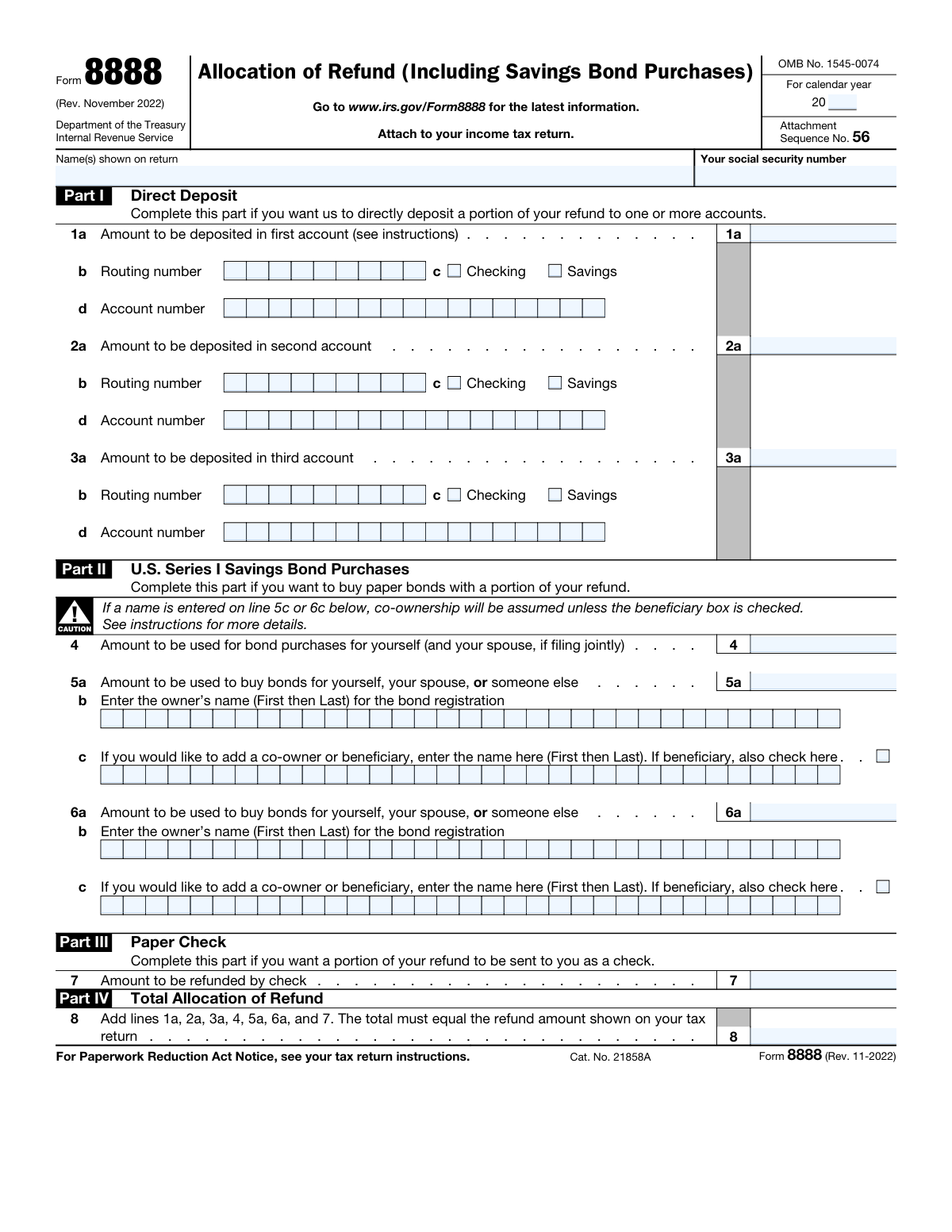
| 1. | Form 8888, Allocation of Refund (Including Savings Bond Purchases) | 1 | Basic 34 |
| 2. | FS Form 5179, Legacy Treasury Direct Security Transfer Request | 1 | Moderate 46 |
- Enterprise-grade security & data encryption
- 99%+ accuracy powered by AI
- 1,000+ forms from all industries
- Complete forms in under 60 seconds
How to Choose the Right Form
Understanding Your Treasury Transfer Options
Navigating the process of managing savings bonds and Treasury securities requires selecting the specific document that matches your account type and your ultimate goal. While many visitors searching this category may also be looking for IRS tax forms or an IRS EIN number application, the primary form available here focuses specifically on the movement of existing government securities.
When to Use FS Form 5179
The FS Form 5179, Legacy Treasury Direct Security Transfer Request is the essential document for holders of older Treasury accounts. You should choose this form if you fall into one of the following scenarios:
- Modernizing Your Account: You want to move your securities from the older, statement-based Legacy Treasury Direct system into a modern, online TreasuryDirect account.
- External Transfers to Brokerages: You need to move your Treasury securities to a private financial institution or a brokerage firm (this is often referred to as a transfer to the commercial book-entry system).
- Internal Transfers to Other Holders: You are transferring ownership or moving securities to another person’s Legacy Treasury Direct account.
Distinguishing Transfers from Tax Filings
It is important to ensure you are not confusing security transfers with tax obligations. If your goal is related to the following, FS Form 5179 is likely not what you need:
- Tax Identification: If you need a federal employer identification number application or want to get an EIN from the IRS, you should look for Form SS-4 rather than Treasury transfer forms.
- Refunds and Extensions: If you are looking for an IRS extension for taxes or checking an IRS refund amended return, you require specific IRS tax forms (such as Form 4868 or 1040-X).
- Cashing Out: If you simply wish to redeem a paper savings bond for cash, you may need FS Form 1522, depending on the circumstances.
By using FS Form 5179 through Instafill.ai, you can ensure your transfer request is completed accurately, helping you avoid delays in moving your government securities.
Form Comparison
| Form | Purpose | Transfer Destination | Who Files It |
|---|---|---|---|
| FS Form 5179, Legacy Treasury Direct Security Transfer Request | Requesting the transfer of securities held in a Legacy Treasury Direct account. | Internal Legacy accounts, modern TreasuryDirect accounts, or external financial brokerages. | Owners or authorized representatives of a Legacy Treasury Direct account. |
Tips for savings bond forms
One of the most common errors is transposing digits in your Legacy Treasury Direct or destination account numbers. Always double-check these figures against your official statements to ensure the transfer reaches the correct recipient without processing delays.
FS Form 5179 allows for internal transfers to other Legacy accounts, modern TreasuryDirect accounts, or external brokerages. Ensure you check the correct box for your specific transaction type, as choosing the wrong destination can lead to a rejection of the entire request.
Many Treasury forms require a certified signature from a financial institution rather than a standard notary public. Check the form instructions to see if you need a Medallion Signature Guarantee to validate your identity before mailing the physical document.
AI-powered tools like Instafill.ai can complete complex savings bond forms in under 30 seconds with high accuracy. Your data stays secure during the process, making it a practical time-saver for those managing multiple security transfers or tax documents.
Before mailing your security transfer request, scan or photograph the completed form for your personal records. Having a copy allows you to quickly reference the transaction details if you need to follow up with the Treasury Department regarding the status of your transfer.
Treasury forms often have specific processing centers that can change over time. Always check the latest instructions for FS Form 5179 to ensure you are sending your paperwork to the current designated Treasury address rather than an outdated location.
Federal agencies frequently update their forms and instructions to reflect new regulations. Ensure you are using the most recent version of the FS Form 5179 to avoid processing delays caused by outdated layouts or missing information fields.
Frequently Asked Questions
Savings bond forms are official documents used to manage, transfer, or redeem government securities like Series EE, HH, or I bonds. These forms allow bondholders to update account information, change ownership, or move securities between different Treasury systems such as Legacy Treasury Direct and the modern TreasuryDirect platform.
FS Form 5179 is specifically for individuals holding securities in a Legacy Treasury Direct account who wish to transfer those assets. This might include moving securities to a modern online TreasuryDirect account or transferring them externally to a private brokerage or financial institution.
Yes, you can use AI-powered tools like Instafill.ai to automate the process of filling out savings bond forms. These tools accurately extract data from your source documents and place it into the correct fields on the PDF, significantly reducing the chance of manual entry errors.
Using AI technology, you can complete complex documents like FS Form 5179 in under 30 seconds. This allows you to focus on the certification and mailing process rather than spending time manually typing in long account numbers and security details.
Most Treasury forms, including those for savings bonds and security transfers, must be mailed to the Bureau of the Fiscal Service. The specific mailing address is usually provided in the instructions section of the form itself, as it can vary based on the type of request being made.
Many savings bond forms require a certified signature, which means you must sign the document in the presence of an authorized certifying officer, typically at a bank or credit union. This step is a security measure to prevent unauthorized transfers or redemptions of government debt.
Generally, you will need the bond's serial numbers, the owner's Social Security number, and specific account details for both the sending and receiving institutions. Having your source documents ready before you start the form ensures a smoother and more accurate completion process.
Yes, the Bureau of the Fiscal Service uses different forms depending on whether the securities are held in paper form, in the older Legacy system, or in the modern online system. Identifying where your securities are currently held is the first step in choosing the correct form for your needs.
While some forms are for general transfers between living owners, others are designed specifically for settling estates or transferring bonds to heirs. It is important to check the specific requirements for inherited securities, as additional legal documentation may be required alongside the standard forms.
You would typically request an external transfer if you want to move your Treasury securities to a private brokerage account for easier management alongside your other investments. This requires the receiving institution's routing information and specific account details to be entered on the transfer form.
Glossary
- Form Complexity Index
- Instafill’s 0–100 measure of how much effort a form takes to complete, calculated deterministically from the form’s own structure rather than estimated. It combines the number of fillable fields (the largest factor), how difficult those fields are to complete based on their type, the number of pages that contain fields, the amount of conditional “fill-only-if” logic, and how many sections the form is divided into, then adds modifiers for tables and repeating lists, bundled instruction pages, and dense page layouts. A higher score means the form is harder to fill out by hand. The forms in this category have a median Form Complexity Index of 46/100 (Moderate). See exactly how it is calculated.
- Legacy Treasury Direct
- An older system used by the U.S. Treasury to hold securities in electronic form before the current online TreasuryDirect system was established.
- TreasuryDirect
- The modern, web-based system provided by the U.S. Department of the Treasury for investors to purchase and manage federal securities online.
- Medallion Signature Guarantee
- A specific certification stamp required for the transfer of securities that verifies the identity and legal authority of the person signing the form.
- Book-entry Form
- A method of tracking ownership of securities where no physical paper certificate is issued, and ownership is instead recorded in electronic records.
- CUSIP Number
- A unique nine-character identification code assigned to all North American stocks and registered bonds to facilitate clearing and settlement.
- Security Transfer
- The formal process of moving ownership of a bond or note from one account holder to another, or between different financial systems.
- Series I Savings Bond
- A U.S. government savings bond that earns interest based on both a fixed rate and a semiannual inflation rate.
- Fiscal Service (FS)
- The bureau of the U.S. Department of the Treasury responsible for managing government accounting, debt collection, and the issuance of savings bonds.