Yes! You can use AI to fill out European Public Prosecutor’s Office (EPPO) Application Form

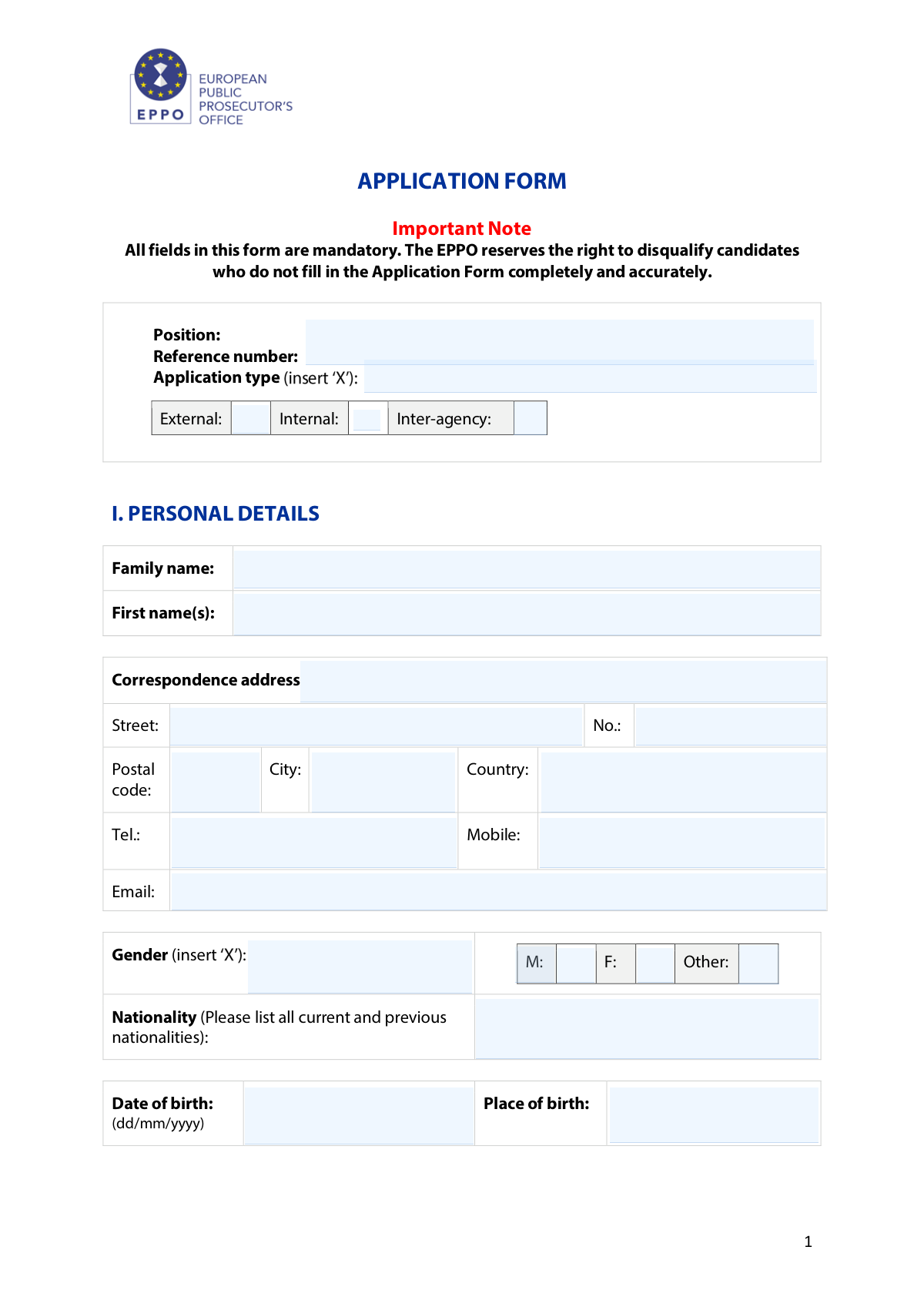
The EPPO Application Form is an official candidate application document for roles advertised by the European Public Prosecutor’s Office, requiring complete and accurate information to be considered for selection. It captures identity and contact details, eligibility-related declarations, structured evidence against selection criteria, employment history, education and training, language proficiency, references, and motivation for the post. Because all fields are mandatory and incomplete/incorrect submissions may be disqualified, careful completion is essential. Today, this form can be filled out quickly and accurately using AI-powered services like Instafill.ai, which can also convert non-fillable PDF versions into interactive fillable forms.
Our AI automatically handles information lookup, data retrieval, formatting, and form filling.
It takes less than a minute to fill out EPPO Application Form using our AI form filling.
Securely upload your data. Information is encrypted in transit and deleted immediately after the form is filled out.

Form specifications

Form name: European Public Prosecutor’s Office (EPPO) Application Form
Number of pages: 14
Language: English
Categories: EPPO forms, EU agency forms, European Union forms, legal application forms
main-image

Instafill Demo: filling out a legal form in seconds

How to Fill Out EPPO Application Form Online for Free in 2026

Are you looking to fill out a EPPO APPLICATION FORM form online quickly and accurately? Instafill.ai offers the #1 AI-powered PDF filling software of 2026, allowing you to complete your EPPO APPLICATION FORM form in just 37 seconds or less.
Follow these steps to fill out your EPPO APPLICATION FORM form online using Instafill.ai:
  1. 1 Go to Instafill.ai and upload the EPPO Application Form PDF (or select it from the form library if available).
  2. 2 Let the AI detect and map the form fields, then confirm the form type (EPPO Application Form) and review required sections (Personal Details, Professional Experience, Education, Motivation, Declaration).
  3. 3 Provide your personal details (name, address, contact info, gender, nationalities, birth details) and select the correct application type (External/Internal/Inter-agency) and position/reference number.
  4. 4 Enter your professional experience: write responses to essential and advantageous selection criteria (keeping each criterion within the word limit) and complete present/previous employment tables with dates, FT/PT status, duties, and employer contact permissions.
  5. 5 Complete education and training history (formal education levels, courses), add language skills using CEFR levels, and provide at least two professional references plus the source channel where you found the vacancy.
  6. 6 Draft and paste your motivation statement (max 500 words), then complete the Declaration of Honour with name/date (and prepare to sign if requested at interview stage).
  7. 7 Run Instafill.ai validation to check mandatory fields, date formats, and word limits, then export the finalized PDF for submission according to the vacancy notice instructions.

Our AI-powered system ensures each field is filled out correctly, reducing errors and saving you time.

Why Choose Instafill.ai for Your Fillable EPPO Application Form Form?

Speed

Complete your EPPO Application Form in as little as 37 seconds.

Up-to-Date

Always use the latest 2026 EPPO Application Form form version.

Cost-effective

No need to hire expensive lawyers.

Accuracy

Our AI performs 10 compliance checks to ensure your form is error-free.

Security

Your personal information is protected with bank-level encryption.

Frequently Asked Questions About Form EPPO Application Form

This form is used to apply for a specific vacancy at the European Public Prosecutor’s Office (EPPO). It collects your personal details, professional experience, education, language skills, references, motivation, and a declaration of honour.

Anyone applying to an EPPO vacancy using this template must complete it, whether applying as an External, Internal, or Inter-agency candidate. You must also enter the position title and reference number exactly as shown in the vacancy notice.

Yes—according to the form’s “Important Note,” all fields are mandatory and EPPO may disqualify candidates who do not complete the form fully and accurately. If a section allows it, you can write “n/a” (for example, for selection criteria you choose not to address).

Mark an “X” in only one box that matches your situation: External (not employed by EPPO), Internal (currently employed within the organisation), or Inter-agency (applying via an inter-agency arrangement). If you are unsure, check the vacancy notice or your HR contact for the correct category.

Respond to each criterion using the same letter labels (a, b, c, d) as in the vacancy notice and provide concrete examples. Keep each criterion response to 200 words or fewer, and write “n/a” for any criterion you do not wish to address (if permitted).

List your present/most recent job first and then go backwards in time (reverse chronological order). Only include jobs for which you can provide proof of the period actually worked (e.g., a contract or certification).

Select PT and indicate the percentage compared to full-time (for example, 50% or 80%). If you worked full-time, select FT instead.

Yes, you may include traineeships/internships, but you should clearly state this in the “Exact title of position” field and indicate whether it was paid. As with other roles, include it only if you can provide documentation of the period worked.

This asks whether EPPO may contact your current employer if needed during the process. If you have confidentiality concerns, you can select “No,” but be prepared to provide alternative verification or references if requested.

You can answer YES or NO to indicate whether you have objections. If you object, EPPO may still need other ways to verify your experience, so ensure your references and documentation are strong and available.

Include only studies for which you have an official certificate or diploma, and complete the relevant level(s) (post-graduate, higher education, post-secondary, secondary). Provide dates, the diploma title in the original language, and the institution’s name and address.

List your mother tongue and then rate other languages for written, spoken, and understanding using CEFR levels (e.g., A1–C2) as referenced in the form. Be consistent across the three skill columns for each language.

You must provide at least two of your most recent professional references, preferably direct superiors. References should be persons (not relatives), and by listing them you confirm EPPO may contact them if needed.

Explain why you are applying and how your background fits the post, focusing on the role’s requirements and your relevant achievements. The motivation section has a maximum of 500 words.

Yes—AI tools can help you draft responses and auto-fill fields; services like Instafill.ai use AI to populate form fields accurately and save time. You can upload the PDF to Instafill.ai, map your information (CV/profile) to the form fields, review each section (especially word limits and lettered criteria), and then export a completed PDF for submission.

If the PDF is “flat” (non-fillable), you can use Instafill.ai to convert it into an interactive fillable form and then complete it digitally. After conversion, review formatting (dates, checkboxes, and tables) before saving the final version.

Compliance EPPO Application Form
Validation Checks by Instafill.ai

1
Mandatory field completeness across all sections
Validates that every field marked as mandatory is populated, including Personal Details, Professional Experience, Education, Language Skills, References, Source, Motivation, and Declaration of Honour. This is critical because the form explicitly states incomplete applications may be disqualified. If any required field is empty (or contains only whitespace), the submission should be blocked and the applicant prompted to complete the missing items.
2
Position title and vacancy reference number format/consistency
Checks that the Position/Reference number field is present and matches the expected pattern from the vacancy notice (e.g., contains a reference identifier, not free-form text only). This prevents misrouting applications to the wrong recruitment procedure and supports automated filing. If the value is missing or does not match the expected reference format, the system should flag it for correction or manual review.
3
Application type selection is exactly one of External/Internal/Inter-agency
Ensures the applicant marks exactly one application type (External, Internal, or Inter-agency) and does not select multiple or none. This is important because eligibility rules and processing steps may differ by application type. If zero or more than one option is selected, validation fails and the applicant must choose a single type before submission.
4
Gender selection mutual exclusivity and box logic
Validates that only one gender option is selected (M, F, or Other) and that any auxiliary selection boxes are used consistently (e.g., do not mark both M and F, and do not fill secondary gender boxes unless required by the form design). This prevents ambiguous demographic data and downstream reporting errors. If conflicting selections are detected, the system should reject the submission until the applicant corrects the selection.
5
Date of birth format and plausibility checks
Checks that Date of birth is provided in dd/mm/yyyy format and represents a real calendar date. It also validates plausibility (e.g., not in the future and within a reasonable human age range such as 14–100 years, unless policy specifies otherwise). If the date is invalid or implausible, the system should require correction to avoid identity and eligibility issues.
6
Email address syntax and deliverability safeguards
Validates that the email address is present and conforms to standard email syntax (local-part@domain) and that the domain portion is plausible (e.g., contains a dot and no illegal characters). This matters because email is a primary communication channel for recruitment updates. If invalid, the system should block submission or require an alternate valid email to prevent lost communications.
7
Telephone and mobile number format validation (E.164-friendly)
Ensures telephone and mobile numbers contain only allowed characters (digits, spaces, +, parentheses, hyphens) and meet minimum length requirements appropriate for international dialing. This reduces failed contact attempts and supports consistent storage/normalization. If a number is too short, contains invalid characters, or is clearly malformed, validation fails and the applicant must correct it.
8
Correspondence address completeness and structure
Validates that the correspondence address is complete: street name, house number, postal code, city, and country must all be present (even if the applicant also provides a full one-line address). This is important for reliable postal correspondence and for verifying residency-related requirements if applicable. If any component is missing, the system should prompt for the missing address parts rather than accepting only a partial address.
9
Postal code and country coherence
Checks that the postal code format is compatible with the selected country (e.g., numeric-only for some countries, alphanumeric for others, expected length ranges). This improves address quality and reduces returned mail. If the postal code does not match the country’s expected pattern, the system should warn or block submission depending on strictness requirements.
10
Nationality list presence and parsing rules
Validates that the nationality field is not empty and contains at least one country name, with multiple nationalities separated in a consistent way (e.g., commas). This is important because the form requests all current and previous nationalities and nationality can affect eligibility. If the field is blank or contains non-country placeholders (e.g., 'N/A' when not allowed), the submission should be rejected or routed for manual verification.
11
Selection criteria responses: word limit and 'n/a' handling
Ensures each selection criterion response does not exceed 200 words and that any intentionally unanswered criterion is explicitly marked as 'n/a' as instructed. This is necessary for fair evaluation and to comply with the vacancy notice constraints. If a response exceeds the limit or is left blank without 'n/a', the system should fail validation and request edits.
12
Employment period date format and chronological consistency
Validates that each employment entry has From/To dates in dd/mm/yyyy format and that From is not after To (unless To is intentionally blank for a current job, if allowed by the implementation). This prevents impossible timelines and supports accurate experience calculations. If dates are invalid or reversed, the entry should be rejected and the applicant prompted to correct the period.
13
Employment workload selection and part-time percentage rules
Checks that each job entry indicates either FT or PT (not both), and if PT is selected, a percentage is provided and is a valid number within 1–99 (or 1–100 if policy allows 100 for PT). This is important for consistent interpretation of experience and workload. If PT is selected without a percentage, or if both FT and PT are selected, validation fails for that job entry.
14
Employment entry completeness when any job row is used
Ensures that if an employment row contains any data (e.g., employer name), then all key fields for that row are completed: employer name/address, exact title, duties description, and dates (and FT/PT). This prevents partially entered jobs that cannot be assessed or verified by contract/certification as required by the form. If a row is partially filled, the system should require completion or removal of the row.
15
Employer contact permission logic consistency
Validates that the question 'May we contact your present employer?' is answered Yes or No, and that the later question about objections to contacting employers for a reserve list is also answered. This matters for compliance with applicant consent and for planning reference checks. If either consent/objection field is missing, the system should block submission until the applicant provides a clear choice.
16
References: minimum count and contact detail validation
Checks that at least two professional references are provided and that each reference includes name, relationship, telephone number, and email address in valid formats (and is not obviously a relative if the relationship field indicates so). This is important because references are required for verification and the form explicitly requests non-relatives, preferably direct superiors. If fewer than two references are provided or contact details are invalid/missing, the submission should fail validation and request additional/complete references.

Common Mistakes in Completing EPPO Application Form

Leaving mandatory fields blank or using placeholders

Because the form is long and repetitive, applicants often skip fields they think are optional (e.g., “No.” for house number, “Period of notice,” or parts of education/training) or leave placeholders like “—” instead of real values. The form explicitly states all fields are mandatory, and EPPO may disqualify candidates for incomplete or inaccurate forms. Avoid this by completing every field; if something truly does not apply, write a clear “n/a” (only where the form allows it, such as selection criteria responses). AI-powered tools like Instafill.ai can flag missing required fields before submission and ensure nothing is accidentally left empty.

Incorrect date format (not using dd/mm/yyyy) and inconsistent timelines

Applicants frequently enter dates in their local format (mm/dd/yyyy or yyyy-mm-dd) or provide partial dates (month/year only), especially across employment and education sections. This can create apparent gaps, overlaps, or eligibility issues when EPPO calculates experience and verifies certificates/contracts. Always use dd/mm/yyyy everywhere and double-check that “From” is earlier than “To,” with no unexplained overlaps. Instafill.ai can automatically format dates correctly and validate that timelines are consistent.

Not matching selection criteria letters and exceeding the 200-word limit

In the selection criteria section, people often write a single narrative paragraph, forget to label answers a), b), c), d), or respond to the wrong criterion letter compared to the vacancy notice. Another common issue is exceeding the 200-word limit per criterion, which can lead to content being ignored or the application being considered non-compliant. Use a clearly lettered structure that mirrors the vacancy notice and keep each criterion under 200 words, using concrete examples. Instafill.ai can help enforce word limits and keep responses aligned to the correct criterion fields.

Claiming experience without being able to certify it (contracts/certificates)

The form asks you to list only jobs for which you can provide certification of the period actually worked, but applicants often include informal work, undeclared work, or roles where they cannot obtain documentation. This can cause verification failures later and may reduce counted experience or jeopardize the application if inconsistencies appear. Only include roles you can document (contract, employer certificate, official letter) and be prepared to provide proof quickly. Instafill.ai can prompt you to confirm documentation availability for each role before it’s added.

Misreporting part-time work (missing percentage or wrong FT/PT selection)

Applicants commonly tick FT and PT inconsistently, forget to provide the PT percentage, or enter a weekly-hours figure instead of a percentage compared to full-time. This affects how EPPO calculates total professional experience and can lead to undercounting or requests for clarification. If part-time, always specify the percentage (e.g., 50%, 80%) and ensure it matches your contract. Instafill.ai can standardize PT entries and validate that a percentage is present whenever PT is selected.

Incorrect or incomplete employer details and job titles

People often provide only the company name without the full address, use internal abbreviations, or list a generic job title that doesn’t match the contract (e.g., “Manager” instead of the exact contractual title). This creates problems when EPPO tries to verify employment and assess relevance to the role. Enter the employer’s full legal name and address and use the exact title from your contract or official HR documentation. Instafill.ai can help normalize employer/address formatting and remind you to use the contractual job title.

Weak duties descriptions that don’t evidence responsibilities or selection criteria

Applicants frequently paste a generic CV summary or a list of tasks without scope, outcomes, or relevance (e.g., no tools, no stakeholders, no deliverables). This makes it harder for evaluators to map your experience to the vacancy requirements and can reduce your score even if you are qualified. Write duty descriptions with specifics: responsibilities, scale, outputs, and measurable results, and ensure they support the essential/advantageous criteria. Instafill.ai can help structure duties into clear, criteria-relevant bullet points while keeping within space constraints.

Nationality field errors (not listing previous nationalities or using non-standard entries)

Because the field requests all current and previous nationalities, applicants often list only their current nationality or enter adjectives (e.g., “French”) instead of country names (e.g., “France”). Missing previous nationalities can trigger follow-up questions or be treated as incomplete/incorrect information under the Declaration of Honour. List every nationality you have held, past and present, using full country names separated by commas. Instafill.ai can standardize country naming and prompt for previous nationalities when relevant.

Contact details not in international format or using an unreliable email

Applicants often omit country codes on phone numbers, mix spaces/symbols inconsistently, or provide an email address they rarely check (or one with typos). This can cause missed interview invitations, verification calls, or time-sensitive requests, which may effectively end the candidacy. Use international phone format (e.g., +32 
) and a primary email you monitor daily, then re-check for typos. Instafill.ai can validate email syntax and normalize phone numbers to international format.

Language skills not using CEFR levels or mixing written/spoken/understanding

The form asks for CEFR levels and separates written, spoken, and understanding, but applicants often write vague terms (“fluent,” “good,” “basic”) or provide one level for everything. This can lead to inconsistent interpretation and may weaken your profile if the vacancy requires specific language competence. Use CEFR levels (A1–C2) for each skill area and be realistic and consistent with evidence (certificates, work usage). Instafill.ai can map common descriptors to CEFR and ensure each language has all three skill ratings completed.

References that are not acceptable or missing consent/complete details

Applicants sometimes list relatives, friends, or outdated contacts, or they omit key details like relationship, phone number, or email. EPPO requests at least two most recent professional references (preferably direct superiors) and the form text implies consent to contact them; incomplete or inappropriate references can delay checks or raise credibility concerns. Choose recent professional referees, confirm their contact details, and ensure they are willing to be contacted. Instafill.ai can enforce completeness (name/phone/email/relationship) and prompt you to confirm referee consent.
Saved over 80 hours a year

“I was never sure if my IRS forms like W-9 were filled correctly. Now, I can complete the forms accurately without any external help.”

Kevin Martin Green

Your data stays secure with advanced protection from Instafill and our subprocessors

Robust compliance program

Transparent business model

You’re not the product. You always know where your data is and what it is processed for.

ISO 27001, HIPAA, and GDPR

Our subprocesses adhere to multiple compliance standards, including but not limited to ISO 27001, HIPAA, and GDPR.

Security & privacy by design

We consider security and privacy from the initial design phase of any new service or functionality. It’s not an afterthought, it’s built-in, including support for two-factor authentication (2FA) to further protect your account.

Fill out EPPO Application Form with Instafill.ai

Worried about filling PDFs wrong? Instafill securely fills european-public-prosecutors-office-eppo-application-form forms, ensuring each field is accurate.