
Yes! You can use AI to fill out QBCC Licence Application Form – Company (Application made under section 33, Queensland Building and Construction Commission Act 1991)
Don't type 276 fields by hand. Tell our AI about yourself, or upload a document you already have, and it fills every field in seconds. You check it, then download, print or sign.
The AI does the filling. You just check it.
No typing into boxes, nothing to install.
What this form asks for
The AI fills all of it, from your answers or your documents.
The AI checks your answers before you download
16 checks built for this form, so a wrong date or a missing answer is caught before anyone else sees it.
Checks that the company name field is completed and appears to match the legal entity name shown on the attached ASIC Current and Historical Company Extract (e.g., no missing “Pty Ltd”, no trading name entered as the legal name). This is important because the licence is issued to the legal entity and mismatches can cause identity and registration errors. If validation fails, the submission should be flagged for correction and the application should not proceed until the legal name is confirmed.
Ensures ACN is exactly 9 digits and ABN is exactly 11 digits, numeric-only, with no spaces or letters (optionally applying standard checksum validation for each). This prevents processing delays and failed cross-checks with government registries. If validation fails, the form should be rejected or returned for correction because the applicant cannot be reliably identified.
Checks that an ASIC Current and Historical Company Extract is attached (not a “current extract” only) and that the extract issue date is no more than 30 days before the QBCC receipt date (or submission date if used as a proxy). This is critical because QBCC relies on up-to-date office holder and company status information. If missing, wrong type, or too old, the application should be marked incomplete and prevented from progressing to assessment.
Verifies that all phone and email fields are completed as stated in the form instructions, and that phone numbers follow an acceptable Australian format (e.g., 10 digits for landline/mobile, allowing spaces) and email matches a standard email pattern. Accurate contact details are required for requests for further information and outcome notifications. If validation fails, the submission should be returned for completion because QBCC may be unable to contact the applicant.
Checks that business address, suburb, state, and postcode are provided and that the business address does not contain PO Box indicators (e.g., “PO Box”, “GPO Box”, “Locked Bag”, “Post Office”). The form explicitly requires a physical business address for public register listing and compliance. If validation fails, the applicant should be prompted to provide a valid physical address or an acceptable alternative (e.g., solicitor/accountant address).
Ensures registered and postal address sections are fully completed (address line, suburb, state, postcode) and that state abbreviations are valid Australian states/territories (QLD, NSW, VIC, ACT, TAS, SA, WA, NT) with postcodes in a plausible range for that state. This reduces returned mail and incorrect public register entries. If validation fails, the application should be flagged for correction before acceptance.
And 10 more checks
- Validates Director/Secretary Declaration Signature Rules and Hand-Signature Requirement
- Validates Declaration Signature Dates are Present, Properly Formatted, and Within 30 Days of Receipt
- Validates Office Holder Identity Section Completeness for All ASIC-Listed Office Holders
- Validates Certified Photo ID Provided for Each Office Holder and Nominee
- Validates Name Change Logic and Supporting Documents for Office Holders/Nominees
- Validates QBCC Licence Number Requirement When Applicant Indicates Prior/Current QBCC Licence
- Validates Nominee Details, Consent Signature, and Role Evidence Selection
- Validates Licence Class Selection and Nominee Coverage Consistency
- Validates PI Insurance Decision Tree and Required Attachments Based on Selected Classes
- Validates Financial Category Selection Rules and MFR Report Requirements
Let AI fill out your QBCC 01-130 LA COMP
No typing. Every field filled in seconds, checked, ready to sign.
How to Fill Out QBCC 01-130 LA COMP Online for Free in 2026
What the AI walks you through.
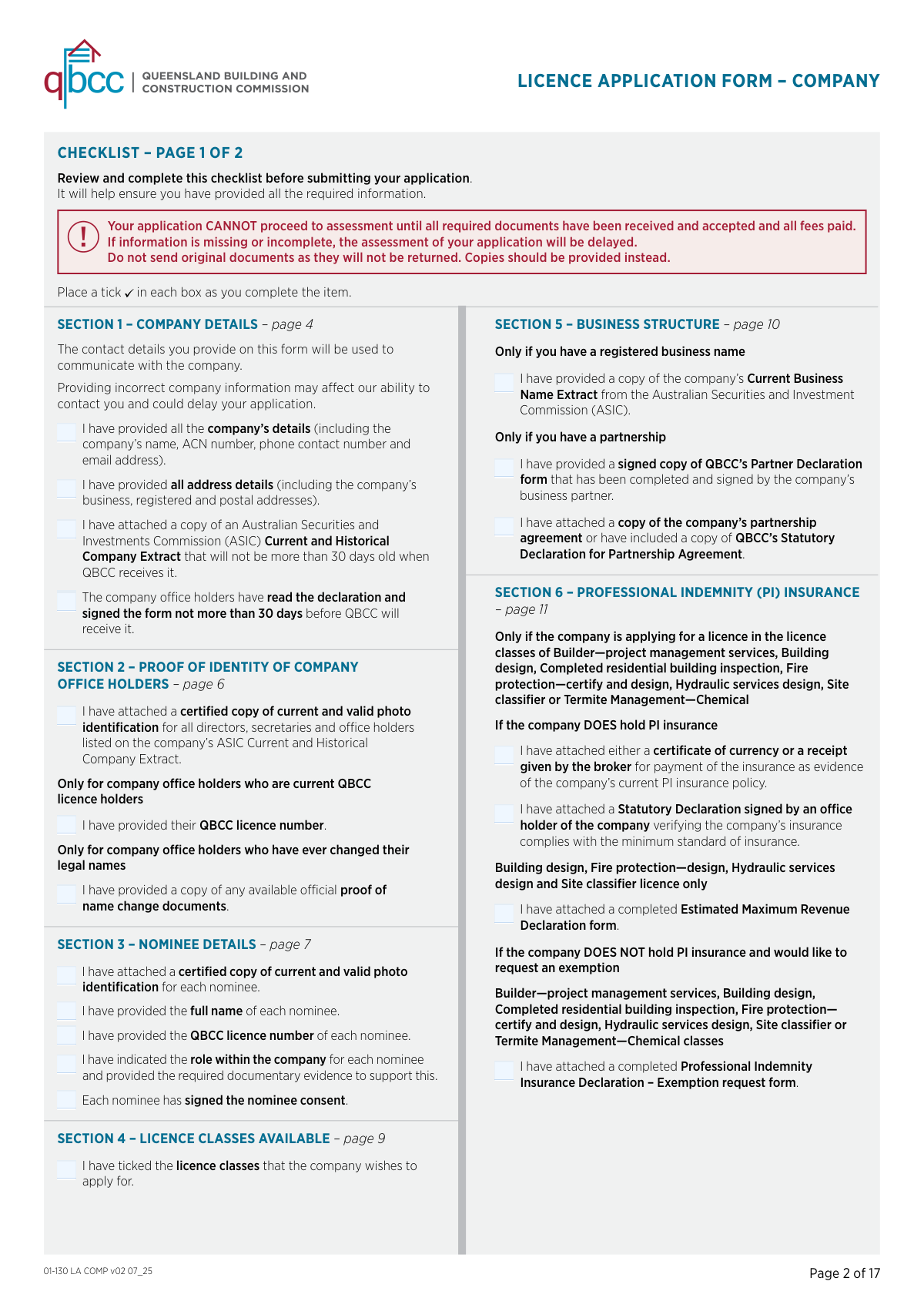
- Confirm you are using the correct form version (01-130 LA COMP v02 07_25) and review the checklist pages to understand all required attachments and certification rules (e.g., certified photo ID, ASIC extracts, MFR report where applicable).
- Complete Section 1 (Company Details): enter the company name, ACN/ABN, phone/email, and business/registered/postal addresses, and obtain an ASIC Current and Historical Company Extract dated within 30 days of QBCC receipt.
- Complete Section 2 (Proof of Identity – Company Office Holders): for each director/secretary/office holder listed on the ASIC extract, enter personal details, note any legal name changes, provide QBCC licence numbers if applicable, and upload certified copies of valid photo ID (front and back where required).
- Complete Section 3 (Nominee Details): add one or more nominees, enter their QBCC licence numbers, specify their role (employee or office holder), attach evidence of employment/position, have each nominee sign the consent, and attach certified nominee photo ID and any name-change documents.
- Complete Sections 4–6: select the licence class(es) the company is applying for, answer business structure questions (business name/partnership/trust) and attach required extracts/declarations, then determine whether Professional Indemnity (PI) insurance is required and attach the correct evidence or exemption request forms (and Estimated Maximum Revenue Declaration where required).
- Complete Sections 7–10: choose the correct financial category (SC1/SC2/Category 1–7) and attach an MFR report and signed financial statements if required; answer all legal eligibility/suitability questions and attach supporting documents for any “Yes” answers; provide interstate/NZ licence details if applicable; optionally attach an Authority to Act – Nominated Representative form.
- Complete Section 11 (Payment of Fees): calculate the total fee from the schedule (including optional certificate), choose payment method (in person or credit card by post), ensure the form is hand-signed (no digital signatures), then submit the full application package with all attachments by post or in person (do not email payment details).
Common Mistakes in Completing QBCC 01-130 LA COMP
The ones the AI is built to catch.
Providing the wrong ASIC extract (or an extract older than 30 days)
Using a PO Box as the business address (or leaving the physical business address blank)
Incomplete contact details (missing phone numbers or email)
Incorrect director/secretary signing arrangement (or missing a required signature)
Using digital signatures or not signing by hand
Signing too early and lodging after the 30-day window
Submitting uncertified or incomplete ID copies (e.g., missing back of licence)
Not disclosing previous legal names or failing to attach name-change evidence
Nominee does not meet eligibility (wrong licence type/class or insufficient evidence of role)
PI insurance section completed incorrectly (wrong pathway, missing statutory declaration/certificate/EMR form)
Selecting an ineligible financial category or misunderstanding maximum revenue thresholds
Frequently Asked Questions About QBCC 01-130 LA COMP
Is it really free for 7 days?
Can I fill other forms too?
How do I cancel?
How does the AI fill out QBCC 01-130 LA COMP?
What happens to my information?
How complex is QBCC 01-130 LA COMP to fill out?
What is this form used for?
Who needs to complete the Licence Application Form – Company?
How do I submit the completed application?
Can I complete the form online and email it to QBCC?
What documents must I include with my company application?
What is the ASIC document requirement, and why won’t a “current company extract” be accepted?
Do I need to send original documents?
What counts as a certified copy of ID, and who can certify it?
Who must sign the company declaration, and are digital signatures allowed?
Is there a time limit between signing the form and QBCC receiving it?
Do all companies need a nominee, and what licence must the nominee hold?
What evidence do I need to show the nominee is connected to the company?
When is Professional Indemnity (PI) insurance required, and what proof is needed?
Can I request an exemption from PI insurance requirements?
How do I choose the correct financial category, and when do I need an MFR report?
What happens if I answer “Yes” to any Legal Eligibility and Suitability questions?
How do I report interstate or New Zealand licences held by the company, office holders, or nominees?
How do I pay the application fee, and when will QBCC start processing my application?
Are application fees refundable if my application is unsuccessful?
Get your QBCC 01-130 LA COMP filled out by AI
$0 today. Cancel before Nov 1 and you pay nothing.
Other forms like this one
construction forms: State of California Department of Transportation Subcontractor List, Form DEP 4015, Application for Construction Permit, Onsite Sewage Treatment and Disposal System (OSTDS), Form DEP 4015, Application for Construction Permit for an Onsite Sewage Treatment and Disposal System (OSTDS)
Section 8 forms: Form I-485 Supp A, Adjustment of Status Under Section 245(i), QBCC Licence Application Form – Mutual Recognition (Application under section 19 of the Mutual Recognition Act 1992 (Cwlth) and section 18 of the Trans-Tasman Mutual Recognition Act 1997 (Cwlth)), ACORD 140 (2014/12), Property Section (Attach to ACORD 125), Building Regulation 2021 (Queensland) – Section 143A(3) – Form 18 (Version 6, March 2023), Notice to the owner (where owner is not the client) that a private certifier has been engaged, Order Instituting Administrative and Cease-and-Desist Proceedings, Pursuant to Sections 15(b) and 21C of the Securities Exchange Act of 1934 and Sections 203(e) and 203(k) of the Investment Advisers Act of 1940, Making Findings, and Imposing Remedial Sanctions and a Cease-and-Desist Order, SEC Application for an Order under Section 17(b) of the Investment Company Act of 1940 (File No. 812-11000), Tax Sheltered Annuity (TSA) IRC Section 403(b) Distribution Request, Affidavit for Collection of Personal Property California Probate Code Section 13100, ACORD 131, Umbrella / Excess Liability Section, ACORD 125, Commercial Insurance Application and ACORD 143, Transportation Section, Official Certificate of Marriage, Section 50(1)(b) of the Marriage Act 1961 (Cth), Form 1023, Application for Recognition of Exemption Under Section 501(c)(3) of the Internal Revenue Code, ACORD 125, Commercial Insurance Application, Applicant Information Section, Notice to Employee (Labor Code section 2810.5), ACORD 147 (2001/02), Installation/Builders Risk Section, ACORD 126 (2010/05), Commercial General Liability Section, ACORD 126 (2009/08), Commercial General Liability Section, Form CMS-1561, Health Insurance Benefit Agreement
Queensland building forms: Building Regulation 2021 (Queensland) – Section 143A(3) – Form 18 (Version 6, March 2023), Notice to the owner (where owner is not the client) that a private certifier has been engaged
SEC forms: Form 4137, Social Security and Medicare Tax on Unreported Tip Income, Form 8919, Uncollected Social Security and Medicare Tax, Form SS-5-FS, Application for a Social Security Card, Form SSA-4-BK, Application for Social Security Benefits, Form I-485 Supp A, Adjustment of Status Under Section 245(i), Form 104, List of Creditors 20 Largest Unsecured Claims, Form SSA-8000-BK, Application for Supplemental Security Income (SSI), Form SSA-1042S, Social Security Benefit Statement, QBCC Licence Application Form – Mutual Recognition (Application under section 19 of the Mutual Recognition Act 1992 (Cwlth) and section 18 of the Trans-Tasman Mutual Recognition Act 1997 (Cwlth)), ACORD 140 (2014/12), Property Section (Attach to ACORD 125), Form SSA-3369-BK, Work History Report (Social Security Administration), European Public Prosecutor’s Office (EPPO) Application Form, Washington Single-Family Property Term Lease & Security Deposit Receipt (WA Single-Family Lease) | Revised 10/08/2025, Form 8919, Uncollected Social Security and Medicare Tax on Wages, VA Form 21-0781a, Statement in Support of Claim for Service Connection for Post-Traumatic Stress Disorder (PTSD) Secondary to Personal Assault, Louisiana Secretary of State – Notice of Change of Registered Office and/or Change of Registered Agent (Domestic Limited Liability Company) (R.S. 12:1308) (Form SS983, Rev. 01/24), Building Regulation 2021 (Queensland) – Section 143A(3) – Form 18 (Version 6, March 2023), Notice to the owner (where owner is not the client) that a private certifier has been engaged, Form SSA-827 (06-2024), Authorization to Disclose Information to the Social Security Administration (SSA), Intra-Brokerage Securities Transfer, Order Instituting Administrative and Cease-and-Desist Proceedings, Pursuant to Sections 15(b) and 21C of the Securities Exchange Act of 1934 and Sections 203(e) and 203(k) of the Investment Advisers Act of 1940, Making Findings, and Imposing Remedial Sanctions and a Cease-and-Desist Order
company forms: Form S-1, Surety Company Annual Report, National Integrity Life Insurance Company Ownership Change Request Form (NI-77-0039-2505), California Form 568 (2024), Limited Liability Company Return of Income, Continental American Insurance Company (CAIC) / Aflac Group Critical Illness Claim Form (with Attending Physician’s Statement, HIPAA Authorization to Obtain Information, and Electronic Funds Transaction Authorization), Brotherhood Mutual Insurance Company Ministry Driver Screening Form (A99), Assurity Life Insurance Company Disability Claim Form — Attending Physician’s Statement, Due Diligence Form (Australian Company) – The Perth Mint, The Prudential Insurance Company of America Group Disability Insurance – Education and Employment History Form (GL.2009.009, Ed. 06/2017), Pennsylvania Department of State — Certificate of Termination (Domestic Limited Liability Company) (15 Pa.C.S. § 8872(f)) (DSCB:15-8872(f)), Louisiana Secretary of State – Notice of Change of Registered Office and/or Change of Registered Agent (Domestic Limited Liability Company) (R.S. 12:1308) (Form SS983, Rev. 01/24), Form LLC1050, Articles of Cancellation of a Virginia Limited Liability Company, HDFC ERGO General Insurance Company Limited – Request for Cashless Hospitalisation for Health Insurance (Policy Part – C), Anmeldung zum R+V-Firmenportal Vorsorge (Registration for the R+V Company Portal for Pensions), Beneficiary Designation/Change - Principal Life Insurance Company, Principal Life Insurance Company UCTIE INTERNATIONAL UNION 401(K) SAVINGS PLAN Enrollment Form, Principal Life Insurance Company Death Notification Form, Principal Life Insurance Company Form PG4701, In-Plan Roth Conversion – No Spousal Consent Needed, Principal Life Insurance Company Administration Guide, Principal Life Insurance Company Small Amounts Benefit Election, SEC Application for an Order under Section 17(b) of the Investment Company Act of 1940 (File No. 812-11000)
Let AI fill out your QBCC 01-130 LA COMP
Your trial starts once a card is added. You pay nothing before Nov 1.
Our AI already knows this form, all 276 fields of it. Skip the typing: tell it about yourself, or upload what you have, and it fills the whole form in seconds.
- AI fills every field on all 16 pages, checkboxes included
- No typing into boxes: answer a few questions, or upload a document you already have, an old copy of this form, a photo of a document
- The AI checks the answers; you review and change anything before you download
- Download the finished PDF, print it, or sign it online
- Encrypted, and never used to train AI
Cancel before Nov 1 and you pay nothing.
A card is needed to start the trial. Cancel in two clicks from your account.
Terms · Privacy