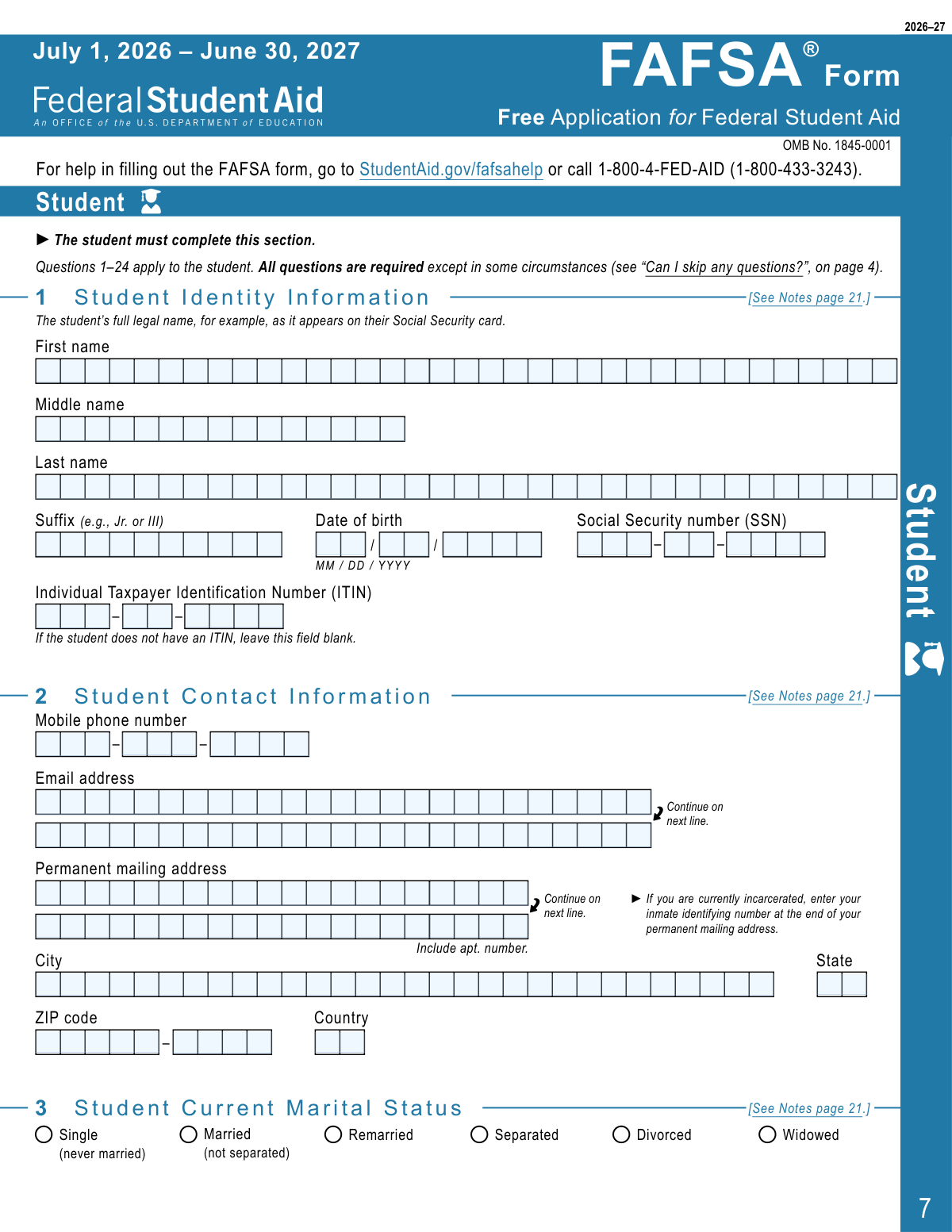
Yes! You can use AI to fill out 2026–27 FAFSA® Form, Free Application for Federal Student Aid

The FAFSA (Free Application for Federal Student Aid) is the official form students and their families use to apply for financial assistance for college or career school. Submitting this application is the first step in the financial aid process to determine eligibility for federal aid like grants, work-study, and loans, and it is also used by most states and colleges to award nonfederal aid. Today, this form can be filled out quickly and accurately using AI-powered services like Instafill.ai, which can also convert non-fillable PDF versions into interactive fillable forms.
Our AI automatically handles information lookup, data retrieval, formatting, and form filling.
It takes less than a minute to fill out FAFSA using our AI form filling.
Securely upload your data. Information is encrypted in transit and deleted immediately after the form is filled out.

Form specifications

Form name: 2026–27 FAFSA® Form, Free Application for Federal Student Aid
Number of pages: 20
Language: English
Categories: student aid forms, federal forms, student application forms
main-image

Instafill Demo: How to fill out PDF forms in seconds with AI

How to Fill Out FAFSA Online for Free in 2026

Are you looking to fill out a FAFSA form online quickly and accurately? Instafill.ai offers the #1 AI-powered PDF filling software of 2026, allowing you to complete your FAFSA form in just 37 seconds or less.
Follow these steps to fill out your FAFSA form online using Instafill.ai:
  1. 1 Navigate to Instafill.ai and upload or select the 2026-27 FAFSA® Form.
  2. 2 Use the AI assistant to accurately fill in the student's identity, contact information, and personal circumstances.
  3. 3 Provide the student's financial information, consenting to the secure transfer of federal tax information from the IRS or entering it manually.
  4. 4 If required, invite contributors such as parents or a spouse to provide their personal and financial information and give their consent for data transfer.
  5. 5 List the federal school codes for the colleges you want to receive your FAFSA information.
  6. 6 Review all sections for accuracy, including student, parent, and spouse information, then electronically sign and submit the completed application.

Our AI-powered system ensures each field is filled out correctly, reducing errors and saving you time.

Why Choose Instafill.ai for Your Fillable FAFSA Form?

Speed

Complete your FAFSA in as little as 37 seconds.

Up-to-Date

Always use the latest 2026 FAFSA form version.

Cost-effective

No need to hire expensive lawyers.

Accuracy

Our AI performs 10 compliance checks to ensure your form is error-free.

Security

Your personal information is protected with bank-level encryption.

Frequently Asked Questions About Form FAFSA

The FAFSA® (Free Application for Federal Student Aid) form is used to apply for federal student aid, such as grants, work-study, and loans for the 2026-27 school year. Most states and colleges also use FAFSA information to award their own financial aid.

For federal aid, you can apply between October 1, 2025, and June 30, 2027. However, many states and colleges have much earlier deadlines for their aid programs, so it is highly recommended to apply as soon as possible after October 1, 2025.

The student must always provide their information. Depending on the student's dependency status, their parent(s), and potentially a parent's spouse or partner, will also need to provide their financial information and a signature.

You are generally considered a dependent student if you were born after 2002, are an undergraduate, are not married, and do not meet other specific criteria for independence. The form provides a detailed guide on page 3 to help you determine your status.

You should provide information for the parent who provided the greater portion of your financial support over the last 12 months, regardless of who you live with. If that parent has remarried, you must also include your stepparent's information.

This is your consent to allow the IRS to directly transfer your federal tax information (FTI) to your FAFSA form. Yes, consent from the student and all required contributors (like parents) is mandatory to be eligible for federal student aid.

After completing the form, make a copy of pages 7 through 20 for your records. Mail the original pages 7-20 to the Federal Student Aid Programs P.O. Box listed on the form, and be sure to use extra postage.

After your application is processed, you will receive a FAFSA Submission Summary. This typically arrives by email in 3-5 days or by mail within three weeks if no email is provided.

You must still complete the FAFSA with the required 2024 tax information. After submitting the form, contact the financial aid office at your college(s) to discuss your special circumstances, such as a job loss or pay cut.

Yes, services like Instafill.ai use AI to accurately auto-fill form fields, which can save you time and help avoid errors. These tools are designed to make completing complex forms faster and easier.

The fastest way to apply is online at fafsa.gov. Alternatively, you can use a service like Instafill.ai, which allows you to upload the PDF and fill it out on your computer, even if the original file is not interactive.

You can print the form and complete it by hand with dark ink. For an easier experience, services like Instafill.ai can convert flat, non-fillable PDFs into interactive forms that you can type into directly on your device.

The paper form is limited to 10 schools, but you can add more after your FAFSA is processed. Log in to your account at StudentAid.gov to add schools, or provide your Data Release Number (DRN) from your FAFSA Submission Summary to a college's financial aid office.

The Student Aid Index (SAI) is a number calculated from your FAFSA information that colleges use to determine your eligibility for federal student aid. Your SAI will be listed on your FAFSA Submission Summary after your application is processed.

Compliance FAFSA
Validation Checks by Instafill.ai

1
Validates Student Social Security Number (SSN)
This check ensures the student's Social Security Number (SSN) in question 1 is entered in the correct 9-digit format (XXX-XX-XXXX). It also verifies that the SSN is not a placeholder (like all zeros or 999-99-9999) if the student has indicated they are a U.S. citizen. This is critical for identity verification with the Social Security Administration and for linking the FAFSA to the correct student record. If the SSN is invalid or missing for a citizen, the application cannot be processed.
2
Ensures Mandatory Contributor Consent and Signature
This validation confirms that each required contributor (student, parent, student spouse, parent spouse) has provided their signature and checked the consent box (Questions 24, 29, 41, 46). The FAFSA Simplification Act requires explicit consent from all contributors to transfer federal tax information (FTI) from the IRS. Failure to provide consent and a signature from any required contributor will result in an incomplete application and immediate ineligibility for all federal student aid.
3
Verifies Dependency Status Logic
This check cross-references the student's date of birth (Q1), marital status (Q3), college grade level (Q4), and personal circumstances (Q5, Q6, Q7) to determine if the student is dependent or independent, according to the rules on page 3. This is crucial because it dictates whether parental information is required. If the logic determines the student is dependent, but the parent section is blank, the form is considered incomplete and will be rejected.
4
Checks Consistency of Family Size and Number in College
This validation ensures that the 'Number in College' (Question 10 for students, Question 35 for parents) is not greater than the 'Family Size' (Question 9 for students, Question 34 for parents). It is logically impossible to have more family members in college than the total number of people in the family. An inconsistency here indicates a data entry error that must be corrected to ensure the Student Aid Index (SAI) is calculated accurately.
5
Validates Conditional A-Number for Eligible Noncitizens
This check verifies that if a student selects 'Eligible noncitizen' as their citizenship status in Question 13, they must provide their Alien Registration Number (A-Number). The A-Number is required for the Department of Homeland Security to verify the student's eligibility for federal aid. If 'Eligible noncitizen' is selected and the A-Number is left blank, the application will be flagged as incomplete and requires correction.
6
Enforces 'None of these apply' Mutual Exclusivity
For questions with multiple checkboxes and a 'None of these apply' option (e.g., Question 5, Personal Circumstances; Question 18, Federal Benefits), this validation ensures that if 'None of these apply' is selected, no other checkboxes in that same question are selected. This prevents contradictory information that can affect eligibility calculations, such as the automatic zero-SAI determination. If a contradiction is found, the user must correct the selection before submission.
7
Validates Student's State of Legal Residence Date
This check ensures the 'Date the student became a resident' (Question 14) is a valid date in MM/YYYY format and is not in the future. It also cross-validates that this date is not before the student's date of birth (Question 1). This date is important for determining eligibility for state-specific financial aid. An invalid date can cause delays or incorrect state aid assessment.
8
Verifies Marital Status and Tax Filing Consistency
This check analyzes the relationship between a contributor's marital status (e.g., Student Q3, Parent Q32) and their tax filing information (e.g., Student Q19/Q20, Parent Q37/Q38). For example, if a parent's marital status is 'Married' but their tax filing status is 'Single', it may require further review or correction. This consistency is vital for determining which financial information to use and whether a spouse's information is also required.
9
Ensures Required Sections are Completed Based on Logic
This is a high-level check that verifies all required sections (Student, Student Spouse, Parent, Parent Spouse or Partner) are filled out based on the application's complex skip logic. For example, if the student is determined to be dependent, it validates that the Parent section (Q30-41) is not blank. If a required section is missing, the application is incomplete and cannot be fully processed until the missing information is provided.
10
Validates Dollar Amount Formatting
This check confirms that all financial fields (e.g., Questions 20, 22, 38, 40) contain only whole-dollar numeric values, as instructed on the form. It ensures no cents, commas, or non-numeric characters are entered in the amount boxes. This prevents calculation errors in the Student Aid Index (SAI) and ensures the data is processed correctly by the system.
11
Verifies Conditional High School Completion Information
This validation checks Question 17 to ensure that if a specific high school completion status is selected, the corresponding required information is provided. If 'High school diploma' is chosen, the high school name, city, and state fields must be filled. If 'State-recognized high school equivalent' is chosen, the type of equivalent and the issuing state must be provided. Missing this conditional information can delay processing while the school requests clarification.
12
Validates College Information Entry
This check ensures that for each college listed in Question 23, the applicant has provided either a valid Federal School Code OR the full college name, address, and state. At least one of these two identification methods is required for the FAFSA information to be sent to the correct institution. If neither is provided for a listed slot, the system cannot identify the college, and that entry will be invalid.

Common Mistakes in Completing FAFSA

Missing State or College-Specific Deadlines

Many applicants focus only on the federal deadline and miss earlier state or institutional priority deadlines listed on page 2. States and colleges often award aid on a first-come, first-served basis, so missing a priority deadline (some as early as October) can result in losing out on significant grants and scholarships. To avoid this, identify the deadlines for your state of residence and for each college you are applying to, and submit the form as early as possible after October 1st.

Identifying the Wrong Parent Contributor

The rules for which parent's information to provide are complex, especially in cases of divorce or separation. Applicants often mistakenly report information for the parent they live with, when the form requires information from the parent who provides the greater portion of financial support (page 4). This error can lead to an incorrect Student Aid Index (SAI) calculation, requiring corrections and causing significant delays in receiving an aid offer. Carefully review the 'Which parent should include information?' section to ensure the correct parent completes the form.

Forgetting Required Signatures and Consent

A paper FAFSA requires a handwritten signature and a filled-in consent circle from the student and each required contributor (e.g., parent, spouse). Forgetting to sign or provide consent (Questions 24, 29, 41, 46) is a critical error that will cause the application to be rejected immediately. This forces the applicant to resubmit, delaying the entire financial aid process. Before mailing, triple-check that every required signature and consent field is properly completed.

Incorrectly Reporting Assets

Applicants frequently misunderstand what to include as an asset in Questions 22 and 40. Common mistakes include reporting the value of the primary home or retirement plans (like a 401k or IRA), which should be excluded. Conversely, applicants may forget to report the value of 529 college savings plans, rental properties, or UTMA/UGMA accounts. These errors lead to an inaccurate SAI and can significantly impact aid eligibility. Review the detailed notes on page 23 to correctly identify and report assets.

Entering a Name or SSN That Doesn't Match Official Records

A simple typo in a name or Social Security Number (SSN) is one of the most common reasons for processing delays. The information entered in Question 1 (student) and Question 30 (parent) must exactly match the name and SSN on file with the Social Security Administration. Using a nickname or an unrecorded name change will cause a data mismatch and halt the application. To prevent this, carefully copy the full legal name and SSN directly from the Social Security card.

Making Errors When Manually Entering Tax Data

Manually transcribing financial data from an IRS Form 1040 into the FAFSA (e.g., Questions 20, 38) is highly prone to error. Applicants may pull figures from the wrong line, make calculation errors, or transpose numbers, which can drastically alter the aid calculation. For example, confusing total income with Adjusted Gross Income (AGI) is a frequent mistake. To avoid this, carefully match each FAFSA question to the specific IRS form and line number indicated in the instructions. AI-powered tools like Instafill.ai can help prevent these errors by validating data as it's entered.

Miscalculating Family Size or Number in College

The definitions for 'family size' (Question 34) and 'number in college' (Question 35) are very specific and often misinterpreted. A common error is including parents in the 'number in college' count, which the instructions explicitly forbid. Incorrectly counting household members can directly impact the SAI calculation and the amount of aid awarded. Carefully read the instructions for these questions to ensure the numbers are accurate.

Illegible Handwriting or Improper Formatting on Paper Form

Since the paper FAFSA is scanned by a computer, messy handwriting or incorrect formatting can cause data to be misread, leading to errors and delays. The form requires using dark ink, printing in BLOCK CAPITAL letters, and reporting dollar amounts without cents. Failing to follow these simple rules can result in an incorrect SAI and require a lengthy correction process. Since the form is a flat PDF, using a tool like Instafill.ai can convert it to a fillable version, eliminating handwriting issues and ensuring proper formatting.

Misunderstanding Dependency Status Questions

Questions 5, 6, and 7 determine if a student is dependent or independent, which dictates whether parental information is required. The legal definitions for terms like 'veteran,' 'legal guardianship,' or 'homeless' are very specific and often misunderstood by applicants. Answering these questions incorrectly can lead to either unnecessarily providing parent data or having the application rejected or flagged for verification by the college's financial aid office, delaying the aid award.

Failing to Mail All Required Pages

The mailing instructions on page 20 are very specific: mail the original pages 7 through 20, even if some are blank. Applicants sometimes assume they only need to send the pages they filled out, resulting in an incomplete application that cannot be processed. This mistake requires the applicant to resubmit the entire packet, causing a major delay. To avoid this, make a copy for your records and then mail all specified original pages together with the required extra postage.
Saved over 80 hours a year

“I was never sure if my IRS forms like W-9 were filled correctly. Now, I can complete the forms accurately without any external help.”

Kevin Martin Green

Your data stays secure with advanced protection from Instafill and our subprocessors

Robust compliance program

Transparent business model

You’re not the product. You always know where your data is and what it is processed for.

ISO 27001, HIPAA, and GDPR

Our subprocesses adhere to multiple compliance standards, including but not limited to ISO 27001, HIPAA, and GDPR.

Security & privacy by design

We consider security and privacy from the initial design phase of any new service or functionality. It’s not an afterthought, it’s built-in, including support for two-factor authentication (2FA) to further protect your account.

Fill out FAFSA with Instafill.ai

Worried about filling PDFs wrong? Instafill securely fills 202627-fafsa-form-free-application-for-federal-student-aid forms, ensuring each field is accurate.