Fill out student aid forms
with AI.
Student aid forms are a critical component of the higher education journey, serving as the primary gateway for accessing financial assistance. This category encompasses a wide range of documents, from federal applications like the FAFSA to international aid requests and specific regional programs such as Quebec's AFE forms. These documents are essential because they determine eligibility for grants, work-study opportunities, and low-interest loans, effectively bridging the gap between a student's resources and the rising costs of tuition and living expenses.
By continuing, you acknowledge Instafill's Privacy Policy and agree to get occasional product update and promotional emails.
About student aid forms
Typically, these forms are required by prospective college students, current undergraduates, and their families during the annual financial aid cycle. They are also used by graduates seeking to manage their debt through programs like the Public Service Loan Forgiveness (PSLF) certification. Because these applications require detailed reporting of income, assets, and household information, completing them accurately is vital to ensure that students receive the maximum amount of support for which they qualify without facing administrative delays or errors.
Navigating the complexities of these documents can be time-consuming, but modern technology has simplified the process significantly. Tools like Instafill.ai use AI to fill these forms in under 30 seconds, ensuring that data is handled accurately and securely so you can focus on your education rather than paperwork.
Every form on this page can be completed without typing. Instafill is form filling software that reads a PDF and fills it for you — including flat and scanned documents that carry no fillable fields at all.
Forms in This Category
The forms in this category have a median Form Complexity Index of 62/100 (Moderate), measured across 5 forms by field count, input difficulty, length, conditional logic and structure. See how it is calculated.
| Form Name | Pages | FCI | |
|---|---|---|---|
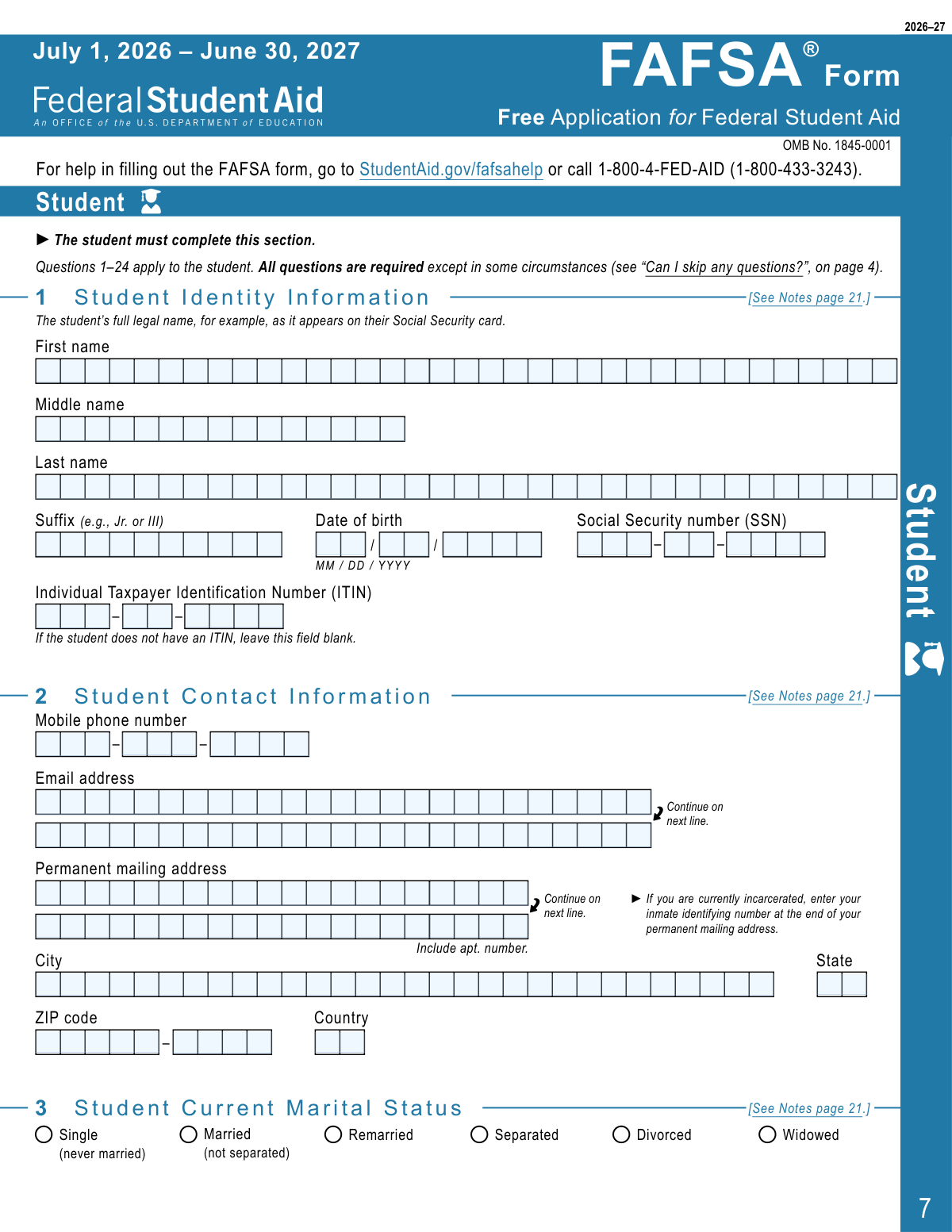
| 1. | 2026–27 FAFSA® Form, Free Application for Federal Student Aid | 20 | Complex 71 |
| 2. | Free Application for Federal Student Aid (FAFSA) | 11 | Moderate 60 |
| 3. | International Student Application for Financial Aid 2026-2027 (International Student Application for Financial Assistance 2026-2027) | 7 | Complex 70 |
| 4. | NSFAS Consent Form (National Student Financial Aid Scheme) – APP2026 | 1 | Moderate 62 |
| 5. | Public Service Loan Forgiveness (PSLF) & TEPSLF Certification & Application | 16 | Moderate 46 |
- Enterprise-grade security & data encryption
- 99%+ accuracy powered by AI
- 1,000+ forms from all industries
- Complete forms in under 60 seconds
How to Choose the Right Form
Navigating financial aid can be overwhelming, but selecting the right form depends primarily on your citizenship status and where you are in your educational journey. Use the guide below to identify which document you need to secure funding or manage your existing loans.
Domestic Financial Aid (U.S. Students)
If you are a U.S. citizen or eligible non-citizen planning to attend college or career school, you will likely need the Free Application for Federal Student Aid (FAFSA).
- 2026–27 FAFSA® Form: Use this specific version if you are applying for aid for the 2026-2027 academic year.
- Free Application for Federal Student Aid (FAFSA): This is the general application used by most states and colleges to award federal grants, work-study funds, and loans.
International and Regional Aid
- International Student Application for Financial Aid 2026-2027: Choose this form if you are a non-U.S. citizen applying to a U.S. college or university. This form allows institutions to evaluate your financial need using your home country's income and asset details.
- NSFAS Consent Form (National Student Financial Aid Scheme): This document is specific to students in South Africa. It is a mandatory authorization that allows NSFAS to validate your personal and financial information with third parties to determine your eligibility for funding.
Loan Forgiveness and Management
If you have already graduated and are currently working, you may be looking for debt relief options rather than new funding.
- Public Service Loan Forgiveness (PSLF) & TEPSLF Certification & Application: Use this form if you are employed by a government or non-profit organization. It is used to certify your employment and track the 120 qualifying payments required to have your federal student loan balance forgiven. It is recommended to submit this form annually to ensure you stay on track for loan cancellation.
Form Comparison
| Form | Primary Purpose | Who Files It | Geographic/Program Scope |
|---|---|---|---|
| 2026–27 FAFSA® Form, Free Application for Federal Student Aid | Apply for federal, state, and institutional aid for the 2026-2027 academic year. | U.S. citizens or eligible non-citizens attending U.S. colleges. | Federal grants, work-study, and loans within the United States. |
| Free Application for Federal Student Aid (FAFSA) | Determine eligibility for all federal student financial assistance programs. | Current and prospective college students seeking financial aid in the U.S. | Standard U.S. federal aid programs and many state-based grants. |
| International Student Application for Financial Aid 2026-2027 (International Student Application for Financial Assistance 2026-2027) | Evaluate financial need for non-U.S. students at participating institutions. | International students applying to U.S. colleges or universities. | Institutional aid based on global household income and assets. |
| NSFAS Consent Form (National Student Financial Aid Scheme) – APP2026 | Authorize background checks and data validation for financial aid eligibility. | South African students and their parents/guardians applying for NSFAS. | South African National Student Financial Aid Scheme (NSFAS) funding. |
| Public Service Loan Forgiveness (PSLF) & TEPSLF Certification & Application | Certify qualifying employment and apply for total loan cancellation. | U.S. federal loan borrowers working in government or non-profit sectors. | Forgiveness of remaining federal loan balances after 120 qualifying payments. |
Tips for student aid forms
Ensure all income and asset figures match your official tax transcripts or bank statements exactly. Small discrepancies between your student aid forms and reported tax data can lead to processing delays or audits that stall your funding.
When filling out international student aid forms, always convert your local currency to U.S. dollars using the specific exchange rate requested by the institution. Failing to use a consistent conversion rate can misrepresent your financial need and negatively affect your eligibility.
Managing multiple student aid applications can be overwhelming, but AI-powered tools like Instafill.ai can complete these forms in under 30 seconds with high accuracy. Your sensitive financial data stays secure during the process, providing a fast and safe way to handle complex paperwork.
Many student aid forms require signatures from both the student and their parents or guardians to be valid. Missing a single signature or failing to check the mandatory authorization box can result in an immediate rejection of the entire application.
Keep digital copies of your tax returns, employer statements, and bank records in one organized folder before you start. Having these documents ready makes it much easier to cross-reference information and upload required attachments for various education forms.
For those pursuing Public Service Loan Forgiveness, do not wait until you reach 120 payments to submit your certification. Filing the form annually ensures your qualifying payments are tracked accurately and helps you catch any eligibility issues early in the process.
Ensure that names, Social Security numbers, and dates of birth are entered exactly as they appear on your legal ID. Even a small typo or a transposed digit in an ID number can prevent government systems from matching your application to your financial records.
Frequently Asked Questions
Student aid forms are essential documents used by students to apply for financial assistance, including grants, loans, and scholarships. These forms help government agencies and educational institutions evaluate a student's financial need based on their income, assets, and household size.
The FAFSA is primarily for U.S. citizens and eligible non-citizens who are planning to attend a college, career school, or graduate program. It is the primary requirement for accessing federal student loans, Pell Grants, and work-study opportunities provided by the Department of Education.
International students typically use specialized forms like the International Student Application for Financial Aid to demonstrate their financial need to U.S.-based universities. These forms require detailed information about global household income and assets, often reported in U.S. dollars using current exchange rates.
The NSFAS Consent Form is required for students applying for aid through South Africa's National Student Financial Aid Scheme. It provides legal authorization for the organization to verify your personal and financial details with third parties, such as credit bureaus and government departments, to determine eligibility.
Yes, you can use AI tools like Instafill.ai to complete various student aid forms quickly and accurately. These tools can extract data from your source documents and place it into the correct fields of a PDF form in under 30 seconds, reducing the risk of manual entry errors.
While manual entry for complex financial forms can take over an hour, using an AI-powered service can complete the process in less than 30 seconds. Services like Instafill.ai automate the data mapping process, allowing you to generate a ready-to-submit PDF almost instantly.
It is generally recommended to submit a PSLF certification and application annually or whenever you change employers. This ensures that your qualifying payments are tracked accurately toward the 120 payments required for total loan cancellation.
You should typically gather your most recent tax returns, bank statements, records of untaxed income, and identification documents like a social security number or passport. Having these documents ready is crucial because most aid forms require precise financial data to calculate your eligibility.
Federal aid is funded by the government and includes programs like Pell Grants and federal student loans, while institutional aid is provided directly by a specific college or university. Most schools use the data from your student aid forms to determine your eligibility for both types of assistance.
Submission methods vary depending on the form; federal forms are usually filed through government portals, while international or institutional forms may need to be uploaded to a college's specific financial aid dashboard. Always check the specific instructions on the form to ensure it is sent to the correct authority.
Providing accurate information is critical because most aid programs use verification processes to cross-check your data with tax records. Providing false or incorrect information can lead to the denial of aid, delays in processing, or potential legal consequences for fraud.
While tuition is the primary focus, student aid can also be used to cover other educational costs such as housing, books, and supplies. The final award amount depends on the cost of attendance determined by the school and the financial need calculated from your submitted forms.
Glossary
- Form Complexity Index
- Instafill’s 0–100 measure of how much effort a form takes to complete, calculated deterministically from the form’s own structure rather than estimated. It combines the number of fillable fields (the largest factor), how difficult those fields are to complete based on their type, the number of pages that contain fields, the amount of conditional “fill-only-if” logic, and how many sections the form is divided into, then adds modifiers for tables and repeating lists, bundled instruction pages, and dense page layouts. A higher score means the form is harder to fill out by hand. The forms in this category have a median Form Complexity Index of 62/100 (Moderate). See exactly how it is calculated.
- FAFSA (Free Application for Federal Student Aid)
- The official form used by current and prospective students in the United States to apply for federal grants, work-study funds, and loans.
- SAI (Student Aid Index)
- An eligibility index number calculated from FAFSA data that colleges use to determine how much financial aid a student is eligible to receive.
- AFE (Aide financière aux études)
- The government agency in Quebec that manages and provides financial assistance programs for students pursuing post-secondary education.
- PSLF (Public Service Loan Forgiveness)
- A U.S. government program that forgives the remaining balance on Direct Loans after a borrower has made 120 qualifying monthly payments while working for a qualifying public service employer.
- NSFAS (National Student Financial Aid Scheme)
- A South African government scheme that provides financial aid to eligible students from low-income families to attend public universities and colleges.
- TEPSLF (Temporary Expanded Public Service Loan Forgiveness)
- A temporary program that provides loan forgiveness to borrowers who were denied PSLF because their payments were made on non-qualifying repayment plans.
- COA (Cost of Attendance)
- The total estimated amount it costs to attend a school for one academic year, including tuition, fees, room and board, books, and supplies.
- MPN (Master Promissory Note)
- A legal document in which a student borrower promises to repay their federal student loans and any accrued interest to the Department of Education.