Yes! You can use AI to fill out International Student Application for Financial Aid 2026-2027 (International Student Application for Financial Assistance 2026-2027)
The International Student Application for Financial Aid 2026-2027 is a standardized financial aid form used by U.S. colleges/universities (and other participating institutions) to evaluate an international studentâs financial need. It gathers the studentâs personal and citizenship details, family/guardian household information, and a full picture of income, assets, and annual expensesâreported in U.S. dollars using a stated exchange rate. Schools often use it alongside required verification documents (tax forms, employer statements, bank records, affidavits) to determine eligibility and award amounts. Accurate completion is important because the form includes a certification/authorization and warns that false information can affect admission decisions and visa status.
Our AI automatically handles information lookup, data retrieval, formatting, and form filling.
It takes less than a minute to fill out International Student Financial Aid Application 2026-2027 using our AI form filling.
Securely upload your data. Information is encrypted in transit and deleted immediately after the form is filled out.
Form specifications
| Form name: | International Student Application for Financial Aid 2026-2027 (International Student Application for Financial Assistance 2026-2027) |
| Number of pages: | 7 |
| Filled form examples: | Form International Student Financial Aid Application 2026-2027 Examples |
| Language: | English |
| Categories: | financial forms, student aid forms, financial aid forms, financial assistance forms |
Instafill Demo: filling out a legal form in seconds
How to Fill Out International Student Financial Aid Application 2026-2027 Online for Free in 2026
Are you looking to fill out a INTERNATIONAL STUDENT FINANCIAL AID APPLICATION 2026-2027 form online quickly and accurately? Instafill.ai offers the #1 AI-powered PDF filling software of 2026, allowing you to complete your INTERNATIONAL STUDENT FINANCIAL AID APPLICATION 2026-2027 form in just 37 seconds or less.
Follow these steps to fill out your INTERNATIONAL STUDENT FINANCIAL AID APPLICATION 2026-2027 form online using Instafill.ai:
- 1 Confirm eligibility and preparation: verify you are a non-U.S. citizen/permanent resident applicant, gather family financial records, and plan to convert all figures to U.S. dollars.
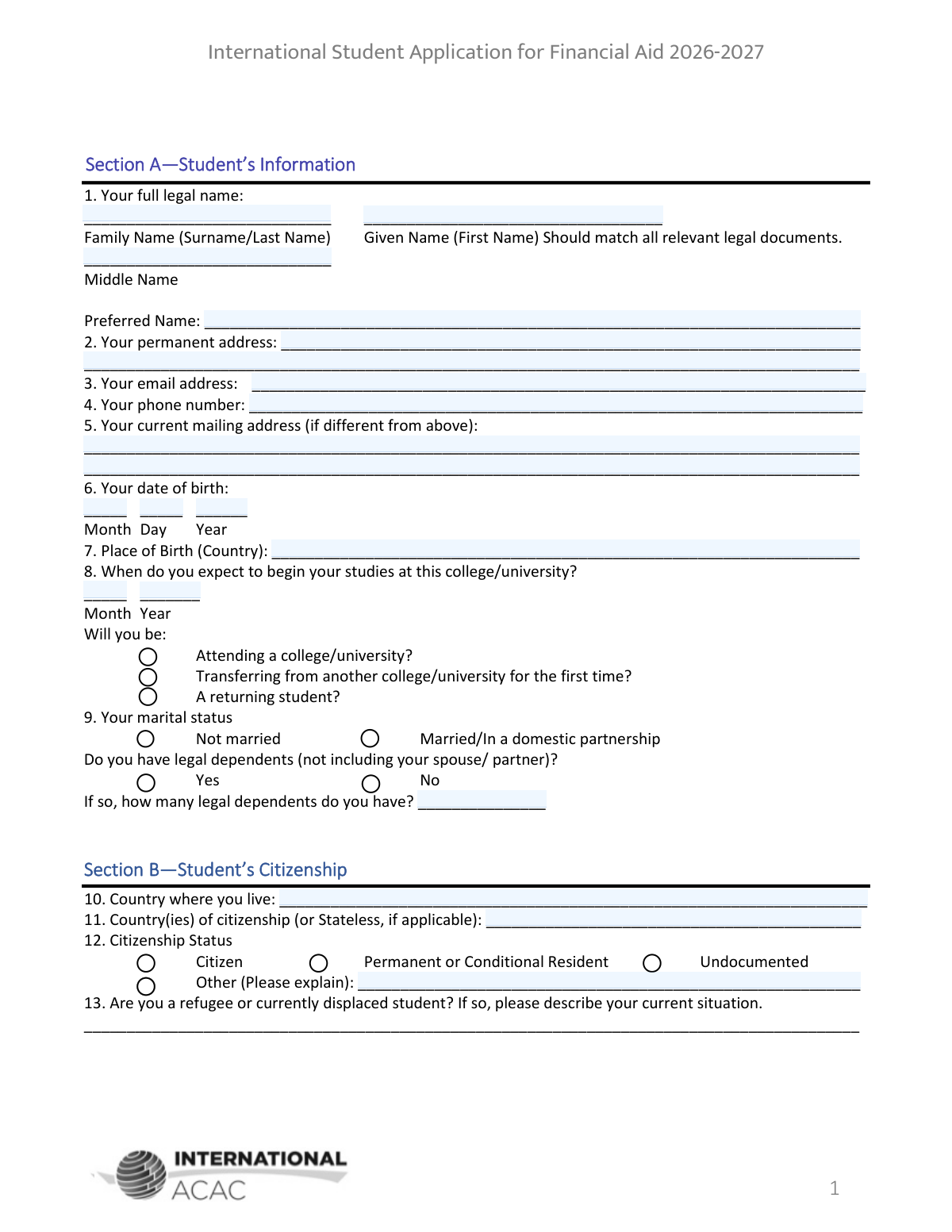
- 2 Complete Section A (Student’s Information): enter your legal name (matching legal documents), contact details, birth information, expected start term, and marital/dependent status.
- 3 Complete Section B (Student’s Citizenship): provide country of residence, citizenship country(ies), status, and any refugee/displacement details if applicable.
- 4 Complete Section C (Family Information): enter custodial parent/legal guardian details, household size, family members in school, and explain special circumstances or documentation barriers.
- 5 Complete Section D (College/University/Program Information): indicate housing plans and admission plan (Early Decision/Early Action/Regular).
- 6 Complete Sections E–G (Income, Assets, Expenses, and Support): select verification documents, record exchange rate/date, report income sources, list property/assets/debts, itemize annual expenses, and project sources of educational support for upcoming years.
- 7 Review and certify in Section H: double-check totals and currency conversions, attach/prepare required supporting documents per each school’s instructions, then sign (student and parent/guardian as applicable) and submit directly to the requesting institution.
Our AI-powered system ensures each field is filled out correctly, reducing errors and saving you time.
Why Choose Instafill.ai for Your Fillable International Student Financial Aid Application 2026-2027 Form?
Speed
Complete your International Student Financial Aid Application 2026-2027 in as little as 37 seconds.
Up-to-Date
Always use the latest 2026 International Student Financial Aid Application 2026-2027 form version.
Cost-effective
No need to hire expensive lawyers.
Accuracy
Our AI performs 10 compliance checks to ensure your form is error-free.
Security
Your personal information is protected with bank-level encryption.
Frequently Asked Questions About Form International Student Financial Aid Application 2026-2027
This form collects financial and family information from international students so a U.S. college/university (or participating institution) can evaluate eligibility for institutional financial aid.
It is intended for students who are not U.S. citizens or U.S. permanent residents and who are applying for financial aid at a school that requests/accepts this form.
You must return the form directly to the college/university that provided or requested it, following that schoolâs submission instructions and preferred format.
You may complete it online and download/print it, complete it in Adobe Acrobat and print, or print and fill it out by handâthen submit it in the format required by each school.
Yes. All amounts must be entered in U.S. dollars, using the exchange rate you list in Question 27 for all calculations on the form.
Use the official exchange rate âtodayâ (the day you complete the form) and record that date in Question 27a; then use that same rate for every currency conversion on the application.
Requirements vary by institution, but the form asks you to indicate what you will provide (e.g., tax forms, employer statements, payslips, affidavits for informal earnings, or bank statements). Check each schoolâs documentation rules.
âParentsâ means your custodial parent(s)âthe parent(s) or legal guardian you lived with most during the 12 months before completing the application. If the custodial parent has remarried, you must include the stepparent as a parent on this form.
Complete Parent/Legal Guardian 1 and leave Parent/Legal Guardian 2 blank if it does not apply, but still answer the questions about your parentsâ/guardiansâ marital status and household situation as accurately as possible.
You must answer the student marital/dependent questions in Section A, and asset reporting in Section F depends on whether you are married and living independently. If you are married and live independently of your parents/legal guardians, Section F indicates you should report assets for you and your family instead of your parents/guardians.
Section E asks for household income during 2024 (before taxes or expenses) broken down by source, such as parent/guardian work, your work, business income, rent, pensions, and other support.
Answer âYesâ to Question 34 and explain the expected increase or decrease. This helps the institution understand whether 2024 income is not representative of your current situation.
Report the value of property/assets and any debt against them as of the time you complete the application. For a home, include purchase/build year, original cost, amount still owed, and current market value if known.
The form requests specific annual amounts in U.S. dollars, but it allows estimates if you do not know the exact figures. Provide your best good-faith estimate and keep it consistent with your overall financial picture.
Use Question 20 (and additional sheets if needed) to explain unusual expenses, debts, or circumstances that affect your ability to pay (e.g., medical costs, eldercare, catastrophic events, employment changes, or documentation barriers noted in Question 21).
Compliance International Student Financial Aid Application 2026-2027
Validation Checks by Instafill.ai
1
Student full legal name completeness and character validation
Validates that the studentâs Family (Surname/Last), Given (First), and any provided Middle Name fields are present where required and contain only reasonable name characters (letters, spaces, hyphens, apostrophes) with no numeric-only or placeholder values (e.g., 'N/A', 'â'). This is important because the form states the name should match legal documents, and mismatches can cause admissions/visa and aid processing issues. If validation fails, the submission should be blocked or flagged for correction and the applicant prompted to enter the name exactly as on passport/legal records.
2
Preferred name optionality and non-duplication check
Checks that Preferred Name is optional, but if provided it is not identical to the full legal name fields and is not used to replace missing legal name components. This prevents applicants from entering nicknames in legal name fields and ensures downstream systems use the correct legal identity. If validation fails, prompt the user to move the nickname to Preferred Name and complete the legal name fields.
3
Permanent address required and structured completeness
Ensures the permanent address is provided and includes minimum components (street/address line, city/locality, country; and postal code if the country uses one). A complete permanent address is needed for identity verification, residency/citizenship context, and document requests. If validation fails, the form should require additional address details before submission.
4
Email address format and deliverability validation
Validates that the email address follows standard email syntax (local@domain), contains a valid domain with a TLD, and does not include spaces or obvious typos (e.g., missing '@'). Email is a primary communication channel for documentation requests and aid decisions. If validation fails, reject the entry and require a corrected email.
5
Phone number format with country code validation
Checks that the phone number is present and formatted as an international number (preferably E.164: +[country code][number]) or includes country code and sufficient digits for the stated country. This reduces failed contact attempts and supports international applicants. If validation fails, prompt for a corrected number including country code.
6
Date of birth format and age reasonableness check
Validates that the date of birth is a real calendar date and is entered in the expected Month/Day/Year structure. Also checks for reasonable age bounds for a college applicant (e.g., not in the future, not implausibly young/old such as under 10 or over 90 unless explicitly allowed). If validation fails, require correction and flag extreme ages for manual review.
7
Expected start term date format and alignment with aid year
Ensures the expected start date is provided as Month/Year and falls within a plausible window for the 2026â2027 academic cycle (e.g., mid-2026 through mid-2027, depending on institution rules). This is important for packaging aid in the correct academic year and term. If validation fails, prompt the applicant to select a valid start month/year or confirm the correct aid year.
8
Enrollment status selection (mutually exclusive) validation
Validates that exactly one of the study status options is selected: attending for the first time, transferring for the first time, or returning student. Mutually exclusive selection prevents conflicting processing paths and document requirements. If validation fails, require the applicant to choose only one option.
9
Marital status and dependents logical consistency
Checks that marital status is selected and that the dependents question is answered. If 'Yes' to legal dependents, the number of dependents must be a non-negative integer greater than zero; if 'No', the dependents count must be blank or zero. If validation fails, prompt for a consistent dependents response and correct count.
10
Citizenship section completeness and 'Other' explanation requirement
Validates that country of residence, country(ies) of citizenship (or 'Stateless'), and a citizenship status option are provided. If 'Other' is selected for citizenship status, an explanation must be entered; if 'Stateless' is entered, it should not be combined with specific citizenship countries unless explicitly allowed. If validation fails, require missing fields and enforce the conditional explanation.
11
Refugee/displaced student narrative required when indicated
If the applicant indicates they are a refugee or currently displaced (or provides any affirmative indicator), requires a non-empty description of the current situation with a minimum length to be meaningful. This information can affect documentation expectations and special circumstance review. If validation fails, prompt the applicant to provide the required narrative.
12
Parents/legal guardians marital status and guardian records consistency
Ensures exactly one parentsâ/guardiansâ marital status is selected and that Parent/Legal Guardian 2 information is provided when applicable (e.g., status 'Married or in a domestic relationship' typically implies a second guardian record unless the applicant explains otherwise). Also checks that Parent/Guardian 1 is always completed. If validation fails, require missing guardian details or an explanation for why a second guardian is not applicable.
13
Parent/guardian employment details conditional completeness
Validates that each listed parent/guardian has an employment status selected, and conditionally requires Occupation/Title, Employer, and Years with employer when 'formal employment' or 'self-employed' is selected. For 'retired' or 'unemployed' statuses, employer/occupation fields should be blank or optional, and years-with-employer should not be a negative or implausible value. If validation fails, prompt for the missing conditional fields or remove inconsistent entries.
14
Household size and family member listing consistency
Checks that the number of people dependent on parentsâ/guardiansâ income (household size) is a positive integer and is consistent with the family member listing (e.g., household size should be at least the count of listed dependents plus the parents/guardians and the student when applicable). This is important for need analysis and per-capita expense/income reasonableness checks. If validation fails, require correction of household size or completion of missing family member entries.
15
Exchange rate and exchange-rate date format validation
Validates that the exchange rate is provided as a positive numeric value representing local currency per US $1 (or the specified format) and that the 'todayâs date' is entered in MM/DD/YYYY and is a real date not in the future. The exchange rate is used for all conversions, so invalid values can distort all income/asset/expense figures. If validation fails, block submission until a valid rate and date are provided.
16
Currency fields numeric, non-negative, and conditional detail checks
Ensures all US $ amount fields across Income, Assets, Expenses, and Support sections are numeric, non-negative, and within reasonable upper bounds (to catch data entry errors like extra zeros). Also enforces conditional details: if emergency funds is 'Yes', both source and amount must be provided; if government exchange restrictions is 'Yes', a description is required; if air transportation funding is 'Yes/Maybe', a source must be provided. If validation fails, highlight the specific field(s) and require corrected numeric entries and missing conditional explanations.
Common Mistakes in Completing International Student Financial Aid Application 2026-2027
Applicants often enter a preferred name, nickname, or a different spelling/order than what appears on their passport and school records. This can cause identity mismatches when the college tries to match your application to admissions, visa, or financial aid files, leading to delays or requests for re-submission. Always enter your full legal name exactly as shown on your passport (including surname/given name order and middle name), and use the âPreferred Nameâ field only for the name you want used informally.
Because many questions are conditional (e.g., âif applicableâ), people skip items that actually apply or write âN/Aâ where a numeric value or a short explanation is expected. Missing data commonly triggers follow-up emails, document requests, or an incomplete aid review. If a question truly does not apply, write â0â for amounts and add a brief note (e.g., âNo bank accountâ) rather than leaving it empty.
A frequent error is entering some figures in local currency while others are in USD, especially in Income (Section E), Assets (Section F), and Expenses (Section G). This makes totals inconsistent and can dramatically distort need calculations, sometimes making a family appear far wealthier or poorer than reality. Convert every figure to US dollars using the exchange rate you report in Question 27 and keep that same rate for the entire form.
Applicants sometimes reverse the rate (e.g., writing â$1 = 3,100 pesosâ vs. â3,100 pesos = $1â), use a bankâs buy/sell rate inconsistently, or forget to provide the date in 27a. An incorrect rate can invalidate all conversions and lead the school to question the credibility of the submission. Use the exact format shown (local currency amount = US $1), record the date, and apply that single rate to every converted number on the form.
In Section C, people often list the non-custodial parent, omit a stepparent, or provide information for relatives who are not legally/financially responsible. This can lead to an inaccurate household profile and may cause the institution to request corrected family information or additional documentation. Follow the definition provided: report the custodial parent(s)/legal guardian(s) the student lived with most in the last 12 months, and include a stepparent if the custodial parent remarried.
Applicants frequently enter a number in Question 17 that conflicts with the people listed in the Family Member Listing (Question 18) or with dependents reported in Question 9. Inconsistencies raise red flags and can delay review while the school reconciles who is supported by the household income. Before submitting, cross-check that the household size includes everyone supported by the parentsâ income and that all students in school are listed with consistent relationships and counts.
Question 31 asks for household income âbefore taxes or expenses,â but many applicants report take-home pay or business profit after expenses, or they count the same money in multiple lines (e.g., wages plus âhousing allowanceâ that is already part of wages). This can understate or overstate true resources and may lead to an incorrect aid decision or requests for clarification. Report gross amounts where possible, keep each income source in only one category, and use the âOther (explain)â line to clarify unusual income types.
In Question 26, applicants check boxes (tax forms, payslips, affidavits, bank statements) but then provide figures that donât match what those documents would show, or they fail to explain informal-sector income. This mismatch often results in verification problems and additional back-and-forth with the financial aid office. Choose documentation you can actually provide, and if income is informal or irregular, include an affidavit and a clear written explanation that ties directly to the amounts entered.
For home ownership (Question 36) and business ownership (Question 37), people often mark âYesâ but leave purchase year, original cost, current market value, or remaining debt blank, or they enter debt as a positive asset value. Incomplete or misreported asset details can significantly affect need analysis and may trigger requests for appraisals or additional proof. If you answer âYes,â complete every required sub-part and clearly separate market value from indebtedness (what you still owe).
Question 38 requires listing money/property/assets in other countries and notes that these amounts should also be included in Question 37 totals, but applicants often do one or the otherânot both. This creates internal inconsistencies and can look like an omission even when unintentional. List all foreign-held assets in the grid and ensure the same values are reflected in the relevant asset lines in Question 37.
Section G (Question 40) asks for annual 2024 spending in US dollars and explicitly says âSPECIFIC AMOUNTS ARE NEEDED,â yet many people enter monthly figures, write ranges, or leave categories empty. This makes the budget picture unusable and can reduce confidence in the application, leading to follow-up questions. Convert monthly spending to annual totals (multiply by 12 where appropriate), provide best estimates when exact numbers arenât known, and enter â0â only when the expense truly did not occur.
Applicants sometimes forget the student/parent signatures in Section H, omit the âDate Completed,â or send the form to a general inbox instead of the specific college/university that requested it. Unsigned or undated forms may be treated as invalid, and misdirected submissions can miss deadlines. Ensure all required signatures are present (including Parent/Guardian 2 if applicable), date the form, and return it directly to the institution that provided/requested it in the format they specify.
Saved over 80 hours a year
âI was never sure if my IRS forms like W-9 were filled correctly. Now, I can complete the forms accurately without any external help.â
Kevin Martin Green
Your data stays secure with advanced protection from Instafill and our subprocessors

Robust compliance program
Transparent business model
Youâre not the product. You always know where your data is and what it is processed for.
ISO 27001, HIPAA, and GDPR
Our subprocesses adhere to multiple compliance standards, including but not limited to ISO 27001, HIPAA, and GDPR.
Security & privacy by design
We consider security and privacy from the initial design phase of any new service or functionality. Itâs not an afterthought, itâs built-in, including support for two-factor authentication (2FA) to further protect your account.
Fill out International Student Financial Aid Application 2026-2027 with Instafill.ai
Worried about filling PDFs wrong? Instafill securely fills international-student-application-for-financial-ai forms, ensuring each field is accurate.



