Fill out financial assistance forms
with AI.
Financial assistance forms serve as a critical bridge for individuals and families seeking support to manage educational costs, living expenses, or social welfare needs. These documents are designed to provide a transparent overview of a person's financial situation, allowing institutions and government agencies to determine eligibility for grants, subsidies, or aid packages. Whether you are navigating higher education or seeking temporary relief during a transition, these forms are the primary mechanism for securing the resources needed to achieve stability or pursue professional growth.
By continuing, you acknowledge Instafill's Privacy Policy and agree to get occasional product update and promotional emails.
About financial assistance forms
This category is particularly vital for international students applying to U.S. colleges and universities, as well as individuals interacting with work and income systems. For students, completing applications for financial aid is a high-stakes task that requires reporting detailed household income, assets, and expenses in specific currencies. Because these applications often influence admission decisions and visa eligibility, accuracy is paramount. Beyond academia, these forms are used in various social welfare and employment contexts to ensure that support reaches those who meet specific financial and employment criteria.
Managing the complex data required for these applications can be time-consuming and stressful. Tools like Instafill.ai use AI to fill these forms in under 30 seconds, handling sensitive financial data accurately and securely. This allows applicants to streamline their paperwork and focus on the substantive parts of their applications without the burden of manual data entry.
Every form on this page can be completed without typing. Instafill is form filling software that reads a PDF and fills it for you — including flat and scanned documents that carry no fillable fields at all.
Forms in This Category
The forms in this category have a median Form Complexity Index of 70/100 (Complex), measured across 2 forms by field count, input difficulty, length, conditional logic and structure. See how it is calculated.
| Form Name | Pages | FCI | |
|---|---|---|---|
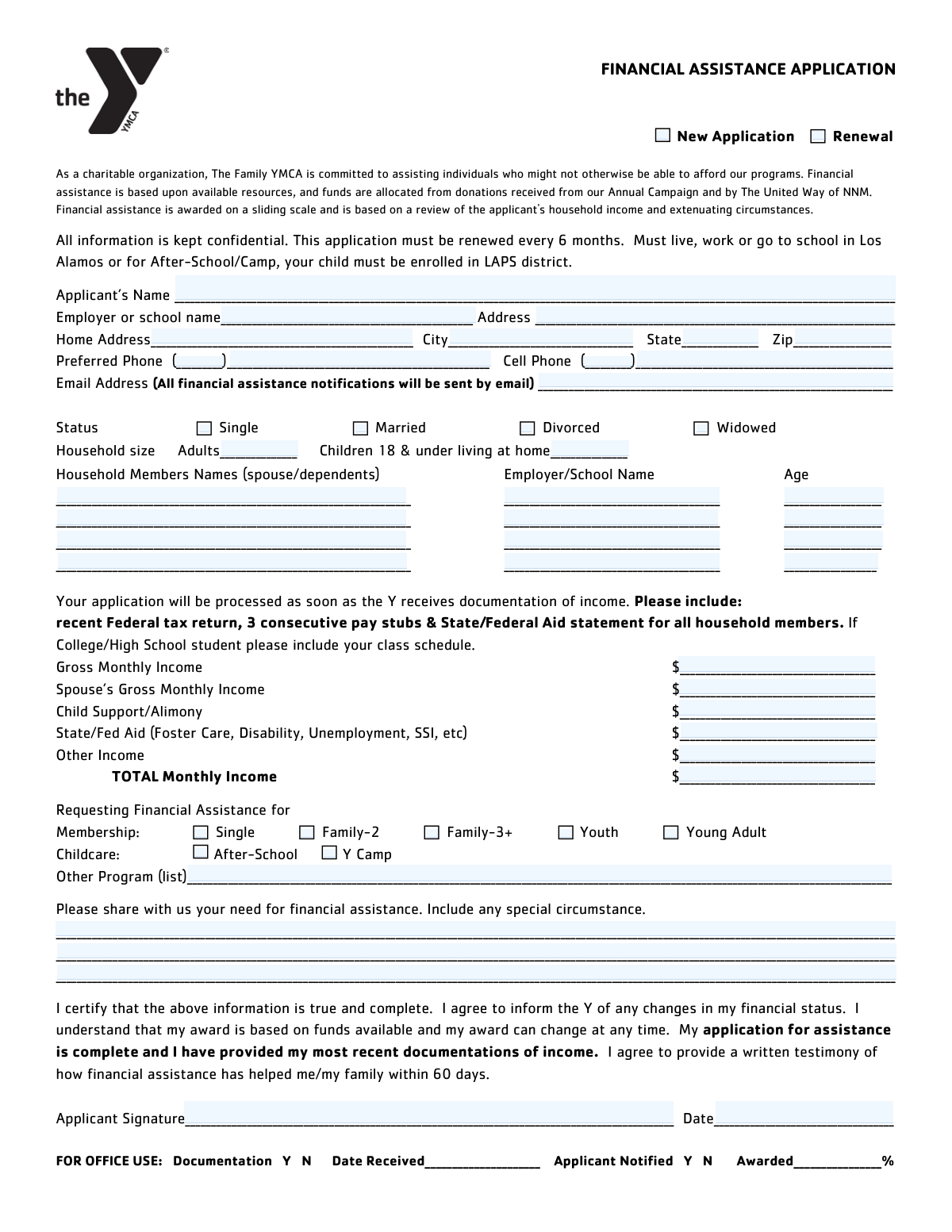
| 1. | Application for Financial Assistance (YMCA) | 1 | Moderate 56 |
| 2. | International Student Application for Financial Aid 2026-2027 (International Student Application for Financial Assistance 2026-2027) | 7 | Complex 70 |
- Enterprise-grade security & data encryption
- 99%+ accuracy powered by AI
- 1,000+ forms from all industries
- Complete forms in under 60 seconds
How to Choose the Right Form
Navigating financial assistance forms can be complex, as the requirements vary significantly depending on whether you are seeking academic aid, social welfare, or employment-based support. To ensure you complete the correct documentation, consider your specific circumstances and the institution requesting the information.
Academic Financial Aid for International Students
If you are a non-U.S. citizen planning to attend a college or university in the United States for the upcoming academic cycle, the International Student Application for Financial Aid 2026-2027 (also known as the International Student Application for Financial Assistance 2026-2027) is the primary document you will need. This form is a standardized tool used by many institutions to evaluate a student's financial need and determine eligibility for institutional grants and scholarships.
You should choose this form if you need to:
- Report household income, assets, and annual expenses to a university admissions office.
- Provide a full financial picture in U.S. dollars using a specific exchange rate.
- Certify your financial status as part of a visa or admission application.
Social Welfare and Employment Forms
While the current list focuses on academic aid, users searching for other types of financial assistance should be aware of the distinctions:
- Social Welfare and Work and Income: If you are seeking government-funded support, such as unemployment benefits or disability assistance, you will typically need forms provided by your local or national social services agency rather than an academic application.
- Employment Forms: If you need to document your income for a new job or verify employment for a loan, look for specific employer-provided affidavits or tax documentation.
Before starting the International Student Application for Financial Aid 2026-2027, verify with your prospective college's financial aid office that they accept this specific version. Some schools may require the CSS Profile or their own internal institutional forms instead.
Form Comparison
| Form | Primary Purpose | Who Files It | Required Information | Target Period |
|---|---|---|---|---|
| International Student Application for Financial Aid 2026-2027 | Evaluates financial need for non-U.S. citizens applying to colleges or universities. | International students seeking financial assistance from participating U.S. educational institutions. | Details on household income, assets, expenses, and supporting tax or bank records. | Used for the 2026-2027 academic year during the college admission cycle. |
Tips for financial assistance forms
Before starting your application, collect all necessary tax forms, bank statements, and employer letters from your home country. Having these documents ready ensures that the figures you enter on the financial assistance forms are accurate and can be verified by the reviewing institution.
Most international financial aid forms require income and expense data to be reported in U.S. dollars. Use a consistent, current exchange rate as specified in the form instructions to avoid discrepancies that could lead to an incorrect evaluation of your financial need.
AI-powered tools like Instafill.ai can complete these complex financial forms in under 30 seconds with high accuracy. This is a significant time-saver for students managing multiple applications, and your sensitive financial data remains secure throughout the automated process.
Double-check that the names, dates, and financial figures on your application match your passport and official bank records exactly. Even minor inconsistencies between your application and your supporting evidence can lead to delays in processing or requests for additional clarification.
Do not leave fields blank unless the instructions specifically tell you to do so. If a question does not apply to your situation, enter 'N/A' or '0' to demonstrate that you have reviewed the section and provided a complete response.
Schools often require supplemental proof, such as affidavits of support or salary certificates, to back up the claims made on your form. Keep high-quality digital scans of these documents organized in a single folder to make the final submission and verification process much smoother.
Frequently Asked Questions
This form is designed for non-U.S. citizens applying to colleges or universities in the United States who require financial support to cover educational costs. It allows institutions to assess the financial need of international applicants based on their family's income, assets, and overall household financial situation.
No, the Free Application for Federal Student Aid (FAFSA) is strictly for U.S. citizens and eligible non-citizens. International students typically use specialized forms like this one or the CSS Profile to apply for institutional aid from private or public colleges, as they are generally ineligible for federal financial aid.
You will generally need to provide supporting evidence such as foreign tax returns, employer statements verifying salary, bank records, and investment statements. Some schools may also require a certified affidavit of support or specific documentation regarding your home country's currency exchange rate.
All financial figures must be converted and reported in U.S. dollars using a specific exchange rate at the time of completion. Most forms will ask you to state the specific exchange rate used to ensure the university can accurately evaluate your financial standing relative to tuition costs.
These forms are usually submitted concurrently with your college application or shortly after the admission deadline. It is crucial to check each individual university's financial aid deadline, as late submissions can significantly reduce your chances of receiving a limited pool of institutional aid.
Yes, AI tools like Instafill.ai can streamline the process by automatically extracting data from your source documents, such as bank statements or tax forms, and placing it into the correct fields. This helps ensure that complex financial data is transcribed accurately and formatted correctly for the specific form.
While manual entry for detailed financial forms can take several hours, using an AI-powered tool like Instafill.ai can complete the form in under 30 seconds. This efficiency allows you to focus on gathering the necessary supporting documentation rather than spending hours on manual data entry.
Providing false or misleading information can lead to the denial of financial aid or the revocation of an admission offer. Additionally, because these forms are used to verify financial eligibility for student visas, inaccuracies can negatively impact your legal status and ability to enter the country.
Completed forms are usually submitted directly to the financial aid office or the admissions department of the specific institution you are applying to. Some schools may use a centralized online portal, while others might require a secure digital upload or physical mailing of the documents.
While many schools use standardized forms, some institutions have their own proprietary financial aid applications or require the CSS Profile. It is important to verify with each school's international admissions website to ensure you are filling out the specific version they require for the current academic year.
Glossary
- Form Complexity Index
- Instafill’s 0–100 measure of how much effort a form takes to complete, calculated deterministically from the form’s own structure rather than estimated. It combines the number of fillable fields (the largest factor), how difficult those fields are to complete based on their type, the number of pages that contain fields, the amount of conditional “fill-only-if” logic, and how many sections the form is divided into, then adds modifiers for tables and repeating lists, bundled instruction pages, and dense page layouts. A higher score means the form is harder to fill out by hand. The forms in this category have a median Form Complexity Index of 70/100 (Complex). See exactly how it is calculated.
- Financial Need
- The calculated difference between the total cost of attending a school and the amount the student’s family is determined able to pay.
- Expected Family Contribution (EFC)
- An estimate used by schools to determine how much money a student and their family are expected to pay toward educational expenses for one year.
- Assets
- Items of value owned by the student or their parents, such as savings, investments, and real estate, which are used to assess financial strength.
- Exchange Rate
- The value of one currency for the purpose of conversion to another; international forms require all financial figures to be converted into U.S. dollars.
- Affidavit of Support
- A legal document signed by a sponsor or guardian that promises they will provide specific financial backing for the student's education and living costs.
- Verification Documents
- Official records such as tax returns, bank statements, or employer letters required by the school to prove the accuracy of the financial data reported on the form.
- Certification and Authorization
- A formal statement where the applicant signs to confirm all provided information is true and grants the school permission to verify the details with third parties.
- Dependency Status
- A classification that determines whether a student must report their parents' financial information or if they are considered financially autonomous.