Fill out federal student aid forms
with AI.
Federal student aid forms are the cornerstone of financing higher education in the United States. These documents facilitate the distribution of billions of dollars in grants, work-study funds, and low-interest loans every year. Navigating these forms is essential for anyone looking to reduce the out-of-pocket costs of college or vocational training. Whether you are applying for initial funding or managing existing debt, these documents ensure that financial assistance is distributed based on need and eligibility, helping to make education more accessible for students from all backgrounds.
By continuing, you acknowledge Instafill's Privacy Policy and agree to get occasional product update and promotional emails.
About federal student aid forms
This category primarily serves prospective and current college students, as well as their parents or guardians. It includes the Free Application for Federal Student Aid (FAFSA), which is the standard requirement for most institutional and state-level aid programs. Additionally, these forms are used by graduates and professionals working in the public sector, such as those submitting Public Service Loan Forgiveness (PSLF) applications to track their progress toward debt cancellation. Completing these forms accurately is vital, as errors or omissions can lead to delays in funding or missed opportunities for forgiveness.
Managing the extensive data required for these applications can be time-consuming and complex. Tools like Instafill.ai use AI to fill these federal student aid forms in under 30 seconds, handling sensitive financial data accurately and securely. This approach simplifies the administrative burden of the financial aid process, allowing students and borrowers to focus on their education and careers rather than manual paperwork.
Every form on this page can be completed without typing. Instafill is form filling software that reads a PDF and fills it for you — including flat and scanned documents that carry no fillable fields at all.
Forms in This Category
The forms in this category have a median Form Complexity Index of 60/100 (Moderate), measured across 3 forms by field count, input difficulty, length, conditional logic and structure. See how it is calculated.
| Form Name | Pages | FCI | |
|---|---|---|---|
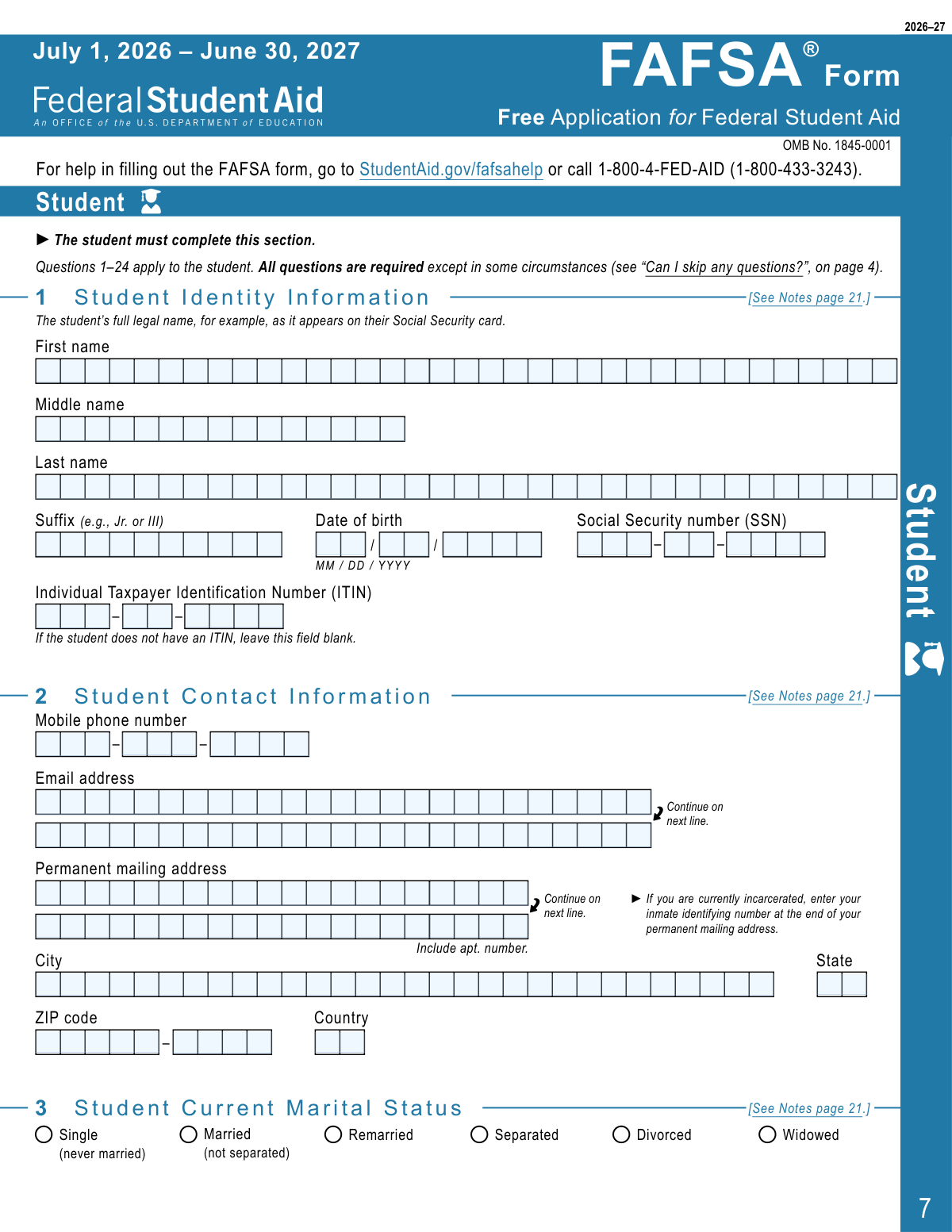
| 1. | 2026–27 FAFSA® Form, Free Application for Federal Student Aid | 20 | Complex 71 |
| 2. | Free Application for Federal Student Aid (FAFSA) | 11 | Moderate 60 |
| 3. | Public Service Loan Forgiveness (PSLF) & TEPSLF Certification & Application | 16 | Moderate 46 |
- Enterprise-grade security & data encryption
- 99%+ accuracy powered by AI
- 1,000+ forms from all industries
- Complete forms in under 60 seconds
How to Choose the Right Form
Navigating federal student aid forms can be complex, but choosing the right one depends entirely on where you are in your educational journey—whether you are just starting to apply for college or you are already in the workforce managing your student debt.
Applying for New Financial Aid
If your goal is to secure funding for tuition, housing, and books, you must complete the Free Application for Federal Student Aid. This is the gateway to federal grants, work-study programs, and low-interest loans.
- 2026–27 FAFSA® Form: Choose this specific version if you are planning to attend college or career school during the 2026–2027 academic year. High school seniors and returning college students should prioritize this form to meet early state and institutional deadlines.
- Free Application for Federal Student Aid (FAFSA): Use this general application if you are looking for the standard version to determine your Student Aid Index (SAI) for the current or upcoming cycle not covered by the specific 2026-27 form.
Managing Existing Loans and Forgiveness
If you have already graduated and are currently repaying your federal student loans, you may be looking for ways to reduce or eliminate your debt based on your career path.
- Public Service Loan Forgiveness (PSLF) & TEPSLF Certification & Application: Choose this form if you work for a government or non-profit organization. This document serves two purposes: it allows you to certify your employment annually to track your progress toward the 120 required payments, and it serves as your formal application for total loan discharge once you have met those requirements.
Quick Selection Tips
- Are you a student or parent seeking money for school? Start with the FAFSA variants.
- Are you a public service employee seeking debt relief? Use the PSLF Certification & Application.
- Are you planning ahead for the 2026 school year? Select the 2026–27 FAFSA® Form to ensure your data is processed for the correct aid cycle.
Form Comparison
| Form | Primary Purpose | Who Files It | Filing Frequency |
|---|---|---|---|
| 2026–27 FAFSA® Form, Free Application for Federal Student Aid | Apply for federal, state, and institutional financial aid for the 2026-27 academic year. | Prospective and current college students and their families. | Annually during the specific application cycle for 2026-2027. |
| Free Application for Federal Student Aid (FAFSA) | Determine eligibility for federal grants, work-study, and student loans. | Current and prospective college students seeking financial assistance. | Annually for every academic year a student is enrolled. |
| Public Service Loan Forgiveness (PSLF) & TEPSLF Certification & Application | Certify qualifying employment and apply for federal student loan forgiveness. | Federal loan borrowers working for government or non-profit organizations. | Annually or when changing employers to track qualifying payments. |
Tips for federal student aid forms
Ensure all income and asset figures match your official tax returns and W-2 forms exactly. Discrepancies between your federal student aid forms and IRS records can trigger audits or significantly delay your financial aid package.
Do not wait until you have made 120 payments to submit your Public Service Loan Forgiveness paperwork. Filing a certification form every year or whenever you change employers ensures your qualifying payment count is always accurate and up to date.
AI-powered tools like Instafill.ai can complete these complex federal forms in under 30 seconds with high accuracy. Your sensitive financial data stays secure during the process, providing a practical way to manage multiple student aid documents efficiently.
Many aid forms require signatures from both the student and a contributor, such as a parent or spouse. For PSLF forms, ensure your employer’s authorized official has signed the certification section before you attempt to submit the document.
Small typos in your Social Security Number or using a nickname instead of your full legal name can lead to immediate processing failures. Always cross-reference these identifiers with your official government-issued ID to avoid unnecessary administrative hurdles.
Always save a PDF copy of your completed FAFSA or loan forgiveness application for your personal records. Having these documents organized makes it much easier to resolve disputes or provide proof of submission if a technical error occurs.
When filling out PSLF forms, verify that the Employer Identification Number (EIN) you provide matches exactly what is listed on your W-2. Using an incorrect EIN is a common mistake that causes applications to be rejected by the loan servicer.
Frequently Asked Questions
Federal student aid forms are official documents used by the U.S. Department of Education to determine a student's eligibility for financial assistance. These forms help facilitate access to grants, work-study programs, and federal student loans, as well as state and institutional aid.
Generally, U.S. citizens or eligible non-citizens who are enrolled in or planning to attend an accredited college, university, or career school can use these forms. Specific forms, like the PSLF certification, are intended for graduates already working in qualifying public service roles.
It is generally recommended to submit forms like the FAFSA as early as possible after the application period opens, as some financial aid is distributed on a first-come, first-served basis. You should also be mindful of state and individual college deadlines, which often fall earlier than the federal deadline.
If you are seeking money for upcoming school years, you will need to complete the FAFSA for the relevant academic cycle. If you are already a borrower working in a non-profit or government role and want to track your progress toward loan cancellation, you should use the PSLF & TEPSLF Certification form.
Yes, you can use AI tools like Instafill.ai to complete federal student aid forms efficiently. These tools can accurately extract data from your financial records or source documents and populate the PDF fields in under 30 seconds.
Common requirements include your Social Security number, tax returns, and records of untaxed income or assets. For loan forgiveness forms, you will also need to provide information regarding your employer's EIN and your dates of employment.
Manual entry for federal forms can often take an hour or more due to the detailed financial information required. However, using AI-powered services can reduce this process to less than 30 seconds by automatically placing data from your documents into the correct form fields.
Most federal student aid forms can be submitted electronically through the official Federal Student Aid website. If you prefer to file a paper version, the instructions on the form will provide a specific mailing address for the Department of Education or the relevant loan servicer.
Filing the Free Application for Federal Student Aid (FAFSA) is completely free of charge. You should be cautious of any service that asks for a fee to submit the official federal application on your behalf.
The FAFSA must be submitted every year that you are enrolled in school to remain eligible for aid. For loan forgiveness programs, it is best practice to submit an employment certification form annually or whenever you change jobs to ensure your qualifying payments are being tracked correctly.
Glossary
- Form Complexity Index
- Instafill’s 0–100 measure of how much effort a form takes to complete, calculated deterministically from the form’s own structure rather than estimated. It combines the number of fillable fields (the largest factor), how difficult those fields are to complete based on their type, the number of pages that contain fields, the amount of conditional “fill-only-if” logic, and how many sections the form is divided into, then adds modifiers for tables and repeating lists, bundled instruction pages, and dense page layouts. A higher score means the form is harder to fill out by hand. The forms in this category have a median Form Complexity Index of 60/100 (Moderate). See exactly how it is calculated.
- FAFSA (Free Application for Federal Student Aid)
- The official form used by current and prospective students to apply for federal, state, and institutional financial aid for college or career school.
- Student Aid Index (SAI)
- An eligibility index number, calculated based on the information provided in the FAFSA, that financial aid offices use to determine how much federal student aid a student is eligible to receive.
- FSA ID
- A unique username and password used by students, parents, and spouses to log in to Department of Education websites and electronically sign the FAFSA and other legal documents.
- Contributor
- Any individual required to provide information, a signature, and consent to have their federal tax information transferred directly into the FAFSA, such as a parent or spouse.
- Public Service Loan Forgiveness (PSLF)
- A federal program that forgives the remaining balance on Direct Loans after a borrower has made 120 qualifying monthly payments while working full-time for a qualifying employer, such as a government or non-profit organization.
- Pell Grant
- A form of federal financial aid that does not typically need to be repaid, awarded to undergraduate students who demonstrate exceptional financial need.
- TEPSLF (Temporary Expanded Public Service Loan Forgiveness)
- A program that provides a limited opportunity for loan forgiveness to borrowers who were previously denied PSLF because their payments were made under a non-qualifying repayment plan.
- Direct Loan
- A federal student loan made directly by the U.S. Department of Education, which may be subsidized (interest-free while in school) or unsubsidized (interest accumulates immediately).