Fill out college financial forms
with AI.
Navigating the financial landscape of higher education often begins with a series of complex documents known as college financial forms. These forms are essential for determining a student's eligibility for various types of financial assistance, including federal grants, work-study programs, and low-interest loans. By providing a detailed snapshot of a family's financial situation, these documents allow educational institutions and government agencies to distribute aid fairly based on demonstrated need and merit.
By continuing, you acknowledge Instafill's Privacy Policy and agree to get occasional product update and promotional emails.
About college financial forms
These forms are typically required by high school seniors preparing for their first year of college, as well as current undergraduate and graduate students who must renew their aid annually. Whether you are completing the FAFSA (Free Application for Federal Student Aid) to access federal support or submitting specific state-level assistance applications, accuracy is critical to ensure you receive the maximum amount of funding available. Missing a deadline or making a clerical error on these forms can significantly impact a student's ability to afford tuition and living expenses.
To simplify this often-overwhelming process, tools like Instafill.ai use AI to fill these forms in under 30 seconds while ensuring data is handled accurately and securely. This allows students and their families to focus on their academic goals rather than the administrative burden of manual data entry.
Every form on this page can be completed without typing. Instafill is form filling software that reads a PDF and fills it for you — including flat and scanned documents that carry no fillable fields at all.
Forms in This Category
The forms in this category have a median Form Complexity Index of 71/100 (Complex), measured across 1 forms by field count, input difficulty, length, conditional logic and structure. See how it is calculated.
| Form Name | Pages | FCI | |
|---|---|---|---|
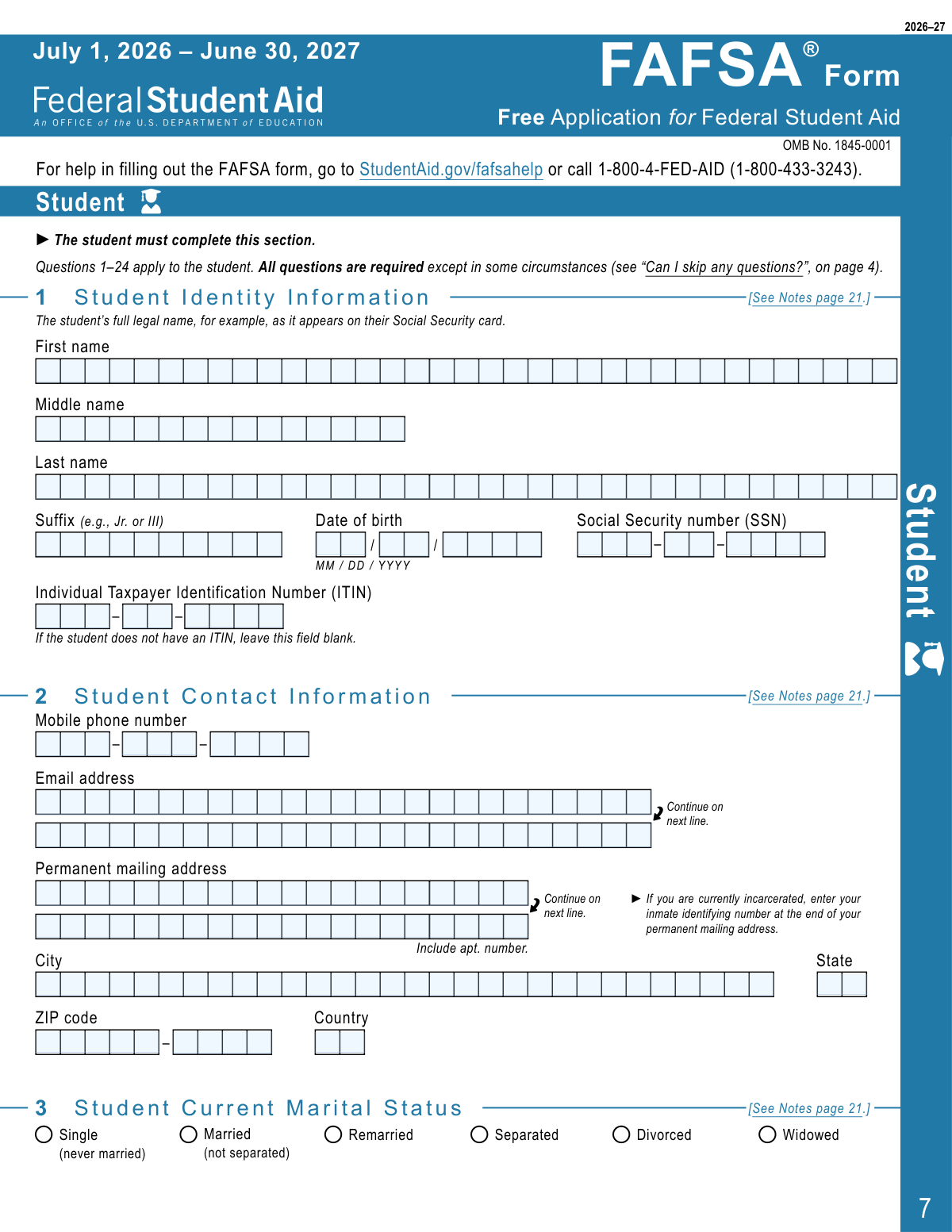
| 1. | 2026–27 FAFSA® Form, Free Application for Federal Student Aid | 20 | Complex 71 |
- Enterprise-grade security & data encryption
- 99%+ accuracy powered by AI
- 1,000+ forms from all industries
- Complete forms in under 60 seconds
How to Choose the Right Form
Navigating college financial forms can feel overwhelming, but for the vast majority of students, the process begins with one critical document. Understanding when and why to use the forms in this category is the first step toward securing your education funding.
The Primary Federal Application
If you are seeking federal grants, work-study programs, or federal student loans, the 2026–27 FAFSA® Form (Free Application for Federal Student Aid) is the essential document you need. This form is the universal standard for financial aid and is used by:
- The Federal Government: To determine eligibility for Pell Grants and subsidized loans.
- State Governments: To award state-specific scholarships and grants.
- Colleges and Universities: To calculate institutional aid packages and need-based scholarships.
When to Choose the 2026–27 FAFSA® Form
You should select the 2026–27 FAFSA® Form if you are planning to attend college or career school during the 2026–2027 academic year. Because this form requires detailed financial data from both students and parents (if applicable), using an AI-powered tool like Instafill.ai can significantly reduce the risk of errors. Our platform helps you navigate the complexities of the application by making the PDF interactive and easier to manage than traditional paper or static digital versions.
Maximizing Your Aid Eligibility
While the FAFSA is the most common requirement, some private institutions may also require supplemental forms. However, the 2026–27 FAFSA® Form remains the mandatory starting point for all domestic students seeking financial assistance. If your goal is to maximize your eligibility for "free money" like grants and work-study before turning to loans, completing this form accurately and early is your best strategy. By using Instafill.ai, you can ensure your data is clear and professional, helping you meet strict priority deadlines for your chosen schools.
Form Comparison
| Form | Primary Purpose | Who Should File | Frequency | Key Information Required |
|---|---|---|---|---|
| 2026–27 FAFSA® Form, Free Application for Federal Student Aid | Determines eligibility for federal, state, and institutional financial aid programs. | Prospective and current college students and their families or guardians. | Submitted annually for every academic year the student is enrolled. | Student and parent demographic data, income details, and asset information. |
Tips for college financial forms
Collect all necessary documents, such as tax returns, W-2 forms, and bank statements, before beginning the application. Having these records organized and ready ensures that you can enter precise figures without having to pause and search for information mid-process.
Financial aid forms often require input from both the student and their parents or guardians. Ensure everyone involved has their identification credentials ready and understands which sections they are responsible for to avoid delays in final submission.
Be careful not to over-report assets by including items that are typically exempt, such as the value of your primary residence or retirement accounts. Mistakenly listing these can negatively impact your aid eligibility, so double-check the instructions for each asset category.
AI-powered tools like Instafill.ai can complete these complex forms in under 30 seconds with high accuracy. By automatically mapping your data to the correct fields, these tools save significant time while ensuring your sensitive financial information remains secure during the process.
Ensure that the names, Social Security numbers, and birthdates entered on the form match your official government documents exactly. Even minor discrepancies, such as using a nickname or transposing digits, can lead to processing errors and significant funding delays.
Before hitting submit, carefully review the summary page for any typos in the financial fields. It is very common to accidentally add an extra zero or swap numbers in income sections, which can drastically change the outcome of your aid determination.
Frequently Asked Questions
College financial forms are documents used by students and families to apply for financial assistance, including grants, scholarships, work-study programs, and student loans. These forms help educational institutions and government agencies determine a student's financial need and eligibility for various types of aid.
Any student planning to attend a college, university, or career school who is seeking financial assistance should complete these forms. This typically includes high school seniors, current undergraduate students, and graduate students, often requiring information from their parents or guardians.
The FAFSA is the primary form for federal aid, while other forms like the CSS Profile or school-specific applications are used by certain private institutions to award their own institutional funds. It is common for students to need to complete multiple forms depending on the requirements of the schools they are applying to.
Most forms become available in the fall or winter prior to the academic year for which you are seeking aid. It is generally recommended to file as early as possible because some aid is distributed on a first-come, first-served basis and deadlines vary by state and institution.
You will typically need tax returns, W-2 forms, and other records of income for both the student and parents. Additionally, you may need bank statements, records of investments, and documentation of untaxed income to ensure the information provided is accurate.
Yes, AI tools like Instafill.ai can be used to fill out these forms by accurately extracting data from your source documents and placing it directly into the required fields. This technology can often complete complex PDF forms in under 30 seconds, reducing the risk of manual entry errors.
While manual entry can take several hours due to the complexity of the questions, using AI-powered services can significantly speed up the process. These tools can process your information and populate the form fields almost instantly, making the overall experience much more efficient.
Errors can delay the processing of your application or result in an incorrect aid offer. If you realize you made a mistake after submitting, you can usually log back into the system to make corrections or contact the financial aid office at your school for guidance.
The FAFSA is free to submit, as indicated by its name (Free Application for Federal Student Aid). However, some institutional forms, such as the CSS Profile, may require a fee, though fee waivers are often available for students who meet certain income criteria.
Most college financial forms are submitted electronically through official government or institutional websites. If you are using a PDF version, you may be required to upload it to a specific portal or mail it to the financial aid office of the college you plan to attend.
Yes, financial aid eligibility is assessed on an annual basis because a family's financial situation can change. You must submit a new application for each academic year you are enrolled in school to remain eligible for assistance.
Glossary
- Form Complexity Index
- Instafill’s 0–100 measure of how much effort a form takes to complete, calculated deterministically from the form’s own structure rather than estimated. It combines the number of fillable fields (the largest factor), how difficult those fields are to complete based on their type, the number of pages that contain fields, the amount of conditional “fill-only-if” logic, and how many sections the form is divided into, then adds modifiers for tables and repeating lists, bundled instruction pages, and dense page layouts. A higher score means the form is harder to fill out by hand. The forms in this category have a median Form Complexity Index of 71/100 (Complex). See exactly how it is calculated.
- SAI (Student Aid Index)
- The numerical value, calculated based on the information provided in the FAFSA, that colleges use to determine how much financial aid a student is eligible to receive.
- Contributor
- Any individual required to provide information, a signature, and consent to have their federal tax information transferred directly into the FAFSA, such as a student, spouse, or parent.
- FSA ID
- A unique username and password used to log in to Federal Student Aid systems and serve as a legal electronic signature on financial aid documents.
- Pell Grant
- A type of federal financial aid for undergraduate students with significant financial need that typically does not need to be repaid.
- COA (Cost of Attendance)
- The estimated total amount it will cost a student to attend a specific college for one year, including tuition, fees, housing, food, books, and supplies.
- Direct Data Exchange (DDX)
- A secure system that allows the FAFSA to automatically retrieve and transfer a contributor's federal tax information directly from the IRS.
- Subsidized Loan
- A federal student loan for which the government pays the interest while the student is in school at least half-time, during the grace period, or during deferment.
- Work-Study
- A federal program that provides part-time jobs for undergraduate and graduate students with financial need, allowing them to earn money to help pay for education expenses.