Fill out FAFSA forms
with AI.
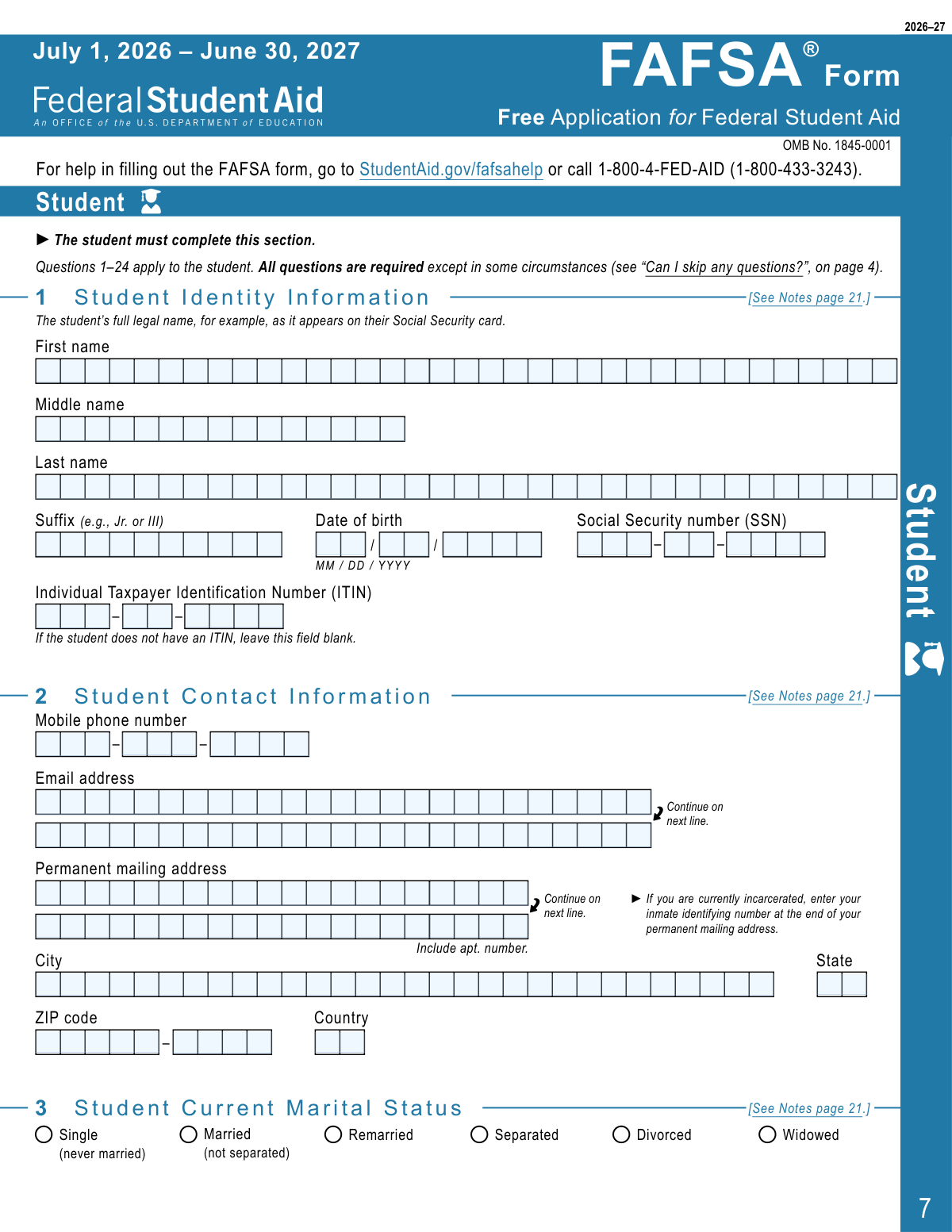
The Free Application for Federal Student Aid (FAFSA) is the cornerstone of the American higher education financing system. These federal student aid forms are essential for any student seeking financial assistance for college, vocational, or career schools. Completing these applications allows the Department of Education to determine eligibility for federal grants, work-study programs, and federal student loans. Beyond federal assistance, many states and individual institutions use the data provided in these forms to award their own scholarships and grants, making them the most critical documents in a student's financial planning toolkit.
By continuing, you acknowledge Instafill's Privacy Policy and agree to get occasional product update and promotional emails.
About FAFSA forms
This category is primarily relevant for high school seniors, current undergraduate and graduate students, and their families. Whether you are applying for the upcoming academic year using the 2026–27 FAFSA® Form or updating your information for ongoing aid, these forms require detailed financial and personal data to calculate the Student Aid Index (SAI). Navigating these requirements can be time-consuming, especially when balancing academic deadlines and family responsibilities. Having the right financial aid forms organized and ready for submission is key to ensuring you do not miss out on available funding due to processing delays or errors.
To simplify this process, tools like Instafill.ai use AI to fill these forms in under 30 seconds while ensuring data is handled accurately and securely. This allows students and parents to focus on the transition to higher education rather than the manual data entry associated with complex federal paperwork.
Every form on this page can be completed without typing. Instafill is form filling software that reads a PDF and fills it for you — including flat and scanned documents that carry no fillable fields at all.
Forms in This Category
The forms in this category have a median Form Complexity Index of 71/100 (Complex), measured across 2 forms by field count, input difficulty, length, conditional logic and structure. See how it is calculated.
| Form Name | Pages | FCI | |
|---|---|---|---|
| 1. | 2026–27 FAFSA® Form, Free Application for Federal Student Aid | 20 | Complex 71 |
| 2. | Free Application for Federal Student Aid (FAFSA) | 11 | Moderate 60 |
- Enterprise-grade security & data encryption
- 99%+ accuracy powered by AI
- 1,000+ forms from all industries
- Complete forms in under 60 seconds
How to Choose the Right Form
Navigating federal student aid can be overwhelming, but selecting the correct document is the first step toward securing grants, work-study, and loans. To ensure your application is processed correctly by the Department of Education and your school's financial aid office, you must choose the form that matches your intended period of enrollment.
Select by Academic Period
The most important factor in choosing a FAFSA form is the specific academic year for which you are seeking aid. Financial aid is not retroactive in the same way other programs might be, so timing is critical:
- 2026–27 FAFSA® Form: Select this specific version if you are planning to attend college, graduate school, or career school during the 2026–2027 academic year (typically beginning in the fall of 2026). This is the correct choice for high school seniors graduating in Spring 2026 or current college students renewing their aid for the upcoming year.
- Free Application for Federal Student Aid (FAFSA): Use this general version if you are looking for the standard application for the current active cycle. This form is used to calculate your Student Aid Index (SAI), which determines your eligibility for federal Pell Grants, subsidized loans, and institutional scholarships.
Why Precision Matters
Submitting the wrong year's form is a common mistake that can significantly delay your financial aid package. Each version of the FAFSA requires financial information from a specific "prior-prior" tax year. Using the 2026–27 FAFSA® Form ensures you are providing the correct historical data required by federal law for that cycle.
Streamline Your Application
Filling out these extensive documents manually can lead to errors that impact your funding. By using the forms listed here on Instafill.ai, you can utilize AI-powered tools to complete the 2026–27 FAFSA® Form or the general Free Application for Federal Student Aid (FAFSA) more accurately. Our platform helps you navigate these complex PDFs by converting them into interactive, easy-to-fill documents, ensuring you don't miss critical fields required for federal student aid.
Form Comparison
| Form | Target Academic Year | Primary Purpose | Key Outcome |
|---|---|---|---|
| 2026–27 FAFSA® Form, Free Application for Federal Student Aid | Specifically for students attending college during the 2026-2027 academic year | Apply for federal grants, work-study programs, and federal student loans | Determines eligibility for federal, state, and institutional financial assistance |
| Free Application for Federal Student Aid (FAFSA) | Standard application for current or upcoming college academic cycles | Collect financial data to determine eligibility for student financial aid | Calculates the Student Aid Index (SAI) used for aid packages |
Tips for FAFSA forms
To ensure accuracy, have your social security number, tax returns, and records of untaxed income ready before starting. Having these documents on hand prevents interruptions and ensures the financial figures you enter match official IRS records.
Many students incorrectly assume they are independent, which can lead to application rejection or processing delays. Review the specific federal criteria for independent status to decide if you are required to provide your parents' financial information.
AI-powered tools like Instafill.ai can complete these complex forms in under 30 seconds with high accuracy. Your data stays secure during the process, making it a reliable and efficient way to handle the extensive data entry required for financial aid applications.
You can list multiple colleges on your FAFSA even if you haven't been accepted or decided where to attend yet. Adding all potential schools early ensures they receive your financial data immediately, preventing delays in your financial aid offer package.
A common reason for processing delays is a missing signature from the student or a required parent contributor. Double-check that all parties have signed the form to ensure it is officially accepted for processing by the Department of Education.
While federal deadlines are generally later in the year, many states and individual colleges have much earlier priority dates for awarding their own aid. Submit your forms as early as possible to maximize your chances of receiving limited first-come, first-served funding.
After submission, carefully review your FAFSA Submission Summary to check your calculated Student Aid Index. If this number seems incorrect due to a change in financial circumstances, contact your school's financial aid office to discuss a professional judgment review.
Frequently Asked Questions
FAFSA forms are the primary application used by the federal government, state agencies, and colleges to determine a student's eligibility for financial assistance. This aid can include federal grants, work-study programs, and low-interest student loans for higher education.
Most current and prospective college or career school students who are U.S. citizens or eligible noncitizens can apply for aid. Eligibility typically requires being enrolled in an eligible degree or certificate program and maintaining satisfactory academic progress.
You should select the form that corresponds to the specific academic year you plan to attend school. For example, if you are planning to attend college during the fall of 2026 and spring of 2027, you should complete the 2026–27 FAFSA® Form.
Generally, you will need your Social Security number, federal income tax returns, W-2s, and records of any untaxed income. You may also need bank statements and records of investments to accurately report the financial status of the student and, if applicable, their parents.
It is highly recommended to submit these forms as early as possible once the application period opens for the year. Many states and colleges have limited funding that is distributed on a first-come, first-served basis, so early filing can maximize your potential aid package.
The Student Aid Index is a calculated number based on the financial information you provide in the application. Colleges use this index to determine your financial need and to build a financial aid package tailored to your specific situation.
Yes, AI tools like Instafill.ai can be used to fill out these forms by accurately extracting data from your financial documents and placing it into the correct fields. This helps ensure the application is filled out precisely based on your source records.
Using AI-powered services like Instafill.ai, these extensive forms can be completed in under 30 seconds. The AI technology quickly parses your uploaded documents and populates the form automatically, saving you from hours of manual data entry.
No, the application for federal student aid is free to submit to the U.S. Department of Education. While you may use tools to help you organize and fill out the data more efficiently, the government does not charge a fee for processing the application.
Yes, you must submit a new FAFSA for every academic year you are enrolled in school. Because financial situations and family dynamics can change, your eligibility for aid is recalculated annually based on the most recent information provided.
Once processed by the Federal Student Aid office, your information is sent to the colleges and career schools you listed on the form. Those institutions then use the data to determine the specific amount of aid they can offer you.
Yes, FAFSA forms are used for both undergraduate and graduate students. While the specific types of aid available may differ—such as graduate students being primarily eligible for federal loans rather than grants—the application process remains the same.
Glossary
- Form Complexity Index
- Instafill’s 0–100 measure of how much effort a form takes to complete, calculated deterministically from the form’s own structure rather than estimated. It combines the number of fillable fields (the largest factor), how difficult those fields are to complete based on their type, the number of pages that contain fields, the amount of conditional “fill-only-if” logic, and how many sections the form is divided into, then adds modifiers for tables and repeating lists, bundled instruction pages, and dense page layouts. A higher score means the form is harder to fill out by hand. The forms in this category have a median Form Complexity Index of 71/100 (Complex). See exactly how it is calculated.
- Student Aid Index (SAI)
- An eligibility index number used by financial aid offices to determine how much federal aid you may receive, replacing the older Expected Family Contribution (EFC) model.
- FSA ID
- A unique username and password used to log in to Federal Student Aid systems and legally sign the FAFSA form electronically.
- Contributor
- Any individual, such as a parent, step-parent, or spouse, who is required to provide information and legal consent on a student’s FAFSA application.
- Student Aid Report (SAR)
- A summary document provided after the FAFSA is processed that details the information submitted and provides an initial estimate of aid eligibility.
- Federal Pell Grant
- A form of federal financial aid that does not typically need to be repaid, awarded to undergraduate students with significant financial need.
- Cost of Attendance (COA)
- The estimated total cost of attending a college or university for one academic year, including tuition, housing, books, and personal expenses.
- Direct Data Exchange (DDX)
- A secure tool that automatically transfers required federal tax information from the IRS directly into the FAFSA form to ensure accuracy.
- Subsidized Loan
- A federal student loan for which the government pays the interest while the borrower is still in school or during specific deferment periods.