Fill out federal tax forms
with AI.
Federal tax forms are the backbone of the United States tax system, serving as the primary communication channel between individuals, businesses, and the Internal Revenue Service (IRS). This category encompasses a wide range of documentation required for reporting income, calculating tax liabilities, and claiming credits or refunds. Accurate completion of these forms is essential not only for remaining in good standing with federal law but also for ensuring that businesses and individuals pay exactly what they owe—no more and no less.
By continuing, you acknowledge Instafill's Privacy Policy and agree to get occasional product update and promotional emails.
About federal tax forms
These forms are typically required by employers, business owners, and specialized workers during various stages of the fiscal year. For instance, employers use documents like Form 941 to report quarterly payroll taxes, while business owners might need Form 720 for excise taxes or Form 2290 for heavy vehicle usage. Beyond standard reporting, these forms are used to correct previous filing errors or request specific determinations, such as worker status. Whether you are managing a large corporation's payroll or resolving a personal tax hardship through the Taxpayer Advocate Service, having the correct paperwork is the first step in successful tax administration.
Dealing with complex IRS paperwork can be time-consuming and prone to manual entry errors. Tools like Instafill.ai use AI to fill these forms in under 30 seconds, ensuring data is handled accurately and securely while saving significant administrative time. By streamlining the data entry process, you can focus on meeting your federal obligations without the stress of navigating complicated PDF layouts.
Every form on this page can be completed without typing. Instafill is form filling software that reads a PDF and fills it for you — including flat and scanned documents that carry no fillable fields at all.
Forms in This Category
The forms in this category have a median Form Complexity Index of 66/100 (Complex), measured across 9 forms by field count, input difficulty, length, conditional logic and structure. See how it is calculated.
| Form Name | Pages | FCI | |
|---|---|---|---|
| 1. | Form 720, Quarterly Federal Excise Tax Return | 8 | Very Complex 80 |
| 2. | Form 945, Annual Return of Withheld Federal Income Tax | 2 | Moderate 51 |
| 3. | Form 2290, Heavy Highway Vehicle Use Tax Return | 10 | Complex 66 |
| 4. | Form 911, Request for Taxpayer Advocate Service Assistance (And Application for Taxpayer Assistance Order) | 4 | Moderate 48 |
| 5. | Form 941, Employer's QUARTERLY Federal Tax Return (Rev. March 2025) | 3 | Moderate 60 |
| 6. | Form 941-X, Adjusted Employer’s QUARTERLY Federal Tax Return or Claim for Refund | 6 | Complex 72 |
| 7. | Form 941-X (Rev. April 2023), Adjusted Employer’s QUARTERLY Federal Tax Return or Claim for Refund | 6 | Complex 76 |
| 8. | Form 941, Employer’s Quarterly Federal Tax Return | 3 | Moderate 62 |
| 9. | Form SS-8, Determination of Worker Status | 5 | Complex 76 |
- Enterprise-grade security & data encryption
- 99%+ accuracy powered by AI
- 1,000+ forms from all industries
- Complete forms in under 60 seconds
How to Choose the Right Form
Navigating federal tax requirements can be complex, but choosing the right form depends primarily on whether you are reporting employee wages, correcting past mistakes, or paying specialized industry taxes. Use this guide to identify the specific paperwork you need for your situation.
Employer Payroll Reporting and Corrections
Most businesses with employees will spend the majority of their time with quarterly filings.
- Form 941 (Employer's Quarterly Federal Tax Return): This is the standard form used four times a year to report employee wages, federal income tax withholding, and Social Security/Medicare taxes.
- Form 941-X (Adjusted Employer’s Quarterly Federal Tax Return): Use this if you have already filed a Form 941 but discovered an error. Whether you underpaid or overpaid, this form allows you to adjust your records or claim a refund.
Worker Classification and Non-Payroll Taxes
If your tax situation involves non-employees or specific types of withholding, look at these options:
- Form SS-8: Choose this if there is a dispute or uncertainty regarding whether a worker should be classified as an independent contractor or an employee. The IRS will use this to make an official determination.
- Form 945 (Annual Return of Withheld Federal Income Tax): Unlike Form 941, this is used for non-payroll withholding, such as taxes taken from pensions, IRAs, annuities, or gambling winnings.
Excise Taxes and Vehicle Fees
Certain industries and activities require specialized excise tax filings:
- Form 2290 (Heavy Highway Vehicle Use Tax Return): Specifically for owners of vehicles weighing 55,000 pounds or more. You need the stamped Schedule 1 from this filing to register your vehicle at the state level.
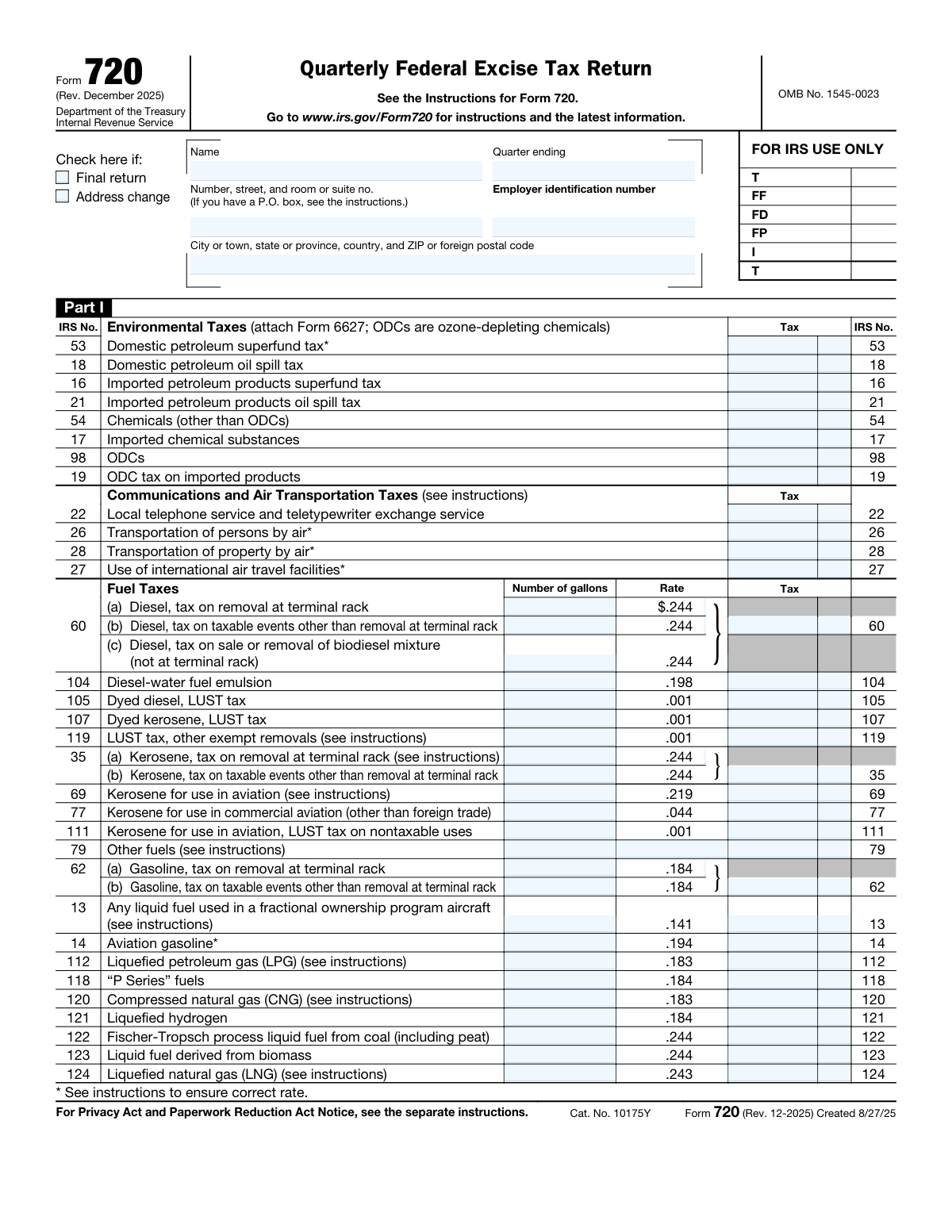
- Form 720 (Quarterly Federal Excise Tax Return): Used by businesses to report taxes on specific goods and services, such as environmental taxes, fuel taxes, or communications and air transportation services.
Seeking IRS Assistance
If you are facing significant financial hardship or an unresolved issue that normal IRS channels haven't fixed, use Form 911 (Request for Taxpayer Advocate Service Assistance). This form formally requests an independent advocate to step in and help resolve your case.
Form Comparison
| Form | Purpose | Who Files It | Filing Frequency |
|---|---|---|---|
| Form 720, Quarterly Federal Excise Tax Return | Reports and pays federal excise taxes on specific goods and services. | Businesses dealing in fuel, air transport, or specific retail goods. | Filed quarterly by the end of the month following each quarter. |
| Form 945, Annual Return of Withheld Federal Income Tax | Reports non-payroll federal income tax withheld from pensions and IRAs. | Payers of pensions, gambling winnings, or military retirement pay. | Filed annually by January 31st for the previous calendar year. |
| Form 2290, Heavy Highway Vehicle Use Tax Return | Calculates and pays tax for heavy vehicles used on public highways. | Owners of vehicles with a gross weight of 55,000 pounds or more. | Filed annually for the period beginning July 1st each year. |
| Form 911, Request for Taxpayer Advocate Service Assistance | Requests help for taxpayers experiencing significant hardship with IRS issues. | Individuals or businesses unable to resolve problems through normal IRS channels. | Filed as needed when experiencing economic harm or serious issues. |
| Form 941, Employer's QUARTERLY Federal Tax Return (Rev. March 2025) | Reports employee wages, withheld income taxes, and FICA tax contributions. | Most employers who pay wages to one or more employees. | Filed quarterly to maintain payroll compliance and tax reporting. |
| Form 941-X, Adjusted Employer’s QUARTERLY Federal Tax Return or Claim for Refund | Corrects errors or claims refunds on previously submitted Form 941 filings. | Employers who discovered mistakes in reported wages or withheld taxes. | Filed as needed to adjust underpayments or overpayments of tax. |
| Form 941-X (Rev. April 2023), Adjusted Employer’s QUARTERLY Federal Tax Return or Claim for Refund | Amends employment tax returns to fix mistakes in withholding or credits. | Employers correcting specific historical quarters using the April 2023 revision. | Filed as needed for adjustments or refund claims for past quarters. |
| Form SS-8 (Rev. December 2023), Determination of Worker Status | Requests an IRS determination regarding worker classification for tax purposes. | Firms or workers needing to clarify employee versus contractor status. | Filed as needed when a worker's status is in dispute. |
| Form 941, Employer’s Quarterly Federal Tax Return | Standard report for income, social security, and Medicare taxes withheld. | Employers paying wages subject to federal income tax withholding. | Filed quarterly by the last day of the month following the quarter. |
Tips for federal tax forms
Many federal tax forms, such as the 941 and 720, are filed on a quarterly basis. Always double-check that you have selected the correct quarter and year on the form to ensure your payments are applied correctly and to avoid unnecessary late notices.
Dealing with multiple federal forms can be time-consuming, but AI-powered tools like Instafill.ai can complete these documents in under 30 seconds with high accuracy. Your sensitive financial data stays secure during the process, providing a fast and safe way to manage your IRS paperwork.
When correcting payroll errors using Form 941-X, you must choose whether to apply overpayments as a credit to your next return or request a refund check. Selecting the adjustment process is generally faster for active businesses that want to offset future tax liabilities.
For forms like the SS-8, the IRS looks for specific details regarding behavioral and financial control. Have your independent contractor agreements, training manuals, and past payment records ready to support your classification request and ensure a thorough review.
To avoid delays and lost mail, use IRS Direct Pay or the Electronic Federal Tax Payment System (EFTPS) for your tax liabilities. These digital methods provide an immediate confirmation number, which serves as vital proof that you met your federal deposit deadlines.
If you are filing Form 2290 for heavy highway vehicles, the IRS-stamped Schedule 1 is your essential proof of payment. You will need this specific document for state vehicle registration and renewals, so keep a high-quality digital copy in your permanent records.
Frequently Asked Questions
Federal tax forms are official documents used by individuals and businesses to report income, expenses, and taxes owed to the Internal Revenue Service (IRS). They ensure that the correct amount of tax is calculated, reported, and paid according to federal law for everything from payroll to excise taxes.
This category primarily includes forms for employers, business owners, and specific service providers. For example, employers use Form 941 for quarterly reporting, while owners of heavy vehicles must file Form 2290 to pay highway use taxes.
Filing frequencies vary depending on the specific form; many employment tax forms like Form 941 are filed quarterly, while others like Form 945 or Form 2290 are filed annually. It is essential to check the IRS schedule for each specific form to avoid late filing penalties.
Yes, you can use AI tools to complete federal tax forms more efficiently. AI platforms like Instafill.ai can accurately extract data from your source documents and automatically place it into the correct fields on the PDF, reducing manual entry errors.
Using AI-powered services, you can fill out these forms in under 30 seconds. The technology handles the complex data mapping from your records to the IRS document, making the process much faster than manual typing.
If you discover an error on a past return, you should use an adjusted return form, such as Form 941-X. This allows you to correct underreported or overreported taxes and ensure your payroll records remain compliant with IRS standards.
You can make payments through the IRS website using services like IRS Direct Pay for individuals or the Electronic Federal Tax Payment System (EFTPS) for businesses. Paying online is generally the most secure and fastest way to ensure your payment is credited to your account.
If you are unsure about a worker's classification, you can file Form SS-8 to request an official determination from the IRS. The agency will evaluate factors like behavioral control and the financial relationship to decide the correct status for federal tax purposes.
You can visit the IRS transcript website and use the 'Get Your Tax Record' tool to download or request a transcript of your past filings. These transcripts provide a summary of your tax return information and are frequently used for verification by lenders or for personal record-keeping.
If you have an unresolved tax problem that is causing significant hardship, you can file Form 911 to request assistance from the Taxpayer Advocate Service (TAS). The TAS is an independent organization within the IRS that helps protect taxpayer rights and resolve complex issues.
Owners of heavy highway motor vehicles with a taxable gross weight of 55,000 pounds or more must file Form 2290. Once processed, the IRS returns a stamped Schedule 1, which serves as necessary proof of payment for state vehicle registration.
Most of these forms can be submitted electronically through the IRS e-file system, which is the preferred method for faster processing. Alternatively, you can mail paper forms to the specific IRS service center address listed in the instructions for that particular form.
Glossary
- Form Complexity Index
- Instafill’s 0–100 measure of how much effort a form takes to complete, calculated deterministically from the form’s own structure rather than estimated. It combines the number of fillable fields (the largest factor), how difficult those fields are to complete based on their type, the number of pages that contain fields, the amount of conditional “fill-only-if” logic, and how many sections the form is divided into, then adds modifiers for tables and repeating lists, bundled instruction pages, and dense page layouts. A higher score means the form is harder to fill out by hand. The forms in this category have a median Form Complexity Index of 66/100 (Complex). See exactly how it is calculated.
- EIN (Employer Identification Number)
- A unique nine-digit number assigned by the IRS to identify a business entity, similar to a Social Security number for individuals.
- FICA Taxes
- The combined Social Security and Medicare taxes withheld from employee paychecks and matched by employers, as reported on Form 941.
- Withholding
- The portion of an employee's wages or other payments, such as pensions, that is taken out and sent directly to the IRS as a prepayment of income tax.
- Excise Tax
- A specialized tax imposed on specific goods, services, or activities, such as fuel, tobacco, or the use of heavy highway vehicles.
- Taxpayer Advocate Service (TAS)
- An independent organization within the IRS that helps taxpayers resolve problems that they haven't been able to fix through normal IRS channels.
- Taxable Gross Weight
- The combined weight of a vehicle, its trailers, and the maximum load it is registered to carry, used to calculate taxes for Form 2290.
- Tax Transcript
- A summary of your tax return information or account activity provided by the IRS, often required by lenders to verify income.
- Estimated Tax
- Quarterly tax payments made by individuals or businesses whose income is not subject to automatic withholding, such as self-employment or investment income.
- Worker Classification
- The IRS determination of whether a person performing services is an employee or an independent contractor, which dictates how taxes are withheld and reported.