Fill out property forms
with AI.
Property forms are essential for managing real estate assets, whether for residential, commercial, or investment purposes. This category covers a broad spectrum of legal and financial requirements, ranging from tax rebate claims and depreciation reporting to property condition disclosures and professional licensing. These documents are fundamental to ensuring that real estate transactions are transparent, tax obligations are met, and the legal rights of landlords, tenants, and agents are fully protected.
By continuing, you acknowledge Instafill's Privacy Policy and agree to get occasional product update and promotional emails.
About property forms
Typically, these forms are required by a wide range of professionals and individuals, including property owners, developers, and real estate brokers. For example, landlords may need to submit GST/HST rebate forms for new rental properties, while business owners use IRS forms to track the depreciation of their assets. Real estate agents also utilize this category for mandatory licensing applications or when preparing residential leases and security deposit receipts. Whether you are disclosing the condition of a home before a sale or appealing a property assessment, accurate documentation is critical to maintaining compliance and avoiding costly administrative delays.
Tools like Instafill.ai use AI to fill these property forms in under 30 seconds, handling complex data accurately and securely to save you valuable time. This streamlined approach makes it easier to manage the paperwork involved in property ownership and real estate management.
Every form on this page can be completed without typing. Instafill is form filling software that reads a PDF and fills it for you — including flat and scanned documents that carry no fillable fields at all.
Forms in This Category
The forms in this category have a median Form Complexity Index of 74/100 (Complex), measured across 34 forms by field count, input difficulty, length, conditional logic and structure. See how it is calculated.
- Enterprise-grade security & data encryption
- 99%+ accuracy powered by AI
- 1,000+ forms from all industries
- Complete forms in under 60 seconds
How to Choose the Right Form
Navigating property-related paperwork can be complex, as requirements vary significantly by location and specific intent. To find the right document, identify whether your primary goal is tax recovery, legal disclosure, or professional licensing.
Tax Rebates and Asset Depreciation
If you are a landlord or builder looking to manage costs and tax liabilities, these forms are essential:
- Form GST524 (GST/HST New Residential Rental Property Rebate): Use this form if you have paid GST/HST on a new or substantially renovated residential rental property in Canada and wish to claim a rebate.
- IRS Form 4562 (Depreciation and Amortization): This federal tax form is for business owners or investors reporting depreciation on "listed property" (like vehicles) or electing to expense assets under Section 179.
- Form TC201 (Income and Expense Schedule): Specifically for New York City property owners, this is required when filing an assessment appeal for rent-producing properties.
Real Estate Transactions and Leasing
For those buying, selling, or renting out residential space, the following documents ensure legal compliance:
- New York State Property Condition Disclosure Statement (DOS-1614-f): Sellers of 1-4 family residential properties in NY must provide this to buyers to disclose known environmental or structural issues.
- Washington Single-Family Property Term Lease & Security Deposit Receipt: Use this for fixed-term residential leases in Washington state to document rent terms and security deposit handling.
- Florida Family Law Form 12.901(b)(3): While technically a divorce petition, this is the correct choice in Florida if you are ending a marriage and specifically have no marital property or assets to divide.
Professional Licensing and Insurance
If you are operating a real estate business or seeking coverage, look for these:
- Form 1–1 (IND) (Queensland): Use this for individual licensing applications for real estate agents, auctioneers, or letting agents in Queensland, Australia.
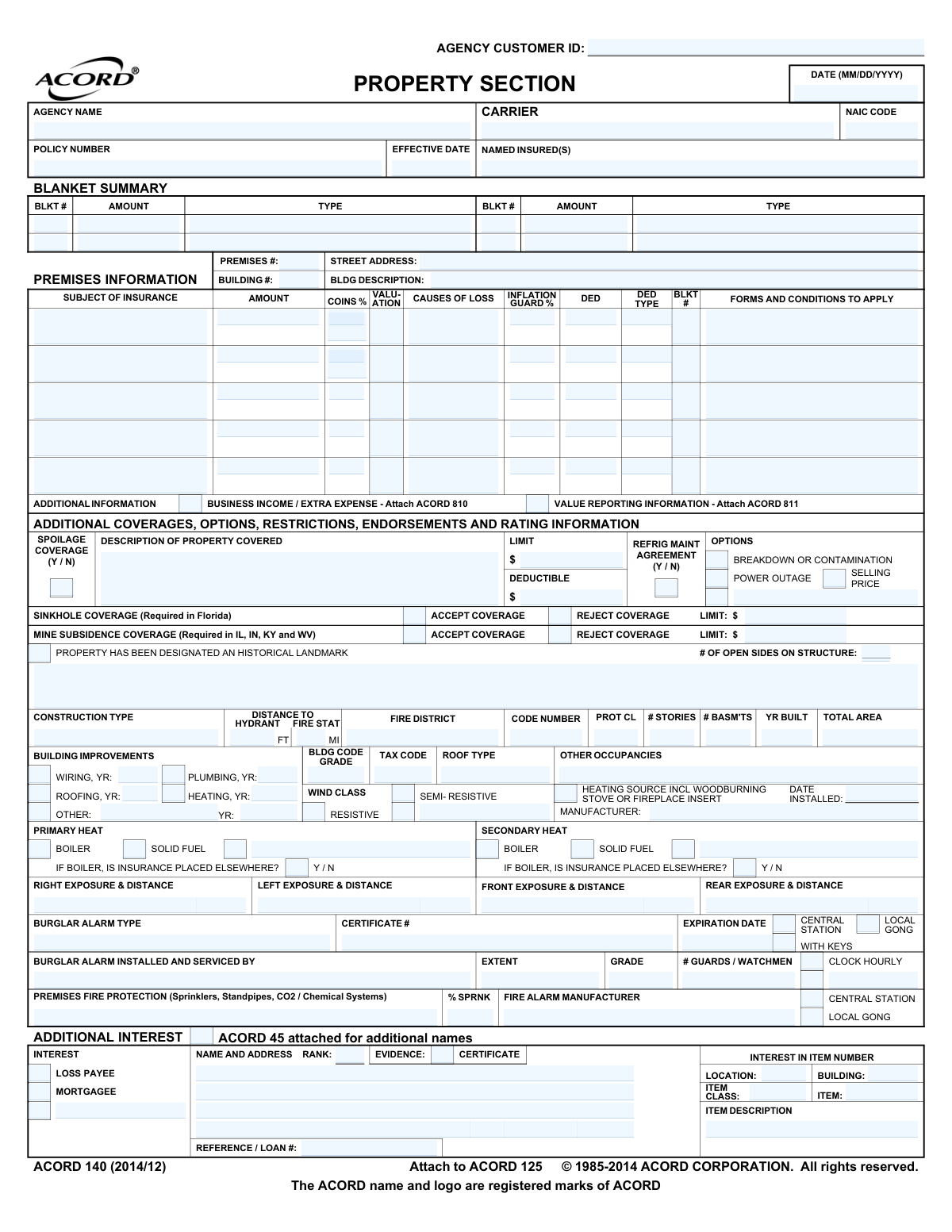
- ACORD 140 (Property Section): This is a supplement to commercial insurance applications (ACORD 125) used to detail building construction and protection risks.
- Martial Arts Studio General Liability and Property Application: A specialized underwriting form for fitness business owners seeking both liability and property coverage.
Form Comparison
| Form | Purpose | Who Files It | Primary Use Case |
|---|---|---|---|
| Form GST524, GST/HST New Residential Rental Property Rebate | To claim a rebate for GST/HST paid on new residential rental properties. | Landlords and builders of new or substantially renovated residential units. | Recovering tax costs for purpose-built rental housing in Canada. |
| Form 4562, Depreciation and Amortization (Including Information on Listed Property) | To report depreciation and amortization for business or income-producing property. | Business owners and investors filing federal income tax returns. | Calculating tax deductions for assets like vehicles and buildings. |
| New licence application – Form 1–1 (IND), Application for an individual’s licence | To apply for a professional license in real estate or auctioneering. | Individuals seeking occupational licensing in Queensland, Australia. | Legally performing licensable real estate or motor dealer activities. |
| ACORD 140 (2014/12), Property Section (Attach to ACORD 125) | To provide underwriting details for commercial property insurance applications. | Insurance agents and business owners seeking commercial coverage. | Evaluating property risks and determining insurance policy pricing. |
| Florida Supreme Court Approved Family Law Form 12.901(b)(3) | To petition for divorce when no children or property are involved. | Spouses in Florida seeking an uncontested or simplified dissolution. | Ending a marriage where there are no shared marital assets. |
| New York State Property Condition Disclosure Statement (DOS-1614-f) | To disclose known environmental and structural conditions of a home. | Sellers of one-to-four family residential properties in New York. | Informing buyers of property defects before a binding sale contract. |
| Martial Arts Studio General Liability and Property Application | To apply for specialized liability and property insurance for studios. | Owners of martial arts, fitness, or wellness business facilities. | Securing coverage for business operations, equipment, and studio premises. |
| Washington Single-Family Property Term Lease & Security Deposit Receipt | To establish legal rental terms and document security deposit funds. | Landlords and tenants entering a fixed-term residential lease agreement. | Complying with Washington state laws for single-family home rentals. |
| TC201, Income and Expense Schedule for Rent-Producing Property | To report financial data for property tax assessment appeals. | Owners of rent-producing properties within New York City. | Challenging the assessed value of a property to reduce taxes. |
Tips for property forms
Always cross-reference addresses, block numbers, and lot identifiers with your latest deed or tax assessment. Small discrepancies in property identification can lead to rejected applications or legal disputes during a real estate transaction.
Whether you are claiming a tax rebate or filing a property disclosure statement, keep organized receipts for renovations and maintenance. Having these documents ready makes it much easier to calculate depreciation or justify property condition claims accurately.
AI-powered tools like Instafill.ai can complete complex property forms in under 30 seconds with high accuracy. This is a significant time-saver for landlords or real estate professionals managing multiple properties, and your data stays secure during the process.
Many property-related legal forms require signatures to be witnessed or notarized to be legally binding. Check the final page of your document before filing to ensure you haven't missed a mandatory notary seal, which could void the entire submission.
When filling out property condition disclosure forms, avoid vague language. Clearly state known issues regarding structural or environmental factors to protect yourself from future liability and ensure a transparent transaction for the buyer.
If you manage multiple rental units, use a standardized lease form as a base template. This ensures consistency across your properties and allows you to quickly update specific terms like rent amounts or tenant names without starting from scratch.
Property forms often act as addenda to larger applications, such as insurance or tax appeals. Always verify if your primary form requires specific attachments, like income schedules or property sections, to be considered a complete filing.
Frequently Asked Questions
This category includes a wide variety of documents used in real estate transactions, property management, and tax reporting. You will find forms for claiming rental property tax rebates, reporting asset depreciation to the IRS, state-mandated property condition disclosures, and residential lease agreements.
The correct form depends on your specific goal, such as whether you are selling a home, managing a rental, or filing taxes. For example, if you are a landlord reporting income-producing assets, you would likely need a depreciation schedule, whereas a seller in New York would need a specific property condition disclosure statement.
Yes, AI tools like Instafill.ai can fill out complex property forms in under 30 seconds. The AI accurately extracts data from your source documents and places it into the appropriate fields, reducing the risk of manual entry errors.
Property disclosure statements are generally completed by the seller of a residential property before a contract of sale is signed. These forms require the owner to disclose known defects or conditions regarding the home's structure, environmental risks, and mechanical systems to the buyer.
Using traditional methods, multi-page property forms can take significant time to complete accurately. However, with AI-powered services like Instafill.ai, the process is streamlined to take less than a minute by automatically populating the form with relevant data from your existing files.
Submission requirements vary by the type of form and the governing jurisdiction. Tax-related forms are submitted to agencies like the IRS or CRA, while licensing applications are sent to state regulatory boards, and lease agreements are kept as private records between landlords and tenants.
Yes, there are specific tax forms designed for landlords and builders to recover taxes paid on new or substantially renovated residential rental properties. These forms help ensure compliance with tax regulations while making purpose-built rental housing more affordable for owners.
Schedules like these are used by tax commissions and assessment offices to evaluate the value of a rent-producing property. Owners provide detailed financial data over a specific period, which the authorities use to determine if the property's assessed value for tax purposes is accurate.
Some property forms, particularly those related to legal petitions or official disclosures, may require a signature under oath before a notary public or a deputy clerk. Always check the specific instructions on the form to see if official witnessing is a requirement for the document to be valid.
If you have a non-fillable PDF, you can use AI tools to convert it into an interactive, fillable document. Platforms like Instafill.ai can transform static property forms into digital ones, allowing you to type directly into the fields and save your progress online.
Glossary
- Form Complexity Index
- Instafill’s 0–100 measure of how much effort a form takes to complete, calculated deterministically from the form’s own structure rather than estimated. It combines the number of fillable fields (the largest factor), how difficult those fields are to complete based on their type, the number of pages that contain fields, the amount of conditional “fill-only-if” logic, and how many sections the form is divided into, then adds modifiers for tables and repeating lists, bundled instruction pages, and dense page layouts. A higher score means the form is harder to fill out by hand. The forms in this category have a median Form Complexity Index of 74/100 (Complex). See exactly how it is calculated.
- Depreciation
- The accounting method of spreading the cost of a tangible property asset over its useful life, used to reduce taxable income on IRS forms.
- MACRS (Modified Accelerated Cost Recovery System)
- The current tax depreciation system in the United States used to calculate the depreciation deduction for most business and investment property.
- Section 179
- An IRS tax election that allows business owners to deduct the full purchase price of qualifying equipment or property in the year it was purchased rather than over several years.
- Substantial Renovation
- A level of property remodeling where the majority of the existing building is removed or replaced, often used as a qualifying factor for GST/HST tax rebates.
- Assessed Value
- The valuation placed on a property by a public tax assessor to calculate property taxes or to determine eligibility for tax appeals.
- Listed Property
- Assets that are used for both business and personal purposes, such as vehicles or certain electronics, which require specific documentation to claim as business expenses.
- Underwriting
- The process an insurance company uses to evaluate the risk of a property to decide whether to provide coverage and what the premium should be.
- Conveyancing
- The legal process of transferring the title of real property from one person to another, including the preparation of deeds and leasehold documents.