Yes! You can use AI to fill out New York State Department of State (Division of Licensing Services) Property Condition Disclosure Statement (DOS-1614-f)
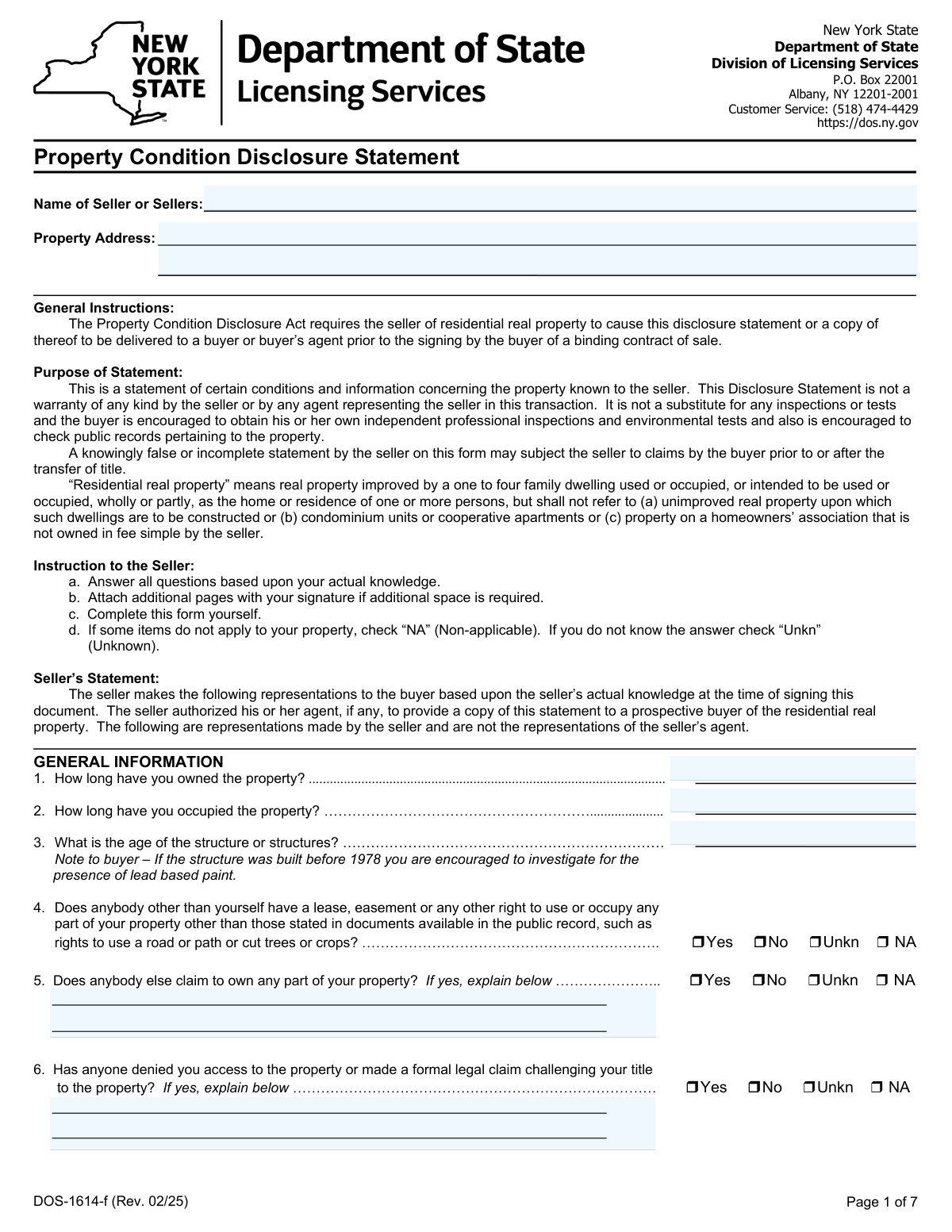
The Property Condition Disclosure Statement (DOS-1614-f) is a New York State form used by sellers of certain one-to-four family residential properties to disclose known conditions affecting the home and property. It covers general property information, environmental risks (including flood-related disclosures), structural issues, and mechanical systems and services. The form is important because it must generally be delivered to the buyer or the buyerâs agent before the buyer signs a binding contract of sale, and knowingly false or incomplete disclosures can expose the seller to buyer claims. It is not a warranty and does not replace inspections; buyers are encouraged to obtain independent inspections and review public records.
Our AI automatically handles information lookup, data retrieval, formatting, and form filling.
It takes less than a minute to fill out DOS-1614-f using our AI form filling.
Securely upload your data. Information is encrypted in transit and deleted immediately after the form is filled out.
Form specifications
| Form name: | New York State Department of State (Division of Licensing Services) Property Condition Disclosure Statement (DOS-1614-f) |
| Number of pages: | 7 |
| Filled form examples: | Form DOS-1614-f Examples |
| Language: | English |
| Categories: | disclosure forms |
Instafill Demo: filling out a legal form in seconds
How to Fill Out DOS-1614-f Online for Free in 2026
Are you looking to fill out a DOS-1614-F form online quickly and accurately? Instafill.ai offers the #1 AI-powered PDF filling software of 2026, allowing you to complete your DOS-1614-F form in just 37 seconds or less.
Follow these steps to fill out your DOS-1614-F form online using Instafill.ai:
- 1 Enter the seller name(s) and the full property address, and confirm the form applies to the transaction (NY residential real property, generally 1–4 family).
- 2 Complete the General Information section by answering ownership/occupancy questions and marking Yes/No/Unknown/NA for rights, claims, shared features, fees, and certificates of occupancy, adding explanations where required.
- 3 Fill out the Environmental section, including FEMA floodplain/SFHA/500-year floodplain questions, flood insurance and prior flood assistance/claims, and any known wetlands, agricultural district status, landfills, tanks, asbestos, lead, radon, spills, and testing; upload any supporting reports/policies/certificates.
- 4 Complete the Structural section by disclosing known damage (rot/water, fire/smoke, pests), roof type/age/warranty, and any known defects in structural systems; attach pest or other inspection reports if available.
- 5 Complete the Mechanical Systems and Services section by providing water source and testing, sewage type and septic/cesspool details, electric service details, and any flooding/drainage/water penetration history; explain any known defects.
- 6 Use the additional explanation area to clarify any “Yes” answers, provide locations/details, and note any additional pages attached; ensure all attachments are included and referenced.
- 7 Review for accuracy based on actual knowledge, then apply seller signature(s) and date(s); deliver the completed disclosure to the buyer/buyer’s agent and obtain buyer acknowledgment signature(s) and date(s).
Our AI-powered system ensures each field is filled out correctly, reducing errors and saving you time.
Why Choose Instafill.ai for Your Fillable DOS-1614-f Form?
Speed
Complete your DOS-1614-f in as little as 37 seconds.
Up-to-Date
Always use the latest 2026 DOS-1614-f form version.
Cost-effective
No need to hire expensive lawyers.
Accuracy
Our AI performs 10 compliance checks to ensure your form is error-free.
Security
Your personal information is protected with bank-level encryption.
Frequently Asked Questions About Form DOS-1614-f
This form is used by a seller to disclose certain known conditions about a residential property to a buyer before the buyer signs a binding contract of sale. It helps inform the buyer but is not a warranty and does not replace inspections.
Sellers of New York âresidential real propertyâ (generally 1â4 family homes) must complete it based on their actual knowledge. The form is intended to be delivered to the buyer or the buyerâs agent before a binding contract is signed.
The definition excludes unimproved land where a dwelling will be built, condominium units, cooperative apartments, and certain homeownersâ association properties not owned in fee simple by the seller. If you are unsure whether your property is covered, consult your attorney or real estate professional.
It must be delivered to the buyer or the buyerâs agent prior to the buyer signing a binding contract of sale. Providing it early helps avoid delays or disputes later in the transaction.
The instructions state the seller should complete the form themselves. The representations are the sellerâs, not the agentâs, although the seller may authorize an agent to provide a copy to prospective buyers.
If an item does not apply, check âNAâ (Non-applicable). If you do not know the answer, check âUnknâ (Unknown) rather than guessing.
The form warns that a knowingly false or incomplete statement may subject the seller to claims by the buyer before or after the transfer of title. You should answer all questions truthfully based on your actual knowledge.
Noâthis statement is not a warranty by the seller or any agent. Buyers are encouraged to obtain independent inspections and tests and to check public records.
Attach copies when the form asks for them, such as a flood insurance policy (if there is flood insurance), a FEMA elevation certificate (if available), and reports for radon, environmental testing, mold testing, or pest/termite testing (if performed). If you need more space to explain answers, attach additional signed pages.
Answer based on what you actually know and explain âYesâ answers in the space provided. The form notes that FEMA flood maps and public records can be checked, and that some properties with federally backed mortgages in high-risk zones must maintain flood insurance.
The form explains that for properties that received federal disaster assistance, the requirement to obtain and maintain flood insurance can pass to future owners. Not maintaining required flood insurance may affect eligibility for future assistance.
Disclose whether there are or ever were above-ground or underground fuel storage tanks, whether they are in use, their locations, and whether they have leaked. Also disclose any known spills, leaks, or releases of petroleum products or hazardous/toxic substances and describe what happened.
You should list the roof/roof covering type, any known material defects, the roofâs age, and whether a transferable roof warranty exists. You must also indicate whether there are known material defects in structural components like footings, beams, girders, lintels, columns, or partitions.
For water, identify the source (well/private/municipal/other) and whether municipal service is metered, and note any testing. For sewage, indicate the system type (public/private sewer, septic, cesspool) and provide septic/cesspool age, last pumped date, pumping frequency, and any known defects; for electric, provide the service provider, amperage, breaker/fuse type, pole type, and any known defects.
Yesâthere are signature lines for seller(s) to certify the information is true and complete to their actual knowledge as of the signing date, and for buyer(s) to acknowledge receipt. The buyerâs signature confirms receipt and understanding that the disclosure is not a warranty and does not replace inspections.
Compliance DOS-1614-f
Validation Checks by Instafill.ai
1
Seller Name(s) Required and Properly Formatted
Validates that at least one seller name is provided and that each seller entry contains a plausible full legal name (e.g., not blank, not only initials, not only a company name unless the seller is an entity). This is important because the disclosure is a seller certification and must be attributable to the correct legal party. If validation fails, the submission should be rejected or flagged for correction before signatures are accepted.
2
Property Address Completeness and USPS-Style Structure
Checks that the property address is present and includes key components such as street number, street name, city, state (NY expected), and ZIP code (5-digit or ZIP+4). A complete address is necessary to tie the disclosure to the correct parcel and avoid misapplication to a different property. If the address is incomplete or malformed, the system should block submission or require address correction/standardization.
3
Ownership Duration and Occupancy Duration Are Non-Negative and Reasonable
Validates that the answers to 'How long have you owned the property?' and 'How long have you occupied the property?' are provided and are numeric durations (or a recognized format like years/months) that are not negative and not unreasonably large. This prevents data entry errors (e.g., negative years, nonsensical text) and supports downstream logic checks. If invalid, prompt the user to re-enter using the accepted duration format.
4
Occupancy Duration Cannot Exceed Ownership Duration (Logical Consistency)
Ensures the reported occupancy duration is less than or equal to the ownership duration, since a seller generally cannot occupy longer than they have owned (absent special cases that should be explained). This check catches common mistakes such as swapped values or typos. If the rule is violated, the system should require correction or an explanatory note in the free-text explanation area.
5
Structure Age Must Be a Valid Number and Triggers Lead Paint Advisory Flag
Validates that the 'age of the structure' is a numeric value within a reasonable range (e.g., 0â300 years) and not blank. If the age implies construction before 1978 (or if a build year is captured elsewhere), the system should flag that the lead-based paint advisory is applicable and ensure the user has not left the field ambiguous. If invalid, block submission until a valid age is provided.
6
Yes/No/Unkn/NA Questions Must Have Exactly One Selection
For each checkbox question that offers Yes/No/Unkn/NA (e.g., items 4â31, 33, 35, 38â55), validates that exactly one option is selected and that multiple selections are not allowed. This is critical to avoid contradictory disclosures (e.g., both Yes and No checked) and to ensure consistent interpretation. If validation fails, the system should require the user to choose a single option before proceeding.
7
Conditional Explanation Required When 'Yes' Is Selected for Title/Use Claims
For questions that explicitly request an explanation when 'Yes' is selected (e.g., 5 and 6, and similar prompts), checks that the corresponding explanation text is present and non-trivial (not just 'N/A' or a single character). These items can materially affect title and buyer decision-making, so missing explanations create legal and operational risk. If missing, the submission should be blocked until an explanation is provided.
8
Flood-Related 'Yes' Answers Require Details and Attachment Prompts
When 'Yes' is selected for floodplain/SFHA/moderate risk area/insurance requirement/assistance/claims (questions 10â14 and 17), validates that an explanation is provided describing the condition and scope (e.g., portion of property affected, dates, claim/assistance context). This ensures the disclosure is actionable and reduces ambiguity for buyers and insurers. If the explanation is missing, the system should require completion; if attachments are expected, it should prompt for upload or a reason for unavailability.
9
Flood Insurance Policy Attachment Required When Flood Insurance = Yes
If question 15 indicates flood insurance exists, validates that a policy document is attached (or that a documented exception reason is provided, if the system allows). The form explicitly instructs the seller to attach a copy, and the policy is important for buyer verification and continuity. If no attachment is present, the system should block submission or flag as incomplete depending on business rules.
10
Elevation Certificate Attachment Required When Available = Yes
If question 16 indicates a FEMA elevation certificate is available, checks that an elevation certificate file is attached and is of an allowed file type/size. This document is used for flood risk rating and is specifically requested by the form. If missing, the system should prompt for upload and prevent finalization until resolved.
11
Fuel Storage Tank Follow-Up Logic and Required Subfields
If question 21 indicates fuel storage tanks exist/have existed, validates that the follow-up fields are completed: in-use status, location(s), and leak history selection, plus an explanation if leaking is 'Yes'. This prevents incomplete environmental disclosures and ensures the buyer receives the minimum required context. If any dependent field is missing, the system should require completion before submission.
12
Environmental Testing Attachments Required When Testing = Yes
For questions that request reports when testing has been done (e.g., 24 radon test, 26 petroleum/hazard testing, 27 indoor mold testing, 31 pest testing), validates that a corresponding report is attached when 'Yes' is selected. Attachments should be checked for acceptable formats and that the upload is not empty/corrupt. If missing, the system should block submission or require the seller to change the answer if no report exists.
13
Water Source Selection Must Include At Least One Option and 'Other' Requires Text
Validates that question 34 has at least one water source selected (Well/Private/Municipal/Other) and that if 'Other' is selected, a description is provided. This ensures the buyer can understand the water supply type and supports downstream checks (e.g., metering). If no selection is made or 'Other' is blank, the system should require correction.
14
Municipal Water Metering Question Must Be Answered When Municipal Selected
If 'Municipal' is selected as a water source in question 34, validates that the 'If municipal, is it metered?' Yes/No/Unkn/NA field is answered (exactly one selection). This is a dependent question and is important for understanding billing and infrastructure. If missing, the system should prompt the user to answer before allowing submission.
15
Sewage System Selection and Septic/Cesspool Dependent Fields Validation
Validates that at least one sewage system type is selected in question 36 (Public sewer/Private sewer/Septic/Cesspool). If Septic or Cesspool is selected, checks that age, last pumped date, and pumping frequency are provided in valid formats, and that any 'known material defects' selection is made with an explanation if 'Yes'. If dependent details are missing or dates are invalid, the system should block submission and request corrections.
16
Signature and Date Completeness for All Signing Parties
Ensures that each seller signature line includes a captured signature (or e-signature token) and a valid date, and similarly that each buyer acknowledgment signature line includes a signature and date when a buyer is present. Dates must be valid calendar dates and should not be in the future relative to submission time (unless explicitly allowed). If any required signature/date is missing or invalid, the form should be considered incomplete and not accepted as a finalized disclosure.
Common Mistakes in Completing DOS-1614-f
People often enter nicknames, omit a co-owner, or use a mailing address instead of the propertyâs legal street address. This creates mismatches with the deed, contract of sale, and title records, which can delay attorney review and closing. Use the full legal names of all sellers on title and the complete property address (including unit number, if any) exactly as it appears on the deed/tax records.
A frequent error is writing notes in the margin or leaving a line blank without checking one of the required boxes. Blank responses can be treated as incomplete disclosures and may trigger follow-up requests, amendments, or disputes later. For each item, always check exactly one option (Yes, No, Unknown, or Non-applicable) and then add an explanation only when the form asks for it or when you checked âYes.â
Sellers sometimes guess to avoid looking uncertain, or they mark âNAâ when the item could apply but they simply donât know. Guessing can expose the seller to claims of a knowingly false or incomplete statement, while misusing âNAâ can make the disclosure look evasive. If you truly do not know, check âUnknâ; if the feature does not exist on the property (e.g., no septic system), check âNAâ; if it exists and you know the condition, answer Yes/No accordingly.
Many sellers check âYesâ but donât describe the issue, location, dates, or scope (e.g., âwater issueâ without where/when). Vague disclosures can lead to buyer distrust, additional negotiations, or post-closing claims that the disclosure was incomplete. When âYesâ is selected, include specifics: what happened, exact location(s), approximate dates, repairs performed, who performed them, and whether the condition is ongoing.
The form repeatedly instructs sellers to attach documents (e.g., flood insurance policy, FEMA elevation certificate, radon report, environmental or pest reports), but people often forget or assume the buyer will obtain them. Missing attachments can delay contract signing, create re-trade risk, or raise questions about whether the seller is withholding information. If you answer âYesâ to an item that requests an attachment, include a copy or clearly state that it is not available and why (and consider checking âUnknâ if you truly cannot confirm).
Flood-related questions (10â17) are commonly misunderstoodâsellers may confuse âfloodplainâ with âhas ever flooded,â or they may not realize prior FEMA/SBA assistance can create ongoing insurance obligations for future owners. Incorrect answers can lead to serious buyer consequences (insurance costs, lender requirements) and potential legal exposure for the seller. Verify using FEMA flood maps, prior closing documents, insurance records, and any claim/assistance paperwork before selecting Yes/No.
For properties with septic or cesspool systems, sellers often skip the sub-questions or provide guesses without records. Missing or inaccurate information can cause buyer concerns, additional inspections, or escrow/repair demands because septic failures are expensive. If septic/cesspool applies, provide the best documented information available (service invoices, pump-out receipts) and use âUnknâ rather than estimating when you cannot confirm.
Sellers frequently leave the electrical section partially blank because they donât know the amperage or whether service is on private/public poles. Incomplete entries can prompt buyer requests for electrician evaluation and slow negotiations. Check the main electrical panel label for amperage, note whether you have breakers or fuses, confirm the utility provider from a bill, and answer âUnknâ only after reasonable checking.
Questions 28, 38, and 39 are often answered âNoâ because the issue was âfixedâ or happened âonly once,â but the form asks about any water damage/penetration and drainage problems that resulted in standing water. Under-disclosure can lead to major disputes if the buyer later experiences seepage or learns of prior events. Disclose prior incidents, even if repaired, and include what remediation was done (grading, sump pump, waterproofing, drainage work) and when.
In the structural and systems sections (roof, foundation, plumbing, HVAC, etc.), sellers sometimes interpret âmaterial defectâ too narrowly and answer âNoâ despite known recurring problems (leaks, cracks with movement, failing equipment). If a buyer later discovers the issue, the seller may face claims that the disclosure was incomplete or misleading. Treat âmaterial defectâ as a known problem that affects function, safety, or value (including recurring issues), and describe symptoms, repairs, and current status.
A common administrative mistake is forgetting a co-sellerâs signature/date, leaving buyer acknowledgment unsigned, or using an old statement after learning new information. Missing signatures can invalidate the disclosure delivery process and cause last-minute closing delays. Ensure every required signature line is completed with dates, and if you learn something that makes a prior answer materially inaccurate, provide a revised statement as soon as practicable (before title transfer/occupancy).
Saved over 80 hours a year
âI was never sure if my IRS forms like W-9 were filled correctly. Now, I can complete the forms accurately without any external help.â
Kevin Martin Green
Your data stays secure with advanced protection from Instafill and our subprocessors

Robust compliance program
Transparent business model
Youâre not the product. You always know where your data is and what it is processed for.
ISO 27001, HIPAA, and GDPR
Our subprocesses adhere to multiple compliance standards, including but not limited to ISO 27001, HIPAA, and GDPR.
Security & privacy by design
We consider security and privacy from the initial design phase of any new service or functionality. Itâs not an afterthought, itâs built-in, including support for two-factor authentication (2FA) to further protect your account.
Fill out DOS-1614-f with Instafill.ai
Worried about filling PDFs wrong? Instafill securely fills new-york-state-department-of-state-division-of-lic forms, ensuring each field is accurate.



