Fill out family petition forms
with AI.
Family petition forms serve as the official starting point for various domestic legal matters, ranging from the dissolution of marriage to the formal separation of domestic partners. These documents are essential for establishing the legal framework of a case, as they provide the court with necessary information regarding residency, the status of the relationship, and the specific relief being requested. By filing these petitions, individuals ensure that their legal rights are protected and that the court has the jurisdiction required to issue binding orders.
By continuing, you acknowledge Instafill's Privacy Policy and agree to get occasional product update and promotional emails.
About family petition forms
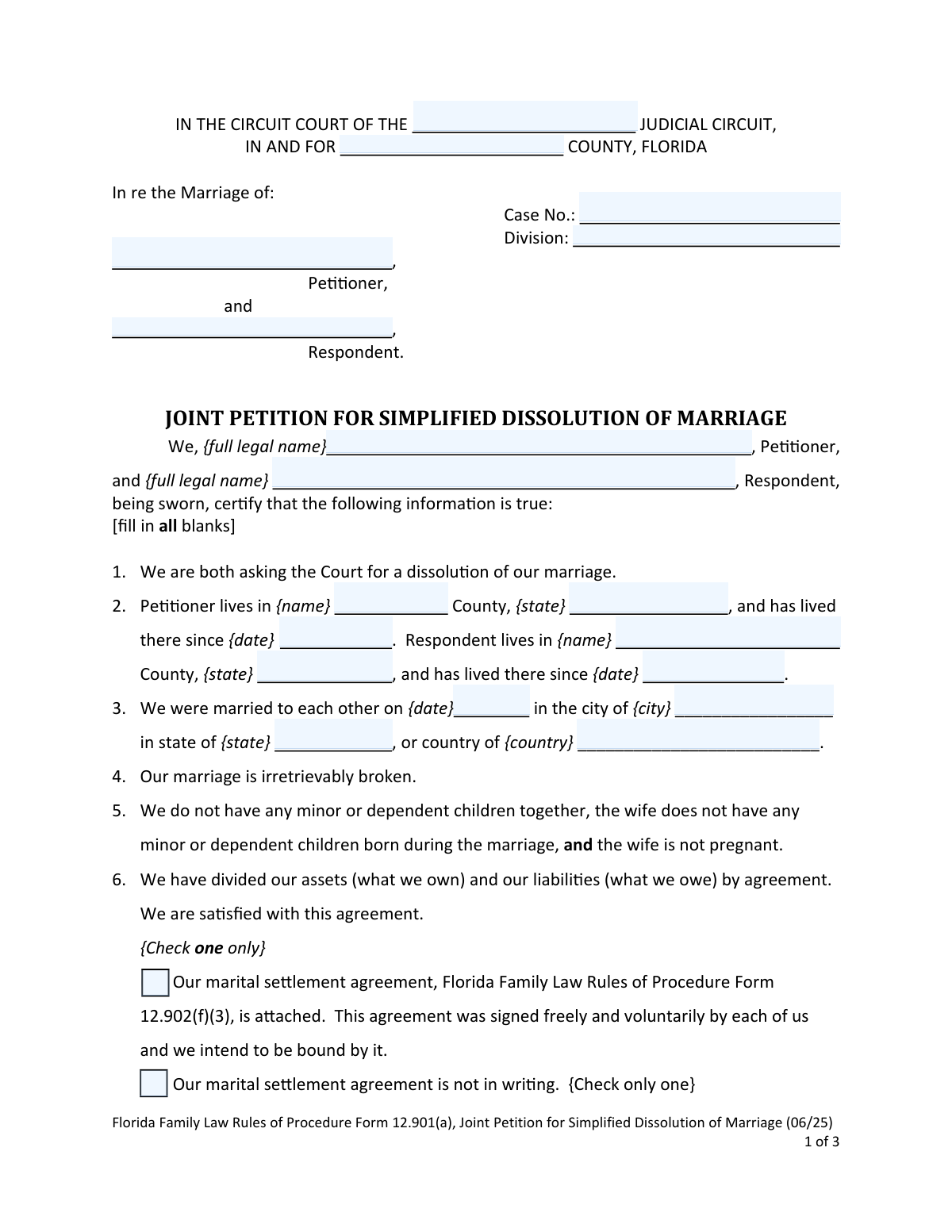
Typically, these forms are needed by individuals who are navigating significant life transitions and require the court's assistance to finalize legal agreements. Whether you are filing for an uncontested divorce with no dependent children or seeking a legal separation in a domestic partnership, these forms help clarify issues such as property division and spousal support. For example, specific petitions like the Florida Petition for Dissolution or California’s FL-100 are used to detail the facts of the marriage and the desired outcome of the proceedings.
Completing these legal documents accurately is vital for avoiding administrative delays in the court system. Tools like Instafill.ai use AI to fill these forms in under 30 seconds, ensuring that data is handled both accurately and securely. This practical approach allows you to manage complex paperwork quickly, so you can focus on the personal aspects of your case while maintaining professional standards in your court filings.
Every form on this page can be completed without typing. Instafill is form filling software that reads a PDF and fills it for you — including flat and scanned documents that carry no fillable fields at all.
Forms in This Category
The forms in this category have a median Form Complexity Index of 49/100 (Moderate), measured across 19 forms by field count, input difficulty, length, conditional logic and structure. See how it is calculated.
- Enterprise-grade security & data encryption
- 99%+ accuracy powered by AI
- 1,000+ forms from all industries
- Complete forms in under 60 seconds
How to Choose the Right Form
Selecting the correct family petition depends primarily on your state of residence and the complexity of your legal situation. Because family law is handled at the state level, using a form from the wrong jurisdiction will result in your case being dismissed.
Choosing by State Jurisdiction
The first step is identifying where you meet the residency requirements for filing:
- Florida Residents: If you have lived in Florida for at least six months, you will likely use the Florida Supreme Court Approved Family Law Form 12.901(b)(3). Note that this specific version is highly specialized for "simplified" cases.
- California Residents: If you are filing for divorce, legal separation, or annulment in California, you must use Form FL-100, Petition—Marriage/Domestic Partnership. This is the universal starting point for family law cases in the state.
Choosing Based on Children and Property
The complexity of your household determines which form is appropriate, particularly in Florida:
- For Clean-Break Scenarios (Florida): Use Form 12.901(b)(3) only if you have no minor or dependent children, no marital assets or debts to divide, and neither spouse is seeking alimony. It is designed for couples who agree on all terms and have no shared financial or parental obligations.
- For All California Scenarios: Use Form FL-100 regardless of whether you have children or property. This form is designed to handle both simple and complex cases. If you do have children, this petition will prompt you to attach additional forms (like the FL-105) to handle custody and visitation details.
Identifying the Legal Action
While the Florida form is strictly for the "Dissolution of Marriage" (divorce), the California Form FL-100 is more versatile. You should select the California petition if you are seeking any of the following:
- A standard Divorce (Dissolution).
- A Legal Separation (where you remain married but divide assets and set support).
- A Nullity (Annulment) of the marriage or domestic partnership.
Form Comparison
| Form | Jurisdiction | Scope of Case | Available Orders | Key Requirement |
|---|---|---|---|---|
| Florida Supreme Court Approved Family Law Form 12.901(b)(3), Petition for Dissolution of Marriage with No Dependent or Minor Child(ren) or Property (02/18) | Florida (Circuit Court) | Divorce with no children, property, debts, or alimony requests. | Final judgment for dissolution of marriage only. | 6-month residency and signed under oath before a notary. |
| Form FL-100, Petition—Marriage/Domestic Partnership (Family Law) | California (Superior Court) | Comprehensive cases involving children, property, and financial support. | Dissolution, legal separation, nullity, custody, and support orders. | Residency facts and UCCJEA disclosures if children are involved. |
Tips for family petition forms
Before filing a family petition, confirm you meet the specific residency duration required by your state, such as Florida's six-month rule. Filing in a jurisdiction where you do not yet meet the legal residency criteria can lead to an immediate dismissal of your case and the loss of filing fees.
Many family law petitions, like California's FL-100, require supplemental forms such as the UCCJEA (FL-105) if children are involved. Failing to include these mandatory attachments at the time of filing can cause the court clerk to reject your petition or delay your hearing date.
Certain family law forms, particularly those in Florida, must be signed under oath in the presence of a notary public or a deputy clerk. Do not sign your petition at home; wait until you are with an authorized official to ensure the document is legally binding and admissible in court.
Filling out legal paperwork manually is time-consuming, but AI-powered tools like Instafill.ai can complete these forms in under 30 seconds with high accuracy. This technology ensures your data stays secure throughout the process, providing a reliable way to manage multiple family law documents efficiently.
Simply filing the petition with the court does not start the clock for your spouse; you must also follow strict 'service of process' rules to legally notify them. Familiarize yourself with local requirements for process servers or sheriff service to ensure your case proceeds to the next stage without procedural errors.
Even if you are filing a simplified petition for a marriage with no assets, you must explicitly state that no marital property exists. Inaccurate or vague descriptions of assets and debts can lead to future legal challenges or cause the court to request additional evidentiary hearings.
Frequently Asked Questions
Family petition forms are legal documents used to formally initiate a case in family court, such as a divorce, legal separation, or the dissolution of a domestic partnership. These forms provide the court with essential information about the parties, the legal grounds for the filing, and the specific orders being requested regarding assets or family structure.
The correct form depends on your state of residence and the complexity of your situation, such as whether you have minor children or shared property. For instance, Florida residents with no children or assets use a specific 'simplified' petition, while California residents generally use a standard petition form like the FL-100 for all marriage or partnership dissolutions.
Yes, AI tools like Instafill.ai can be used to fill out family petition forms efficiently by accurately extracting data from your source documents and placing it into the required fields. This technology helps ensure that your information is consistent across multiple pages and reduces the time spent on manual data entry.
Using AI-powered services, you can complete these forms in under 30 seconds. The AI automates the process of reading your personal information and populating the PDF, which is significantly faster than filling out the documents by hand or using traditional software.
Most states require at least one spouse to have lived in the state for a minimum period, often six months, before a petition can be filed in that jurisdiction. Additionally, you may need to prove that you have lived in the specific county where you are filing for a set amount of time, such as three months.
Requirements vary by state, but many jurisdictions require petitions to be signed under oath in the presence of a notary public or a court clerk. This verification ensures that the information provided in the petition is true and correct under penalty of perjury.
Completed forms must be filed with the Clerk of the Circuit Court or the Superior Court in the county where you or your spouse resides. Most courts require the original document plus several copies, and you will typically need to pay a filing fee unless you qualify for a fee waiver.
If minor children are involved, you will usually need to provide additional information regarding their residence history and any existing custody orders. While the main petition starts the case, it often triggers the requirement for supplemental forms like a Uniform Child Custody Jurisdiction and Enforcement Act (UCCJEA) affidavit.
Yes, many standard family petition forms allow you to choose between dissolution (divorce), legal separation, or nullity. You simply check the box corresponding to the legal status you are seeking, and the court will process the case according to the laws governing that specific request.
Serving is the formal process of delivering a copy of the filed petition and a summons to the other party to notify them of the legal action. This step is required by law to give the other spouse an opportunity to respond before the court makes any final decisions or orders.
Glossary
- Form Complexity Index
- Instafill’s 0–100 measure of how much effort a form takes to complete, calculated deterministically from the form’s own structure rather than estimated. It combines the number of fillable fields (the largest factor), how difficult those fields are to complete based on their type, the number of pages that contain fields, the amount of conditional “fill-only-if” logic, and how many sections the form is divided into, then adds modifiers for tables and repeating lists, bundled instruction pages, and dense page layouts. A higher score means the form is harder to fill out by hand. The forms in this category have a median Form Complexity Index of 49/100 (Moderate). See exactly how it is calculated.
- Petitioner
- The spouse or domestic partner who officially starts the legal case by filing the initial petition with the court.
- Respondent
- The person against whom a petition is filed; they must be notified of the case and have the opportunity to respond to the claims made.
- Dissolution of Marriage
- The formal legal term for a divorce, which is the process of legally terminating a marriage or domestic partnership.
- Service of Process
- The official act of delivering legal documents to the other party to ensure they are legally notified of the court proceedings.
- Jurisdiction
- The court's legal power to hear a case, which is usually established by meeting specific state and county residency requirements.
- Irretrievably Broken
- A standard legal phrase used in no-fault divorce cases meaning that the relationship has failed and there is no hope for reconciliation.
- UCCJEA
- The Uniform Child Custody Jurisdiction and Enforcement Act, a standard law used to determine which state has the authority to make orders regarding child custody.
- Nullity
- A legal action, commonly known as an annulment, that asks the court to declare a marriage or domestic partnership void as if it never existed.