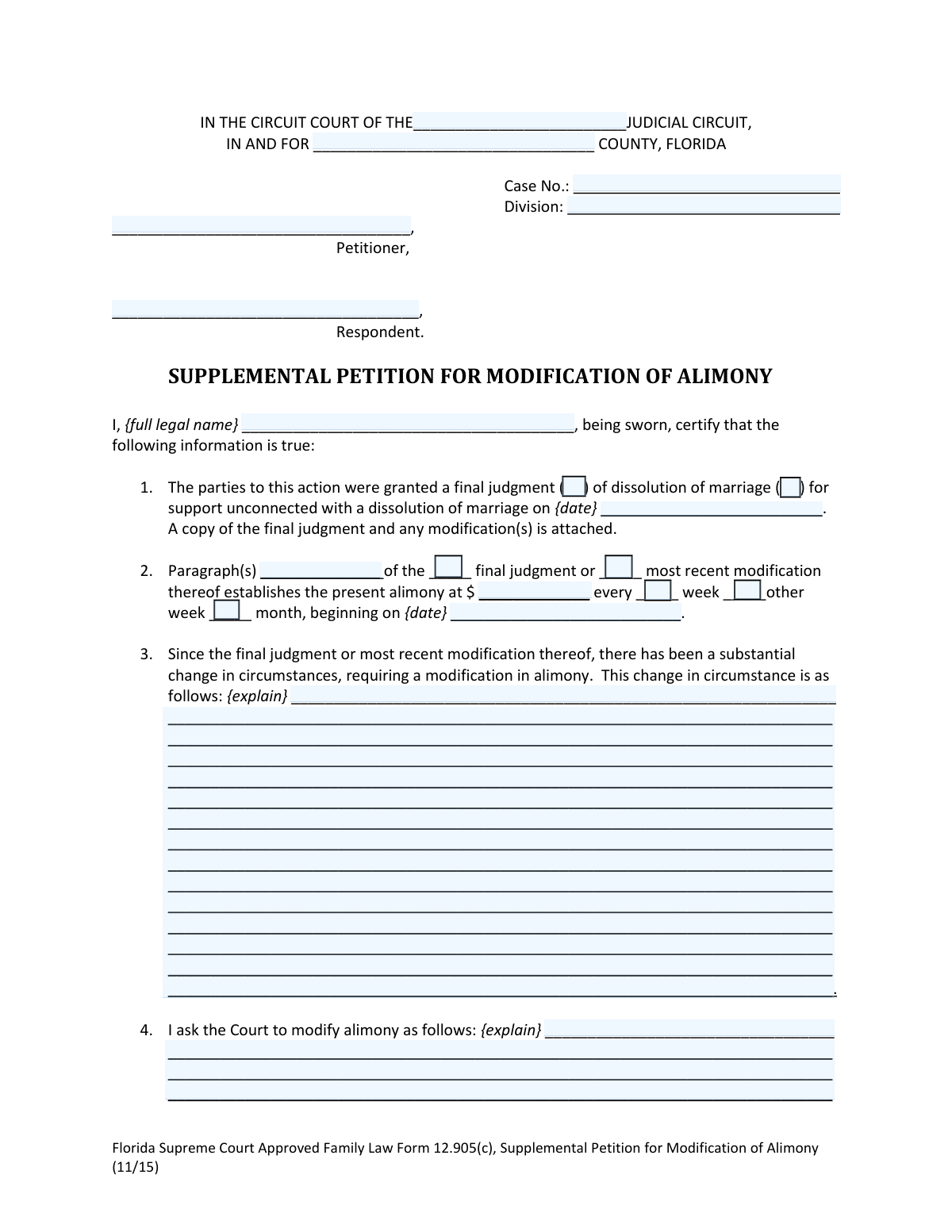
Yes! You can use AI to fill out Florida Supreme Court Approved Family Law Form 12.905(c), Supplemental Petition for Modification of Alimony
Form 12.905(c) is a legal document used in Florida to petition the court to change a current court-ordered alimony obligation. A modification can be requested if there has been a substantial change in the circumstances of either party since the last order was issued. It's important to note that not all types of alimony can be modified. Today, this form can be filled out quickly and accurately using AI-powered services like Instafill.ai, which can also convert non-fillable PDF versions into interactive fillable forms.
Form 12.905(c) is part of the
family court forms, family law forms, family petition forms and florida court forms categories on Instafill.
Our AI automatically handles information lookup, data retrieval, formatting, and form filling.
It takes less than a minute to fill out Form 12.905(c) using our AI form filling.
Securely upload your data. Information is encrypted in transit and deleted immediately after the form is filled out.
Form specifications
| Form name: | Florida Supreme Court Approved Family Law Form 12.905(c), Supplemental Petition for Modification of Alimony |
| Number of fields: | 43 |
| Number of pages: | 1 |
| Language: | English |
Instafill Demo: How to fill out PDF forms in seconds with AI
How to Fill Out Form 12.905(c) Online for Free in 2026
Are you looking to fill out a FORM 12.905(C) form online quickly and accurately? Instafill.ai offers the #1 AI-powered PDF filling software of 2026, allowing you to complete your FORM 12.905(C) form in just 37 seconds or less.
Follow these steps to fill out your FORM 12.905(C) form online using Instafill.ai:
- 1 Navigate to Instafill.ai and upload your PDF or select the Supplemental Petition for Modification of Alimony, Form 12.905(c).
- 2 Use the AI assistant to input case information, including the judicial circuit, county, case number, and the names of the petitioner and respondent.
- 3 Provide details of the original judgment, specifying the date it was granted and the paragraph numbers that establish the current alimony amount and schedule.
- 4 Clearly describe the substantial change in circumstances that has occurred since the last order, which is the legal basis for your request.
- 5 State precisely what changes you are asking the court to make to the alimony order.
- 6 Review all the information you've entered for accuracy, then electronically sign and date the petition. The AI will format the document for proper notarization.
- 7 Download your completed, signed petition, ready for filing with the clerk of the circuit court in the correct Florida county.
Our AI-powered system ensures each field is filled out correctly, reducing errors and saving you time.
Why Choose Instafill.ai for Your Fillable Form 12.905(c) Form?
Speed
Complete your Form 12.905(c) in as little as 37 seconds.
Up-to-Date
Always use the latest 2026 Form 12.905(c) form version.
Cost-effective
No need to hire expensive lawyers.
Accuracy
Our AI performs 10 compliance checks to ensure your form is error-free.
Security
Your personal information is protected with bank-level encryption.
Frequently Asked Questions About Form Form 12.905(c)
This form is used to ask a Florida court to change a current, court-ordered alimony obligation due to a significant change in circumstances.
You should file this form if you are paying or receiving court-ordered alimony and believe there has been a substantial change in either your or the other party's financial situation.
No. The court can modify temporary, permanent periodic, durational, and rehabilitative alimony, but lump sum and bridge-the-gap alimony cannot be changed.
You must file a Family Law Financial Affidavit and a Certificate of Compliance with Mandatory Disclosure, and you must attach a copy of the original final judgment and any prior modifications.
This refers to a significant, involuntary, and permanent change in a party's financial situation, such as a major change in income, disability, or retirement. You must explain this change in detail on the form.
You must file the original petition with the clerk of the circuit court in the same county where the original alimony order was issued.
You are required to use personal service to formally deliver a copy of the petition to the other party. The other party then has 20 days to file a response with the court.
If the other party fails to file an answer within 20 days of being served, you can file a Motion for Default, which may allow the case to proceed to a final hearing without their participation.
Yes, you must sign the petition under oath before a notary public or a deputy clerk before you can file it with the court.
You can ask the clerk for an Application for Determination of Civil Indigent Status. If you qualify, the court may allow you to have the filing fees deferred.
Yes, services like Instafill.ai use AI to help you accurately auto-fill form fields with your saved information, which saves time and helps prevent errors.
You can use a platform like Instafill.ai to upload the PDF, fill it out on any device, and then download or print the completed form for submission.
Services like Instafill.ai can convert flat, non-fillable PDFs into interactive forms that you can easily type into online, saving you the hassle of printing and writing by hand.
Compliance Form 12.905(c)
Validation Checks by Instafill.ai
1
Ensures Petitioner Name Consistency
Verifies that the petitioner's name entered in the case caption at the top of the form matches the 'full legal name' provided in the sworn statement section. This consistency is vital for legal identity verification and to prevent ambiguity in court records. A mismatch could cause the petition to be rejected for clerical errors.
2
Validates Case Number Format
Checks if the 'Case No.' field is filled and follows the expected format for the specified judicial circuit and county. The case number is the primary identifier for the legal proceeding, and an incorrect or missing number will prevent the document from being filed correctly. This ensures the petition is associated with the correct existing case file.
3
Requires County and Circuit Court Selection
Ensures the 'JUDICIAL CIRCUIT' and 'COUNTY' fields are not empty. These fields are mandatory for identifying the specific court with jurisdiction over the case. Submitting a form without this information would make it impossible for the clerk's office to file it, leading to immediate rejection.
4
Validates Exclusive Judgment Type Selection
In section 1, this check ensures that the petitioner has selected only one of the two mutually exclusive options: 'dissolution of marriage' or 'support unconnected with a dissolution of marriage.' Selecting both or neither would create ambiguity about the origin of the original order. This validation prevents incomplete or contradictory information from being submitted to the court.
5
Verifies Final Judgment Date is in the Past
This validation confirms that the date entered for the final judgment in section 1 is a valid calendar date that has already occurred. A future or invalid date would be logically impossible and would invalidate the petition's basis. This check ensures the foundational facts of the case are chronologically correct.
6
Validates Alimony Amount is a Positive Number
This validation ensures that the current alimony amount entered in section 2 is a valid, positive numerical value. The field cannot be empty, negative, or contain non-numeric characters, as it represents a specific monetary obligation. This is critical for establishing the baseline from which a modification is being requested.
7
Ensures Singular Alimony Payment Frequency
In section 2, this check confirms that the petitioner has selected exactly one payment frequency from the available options ('week', 'every other week', 'month'). Failing to select one, or selecting multiple, would make the current alimony terms unclear. This validation is necessary to accurately define the existing court order being modified.
8
Requires Explanation for Change in Circumstances
This validation ensures that the text field in section 3, explaining the 'substantial change in circumstances,' is not left blank. This explanation is the legal core of the petition and the primary justification for requesting a modification. An empty field would mean the petition lacks a legal basis and would be summarily dismissed.
9
Requires Details of Requested Alimony Modification
This check verifies that the text field in section 4, where the petitioner specifies the requested modification, is filled out. This section informs the court of the specific outcome the petitioner is seeking, such as an increase, decrease, or termination of alimony. Without this information, the court has no clear request to rule on.
10
Validates Exclusive Financial Affidavit Status
This validation ensures that in section 5, the petitioner selects one and only one option regarding the Family Law Financial Affidavit: either it 'is' filed or it 'will be' filed. This affidavit is a mandatory component of the process, and its status must be clearly communicated. Selecting both or neither would create an ambiguity that could halt the case's progress.
11
Validates Petitioner's Telephone Number Format
This check ensures the petitioner's telephone number is provided and follows a recognizable format (e.g., 10 digits, with or without parentheses and hyphens). Accurate contact information is essential for the court and the opposing party to communicate with the petitioner regarding hearings and other case matters. An invalid number could lead to missed notifications and procedural delays.
12
Validates Petitioner's Email Address Format
If an email address is provided in the 'Designated E-mail Address(es)' field, this check verifies it follows a standard email format (e.g., [email protected]). As courts increasingly use e-service, a valid email is crucial for receiving official documents and notices. An invalid format could result in failure of service and negative legal consequences.
13
Ensures Completeness of Nonlawyer Information if Applicable
This is a conditional validation that triggers if any field in the 'IF A NONLAWYER HELPED YOU' section is filled. It then requires all other fields in that section (name, business, full address, and phone number) to be completed. This rule is in place for transparency and accountability, ensuring that any non-attorney assistance is fully disclosed as required by court procedure.
Common Mistakes in Completing Form 12.905(c)
Petitioners often file in the county where they currently reside, not the county where the original divorce judgment was entered. This happens due to relocation and a misunderstanding of legal jurisdiction. The consequence is that the court will dismiss the petition for lack of jurisdiction, forcing the petitioner to lose their filing fee and start the entire process over in the correct court.
Section 1 of the petition explicitly requires a copy of the final judgment and any prior modifications to be attached. People often forget this step or cannot locate the old documents, leading to an incomplete filing. An incomplete filing will be rejected by the clerk or delayed until the required documents are provided, stalling the entire modification process.
In Section 3, petitioners must detail a 'substantial change in circumstances.' Many people provide vague or emotional statements like 'I can't afford it anymore' instead of specific, factual, and quantifiable details (e.g., 'My income has decreased by 40% from $X to $Y due to a documented medical disability'). A vague explanation is the most common reason for a judge to deny the petition on its merits.
The instructions and Section 5 of the petition require the filing of a Family Law Financial Affidavit (Form 12.902(b) or (c)). This is a separate, detailed, and mandatory document that petitioners often overlook or forget to complete. Failure to file the affidavit will render the petition incomplete, causing significant delays or even dismissal of the case until it is properly filed and served on the other party.
The form's instructions clearly state that lump sum and bridge-the-gap alimony cannot be modified. Petitioners who are not aware of this distinction may waste time and filing fees attempting to change an unchangeable order. The court will quickly dismiss such a petition, as it has no legal authority to grant the requested relief.
The instructions require 'personal service' for the initial petition, which means delivery by a sheriff or certified process server. Many self-represented litigants mistakenly believe they can just mail or email the documents to the other party. Improper service means the court has no jurisdiction over the respondent, and the case cannot move forward until service is properly completed, which can take weeks or months to correct.
This petition is a sworn statement and requires the petitioner's signature to be witnessed and certified by a Notary Public or Deputy Clerk. Simply signing the form at home is not sufficient. The court clerk will reject any petition that lacks the proper notarization, forcing the petitioner to get it notarized and re-file, causing unnecessary delays.
This form is often available as a non-fillable PDF, leading people to print and handwrite their answers. If the handwriting is messy or illegible, the clerk may reject the form or misenter critical information like case numbers or names, causing significant clerical errors. To avoid this, use a tool like Instafill.ai, which can convert non-fillable PDFs into easy-to-use fillable forms, ensuring all entries are typed, legible, and professional.
The person filing this new petition is the 'Petitioner,' and the other party is the 'Respondent,' regardless of what their roles were in the original divorce. This can be confusing, and people sometimes misidentify the parties in the case caption. This error can lead to confusion in the court's records and require amendments to fix, delaying the proceedings.
In Section 2, the petitioner must accurately state the paragraph number, amount, and frequency of the current alimony order from the existing judgment. People often guess or state incorrect figures from memory. This mistake undermines the petitioner's credibility and can cause confusion or require clarification, slowing down the court's review of the case.
Saved over 80 hours a year
“I was never sure if my IRS forms like W-9 were filled correctly. Now, I can complete the forms accurately without any external help.”
Kevin Martin Green
Your data stays secure with advanced protection from Instafill and our subprocessors

Robust compliance program
Transparent business model
You’re not the product. You always know where your data is and what it is processed for.
ISO 27001, HIPAA, and GDPR
Our subprocesses adhere to multiple compliance standards, including but not limited to ISO 27001, HIPAA, and GDPR.
Security & privacy by design
We consider security and privacy from the initial design phase of any new service or functionality. It’s not an afterthought, it’s built-in, including support for two-factor authentication (2FA) to further protect your account.
Fill out Form 12.905(c) with Instafill.ai
Worried about filling PDFs wrong? Instafill securely fills florida-supreme-court-approved-family-law-form-12905c-supplemental-petition-for-modification-of-alimony forms, ensuring each field is accurate.