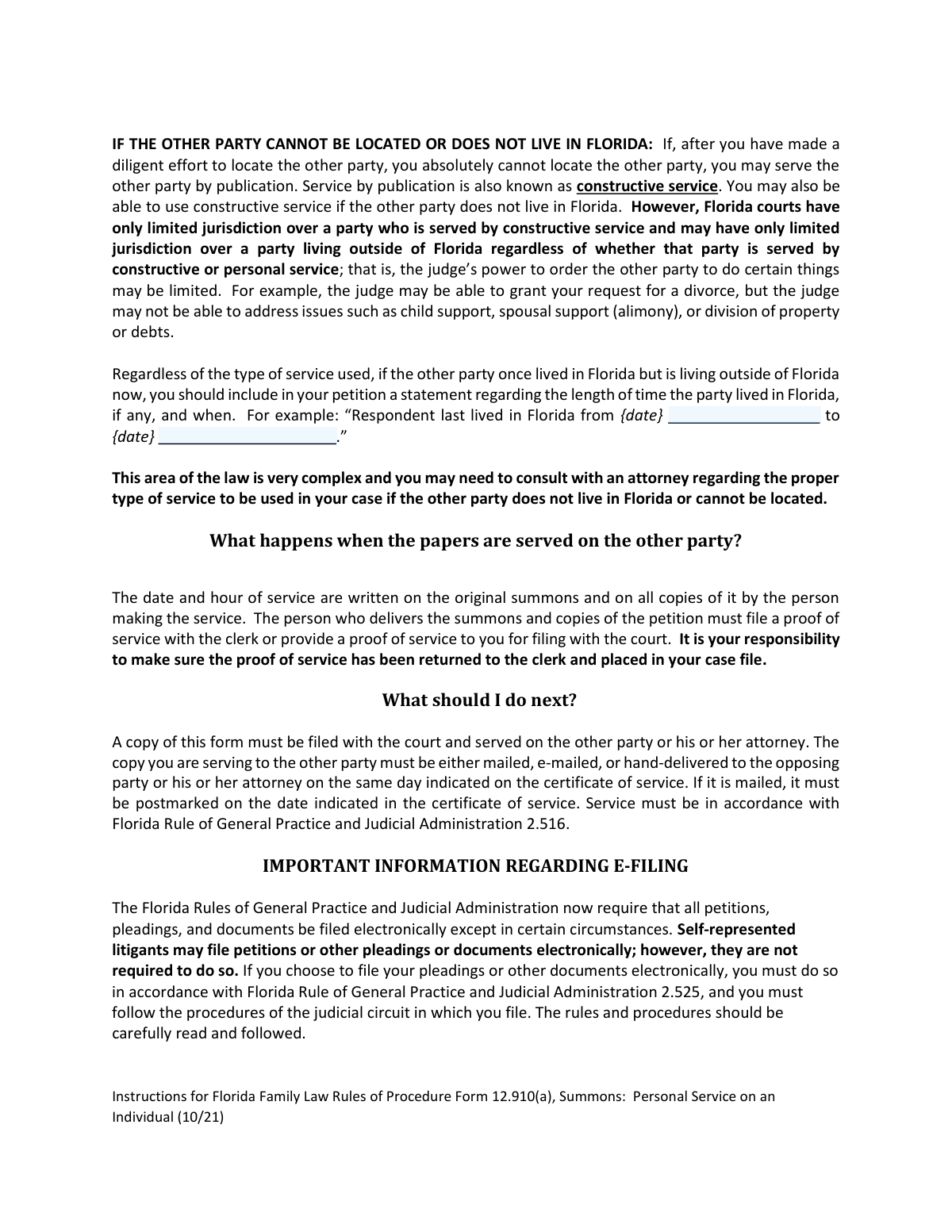
Yes! You can use AI to fill out Florida Family Law Rules of Procedure Form 12.910(a), Summons: Personal Service on an Individual

Form 12.910(a) is a legal document used in Florida family law cases to formally notify an individual that a lawsuit has been filed against them. This summons, which must be personally served by a sheriff or private process server, commands the recipient to file a written response within 20 days, making it a critical first step in the legal process. Today, this form can be filled out quickly and accurately using AI-powered services like Instafill.ai, which can also convert non-fillable PDF versions into interactive fillable forms.
Our AI automatically handles information lookup, data retrieval, formatting, and form filling.
It takes less than a minute to fill out Form 12.910(a) using our AI form filling.
Securely upload your data. Information is encrypted in transit and deleted immediately after the form is filled out.

Form specifications

Form name: Florida Family Law Rules of Procedure Form 12.910(a), Summons: Personal Service on an Individual
Number of fields: 19
Number of pages: 8
Language: English
Categories: family law forms
main-image

Instafill Demo: How to fill out PDF forms in seconds with AI

How to Fill Out Form 12.910(a) Online for Free in 2026

Are you looking to fill out a FORM 12.910(A) form online quickly and accurately? Instafill.ai offers the #1 AI-powered PDF filling software of 2026, allowing you to complete your FORM 12.910(A) form in just 37 seconds or less.
Follow these steps to fill out your FORM 12.910(A) form online using Instafill.ai:
  1. 1 Navigate to Instafill.ai and upload or select the Florida Form 12.910(a).
  2. 2 Provide the court and case information, including the judicial circuit, county, case number, and division.
  3. 3 Enter the full legal names of the Petitioner and the Respondent in the designated fields.
  4. 4 Input the recipient's full legal name and the complete address where they will be personally served.
  5. 5 Fill in the address for the Clerk of the Circuit Court and the name and address of the party who is serving the summons.
  6. 6 Review all the information automatically populated by the AI to ensure accuracy and completeness.
  7. 7 Download the completed summons, file it with the clerk to obtain a signature and seal, and then provide it to the sheriff or process server for delivery.

Our AI-powered system ensures each field is filled out correctly, reducing errors and saving you time.

Why Choose Instafill.ai for Your Fillable Form 12.910(a) Form?

Speed

Complete your Form 12.910(a) in as little as 37 seconds.

Up-to-Date

Always use the latest 2026 Form 12.910(a) form version.

Cost-effective

No need to hire expensive lawyers.

Accuracy

Our AI performs 10 compliance checks to ensure your form is error-free.

Security

Your personal information is protected with bank-level encryption.

Frequently Asked Questions About Form Form 12.910(a)

This form is a Summons for Personal Service on an Individual. It is used to officially notify the other party that you have started a family law lawsuit against them, which is a required first step in the legal process.

No, you are not allowed to serve these papers yourself. Personal service must be completed by a deputy sheriff or a certified private process server to be legally valid.

You must complete this summons, a Process Service Memorandum (Form 12.910(b)), and attach a copy of the petition and any other papers you are filing with the court to start your lawsuit.

After filling out the forms, you must file them with the clerk of the circuit court. The clerk will sign the summons, which you then deliver to the sheriff's office or a private process server to be served on the other party.

Service must be made by a sheriff or a certified process server in the county where the other party lives. You will need to coordinate with the clerk or the service provider to send the documents to the correct jurisdiction.

If you cannot find the other party after a diligent search, you may be able to use 'constructive service' by publication. This is a complex legal area, and it is highly recommended to consult an attorney as it may limit the relief the court can grant.

You have 120 days after filing your lawsuit to serve the other party. If you fail to do so, the court may dismiss your case unless you can show a good reason for the delay.

The other party has 20 calendar days to file a written response with the court. If they do not respond within that time, you may be able to ask the court for a default judgment in your favor.

The person who serves the papers will complete a 'proof of service' document. It is your responsibility to make sure this proof of service is returned to the clerk and filed in your case file.

Yes, both the sheriff's department and private process servers charge a fee for their services. You will typically need to pay with a cashier's check or money order, as personal checks are often not accepted.

Yes, services like Instafill.ai use AI to help you accurately auto-fill form fields with your case information, names, and addresses. This can save time and help prevent common errors.

You can use a service like Instafill.ai to complete the form digitally. Simply upload the document, and the platform will guide you in filling out all the necessary fields before you print it for filing with the court clerk.

If you have a flat or non-fillable PDF, tools like Instafill.ai can convert it into an interactive, fillable form. This allows you to easily type your information directly into the correct fields for a clean and legible document.

Compliance Form 12.910(a)
Validation Checks by Instafill.ai

1
Case Number Format and Presence
This check verifies that the 'Case Number' field is not empty and conforms to the standard format for the specified judicial circuit and county. A valid case number is essential for the Clerk of Court to correctly file the summons and all subsequent documents. If the format is incorrect or the field is empty, the document could be rejected, delaying the legal process.
2
Court Identification Completeness
This validation ensures that the 'Judicial Circuit', 'County', and 'Division' fields are all populated. These three pieces of information are fundamental to identifying the specific court handling the case. Missing information would make it impossible to route the document correctly, leading to filing errors and potential dismissal.
3
Petitioner and Respondent Name Presence
This check confirms that both the 'Petitioner Name' and 'Respondent Name' fields contain a full legal name. These names define the primary parties of the lawsuit and are required for the legal validity of the document. An empty or incomplete name field would render the summons invalid and legally unenforceable.
4
Respondent and Recipient Name Consistency
This validation cross-references the 'Respondent Name' in the case caption with the 'Recipient Full Legal Name' in the 'TO/PARA/A' section. The names must match exactly to ensure the summons is legally directed at the correct party in the lawsuit. A mismatch could invalidate the service of process, requiring the petitioner to start over.
5
Service Address Completeness
This check ensures the 'Service Address' field contains a complete and parsable address, including a street, city, state, and ideally a zip code. This address is used by the sheriff or process server to physically deliver the summons, which is a critical step in a lawsuit. An incomplete or invalid address will result in a failed service attempt, halting case progress.
6
Clerk of Court Address Presence
This validation verifies that the 'Clerk of Court Street Address' field is filled out. This address is critical information for the respondent, as it tells them exactly where they must file their written response to the lawsuit. If this field is blank, the respondent would not know where to file, potentially violating their due process rights.
7
Serving Party Information Completeness
This check ensures the 'Name and Address of Party Serving Summons' field is fully completed. The respondent is required to serve a copy of their written response to the petitioner (or their attorney), and this information tells them where to send it. Failure to provide a complete name and address would prevent the respondent from fulfilling their legal obligation to serve the other party.
8
Florida Residency Date Logic
This validation applies if the 'Respondent Last Lived in Florida' dates are entered. It checks that the 'From Date' is chronologically earlier than the 'To Date'. This ensures the information provided about the respondent's residency history is logical and not contradictory. An illogical date range could call the petitioner's diligence into question.
9
Official Issuance Date Validity
This check validates that the 'DATED' field, which is entered by the Clerk of Court, is a valid date and is not a future date. This date establishes the official issuance date of the summons and is the starting point for legal timelines, such as the 120-day service period. An invalid or future date would make the summons legally defective.
10
Deputy Clerk Name Presence
This validation ensures that the 'By: Deputy Clerk' field is populated with a name. The Deputy Clerk's signature or name signifies that the summons has been officially reviewed, sealed, and issued by the court. A summons without this authorization is not a valid legal instrument and cannot be used for service.
11
Cross-Language Field Synchronization
This check verifies that addresses and names entered in the English, Spanish ('Delivering party name and address'), and French ('Nom et adresse du déposant de la citation') sections are consistent. Since this is a multi-language legal document, the core information must be identical across all language sections to avoid confusion and ensure legal clarity. Discrepancies could lead to challenges regarding the sufficiency of the notice provided.

Common Mistakes in Completing Form 12.910(a)

Entering an Incorrect Address for Service

This mistake involves providing an old, incomplete, or incorrect address for the Respondent. This often happens when the filer uses a last known address without verifying it. An incorrect address will prevent the sheriff or process server from successfully serving the papers, causing significant delays and potentially leading to the case being dismissed if not corrected within the 120-day service window.

Confusing Petitioner and Respondent Information

Users frequently mix up the roles of Petitioner (the person filing the lawsuit) and Respondent (the person being sued), entering names in the wrong fields. For example, they might list themselves in the 'TO:' section meant for the Respondent. This error creates legal confusion, can invalidate the summons, and requires correction and re-issuing, which delays the legal process.

Attempting to Personally Serve the Summons

A critical error is when the Petitioner tries to serve the legal documents themselves to save time or money. The instructions explicitly state that the Petitioner cannot personally serve the summons; it must be done by a sheriff's deputy or a certified private process server. Attempting self-service invalidates the entire service process, forcing the Petitioner to start over and wasting valuable time.

Failing to Ensure Proof of Service is Filed

Many filers assume the sheriff or process server will automatically file the 'Proof of Service' with the court clerk after serving the documents. However, the instructions clarify it is the Petitioner's responsibility to follow up and ensure this crucial document is in the case file. Without a filed Proof of Service, the court has no record that the Respondent was legally notified, and the case cannot move forward to default or other proceedings.

Using Incomplete or Informal Names

Filers often use nicknames, initials, or incomplete versions of their own or the other party's name instead of the full legal name. Legal documents require precise identification to be valid and enforceable. This mistake can lead to challenges regarding the identity of the parties and may require amendments to the filings, causing unnecessary delays.

Forgetting to Attach the Petition to the Summons

The summons is a notice that a lawsuit exists, but it is not the lawsuit itself. A common mistake is delivering the summons to the process server without attaching a copy of the petition or complaint that is being filed. Serving an incomplete package makes the service defective, as the Respondent has not been properly informed of the claims against them, requiring the service process to be repeated correctly.

Omitting the Clerk of Court's Address

The summons form has a specific field for the street address of the Clerk of the Circuit Court where the Respondent must file their written response. Filers sometimes leave this blank, assuming the Respondent will know where to go. This omission can be grounds for a motion to dismiss for insufficient process, as it fails to provide the Respondent with essential information on how to respond to the lawsuit.

Submitting an Illegible or Improperly Completed Form

The instructions require the form to be typed or printed legibly in black ink, but people often submit handwritten forms that are difficult to read. Illegible handwriting, using the wrong color ink, or leaving fields blank can lead to the clerk rejecting the form. Since this is often a non-fillable PDF, users can struggle with neatness; tools like Instafill.ai can convert such documents into fillable versions to ensure clarity and completeness.

Misunderstanding the 120-Day Service Deadline

Filers may not realize that Florida law requires service to be completed within 120 days of filing the initial petition. They may fail to actively track the service status, especially if there are issues with a bad address. This inaction can lead to the court dismissing the entire case, forcing the Petitioner to start and pay for the filing all over again.

Incorrectly Filling the 'Party Serving Summons' Field

The form requires the name and address of the party 'serving this summons,' which refers to the Petitioner or their attorney, as they are the ones initiating the service. A common point of confusion is entering the process server's information or the Respondent's information in this field. This error can confuse the Respondent about who to send their response to, potentially delaying communication and case progress. AI-powered form fillers like Instafill.ai can help prevent this by pre-filling and validating party information correctly.
Saved over 80 hours a year

“I was never sure if my IRS forms like W-9 were filled correctly. Now, I can complete the forms accurately without any external help.”

Kevin Martin Green

Your data stays secure with advanced protection from Instafill and our subprocessors

Robust compliance program

Transparent business model

You’re not the product. You always know where your data is and what it is processed for.

ISO 27001, HIPAA, and GDPR

Our subprocesses adhere to multiple compliance standards, including but not limited to ISO 27001, HIPAA, and GDPR.

Security & privacy by design

We consider security and privacy from the initial design phase of any new service or functionality. It’s not an afterthought, it’s built-in, including support for two-factor authentication (2FA) to further protect your account.

Fill out Form 12.910(a) with Instafill.ai

Worried about filling PDFs wrong? Instafill securely fills florida-family-law-rules-of-procedure-form-12910a-summons-personal-service-on-an-individual forms, ensuring each field is accurate.