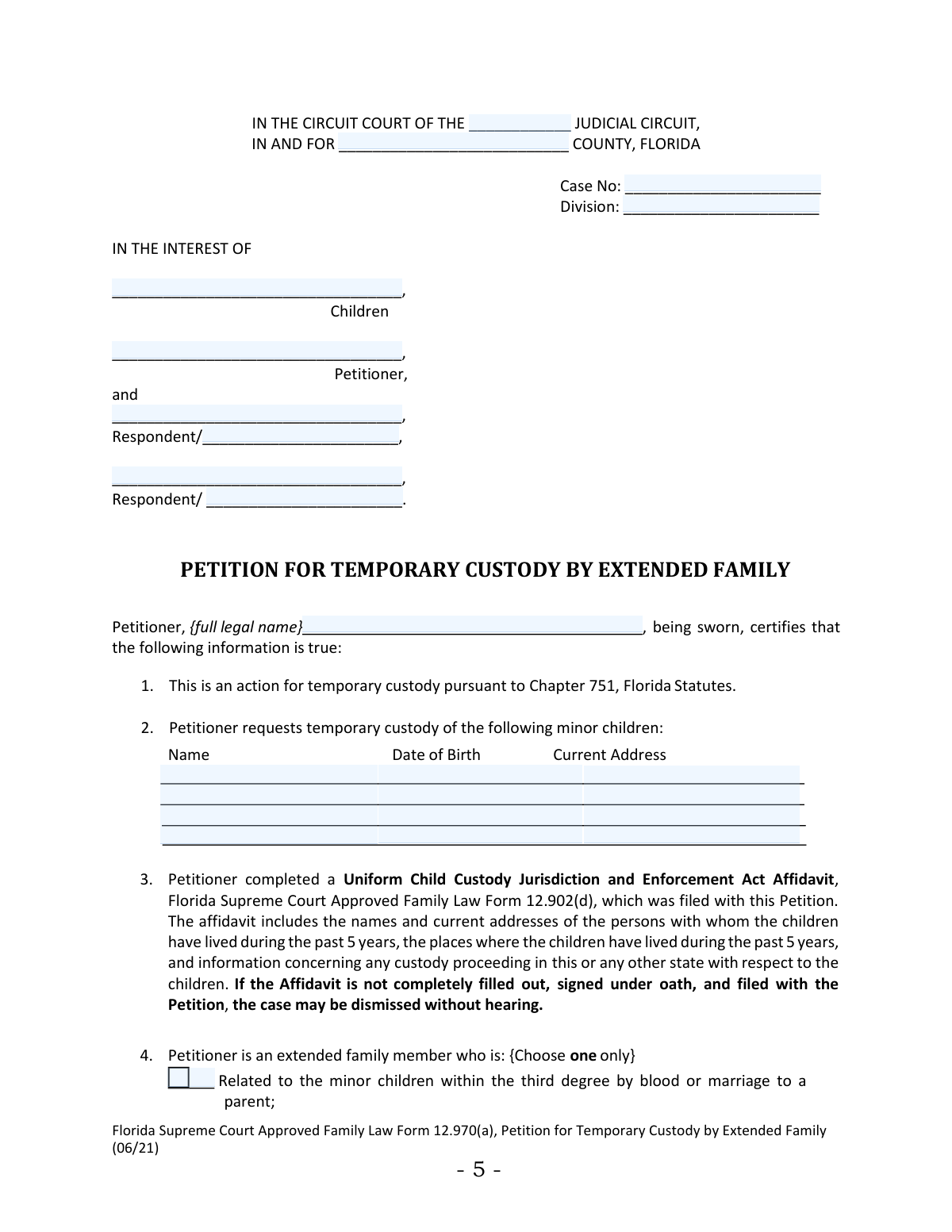
Yes! You can use AI to fill out Florida Supreme Court Approved Family Law Form 12.970(a), Petition for Temporary Custody by Extended Family

Florida Form 12.970(a) is a legal document used by an extended family member, such as a relative or stepparent, to petition the court for temporary custody of a minor child. This petition is crucial when a child's parents are unable to provide care, and it can be filed with or without their consent, though the requirements differ. Today, this form can be filled out quickly and accurately using AI-powered services like Instafill.ai, which can also convert non-fillable PDF versions into interactive fillable forms.
Form 12.970(a) is part of the court forms, family court forms, family law forms, family petition forms, Florida court forms and UK court forms categories on Instafill.
Our AI automatically handles information lookup, data retrieval, formatting, and form filling.
It takes less than a minute to fill out Form 12.970(a) using our AI form filling.
Securely upload your data. Information is encrypted in transit and deleted immediately after the form is filled out.

Form specifications

Form name: Florida Supreme Court Approved Family Law Form 12.970(a), Petition for Temporary Custody by Extended Family
Number of fields: 74
Number of pages: 10
Filled form examples: Form Form 12.970(a) Examples
Language: English
main-image

Instafill Demo: How to fill out PDF forms in seconds with AI

How to Fill Out Form 12.970(a) Online for Free in 2026

Are you looking to fill out a FORM 12.970(A) form online quickly and accurately? Instafill.ai offers the #1 AI-powered PDF filling software of 2026, allowing you to complete your FORM 12.970(A) form in just 37 seconds or less.
Follow these steps to fill out your FORM 12.970(A) form online using Instafill.ai:
  1. 1 Navigate to Instafill.ai and upload or select the Florida Petition for Temporary Custody by Extended Family, Form 12.970(a).
  2. 2 Provide your personal information as the Petitioner, including your full legal name, address, and relationship to the child(ren).
  3. 3 Enter the required details for each minor child, such as their name, date of birth, and current address.
  4. 4 Specify the legal grounds for your petition, indicating whether you have parental consent or are acting as a full-time substitute parent.
  5. 5 Input the information for the child(ren)'s legal parents and attach any required documents, like signed consents or proof of death.
  6. 6 Address sections related to child support, existing protection orders, and any other specific requests for the court's consideration.
  7. 7 Review all the information you've entered for accuracy, then use the platform to securely sign the document before downloading it for notarization and filing with the appropriate Florida circuit court.

Our AI-powered system ensures each field is filled out correctly, reducing errors and saving you time.

Why Choose Instafill.ai for Your Fillable Form 12.970(a) Form?

Speed

Complete your Form 12.970(a) in as little as 37 seconds.

Up-to-Date

Always use the latest 2026 Form 12.970(a) form version.

Cost-effective

No need to hire expensive lawyers.

Accuracy

Our AI performs 10 compliance checks to ensure your form is error-free.

Security

Your personal information is protected with bank-level encryption.

Frequently Asked Questions About Form Form 12.970(a)

This form is used by an extended family member, such as a grandparent or stepparent, to petition a Florida court for temporary custody of a minor child. It is not intended for use by a child's parents.

An extended family member is a relative within the third degree by blood or marriage, a stepparent under specific conditions, or a 'fictive kin' who has a significant, family-like relationship with the child.

While having signed, notarized consent from the parents makes the process easier, it is not strictly required. If you do not have consent, you must be caring for the child full-time and prove to the court that the parents are unfit due to abuse, abandonment, or neglect.

You must also file a Uniform Child Custody Jurisdiction and Enforcement Act (UCCJEA) Affidavit (Form 12.902(d)), a Notice of Related Cases (Form 12.900(h)), and a Family Court Cover Sheet (Form 12.928).

You must sign the petition in front of a notary public or deputy clerk. Then, file the original document with the clerk of the circuit court in the county where you live and keep a copy for your personal records.

If a parent disagrees with your petition, the case becomes 'contested,' and you may be required to attend mediation. To proceed, you will need to file a Notice for Trial to have a judge make a final decision.

You must arrange for 'personal service' through a sheriff or certified process server to deliver the petition to the parents. If a parent cannot be located, you may need to use 'constructive service,' which is a more complex legal procedure.

Yes, you can request that the court order the parents to pay child support or redirect an existing support obligation to you. The parents must be properly served with the petition for the court to consider this request.

You can request an 'Application for Determination of Civil Indigent Status' from the court clerk. If you are approved, the filing fees may be deferred.

Yes, a parent can petition the court at any time to modify or terminate the order. The court will terminate the order if it finds the parent is fit to care for the child or if all parties consent to the termination.

Yes, services like Instafill.ai use AI to auto-fill form fields accurately and save time. This can help reduce errors and simplify the process of completing complex legal documents.

You can use a service like Instafill.ai to complete the form on your computer. Simply upload the PDF to the platform, and it will become an interactive form that you can type into, save, and print.

You can use a tool like Instafill.ai to make the document interactive. Upload the flat, non-fillable PDF, and the service will convert it into a fillable form you can easily complete online.

While electronic filing is standard in Florida, self-represented litigants are not required to e-file. You have the option to file your documents electronically or submit physical paper copies to the clerk of court.

Compliance Form 12.970(a)
Validation Checks by Instafill.ai

1
Petitioner Eligibility Selection
This check ensures that in Section 4, the petitioner has selected exactly one option defining their status as an extended family member (relative, stepparent, or fictive kin). This is a critical eligibility requirement, and selecting none or more than one option would make the petition invalid. If validation fails, the form cannot be submitted until a single, valid choice is made.
2
Basis for Custody Claim Validation
This validation verifies that in Section 7, the petitioner has selected exactly one of the two possible grounds for the petition: either they have notarized consent from the parents, or they are caring for the children full-time. This choice determines the legal path of the petition (contested vs. uncontested). An invalid selection would halt processing until the basis for the claim is clarified.
3
Child Information Completeness
This check ensures that for every child listed in Section 2, the full name, date of birth, and current address are all provided. It also validates that at least one child is listed on the petition. Incomplete information for any child can lead to delays or rejection, as the court requires full details for all subjects of the petition.
4
Child's Date of Birth Validity
This check validates that the 'Date of Birth' provided for each child in Section 2 is a valid date in MM/DD/YYYY format and that the date confirms the individual is a minor. This is crucial for establishing the court's jurisdiction over the child. An invalid date or a date indicating the person is an adult would render the petition for that individual void.
5
Parental Consent Logic Check
This validation enforces the logic in Section 9 regarding parental consent. If 'Consent...is/are attached' is selected, parent names must be present. If 'parent is deceased' is chosen, it flags the requirement for a death certificate. If 'Consent has NOT been obtained' is checked, it requires the subsequent text box explaining abuse or neglect to be filled. This prevents contradictory or incomplete information regarding the parents' status.
6
Contingent Field for Protection Orders
This check validates the data in Section 12. If the petitioner checks the box indicating they 'IS aware' of an order of protection, the system must verify that the corresponding text field for the court and case number is filled out. If this information is missing, the filing is incomplete and may be returned for correction.
7
Contingent Field for Child Support Orders
This validation mirrors the check for Section 12 but applies to Section 13. If the petitioner indicates they 'IS aware' of an existing child support order, the system must ensure the court and case number details are provided. This is essential for the court to understand the existing financial landscape and avoid conflicting orders.
8
Required Case Header Information
This check ensures the 'Judicial Circuit' and 'County' fields at the very top of the form are completed. This information is fundamental for routing the document to the correct court for filing and processing. A submission missing this information is un-fileable and would be immediately rejected by the clerk's office.
9
Completeness of Legal Names
This validation scans the document for all fields requiring a 'full legal name' (e.g., Petitioner, Respondents/Parents) and ensures they are not empty. Correct and complete legal names are essential for proper party identification, serving legal notice, and ensuring the final order is legally binding. Failure to provide a name would invalidate sections of the petition.
10
Required Attachments Verification
This check confirms that the submission includes all mandatory accompanying documents mentioned in the instructions, such as the 'Uniform Child Custody Jurisdiction and Enforcement Act (UCCJEA) Affidavit'. The petition is considered incomplete without these required forms. The system should flag a submission as incomplete if these associated documents are not detected.
11
Nonlawyer Preparer Disclosure
This check validates the 'IF A NONLAWYER HELPED YOU' section at the end of the form. If this section is initiated, it must be fully completed with the preparer's name, business, full address, and telephone number. This is a mandatory disclosure under Florida Family Law Rules, and incomplete information can lead to rejection or scrutiny.
12
Petitioner Signature Block Completeness
This validation ensures the petitioner's signature block contains a printed name, a full address (street, city, state, zip), and a signature date. While the physical signature cannot be validated digitally, the presence of the supporting data is required for the sworn statement to be considered complete and valid. Missing information could cause the clerk to reject the filing.
13
Stepparent Respondent Identification
This is a logical consistency check for Section 4. If the petitioner selects the 'stepparent' option, the system must validate that the name of the parent to whom they are married ('Respondent {full legal name}') is filled in within that same option. This correctly establishes the legal relationship required for this filing path.
14
Explanation for Lack of Consent
This check focuses on the text box in Section 9. If the option 'Consent has NOT been obtained' is selected, this validation ensures the subsequent text area explaining the specific acts of abuse, abandonment, or neglect is not empty. This explanation is the legal basis for proceeding without consent and must be provided for the court's review.

Common Mistakes in Completing Form 12.970(a)

Using the Incorrect Form for Parental Custody

Parents sometimes mistakenly use this form to establish their own parental responsibility or time-sharing. This form is exclusively for 'extended family members' (like grandparents or aunts/uncles), not biological or legal parents. Using the incorrect form will result in the petition being dismissed by the court, wasting significant time and filing fees.

Misunderstanding 'Extended Family Member' Status

Petitioners often fail to correctly identify or prove their relationship as an 'extended family member' as defined by Florida law (e.g., a relative within the third degree, a specific type of stepparent, or 'fictive kin'). This is a fundamental requirement, and failing to meet the definition means the court cannot grant the petition. Before filing, you must confirm your relationship qualifies and clearly state it in Section 5 of the form.

Forgetting Mandatory Accompanying Forms

The instructions explicitly state that this petition must be filed with other documents, such as the Uniform Child Custody Jurisdiction and Enforcement Act (UCCJEA) Affidavit and the Family Court Cover Sheet. Forgetting to file these mandatory forms is a very common error that leads to immediate rejection by the clerk or dismissal of the case. Creating a checklist of all required documents before filing is crucial for avoiding this.

Providing Vague Details of Parental Unfitness

When parental consent is not provided, the petitioner must detail specific acts of abuse, abandonment, or neglect in Section 9. Many filers provide general or emotional statements instead of concrete, factual examples with dates and locations. The court requires 'clear and convincing evidence,' so vague allegations will be deemed insufficient and can cause the petition to be denied.

Incorrectly Filling Out the Case Caption

The top of the form requires the Judicial Circuit, County, Case Number, and Division. Self-represented litigants often leave these blank or enter incorrect information, especially the circuit and division. Filing in the wrong county or circuit can lead to dismissal for lack of jurisdiction, forcing you to start over and pay new fees. This information should be obtained directly from the clerk of court in the county where the petitioner lives.

Submitting an Un-notarized or Improperly Signed Form

The petition is a sworn statement and must be signed in the presence of a notary public or deputy clerk. A common mistake is signing the form at home and then taking it to be notarized, which invalidates the signature and the notarization. This error requires the petitioner to redo the signature page, causing delays. Always wait to sign the form until you are physically in front of the notary.

Selecting Contradictory Check-Box Options

Several sections (e.g., Sections 4, 7, and 9) require the petitioner to 'Choose one only.' Filers sometimes check multiple boxes out of confusion, creating a legally contradictory petition that the court cannot process. For example, checking both that you have parental consent and that you don't will require clarification and delay your case. Read each option carefully and select only the one that accurately reflects your situation.

Failing to Properly Serve the Parents

The law requires parents to be formally notified of the petition through a specific legal process called 'service of process.' Many petitioners simply mail a copy or assume an email is sufficient, which is legally inadequate and violates the parents' due process rights. This mistake will halt the case until proper service (usually by a sheriff or certified process server) is completed and proven to the court.

Submitting an Illegible or Improperly Formatted Form

The instructions specify the form should be 'typed or printed in black ink.' Submitting a form with illegible handwriting, scribbled corrections, or in blue ink can cause the clerk to reject it, forcing the petitioner to redo the entire document. Since many court forms are non-fillable PDFs, using a tool like Instafill.ai can convert the document into an easily fillable version, ensuring all entries are clear, legible, and correctly formatted.

Not Attaching Proof of Death for a Deceased Parent

If a petitioner is proceeding without the consent of one parent because that parent is deceased, Section 9 requires a certified copy of the death certificate to be attached. Forgetting to include this official document is a critical error that leaves a gap in the legal justification for the petition. The court cannot move forward until this proof is provided, which will significantly delay the hearing.

Omitting Full Legal Names of Children and Parents

The form requires the 'full legal name' for the petitioner, parents, and children involved. Filers often use nicknames, initials, or forget to include a middle name, which can create confusion and conflict with official records like birth certificates. These inaccuracies can cause problems with identity verification and delay the case. AI-powered form fillers like Instafill.ai can help prevent these data entry errors by saving and reusing verified information across all related legal documents.
Saved over 80 hours a year

“I was never sure if my IRS forms like W-9 were filled correctly. Now, I can complete the forms accurately without any external help.”

Kevin Martin Green

Your data stays secure with advanced protection from Instafill and our subprocessors

Robust compliance program

Transparent business model

You’re not the product. You always know where your data is and what it is processed for.

ISO 27001, HIPAA, and GDPR

Our subprocesses adhere to multiple compliance standards, including but not limited to ISO 27001, HIPAA, and GDPR.

Security & privacy by design

We consider security and privacy from the initial design phase of any new service or functionality. It’s not an afterthought, it’s built-in, including support for two-factor authentication (2FA) to further protect your account.

Fill out Form 12.970(a) with Instafill.ai

Worried about filling PDFs wrong? Instafill securely fills florida-supreme-court-approved-family-law-form-12970a-petition-for-temporary-custody-by-extended-family forms, ensuring each field is accurate.