Fill out florida court forms
with AI.
Florida court forms are the essential legal documents required to navigate the state's judicial system, particularly within the family law division. These standardized forms ensure that all parties provide the necessary information for the circuit court to rule on matters ranging from marriage and divorce to child custody and safety. Because the Florida Supreme Court mandates specific formats for these filings, using the correct, up-to-date documentation is critical to ensuring your case proceeds without procedural delays or administrative rejections.
By continuing, you acknowledge Instafill's Privacy Policy and agree to get occasional product update and promotional emails.
About florida court forms
These forms are typically used by individuals representing themselves or those working with legal counsel to address significant life transitions. Common scenarios include filing a Petition for Dissolution of Marriage for an uncontested divorce or submitting a UCCJEA Affidavit to establish jurisdictional history in cases involving minor children. Additionally, parents often utilize safety-focused parenting plans to clearly define time-sharing schedules and decision-making authority. Accurate completion is vital, as these documents serve as the official record for the court regarding residency, financial status, and the well-being of family members.
Completing complex legal paperwork can be a daunting task, but tools like Instafill.ai use AI to fill these Florida court forms in under 30 seconds while ensuring the data is handled accurately and securely. This technology simplifies the document preparation process, allowing you to move forward with your legal requirements with greater confidence and less manual effort.
Every form on this page can be completed without typing. Instafill is form filling software that reads a PDF and fills it for you — including flat and scanned documents that carry no fillable fields at all.
Forms in This Category
The forms in this category have a median Form Complexity Index of 48/100 (Moderate), measured across 42 forms by field count, input difficulty, length, conditional logic and structure. See how it is calculated.
- Enterprise-grade security & data encryption
- 99%+ accuracy powered by AI
- 1,000+ forms from all industries
- Complete forms in under 60 seconds
How to Choose the Right Form
Navigating the Florida court system requires specific forms tailored to your family's unique situation. Whether you are beginning a divorce or addressing child custody issues, choosing the correct document ensures your case proceeds without administrative delays.
Starting a Simple Divorce
If you and your spouse are seeking a divorce and have no minor children, no marital property or debts, and neither party is seeking alimony, you should use Florida Supreme Court Approved Family Law Form 12.901(b)(3). This petition is the standard way to open a case when there are no complex assets or dependents to consider, provided at least one spouse has been a Florida resident for six months.
Managing Child Custody and Safety
When children are involved, the court requires specific information regarding their residence, jurisdiction, and welfare:
- Mandatory Jurisdiction: Use Form 12.902(d) (UCCJEA Affidavit) in any case involving parental responsibility or time-sharing. This is a required filing that helps the court determine if it has the legal authority to make decisions about your child.
- High-Risk Situations: If there are concerns regarding domestic violence, substance abuse, or child safety, Form 12.995(c) (Safety-Focused Parenting Plan) is used to establish structured time-sharing, which may include supervised visitation.
- Out-of-State Enforcement: If you need a Florida court to recognize and enforce a custody order originally issued in another state, use Form 12.941(a). This is critical for parents dealing with interstate custody disputes or wrongful retention of a child.
Administrative Updates
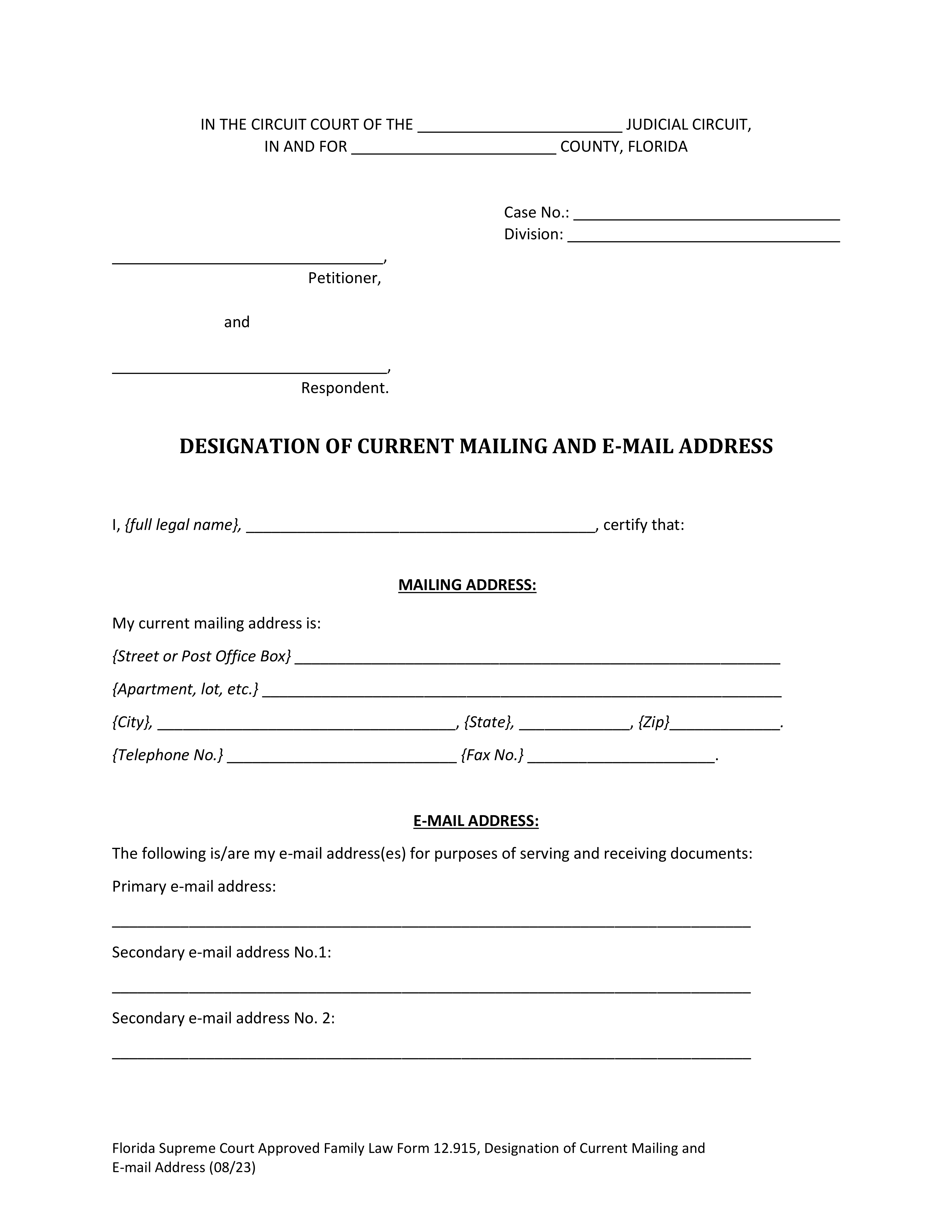
Regardless of your specific legal issue, you must keep the court and all parties informed of your contact details. Use Florida Family Law Form 12.915 (Designation of Current Mailing and E-mail Address) to formally register your current contact information. This ensures you receive all hearing notices and official correspondence, preventing you from missing critical deadlines in your case.
Form Comparison
| Form | Primary Purpose | Child-Related? | When to Use |
|---|---|---|---|
| Florida Supreme Court Approved Family Law Form 12.901(b)(3), Petition for Dissolution of Marriage with No Dependent or Minor Child(ren) or Property (02/18) | Initiates a divorce for couples with no children, property, or alimony needs. | No, specifically for cases with no minor or dependent children. | When starting a simplified divorce case with no shared assets or kids. |
| Florida Supreme Court Approved Family Law Form 12.902(d), Uniform Child Custody Jurisdiction and Enforcement Act (UCCJEA) Affidavit | Provides child residency history to establish the court's legal jurisdiction. | Yes, mandatory for all cases involving parental responsibility or time-sharing. | Filed alongside any petition that involves custody or visitation of minors. |
| Florida Supreme Court Approved Family Law Form 12.915, Designation of Current Mailing and E-mail Address | Formally notifies the court and parties of your current contact information. | N/A, used in all types of family law cases regardless of children. | At the start of a case or whenever your contact info changes. |
| Florida Supreme Court Approved Family Law Form 12.941(a), Petition for Enforcement of Out-of-State Custody Decree and for Order to Pick Up Minor Child(ren) | Requests Florida court enforcement of a custody order from another state. | Yes, used to recover children or enforce out-of-state visitation rights. | When a child is wrongfully retained in violation of a foreign order. |
| Form 12.995(c), Safety-Focused Parenting Plan | Establishes a parenting plan where safety concerns require restricted visitation. | Yes, defines time-sharing and decision-making for at-risk children. | When domestic violence, abuse, or substance issues threaten a child's safety. |
Tips for florida court forms
Before filing for dissolution of marriage, ensure at least one spouse has resided in Florida for at least six months. You will need to provide proof, such as a valid Florida driver’s license or a witness affidavit, to avoid having your case dismissed by the court.
Many Florida family law forms must be signed under oath to be legally binding. Do not sign these documents at home; wait until you are in the presence of a notary public or a deputy clerk of court to execute your signature.
The UCCJEA Affidavit requires a detailed list of every address where the child has lived for the past five years. Collect these dates and locations before starting the form to ensure your jurisdictional information is complete and accurate.
AI-powered tools like Instafill.ai can complete these detailed Florida court forms in under 30 seconds with high accuracy. Your sensitive legal data stays secure during the process, providing a significant time-saving advantage when managing multiple court documents.
Official court notices are sent to the address you provide on Form 12.915. If you move or change your email during your case, file an updated designation immediately to ensure you never miss a hearing date or a court order.
When filling out safety-focused plans, clearly define supervision requirements and specific locations for exchanges. Providing granular detail helps the court establish a structure that prioritizes the child's safety and reduces future conflict.
Filing a petition with the clerk is only the first step; you must also legally serve the other party to give them official notice. Use a professional process server or the local sheriff to ensure the court has the authority to move forward with your case.
Frequently Asked Questions
These forms address a variety of domestic relations issues, including simplified dissolutions of marriage, child custody jurisdiction, and parenting plans. They are designed to help individuals navigate the legal process for divorce, enforcement of out-of-state orders, and maintaining official contact information with the court system.
The correct form depends on factors like whether you have minor children, marital assets, or shared debts. For instance, Form 12.901(b)(3) is specifically for couples with no dependent children and no property to divide, while other forms exist for more complex scenarios involving assets or alimony.
Generally, you must file completed forms with the Clerk of the Circuit Court in the county where you or your spouse resides. Many Florida counties now allow or require electronic filing through the Florida Courts E-Filing Portal, though you should check with your local clerk for specific submission requirements.
Anyone involved in a Florida family law case that concerns the parental responsibility, custody, or time-sharing of a minor child must file Form 12.902(d). This affidavit helps the court determine if it has the legal authority to make decisions regarding the child based on their residential history over the last five years.
You are required to keep the court and all other parties informed of your current contact information to ensure you receive legal notices. Form 12.915 is used to formally designate your mailing and email addresses, preventing you from missing important hearing dates or court orders.
Yes, Form 12.941(a) is specifically designed for parents seeking to have a Florida court recognize and enforce a custody decree issued by a court in another state. This is often used in urgent situations or when a child has been wrongfully retained in Florida contrary to an existing order.
A Safety-Focused Parenting Plan (Form 12.995(c)) is used when there are concerns about a child's safety due to issues like domestic violence, child abuse, or substance abuse. It allows the court to establish restrictive time-sharing arrangements, such as supervised visitation, to ensure the child remains protected.
Many Florida Supreme Court Approved Family Law forms, such as petitions and affidavits, must be signed under oath in the presence of a notary public or a deputy clerk. You should check the specific instructions at the beginning of each form to see if a notary signature is required before you submit it.
Yes, you can use AI tools like Instafill.ai to complete Florida court forms accurately by extracting data from your source documents. This technology ensures that information is placed in the correct fields, helping you avoid common manual entry errors on complex legal paperwork.
While manual completion can take hours of careful typing, AI platforms like Instafill.ai can often fill these forms in under 30 seconds. The system automatically populates the required information from your uploaded documents, making the process significantly faster and more efficient.
To file for a dissolution of marriage in Florida, at least one of the spouses must have been a resident of the state for at least six months prior to filing the petition. You will typically need to provide proof of residency, such as a Florida driver's license or a witness affidavit, as part of your filing.
Glossary
- Form Complexity Index
- Instafill’s 0–100 measure of how much effort a form takes to complete, calculated deterministically from the form’s own structure rather than estimated. It combines the number of fillable fields (the largest factor), how difficult those fields are to complete based on their type, the number of pages that contain fields, the amount of conditional “fill-only-if” logic, and how many sections the form is divided into, then adds modifiers for tables and repeating lists, bundled instruction pages, and dense page layouts. A higher score means the form is harder to fill out by hand. The forms in this category have a median Form Complexity Index of 48/100 (Moderate). See exactly how it is calculated.
- Dissolution of Marriage
- The formal legal term used in Florida to describe the process of ending a marriage, commonly known as divorce.
- Petitioner
- The person who starts a court case by filing the initial legal documents or petition.
- Respondent
- The person against whom a legal case is filed, who must respond to the claims made in the petition.
- UCCJEA
- The Uniform Child Custody Jurisdiction and Enforcement Act, a law used to determine which state has the legal authority to handle a child custody case.
- Time-Sharing
- The specific schedule and arrangement that determines when a child spends time with each parent, which Florida uses instead of the term 'visitation.'
- Parental Responsibility
- The legal obligation of parents to make major decisions for their child’s welfare, including education, healthcare, and religious upbringing.
- Irretrievably Broken
- The legal standard required for a divorce in Florida, indicating that the marriage cannot be saved or repaired.
- Service of Process
- The formal procedure of delivering court papers to the other party to ensure they have been legally notified of the lawsuit.