Yes! You can use AI to fill out Form 12.915, Designation of Current Mailing and E-mail Address

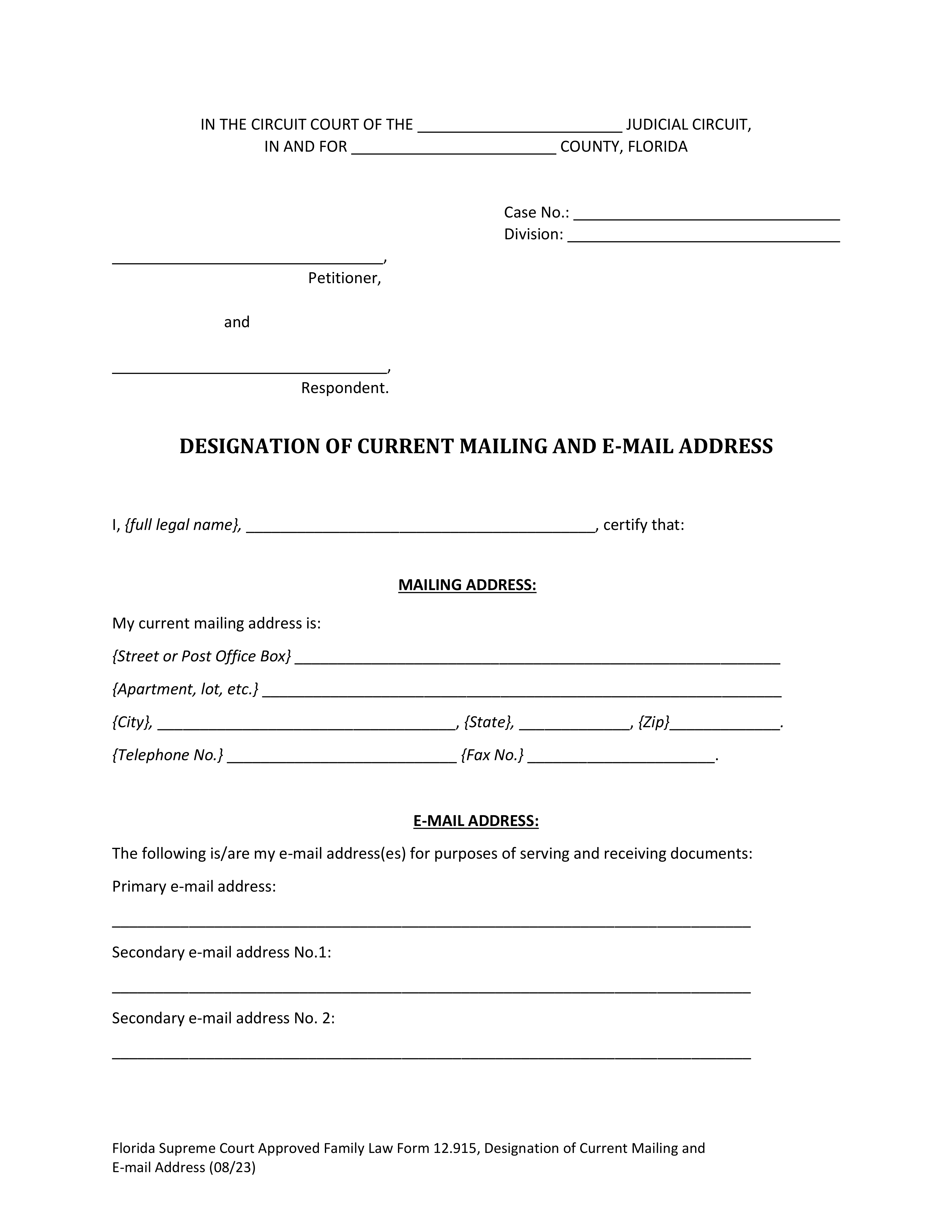
Form 12.915, officially known as the Designation of Current Mailing and E-mail Address, is a Florida Supreme Court Approved Family Law Form. It is used to notify the court and other parties involved in a case of your current mailing and e-mail addresses or any changes to them. This form is crucial for ensuring that all legal documents and communications are properly delivered, maintaining the integrity of the legal process.
Form 12.915 is part of the court forms, family court forms, family law forms, florida court forms and UK court forms categories on Instafill.
Form 12.915 has a moderate Form Complexity Index of 46/100 — 43 fillable fields across 4 pages. Instafill’s AI completes it accurately in under a minute.

Form specifications

Form name: Form 12.915, Designation of Current Mailing and E-mail Address
Form issued by: Florida Supreme Court
Number of fields: 43
Number of pages: 4
FCI: Moderate (46/100)
Version: 08/23
Field instructions: Form 12.915 Instructions
Language: English
Our AI automatically handles information lookup, data retrieval, formatting, and form filling.
It takes less than a minute to fill out Form 12.915 using our AI form filling.
Securely upload your data. Information is encrypted in transit and deleted immediately after the form is filled out.
Preview of Form 12.915, Designation of Current Mailing and E-mail Address

Instafill Demo: How to fill out PDF forms in seconds with AI

How to Fill Out Form 12.915 Online for Free in 2026

Are you looking to fill out a FORM 12.915 form online quickly and accurately? Instafill.ai offers the #1 AI-powered PDF filling software of 2026, allowing you to complete your FORM 12.915 form in just 37 seconds or less.
Follow these steps to fill out your FORM 12.915 form online using Instafill.ai:
  1. 1 Visit instafill.ai site and select Form 12.915
  2. 2 Enter your full legal name
  3. 3 Provide current mailing address details
  4. 4 List primary and secondary e-mail addresses
  5. 5 Sign and date the form electronically
  6. 6 Check for accuracy and submit form

Our AI-powered system ensures each field is filled out correctly, reducing errors and saving you time.

Why Choose Instafill.ai for Your Fillable Form 12.915 Form?

Speed

Complete your Form 12.915 in as little as 37 seconds.

Up-to-Date

Always use the latest 2026 Form 12.915 form version.

Cost-effective

No need to hire expensive lawyers.

Accuracy

Our AI performs 10 compliance checks to ensure your form is error-free.

Security

Your personal information is protected with bank-level encryption.

Frequently Asked Questions About Form 12.915

Form 12.915 has a Form Complexity Index of 46 out of 100, placing it in the moderate complexity tier. This score is calculated deterministically from the form’s own structure using Instafill’s published Form Complexity Index methodology, so it can be reproduced and independently verified — it is not a subjective estimate.

For Form 12.915 specifically, the score reflects 43 fillable fields across 4 pages, grouped into 10 sections, and 5 conditional fields that only apply depending on earlier answers. The number of fields is the largest factor in the base score (weighted 36%), followed by how difficult those fields are to complete based on their type, where free-text and signature fields count for more than simple checkboxes (26%). The number of pages that actually contain fields (15%), the amount of conditional “fill-only-if” logic (16%), and how many sections the form is divided into (7%) account for the rest of the base. On top of that base, the index adds points for tables and repeating lists, bundled instruction pages, and dense page layouts — capturing difficulty the base alone can miss.

In practical terms, a moderate score means the form takes real effort: there are enough fields, pages and rules that errors are easy to make by hand. Instafill removes that effort entirely: our AI reads your information, maps each value to the correct field — including the conditional ones — and completes Form 12.915 accurately in under a minute, with every field available for you to review before you download. See exactly how the Form Complexity Index is calculated.

Form 12.915 should be used when you need to designate or update your current mailing and e-mail address for service of documents in a court case. It ensures that all parties involved in the case have your correct contact information.

No, it is not mandatory to designate an e-mail address for service if you are not represented by an attorney. However, providing an e-mail address can facilitate faster and more efficient communication and service of documents.

You can designate one primary e-mail address for service on Form 12.915. It is important to ensure that the e-mail address provided is one that you check regularly to avoid missing important communications.

If your mailing or e-mail address changes after filing Form 12.915, you should promptly file an updated Form 12.915 with the clerk of the circuit court to ensure that all parties have your current contact information.

To file Form 12.915, you should complete the form with your current mailing and e-mail address information, sign it, and submit it to the clerk of the circuit court where your case is being heard. Filing can usually be done in person, by mail, or electronically, depending on the court's procedures.

The requirements for serving a copy of Form 12.915 on other parties include ensuring that the form is properly completed with the current mailing and e-mail addresses, and then serving it according to the Florida Rules of Judicial Administration. This typically means serving the form on all parties or their attorneys, if represented, in the manner prescribed by the rules, which may include e-service, mail, or personal delivery.

Yes, self-represented litigants are generally required to file documents electronically in Florida courts, unless they are excused from this requirement. The Florida Rules of Judicial Administration mandate e-filing for all parties, including those representing themselves. However, exceptions may be granted upon a showing of good cause.

The rules for e-filing documents in Florida courts are outlined in the Florida Rules of Judicial Administration. These rules require that most documents be filed electronically through the Florida Courts E-Filing Portal. Parties must comply with technical requirements, formatting standards, and deadlines specified by the rules. Certain documents may be exempt from e-filing, and parties may seek exemptions based on good cause.

The e-service election after the initial service of process is important because it establishes the method by which parties will receive documents electronically throughout the case. This election ensures efficient and timely communication between parties, reduces paper usage, and aligns with the Florida courts' push towards digital transformation. It must be made in accordance with the Florida Rules of Judicial Administration.

A self-represented litigant can be excused from serving documents by e-mail by filing a motion with the court demonstrating good cause for the exemption. Good cause may include lack of access to technology, inability to use electronic means, or other valid reasons that make e-service impractical. The court will review the motion and grant the exemption if justified.

A self-represented litigant must complete and file Form 12.915, Designation of Current Mailing and E-mail Address, with the court to serve and receive documents by e-mail. This form must include the litigant's current mailing address and a valid e-mail address where they agree to receive service of documents.

More information about the rules and procedures for e-filing and e-service can typically be found on the official website of the court where the case is being filed. Additionally, the clerk’s office of the respective court can provide guidance and resources regarding e-filing and e-service procedures.

A nonlawyer can assist in filling out Form 12.915 by providing guidance on how to complete the form accurately. However, it is important to note that the nonlawyer cannot provide legal advice or represent the litigant in court. The litigant must ensure that all information provided on the form is accurate and complete.

When assisting with Form 12.915, a nonlawyer must provide their name, address, and relationship to the litigant (if any). This information is required to ensure transparency and accountability in the assistance provided to the litigant in completing the form.

Failing to notify the clerk’s office and the opposing party of address changes can result in missed communications, including important court documents and deadlines. This may lead to adverse rulings, dismissal of the case, or other legal consequences. It is the litigant's responsibility to ensure that their contact information is current at all times.

The Designation of Current Mailing and E-mail Address form is certified by the filer's signature, which attests to the accuracy and completeness of the information provided. The signature serves as a legal certification under penalty of perjury that the mailing and e-mail addresses listed are current and correct.

False statements made in Form 12.915 can result in penalties under Florida law, including but not limited to perjury charges. The severity of the penalties can vary depending on the nature of the false statement and its impact on judicial proceedings. It is important to ensure all information provided is accurate to avoid legal consequences.

Yes, you can designate a secondary e-mail address for service in addition to a primary one on Form 12.915. This ensures that you receive all court communications even if there are issues with the primary e-mail address. It is recommended to provide both to ensure uninterrupted service of court documents.

If you choose not to file your pleadings or other documents electronically, you must indicate this preference on Form 12.915. You will then be required to file and serve documents in paper format according to the rules and procedures set forth by the Florida courts. It's important to comply with all filing requirements to avoid delays or dismissal of your case.

The Florida Rules of General Practice and Judicial Administration can be found on the official website of the Florida Supreme Court or through the Florida Bar's website. These rules govern the procedures for filing and serving documents in Florida courts, including the use of electronic filing and service. It is advisable to review these rules to ensure compliance with all legal requirements.

Compliance Form 12.915
Validation Checks by Instafill.ai

1
Verifies that the form is completed by typing or printing in black ink as required.
Ensures that the form is filled out either by typing or printing in black ink, adhering to the specified requirements. This check confirms that the submission meets the basic formatting standards to avoid rejection. It verifies that the use of black ink is consistent throughout the document. This step is crucial for maintaining the legibility and professionalism of the form.
2
Confirms that the full legal name of the individual is provided and matches official records.
Validates that the individual's full legal name is accurately provided on the form. It checks for any discrepancies between the name entered and the name on official records to prevent processing delays. This ensures that all legal documents are correctly associated with the individual. The verification process is essential for maintaining the integrity of legal and official communications.
3
Ensures that the current mailing address is complete, including street or P.O. box, apartment or lot number, city, state, and zip code.
Confirms the completeness of the current mailing address by checking for all required components such as street or P.O. box, apartment or lot number, city, state, and zip code. This validation ensures that the address is sufficient for mail delivery and official correspondence. It helps in avoiding any miscommunication or delay in receiving important documents. The thoroughness of this check is vital for effective communication and legal processes.
4
Validates the inclusion of a telephone number and, if applicable, a fax number.
Checks for the presence of a telephone number to ensure that there is a direct line of communication with the individual. If applicable, it also verifies the inclusion of a fax number for alternative communication methods. This step is important for facilitating quick and efficient contact when necessary. The validation supports the overall goal of maintaining open lines of communication for legal and official purposes.
5
Checks that a primary e-mail address is designated for service, especially if the individual is not represented by an attorney.
Ensures that a primary e-mail address is provided for service, particularly in cases where the individual is not represented by an attorney. This check is crucial for enabling electronic communication and service of documents, which can expedite legal processes. It verifies that the e-mail address is correctly formatted and likely to be active. The inclusion of this information is key to modernizing and streamlining legal communications.
6
Verifies that up to two secondary e-mail addresses are correctly designated, if provided.
Ensures that the form accurately captures up to two secondary e-mail addresses, if the filer chooses to provide them. Confirms that each e-mail address follows the standard format to avoid any delivery issues. Validates that the designation of secondary e-mail addresses does not exceed the limit of two. Checks that the e-mail addresses are clearly marked as secondary to distinguish them from the primary contact information.
7
Ensures that the individual understands the obligation to notify the clerk’s office and the opposing party of any changes to mailing or e-mail addresses.
Confirms that the filer acknowledges their responsibility to update the clerk’s office and the opposing party about any changes in their contact information. Validates that the form includes a clear statement or checkbox indicating this understanding. Ensures that the filer is aware of the potential consequences of failing to update their information. Checks for any additional instructions or reminders about this obligation within the form.
8
Confirms that the form is filed with the clerk of the circuit court in the appropriate county.
Ensures that the form is submitted to the correct circuit court clerk's office based on the case's jurisdiction. Validates that the filer has selected the appropriate county for filing to avoid processing delays. Confirms that the form includes all necessary county-specific requirements or markings. Checks that the filing location is clearly indicated or referenced in the form's instructions.
9
Validates that a copy of the form is served on any other party in the case in accordance with Florida Rule of General Practice and Judicial Administration 2.516.
Ensures that the filer has complied with the requirement to serve a copy of the form to all other parties involved in the case. Confirms that the method of service adheres to the specifications outlined in Florida Rule of General Practice and Judicial Administration 2.516. Validates that proof of service is documented and attached to the form, if required. Checks that the form includes instructions or reminders about this service requirement.
10
Checks for the completion of the Disclosure from Nonlawyer section, if applicable, including the provision of Form 12.900(a).
Ensures that the Disclosure from Nonlawyer section is fully completed when the filer is not represented by a lawyer. Confirms that Form 12.900(a) is provided as part of the submission, if applicable. Validates that all required fields in this section are filled out to comply with legal standards. Checks that the form includes clear instructions on when and how to complete this section.
11
Ensures that all statements in the document are made under penalty of perjury.
The validation check confirms that every statement within the document is declared under penalty of perjury, ensuring the truthfulness and accuracy of the information provided. It safeguards against false declarations by legally binding the declarant to the veracity of their statements. This step is crucial for maintaining the integrity of the legal process. It also serves as a deterrent against the submission of fraudulent information.
12
Verifies that the form is used solely for the purpose of informing the clerk and the other party of current mailing and e-mail addresses or any changes.
This check ensures the form's usage is strictly limited to notifying the clerk and the opposing party about current or updated mailing and e-mail addresses. It prevents misuse of the form for purposes other than its intended use. The validation is key to maintaining the form's specificity and relevance. It also helps in streamlining communication within legal proceedings by ensuring accurate and up-to-date contact information.
13
Confirms that the individual is not represented by an attorney if designating a primary e-mail address for service is required.
The validation verifies that the individual submitting the form is not under legal representation when a primary e-mail address for service is designated. This ensures compliance with legal protocols regarding direct communication. It prevents conflicts in communication channels between represented parties and their attorneys. The check is essential for upholding the proper procedures in legal correspondence.
14
Validates that the form is the original filed with the clerk and a copy is retained by the individual.
This check ensures the form submitted to the clerk is the original document, while the individual retains a copy for their records. It guarantees the authenticity and originality of the filed document. The process aids in record-keeping and provides the individual with proof of submission. It is a critical step in document management within legal proceedings.
15
Checks that the form is completed in compliance with all specified Florida Family Law Rules of Procedure.
The validation ensures the form adheres to all stipulated Florida Family Law Rules of Procedure, guaranteeing legal compliance. It scrutinizes the form for any deviations from the required legal standards. This step is vital for the form's acceptance and validity in legal contexts. It also minimizes the risk of procedural errors that could delay or invalidate the submission.

Common Mistakes in Completing Form 12.915

Not designating a primary e-mail address when required

Failing to designate a primary e-mail address can lead to missed communications and delays in processing. It is essential to provide a primary e-mail address if the form requires it to ensure timely receipt of important notices. Always double-check the e-mail address for accuracy before submission. Consider using an e-mail address that is checked regularly to avoid missing critical updates.

Failing to update address changes with the clerk

Not updating address changes with the clerk can result in important documents being sent to the wrong location. It is crucial to inform the clerk of any address changes promptly to maintain accurate records. Regularly verify that the clerk has your current address on file. This practice helps prevent potential legal or administrative issues due to undelivered mail.

Omitting secondary e-mail addresses when available

Omitting secondary e-mail addresses may limit the channels through which you can receive important communications. Providing secondary e-mail addresses ensures redundancy and increases the likelihood of receiving critical information. Ensure all provided e-mail addresses are active and monitored. This step is particularly important in cases where the primary e-mail might be inaccessible.

Using incorrect or incomplete mailing address details

Incorrect or incomplete mailing address details can cause significant delays or the loss of important documents. Always verify the accuracy and completeness of the mailing address before submitting the form. Include all necessary components such as apartment numbers, suite numbers, or postal codes. Cross-referencing with official documents can help ensure the address is correctly listed.

Not serving the form to other parties as required

Failing to serve the form to other parties as required can invalidate the submission or lead to legal complications. It is imperative to understand and follow all serving requirements outlined in the form's instructions. Ensure that all parties receive the form within the specified timeframe. Keeping proof of service can provide documentation if disputes arise.

Failing to sign under penalty of perjury

Failing to sign under penalty of perjury is a critical oversight that can invalidate the form. This signature is a legal affirmation of the truthfulness of the information provided. To avoid this mistake, always ensure that the form is signed in the designated area before submission. Additionally, reviewing the form for any unsigned sections prior to filing can prevent this issue.

Not filing the original form with the clerk

Submitting a copy instead of the original form to the clerk can lead to processing delays or rejection. The original form is required to ensure the authenticity of the document. Always verify that you are filing the original, signed form. Keeping a copy for your records while submitting the original can help maintain compliance.

Overlooking the need for nonlawyer disclosure

Overlooking the requirement to disclose nonlawyer assistance can result in non-compliance with legal procedures. This disclosure is necessary to maintain transparency in legal representations. Ensure that any assistance from nonlawyers is properly documented on the form. Reviewing the form's instructions for disclosure requirements can aid in avoiding this oversight.

Forgetting to include telephone or fax numbers

Omitting telephone or fax numbers can hinder communication regarding the form. These contact details are essential for any follow-up or verification processes. Double-check the form to ensure all required contact information is accurately provided. Including both telephone and fax numbers, if available, can facilitate smoother communication.

Using non-black ink or handwriting illegibly

Using non-black ink or illegible handwriting can make the form difficult to read and process. Black ink is typically required for its clarity and photocopying quality. Writing clearly and legibly ensures that all information is accurately captured. Adhering to these presentation standards can prevent unnecessary delays in form processing.
Saved over 80 hours a year

“I was never sure if my IRS forms like W-9 were filled correctly. Now, I can complete the forms accurately without any external help.”

Kevin Martin Green

Your data stays secure with advanced protection from Instafill and our subprocessors

Robust compliance program

Transparent business model

You’re not the product. You always know where your data is and what it is processed for.

ISO 27001, HIPAA, and GDPR

Our subprocesses adhere to multiple compliance standards, including but not limited to ISO 27001, HIPAA, and GDPR.

Security & privacy by design

We consider security and privacy from the initial design phase of any new service or functionality. It’s not an afterthought, it’s built-in, including support for two-factor authentication (2FA) to further protect your account.

Fill out Form 12.915 with Instafill.ai

Worried about filling PDFs wrong? Instafill securely fills 12.915 forms, ensuring each field is accurate.

Related forms by category

court forms Form Summons, Supreme Court of New York, Form SC-100, Plaintiff's Claim and ORDER to Go to Small Claims Court, Form AO 240, Application to Proceed in District Court Without Prepaying Fees or Costs, Form AO 239, Application to Proceed in District Court Without Prepaying Fees or Costs, Affidavit for Service by Publication/Posting (Circuit Court of Cook County, Illinois) (CCG 0013 A/B), Petition for Leave to Proceed In Forma Pauperis (Court of Common Pleas of Lehigh County, Pennsylvania, Civil Division), In Forma Pauperis Affidavit/Petition (AOPC 622A) – Pennsylvania Magisterial District Court, Judicial Council of California Form SC-105, Request for Court Order and Answer (Small Claims), SC-120, Defendant’s Claim and ORDER to Go to Small Claims Court (Small Claims), SC-105, Request for Court Order and Answer (Small Claims), Judicial Council of California Form SC-120, Defendant’s Claim and ORDER to Go to Small Claims Court (Small Claims), In Forma Pauperis Affidavit Petition (AOPC 622A) — Pennsylvania Magisterial District Court, Florida Supreme Court Approved Family Law Form 12.901(b)(3), Petition for Dissolution of Marriage with No Dependent or Minor Child(ren) or Property (02/18), Illinois Supreme Court Approved Form E-O 3500.3, Eviction Order, Form P3 (Rule 25-3(2)) — Affidavit of Applicant for Grant of Probate or Grant of Administration with Will Annexed (Short Form) (Supreme Court of British Columbia), Form SC-100, Plaintiff’s Claim and ORDER to Go to Small Claims Court, Designation of Record on Appeal (Civil) (Maricopa County Justice Courts, Arizona) (Form APP 8150-702), FW-003, Order on Court Fee Waiver (Superior Court), Judicial Council of California Form SER-001, Request for Sheriff to Serve Court Papers, FW-003, Order on Court Fee Waiver (Superior Court) · + 37 more →
family court forms Form 12.995(c), Safety-Focused Parenting Plan, Florida Supreme Court Approved Family Law Form 12.901(b)(3), Petition for Dissolution of Marriage with No Dependent or Minor Child(ren) or Property (02/18), Form N161, Appellant’s notice (All appeals except small claims track appeals and appeals to the Family Division of the High Court), Form N161, Appellant's Notice (All appeals except small claims track appeals and appeals to the Family Division of the High Court), declaration-of-marriage-for-court-proceeding-california-family-law, Florida Supreme Court Approved Family Law Form 12.902(d), Uniform Child Custody Jurisdiction and Enforcement Act (UCCJEA) Affidavit, Florida Supreme Court Approved Family Law Form 12.941(a), Petition for Enforcement of Out-of-State Custody Decree and for Order to Pick Up Minor Child(ren), Florida Supreme Court Approved Family Law Form 12.970(a), Petition for Temporary Custody by Extended Family, Adoption Request (Stepparent), Florida Family Law Rules of Procedure Form 12.900(b), Notice of and Consent to Limited Appearance, Florida Family Law Rules of Procedure Form 12.900(d), Termination of Limited Appearance, Florida Family Law Rules of Procedure Form 12.900(e), Acknowledgment of Assistance by Attorney, Florida Family Law Rules of Procedure Form 12.900(g), Agreement Limiting Representation, Florida Family Law Rules of Procedure Form 12.900(h), Notice of Related Cases, Florida Family Law Rules of Procedure Form 12.901(a), Joint Petition for Simplified Dissolution of Marriage, Form 12.902(b), Family Law Financial Affidavit (Short Form), Florida Family Law Rules of Procedure Form 12.902(c), Family Law Financial Affidavit (Long Form), Florida Family Law Rules of Procedure Form 12.902(e), Child Support Guidelines Worksheet, Florida Supreme Court Approved Family Law Form 12.902(f)(1), Marital Settlement Agreement for Dissolution of Marriage with Dependent or Minor Child(ren), Florida Supreme Court Approved Family Law Form 12.902(f)(2), Marital Settlement Agreement for Dissolution of Marriage with Property but No Dependent or Minor Child(ren) · + 74 more →
family law forms Form 12.902(b), Family Law Financial Affidavit (Short Form), Florida Supreme Court Approved Family Law Form 12.901(b)(3), Petition for Dissolution of Marriage with No Dependent or Minor Child(ren) or Property (02/18), Form FL-170, Declaration for Default or Uncontested Dissolution or Legal Separation (Family Law), Form FL-100, Petition—Marriage/Domestic Partnership (Family Law), declaration-of-marriage-for-court-proceeding-california-family-law, Florida Supreme Court Approved Family Law Form 12.902(d), Uniform Child Custody Jurisdiction and Enforcement Act (UCCJEA) Affidavit, Florida Family Law Rules of Procedure Form 12.910(a), Summons: Personal Service on an Individual, Florida Supreme Court Approved Family Law Form 12.941(a), Petition for Enforcement of Out-of-State Custody Decree and for Order to Pick Up Minor Child(ren), Florida Supreme Court Approved Family Law Form 12.970(a), Petition for Temporary Custody by Extended Family, Form FL-110, Summons (Family Law), Form FL-120, Response—Marriage/Domestic Partnership (Family Law), ADOPT-200, Adoption Request, ADOPT-200, Stepparent Adoption Request, ADOPT-210, Adoption Agreement, ADOPT-310, Contact After Adoption Agreement, Adoption Assistance Program Nonrecurring Adoption Expense Agreement and Claim, Adoption Request (Stepparent), Adoption and Safe Families Act (ASFA) Survey, Florida Family Law Rules of Procedure Form 12.900(b), Notice of and Consent to Limited Appearance, Florida Family Law Rules of Procedure Form 12.900(d), Termination of Limited Appearance · + 77 more →
florida court forms Form 12.995(c), Safety-Focused Parenting Plan, Florida Supreme Court Approved Family Law Form 12.901(b)(3), Petition for Dissolution of Marriage with No Dependent or Minor Child(ren) or Property (02/18), Florida Supreme Court Approved Family Law Form 12.902(d), Uniform Child Custody Jurisdiction and Enforcement Act (UCCJEA) Affidavit, Florida Supreme Court Approved Family Law Form 12.941(a), Petition for Enforcement of Out-of-State Custody Decree and for Order to Pick Up Minor Child(ren), Florida Supreme Court Approved Family Law Form 12.970(a), Petition for Temporary Custody by Extended Family, Florida Family Law Rules of Procedure Form 12.900(b), Notice of and Consent to Limited Appearance, Florida Family Law Rules of Procedure Form 12.900(d), Termination of Limited Appearance, Florida Family Law Rules of Procedure Form 12.900(e), Acknowledgment of Assistance by Attorney, Florida Family Law Rules of Procedure Form 12.900(a), Disclosure from Nonlawyer, Florida Family Law Rules of Procedure Form 12.910(a), Summons: Personal Service on an Individual, Form 12.902(b), Family Law Financial Affidavit (Short Form), Florida Supreme Court Approved Family Law Form 12.902(f)(1), Marital Settlement Agreement for Dissolution of Marriage with Dependent or Minor Child(ren), Florida Supreme Court Approved Family Law Form 12.903(c)(1), Answer to Petition and Counterpetition for Dissolution of Marriage with Dependent or Minor Child(ren), Florida Supreme Court Approved Family Law Form 12.902(l), Affidavit of Income for Child Support, Florida Supreme Court Approved Family Law Form 12.903(b), Answer to Petition for Dissolution of Marriage, Florida Supreme Court Approved Family Law Form 12.902(i), Affidavit of Corroborating Witness, Florida Supreme Court Approved Family Law Form 12.902(f)(2), Marital Settlement Agreement for Dissolution of Marriage with Property but No Dependent or Minor Child(ren), Florida Family Law Rules of Procedure Form 12.902(c), Family Law Financial Affidavit (Long Form), Florida Family Law Rules of Procedure Form 12.902(e), Child Support Guidelines Worksheet, Florida Family Law Rules of Procedure Form 12.900(h), Notice of Related Cases · + 21 more →
UK court forms Form Summons, Supreme Court of New York, Form SC-100, Plaintiff's Claim and ORDER to Go to Small Claims Court, Form AO 240, Application to Proceed in District Court Without Prepaying Fees or Costs, Form AO 239, Application to Proceed in District Court Without Prepaying Fees or Costs, Affidavit for Service by Publication/Posting (Circuit Court of Cook County, Illinois) (CCG 0013 A/B), Petition for Leave to Proceed In Forma Pauperis (Court of Common Pleas of Lehigh County, Pennsylvania, Civil Division), In Forma Pauperis Affidavit/Petition (AOPC 622A) – Pennsylvania Magisterial District Court, Judicial Council of California Form SC-105, Request for Court Order and Answer (Small Claims), SC-120, Defendant’s Claim and ORDER to Go to Small Claims Court (Small Claims), SC-105, Request for Court Order and Answer (Small Claims), Judicial Council of California Form SC-120, Defendant’s Claim and ORDER to Go to Small Claims Court (Small Claims), In Forma Pauperis Affidavit Petition (AOPC 622A) — Pennsylvania Magisterial District Court, Florida Supreme Court Approved Family Law Form 12.901(b)(3), Petition for Dissolution of Marriage with No Dependent or Minor Child(ren) or Property (02/18), Illinois Supreme Court Approved Form E-O 3500.3, Eviction Order, Form P3 (Rule 25-3(2)) — Affidavit of Applicant for Grant of Probate or Grant of Administration with Will Annexed (Short Form) (Supreme Court of British Columbia), Form SC-100, Plaintiff’s Claim and ORDER to Go to Small Claims Court, Designation of Record on Appeal (Civil) (Maricopa County Justice Courts, Arizona) (Form APP 8150-702), FW-003, Order on Court Fee Waiver (Superior Court), Judicial Council of California Form SER-001, Request for Sheriff to Serve Court Papers, FW-003, Order on Court Fee Waiver (Superior Court) · + 36 more →