Yes! You can use AI to fill out Adoption and Safe Families Act (ASFA) Survey

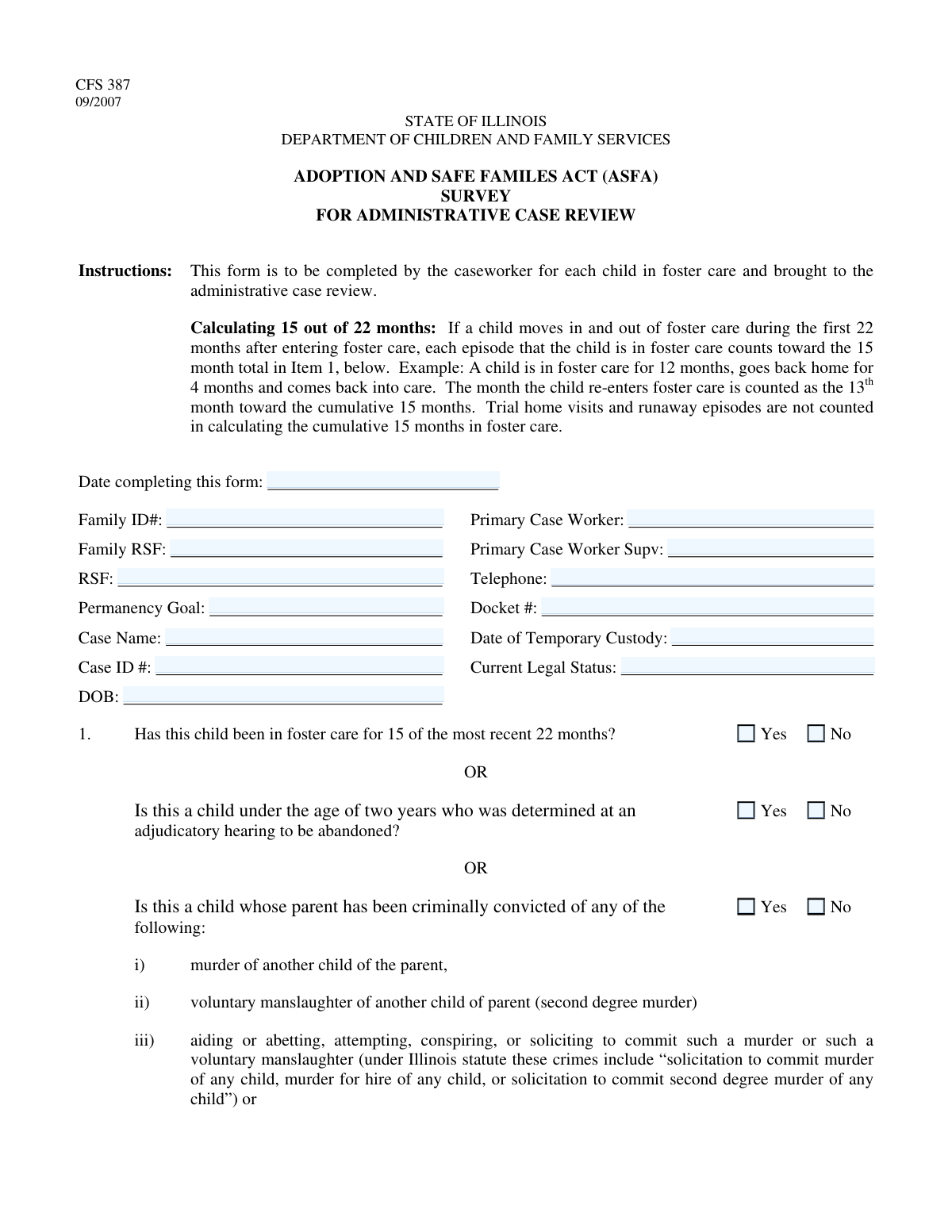
The Adoption and Safe Families Act (ASFA) Survey is a critical document used by child welfare professionals to assess a child's case against federal guidelines for permanency. It helps determine if the legal requirements for filing a Termination of Parental Rights (TPR) petition have been met by documenting the child's time in foster care, the parents' history, and the current permanency goal. This detailed evaluation is crucial for ensuring timely and appropriate legal action to secure a stable, permanent home for the child. Today, this form can be filled out quickly and accurately using AI-powered services like Instafill.ai, which can also convert non-fillable PDF versions into interactive fillable forms.
ASFA Survey is part of the AFE forms and adoption forms categories on Instafill.
Our AI automatically handles information lookup, data retrieval, formatting, and form filling.
It takes less than a minute to fill out ASFA Survey using our AI form filling.
Securely upload your data. Information is encrypted in transit and deleted immediately after the form is filled out.

Form specifications

Form name: Adoption and Safe Families Act (ASFA) Survey
Number of fields: 113
Number of pages: 5
Language: English
main-image

Instafill Demo: How to fill out PDF forms in seconds with AI

How to Fill Out ASFA Survey Online for Free in 2026

Are you looking to fill out a ASFA SURVEY form online quickly and accurately? Instafill.ai offers the #1 AI-powered PDF filling software of 2026, allowing you to complete your ASFA SURVEY form in just 37 seconds or less.
Follow these steps to fill out your ASFA SURVEY form online using Instafill.ai:
  1. 1 Navigate to Instafill.ai and upload or select the Adoption and Safe Families Act (ASFA) Survey form.
  2. 2 Allow the AI to scan and process the form, identifying all fields for case identification, caseworker details, and legal status.
  3. 3 Enter the core case details, such as the Case ID, child's name, date of birth, and caseworker information, into the designated fields.
  4. 4 Answer the series of yes/no questions regarding the child's time in foster care, parental history, and other conditions stipulated by the ASFA.
  5. 5 Based on your answers, the AI will guide you to the relevant sections, such as providing explanations for not screening for TPR or detailing efforts to find an adoptive home.
  6. 6 Complete the sections for supporting comments, recommendations, and any additional tasks or documents required for the case review.
  7. 7 Review all the entered information for accuracy and completeness before finalizing and downloading the completed ASFA Survey for your records or submission.

Our AI-powered system ensures each field is filled out correctly, reducing errors and saving you time.

Why Choose Instafill.ai for Your Fillable ASFA Survey Form?

Speed

Complete your ASFA Survey in as little as 37 seconds.

Up-to-Date

Always use the latest 2026 ASFA Survey form version.

Cost-effective

No need to hire expensive lawyers.

Accuracy

Our AI performs 10 compliance checks to ensure your form is error-free.

Security

Your personal information is protected with bank-level encryption.

Frequently Asked Questions About Form ASFA Survey

This form is an Adoption and Safe Families Act (ASFA) survey used to review a child's foster care case. It helps determine if filing a Termination of Parental Rights (TPR) petition is appropriate and documents the child's permanency plan.

The primary caseworker assigned to the child's case is responsible for completing this form, typically in preparation for an administrative case review. A supervisor may also need to review or approve it.

This refers to a key ASFA provision requiring the agency to file a TPR petition if a child has been in foster care for 15 of the last 22 months, unless a specific exception applies.

These codes explain why a Termination of Parental Rights (TPR) petition is not being filed. For example, 'RET' means the goal is to return the child home, and 'HMR' means the child is placed with relatives.

These fields refer to specific regional processes for reviewing a case for TPR. 'Cook' refers to Cook County's process, while 'Downstate' refers to the process used in other Illinois regions.

AICI likely refers to the Adoption Information Center of Illinois. You need an AICI confirmation number if an adoptive placement has not been found and the child is listed with this service to help find an adoptive home.

If a TPR petition has been filed, you must check the 'Yes' box and provide the exact date the petition was officially filed with the court.

This section is completed by an administrative case reviewer during a formal review meeting. They use it to document findings, note missing paperwork, and list required follow-up tasks for the caseworker.

You should have the complete case file, including legal documents with the docket number, the child's permanency goal, and any documentation related to TPR screenings or adoptive placement searches.

This is for documented situations where adoption is not in the child's best interest for a unique reason, such as a child's severe mental health issues making a placement change traumatic, as approved by relevant authorities.

Yes, AI-powered services like Instafill.ai can help you fill out this form more efficiently. These tools can accurately auto-fill fields with your case information, reducing manual data entry and saving you time.

Simply upload your form to the Instafill.ai platform. The AI will analyze the document, identify all the fields, and allow you to quickly fill in the required information online before downloading the completed PDF.

If you have a non-fillable or 'flat' PDF, you can use a service like Instafill.ai. It can convert the static PDF into an interactive, fillable form that you can complete easily on your computer.

The 'Family ID Number' typically refers to an ID assigned to the entire family unit. The 'Case ID Number' is specific to the individual child's legal case within the child welfare system.

Compliance ASFA Survey
Validation Checks by Instafill.ai

1
Date of Custody After Date of Birth
Checks that the 'Date of Temporary Custody' is on or after the individual's 'Date of Birth'. This is a fundamental chronological validation to ensure the data is logical, as custody cannot be established before a person is born. If this check fails, the system should flag an error requiring the user to correct one or both dates.
2
Valid and Past Form Completion Date
Ensures the 'Form Completion Date' is a validly formatted date and is not a date in the future. This prevents users from accidentally entering future dates, which would be illogical for a record of a completed action. A failed validation should prompt the user to enter a date that is today or in the past.
3
Mutually Exclusive Foster Care Status
Validates that only one of the two checkboxes, 'In foster care for 15 of 22 months - Yes' or 'In foster care for 15 of 22 months - No', is selected. These options are mutually exclusive, and selecting both would create contradictory data. The system should prevent the submission or clear the opposing selection if one is checked.
4
Required Explanation for No TPR Screening
Verifies that if the 'Screened for TPR - No' checkbox is selected, the 'Explanation for Not Screening' text field is not empty. This is crucial for accountability and case documentation, ensuring that a reason is always provided when a standard procedure is skipped. A failed validation should prevent form submission until an explanation is entered.
5
Required AICI Confirmation Number
Checks that if 'Child Listed with AICI - Yes' is selected, the 'AICI Confirmation Number' field is populated. This validation ensures that a claim of listing with the Adoption and Child Information Center (AICI) is substantiated with a reference number. If the number is missing, the form should be considered incomplete for that section.
6
Age Verification for 'AGE' Checkbox
Confirms that if the 'AGE' checkbox (indicating the child is 18 or over) is checked, the age calculated using the 'Date of Birth' and 'Form Completion Date' is 18 years or greater. This cross-field check prevents logical inconsistencies between stated age status and the birth date on record. An error should be displayed if the calculated age is less than 18.
7
Standard Telephone Number Format
Validates that the 'Telephone' field for the caseworker follows a standard North American phone number format (e.g., 10 digits, optional country code, parentheses, and hyphens). This ensures data quality and that the phone number is machine-readable and usable for communication systems. An invalid format should trigger a formatting hint for the user.
8
Mandatory Case ID Number
Ensures that the 'Case ID Number' field is not empty. The Case ID is a primary key for identifying and retrieving case information, making it a critical piece of data for database integrity and record linkage. The form should not be submittable without this essential identifier.
9
Conditional Enablement of Reason Codes
This validation ensures that the 'Reason Code' checkboxes (HMR, RET, SGH, etc.) can only be selected if one of the prerequisite conditions ('In foster care for 15 of 22 months - Yes', 'Child under two abandoned - Yes', or 'Parent criminally convicted - Yes') is true. This enforces the intended workflow of the form, preventing users from selecting an exception reason without first establishing the primary condition. If the prerequisite is not met, these checkboxes should be disabled.
10
Hierarchical Goal Selection for 'Return Home'
Verifies that the more specific 'return home' timeline checkboxes ('within five months', 'within one year', 'status pending') can only be selected if the parent 'RET' (permanency goal of return home) checkbox is also selected. This maintains a logical hierarchy in the goal-setting section of the form. If 'RET' is not checked, the sub-options should be disabled or trigger an error if selected.
11
Mutually Exclusive TPR Screening Status
Validates that only one of the two checkboxes, 'Screened for TPR - Yes' or 'Screened for TPR - No', can be selected at a time. A case cannot have been both screened and not screened, so these options are logically exclusive. The system should enforce this by preventing both from being checked simultaneously.
12
Required TPR Petition Filing Date
Checks that if the 'Yes' checkbox under 'has a TPR petition been filed for this case?' is selected, the 'TPR Petition Filing Date' field is populated with a valid date. This ensures that a positive confirmation of a filed petition is accompanied by the specific date of the action for accurate legal tracking. Failure to provide the date should result in a validation error.
13
Chronological Consistency of Custody and Completion Dates
This check ensures that the 'Form Completion Date' is on or after the 'Date of Temporary Custody'. It is logically impossible to complete a form about a case before the key event of temporary custody has occurred. This validation prevents data entry errors and maintains the chronological integrity of the case timeline.
14
Cross-Section Case ID Consistency
Validates that the value entered in the 'Case ID Number' field (under 'Case Identification') is identical to the value entered in the 'ID Number' field (under 'Case Information'). This check ensures the primary identifier is consistent throughout the form, preventing ambiguity and data mismatch errors. If the values do not match, the user should be prompted to correct the discrepancy.

Common Mistakes in Completing ASFA Survey

Mixing Up Case, Family, and RSF Identifiers

The form requests multiple similar-sounding IDs like 'Family ID Number', 'Case ID Number', and 'RSF'. Users often transpose these numbers or enter the same ID in multiple fields, which can link the form to the wrong case file. This causes significant administrative delays and requires manual correction. To avoid this, carefully cross-reference the exact ID name with the source document for each field before entering it.

Ignoring Conditional Question Logic

This form has complex conditional logic, where answering one question determines which subsequent questions should be answered (e.g., the 'Child under two abandoned' section depends on the '15 of 22 months' answer). A common mistake on paper or flat PDFs is answering all questions sequentially, leading to contradictory information that invalidates the form. If the form is a non-fillable PDF, tools like Instafill.ai can convert it into an interactive version that automatically shows or hides relevant questions based on your answers, preventing this error.

Entering Inconsistent or Invalid Date Formats

Fields like 'Date of Birth' and 'Date of Temporary Custody' are often filled with inconsistent formats (e.g., 'Jan 5, 2023', '5/1/23'). This ambiguity can cause data import errors and misinterpretation, especially between US (MM/DD/YYYY) and other formats. To prevent this, always use the standard MM/DD/YYYY format. AI form-filling tools like Instafill.ai can automatically validate and format dates correctly as you type, ensuring consistency.

Providing Incomplete or Missing Explanations

Several sections require a detailed explanation if a specific option (usually 'No' or 'Other') is selected, such as 'Explanation for Not Screening'. People often check the box but neglect to provide the mandatory narrative. An incomplete explanation makes it impossible for reviewers to understand the case context, leading to the form being rejected and delaying critical case decisions. Always treat the explanation field as a required component of the question.

Misinterpreting Legal and Agency-Specific Acronyms

The form is filled with acronyms like TPR, AICI, HMR, and RET, which have precise legal and procedural meanings. Users unfamiliar with the terminology may guess or select an incorrect reason code, fundamentally misrepresenting the case's status or permanency goal. This can lead to the wrong legal track being pursued. If unsure, consult agency guidelines or a supervisor before selecting an option.

Incorrectly Calculating the '15 of 22 Months' Rule

Determining if a child has been in foster care for '15 of the most recent 22 months' is a critical legal trigger that is complex to calculate from placement history. Errors in this calculation can lead to a failure to file for Termination of Parental Rights (TPR) when required, or filing inappropriately. This calculation must be based on official placement records and verified for accuracy before completing this section.

Failing to Complete Dependent Fields

Users frequently check a 'Yes' box but fail to provide the required follow-up information in the adjacent field. For example, checking 'Child Listed with AICI - Yes' but leaving the 'AICI Confirmation Number' blank renders the answer incomplete and causes delays. To prevent this, always scan for a corresponding data field after checking 'Yes'. AI tools like Instafill.ai can make these dependent fields automatically appear and mark them as required, ensuring they are not overlooked.

Making Contradictory Selections in Yes/No Pairs

On a long and complex form, it's easy to lose focus and accidentally check both the 'Yes' and 'No' boxes for a single question (e.g., 'Screened for TPR - Yes' and 'Screened for TPR - No'). This creates an immediate data conflict that makes the response invalid and halts case progress. If the form is a non-fillable PDF, a tool like Instafill.ai can convert it to a fillable version with radio buttons, which inherently prevent selecting both options at once.

Confusing Regional Screening Dates

The form specifies distinct fields for 'Pre-screening Date (Cook)' and 'Screening Date (Downstate)', indicating a process that varies by geographic location. Entering a date in the wrong field misattributes activity to the wrong jurisdiction, causing tracking and reporting errors. It's crucial to verify the case's correct jurisdiction before entering dates in these fields. An intelligent form filler like Instafill.ai could use case data to automatically select the correct regional field.

Omitting Critical Case Status Information

The 'Permanency Goal' and 'Current Legal Status' fields are fundamental to understanding the entire case, yet they are sometimes left blank due to oversight or uncertainty. Without this information, the rest of the form lacks context, making it difficult for a reviewer to assess the appropriateness of the actions taken. This omission can lead to immediate rejection of the form and delays in permanency planning for the child.
Saved over 80 hours a year

“I was never sure if my IRS forms like W-9 were filled correctly. Now, I can complete the forms accurately without any external help.”

Kevin Martin Green

Your data stays secure with advanced protection from Instafill and our subprocessors

Robust compliance program

Transparent business model

You’re not the product. You always know where your data is and what it is processed for.

ISO 27001, HIPAA, and GDPR

Our subprocesses adhere to multiple compliance standards, including but not limited to ISO 27001, HIPAA, and GDPR.

Security & privacy by design

We consider security and privacy from the initial design phase of any new service or functionality. It’s not an afterthought, it’s built-in, including support for two-factor authentication (2FA) to further protect your account.

Fill out ASFA Survey with Instafill.ai

Worried about filling PDFs wrong? Instafill securely fills adoption-and-safe-families-act-asfa-survey forms, ensuring each field is accurate.