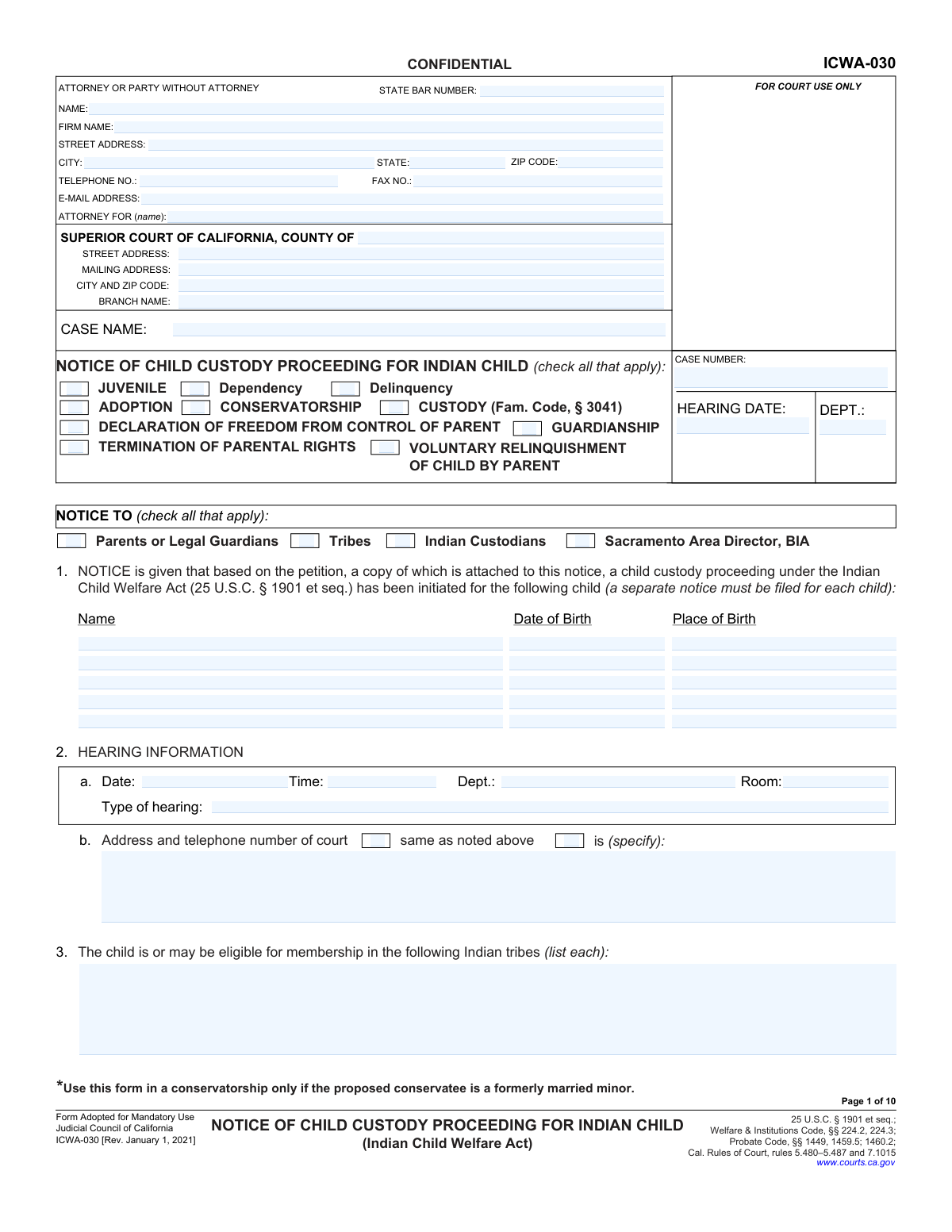
Yes! You can use AI to fill out Form ICWA-030, Notice of Child Custody Proceeding for Indian Child (Indian Child Welfare Act)

Form ICWA-030 is a mandatory California court form used to notify a child's parents, Indian custodian, and tribe(s) about a pending child custody case. This notice is crucial for upholding the rights granted under the Indian Child Welfare Act (ICWA), ensuring tribes have the opportunity to intervene in cases involving Indian children. Today, this form can be filled out quickly and accurately using AI-powered services like Instafill.ai, which can also convert non-fillable PDF versions into interactive fillable forms.
ICWA-030 is part of the California court forms, child custody forms and child welfare forms categories on Instafill.
Our AI automatically handles information lookup, data retrieval, formatting, and form filling.
It takes less than a minute to fill out ICWA-030 using our AI form filling.
Securely upload your data. Information is encrypted in transit and deleted immediately after the form is filled out.

Form specifications

Form name: Form ICWA-030, Notice of Child Custody Proceeding for Indian Child (Indian Child Welfare Act)
Number of fields: 414
Number of pages: 1
Language: English
main-image

Instafill Demo: How to fill out PDF forms in seconds with AI

How to Fill Out ICWA-030 Online for Free in 2026

Are you looking to fill out a ICWA-030 form online quickly and accurately? Instafill.ai offers the #1 AI-powered PDF filling software of 2026, allowing you to complete your ICWA-030 form in just 37 seconds or less.
Follow these steps to fill out your ICWA-030 form online using Instafill.ai:
  1. 1 Navigate to Instafill.ai and upload or select Form ICWA-030.
  2. 2 Provide the court and case information, including case number, hearing details, and your attorney or personal information.
  3. 3 Identify the child involved, the type of custody proceeding (e.g., dependency, adoption), and the parties to be notified.
  4. 4 Use the AI-assisted fields to input detailed information about the child's biological family tree, including parents, grandparents, and great-grandparents, to establish potential tribal affiliation.
  5. 5 Complete the sections with any known information about the family's connections to Indian tribes, schools, or health services.
  6. 6 List the names and addresses of all persons, tribes, and agencies to whom the notice will be mailed.
  7. 7 Review all the information populated by the AI for accuracy, then e-sign the declaration and complete the appropriate Certificate or Declaration of Mailing.

Our AI-powered system ensures each field is filled out correctly, reducing errors and saving you time.

Why Choose Instafill.ai for Your Fillable ICWA-030 Form?

Speed

Complete your ICWA-030 in as little as 37 seconds.

Up-to-Date

Always use the latest 2026 ICWA-030 form version.

Cost-effective

No need to hire expensive lawyers.

Accuracy

Our AI performs 10 compliance checks to ensure your form is error-free.

Security

Your personal information is protected with bank-level encryption.

Frequently Asked Questions About Form ICWA-030

This form serves as a legal notice for a child custody proceeding that involves a child who may have Native American ancestry. It is required under the Indian Child Welfare Act (ICWA) to inform the child's parents, tribe, and other relevant parties of the legal proceedings.

The petitioner in the child custody case, or their attorney, is responsible for completing and sending this notice. In juvenile court proceedings, a social worker or probation officer may complete the mailing certificate.

The extensive family information, including details on parents, grandparents, and great-grandparents, is necessary for the tribes to research the child's lineage and determine if the child is eligible for tribal membership. This is a critical step in applying the protections of the ICWA.

You must provide all the information you have and clearly write "unknown" in the fields for any information you cannot find. Do not use abbreviations like "N/A"; a good faith effort to gather the information is required.

Notice must be sent to the child's parents or legal guardians, any known Indian custodians, the relevant tribe(s), and the Sacramento Area Director of the Bureau of Indian Affairs (BIA). Page 10 of the form provides a checklist for all parties who were mailed the notice.

The notice, along with a copy of the court petition, must be sent via registered or certified mail with a return receipt requested. This provides proof that the notice was delivered to all required parties.

You must attach a copy of the petition that started the child custody case. If available, you should also attach the child's birth certificate and any tribal registration cards for the child or parents.

The tribe has the right to intervene in the court case, and the court may grant an extension of up to 20 days for the tribe or parents to prepare for the hearing. The case cannot proceed to termination of parental rights until at least 10 days after the parties have received the notice.

Yes, if there is any reason to believe the child may be an Indian child, this notice must be sent. The purpose of the notice is to allow the federally recognized tribes to make the official determination of the child's eligibility for membership.

An Indian Custodian is any Indian person who has legal custody of the child under tribal law or custom, or state law. It also includes someone to whom a parent has transferred temporary physical care, custody, and control of the child.

Yes, AI-powered services like Instafill.ai can help you accurately auto-fill this form using your saved information, which is especially useful for the repetitive family details required. This saves significant time and reduces the chance of errors.

You can use services like Instafill.ai to upload the ICWA-030 form and fill it out interactively online. The platform allows you to easily enter information, save your progress, and ensure all required fields are completed before printing.

If you have a non-fillable or 'flat' PDF, you can upload it to a service like Instafill.ai. Their technology can convert it into an interactive, fillable form that you can complete on your computer, save, and print.

Compliance ICWA-030
Validation Checks by Instafill.ai

1
Case and Hearing Date Validation
This check ensures that the 'CASE NUMBER' and 'HEARING DATE' fields at the top of the form are both completed. It also validates that the 'HEARING DATE' is a valid calendar date and is set in the future, not in the past. This is critical for ensuring the notice is for a valid, scheduled court proceeding and that all parties are aware of the correct date. A failure would prevent submission and prompt the user to enter a valid case number and a future hearing date.
2
Required Proceeding Type Selection
Validates that at least one checkbox is selected in the 'NOTICE OF CHILD CUSTODY PROCEEDING FOR INDIAN CHILD' section on page 1. The form requires specifying the type of legal action, such as 'Dependency', 'Adoption', or 'Guardianship'. This information is fundamental to understanding the context of the notice. If no selection is made, the form is incomplete and cannot be properly processed by the court or notified parties.
3
Child's Date of Birth Validity
This check verifies that the child's 'Date of Birth' in item 1 is entered in a valid date format (e.g., MM/DD/YYYY) and that the date is in the past. A future or invalid date would indicate a data entry error for the subject of the proceeding. This validation is essential for correctly identifying the child and for all subsequent age-related legal determinations. An error would require the user to correct the date before proceeding.
4
Prohibition of 'N/A' Abbreviation in Relative Information
This validation scans all text fields within the biological relative sections (items 5d through 5j) to ensure the abbreviation 'N/A' is not used. The form explicitly instructs the user to indicate if information is 'unknown' or does not apply, rather than using 'N/A'. Enforcing this rule ensures the filer has made a definitive statement about the availability of information, which is crucial for the tribe's genealogical research. If 'N/A' is found, the user will be prompted to replace it with 'unknown' or the correct information.
5
Logical Date Consistency for Relatives
For any relative listed in sections 5d through 5i, this check ensures that if both a 'Birthdate' and a 'date of death' are entered, the date of death is not earlier than the birth date. This prevents logical impossibilities and catches significant data entry errors in the family history. Maintaining accurate genealogical data is a primary purpose of this form, and this check upholds data integrity. A validation failure would highlight the inconsistent dates for user correction.
6
Parental Age Plausibility Check
This validation compares the child's date of birth (item 1) with the birth dates of the biological mother and father (item 5d). It flags any entry where a parent's birth date is less than a plausible child-bearing age (e.g., 12 years) before the child's birth date. This serves as a sanity check to catch major typographical errors in dates that could impact genealogical verification. If an implausible age gap is detected, a warning is issued, prompting the user to confirm the dates are correct.
7
Conditional Requirement for 'Other' Hearing Address
In item 2.b, this check ensures that if the checkbox next to 'is (specify)' is selected for the court address, the corresponding text field for the address is not left empty. This rule ensures that when the hearing location is different from the main court address, the specific location is provided. Failure to provide this information would make the notice deficient and could cause parties to miss the hearing. The system would prevent submission until the address is entered.
8
Declaration Signature and Date Requirement
This check verifies that at least one petitioner has completed the 'DECLARATION' section on page 8 by providing a printed name, a signature, and a valid date. The declaration is a sworn statement under penalty of perjury that the information is true and correct, making it legally essential. An unsigned or undated form is invalid. The system would block submission until at least one petitioner's declaration is complete.
9
Mailing Certification Completeness
Validates that exactly one of the three mailing sections on page 9 ('CERTIFICATE OF MAILING—JUVENILE', 'DECLARATION OF MAILING—ADOPTION...', or 'CERTIFICATE OF MAILING—PROBATE') is filled out. The correct section depends on the case type and who is performing the mailing. This proof of service is a legal requirement to demonstrate that all required parties were properly notified. The form would be considered incomplete if zero or more than one of these sections are completed.
10
Mailing List and Notice Recipient Consistency
This validation cross-references the checkboxes selected in the 'NOTICE TO' section on page 1 with the entries on the mailing list on page 10. For example, if 'Tribes' is checked on page 1, the system verifies that at least one 'Tribe' is listed with a complete name and address on page 10. This ensures that the intent to notify a category of recipients is matched by an actual mailing entry. A mismatch would trigger a warning to the user to add the required recipients to the mailing list.
11
Attorney Bar Number Format
This check ensures that if a value is entered into the 'STATE BAR NUMBER' field, it consists only of numeric digits. This is important for correctly identifying the attorney of record within the court's systems. An invalid format could lead to processing delays or incorrect attorney association with the case. The user would be prompted to enter a valid, numeric-only bar number.
12
Conditional Requirement for Item 8 Tribal Roll Details
In item 8, if a checkbox for a specific tribal roll ('1906 Final Roll', 'Roll of 1924', or 'California Judgment Roll') is selected, this validation ensures the corresponding 'Name of relative' and 'Relationship to child' fields are filled. This information is critical for the tribe to begin its verification process. Checking a box without providing the details makes the information useless, so the system would require the user to complete the fields before submission.

Common Mistakes in Completing ICWA-030

Using 'N/A' or Leaving Fields Blank Instead of 'Unknown'

The form explicitly instructs users on multiple pages to write 'unknown' or 'does not apply' and not to use the abbreviation 'N/A' or leave fields blank. People often miss this instruction and revert to common habits. This can lead to the form being considered incomplete by the court or the tribe, causing delays as they request clarification on whether the information is truly not applicable or simply wasn't known by the filer. To avoid this, carefully read all instructions and explicitly write 'unknown' for any piece of information you cannot find.

Providing Vague or Incorrect Tribal Information

A frequent and critical error is listing a general tribal affiliation like 'Cherokee' instead of the specific, federally-recognized tribal entity (e.g., 'Cherokee Nation' or 'Eastern Band of Cherokee Indians'). This happens because filers may not know the exact legal name of the tribe. This mistake can result in notice being sent to the wrong entity or being impossible to deliver, invalidating the notice process and causing significant legal delays and potential dismissal of the proceeding. Always research and use the full, official name and location of the tribe.

Incomplete Ancestor Name and Address History

The form requires extensive details for ancestors, including all maiden, married, and former names, as well as current and former addresses. Filers often provide only the most recent name and address, hindering the tribe's ability to conduct genealogical research. Incomplete information makes it difficult to connect the child to tribal records, potentially resulting in a failure to establish eligibility and a loss of rights under ICWA. Gather as much historical information as possible before filling out the form.

Improper Mailing and Proof of Service

The form requires that notice be sent via 'registered or certified mail, return receipt requested.' Many filers mistakenly use standard mail or forget to request a return receipt. This error invalidates the legal notice, which can halt the case, require the entire notice process to be repeated, and lead to sanctions. Always follow the specific mailing instructions on Page 9 and ensure the correct person (attorney, social worker, or clerk) completes and signs the appropriate mailing declaration.

Incorrectly Addressing Notice to the Tribe

Notice sent to a tribe must be addressed to the 'tribal chairperson or designated authorized agent for service,' as noted on Page 10. A common mistake is sending it to a generic 'Tribal Headquarters' address or another department. This can cause the notice to be lost, delayed, or delivered to a person without authority to act on it, failing the legal requirement for proper notice. Before mailing, check the tribe's official website or contact them to confirm the correct designated agent and address for ICWA notices.

Forgetting to Fill Headers on Subsequent Pages

The 'CASE NAME' and 'CASE NUMBER' fields appear at the top of every page, but filers often only complete them on the first page. This happens due to oversight when dealing with a multi-page document. If pages become separated during processing or scanning, they can be misfiled or lost, creating administrative chaos and delaying the case. AI-powered tools like Instafill.ai can prevent this by automatically populating recurring information across all pages of the form.

Filing a Single Form for Multiple Children

The instructions in Section 1 clearly state, 'a separate notice must be filed for each child.' However, in cases involving siblings, filers sometimes try to save time by listing all children on one form. This will lead to the court clerk rejecting the filing, forcing the petitioner to start over and complete individual forms for each child, thereby delaying the proceedings. Always prepare a distinct and complete ICWA-030 form for every child involved in the case.

Missing Signatures on the Declaration

The declaration on Page 8 must be dated and signed by every petitioner in the case. If there are two or more petitioners, it is a common mistake for only one to sign the form. An incomplete or missing signature invalidates the declaration under penalty of perjury, which can lead to the court rejecting the entire notice filing. Ensure all individuals listed as petitioners provide their signature and the date.

Failing to Notify All Required Parties

On Page 1, the form requires the filer to check all parties being notified, including parents, tribes, and the Sacramento Area Director of the Bureau of Indian Affairs (BIA). It is a serious error to overlook a required party, especially the BIA, which must be notified in many circumstances. Failure to notify all legally mandated parties renders the notice defective and can be grounds for invalidating the court's orders. Carefully review the case facts and legal requirements to create a complete notice list.

Omitting Required Attachments

The form states in Section 1 and Section 5 that a copy of the petition initiating the case must be attached to the notice. Filers sometimes forget to include this crucial document, especially when mailing multiple notices. An ICWA notice sent without the underlying petition is legally insufficient, as it does not give the recipient adequate information about the nature of the proceedings. Always double-check that a copy of the petition is included with every notice packet you send.

Confusing the Different Mailing Certification Sections

Page 9 contains three separate sections for certifying the mailing: one for Juvenile Court proceedings, one for attorneys in other proceedings, and one for the court clerk. Filers can be confused about which section applies to them and may fill out the wrong one or leave it blank. This creates ambiguity about who sent the notice and under what authority, potentially causing rejection by the court clerk. To avoid this, carefully read the title of each section and complete only the one that matches your role and the type of case. If the form is a non-fillable PDF, a tool like Instafill.ai can convert it to a smart, fillable version, making it easier to navigate.
Saved over 80 hours a year

“I was never sure if my IRS forms like W-9 were filled correctly. Now, I can complete the forms accurately without any external help.”

Kevin Martin Green

Your data stays secure with advanced protection from Instafill and our subprocessors

Robust compliance program

Transparent business model

You’re not the product. You always know where your data is and what it is processed for.

ISO 27001, HIPAA, and GDPR

Our subprocesses adhere to multiple compliance standards, including but not limited to ISO 27001, HIPAA, and GDPR.

Security & privacy by design

We consider security and privacy from the initial design phase of any new service or functionality. It’s not an afterthought, it’s built-in, including support for two-factor authentication (2FA) to further protect your account.

Fill out ICWA-030 with Instafill.ai

Worried about filling PDFs wrong? Instafill securely fills form-icwa-030-notice-of-child-custody-proceeding-for-indian-child-indian-child-welfare-act forms, ensuring each field is accurate.

Related forms by category

California court forms Judicial Council of California Form SC-105, Request for Court Order and Answer (Small Claims), Judicial Council of California Form SC-120, Defendant’s Claim and ORDER to Go to Small Claims Court (Small Claims), Judicial Council of California Form SER-001, Request for Sheriff to Serve Court Papers, Judicial Council of California Form SER-001, Request for Sheriff to Serve Court Papers, Affidavit for Collection of Personal Property California Probate Code Section 13100, Form POS-040, Proof of Service—Civil, Declaration of Facts of Death (California Superior Court), declaration-of-marriage-for-court-proceeding-california-family-law, ADOPT-200, Adoption Request, ADOPT-200, Stepparent Adoption Request, ADOPT-210, Adoption Agreement, ADOPT-310, Contact After Adoption Agreement, Judicial Council of California Form ADOPT-200, Adoption Request, Form ADR-107, Mediation Attendance Sheet, Form ADR-110, Order Appointing Referee, Form ADR-109, Stipulation or Motion for Order Appointing Referee, Form ADR-102, Request for Trial De Novo After Judicial Arbitration, Form ADR-108, Referee's Report (Code Civ. Proc., §§ 638, 639), Form ADR-106, Petition to Confirm, Correct, or Vacate Contractual Arbitration Award, Form ADR-104, Rejection of Award and Request for Trial After Attorney-Client Fee Arbitration · + 434 more →
child custody forms Form 12.995(c), Safety-Focused Parenting Plan, Form FL-341(E), Child Custody and Visitation (Parenting Time) Application Attachment, Florida Supreme Court Approved Family Law Form 12.902(d), Uniform Child Custody Jurisdiction and Enforcement Act (UCCJEA) Affidavit, Florida Supreme Court Approved Family Law Form 12.941(a), Petition for Enforcement of Out-of-State Custody Decree and for Order to Pick Up Minor Child(ren), Form DV-105, Request for Child Custody and Visitation Orders (Domestic Violence Prevention), Form DV-140, Child Custody and Visitation Order (Domestic Violence Prevention), Form FL-105/GC-120, Declaration Under Uniform Child Custody Jurisdiction and Enforcement Act (UCCJEA), form-fl-105gc-120-declaration-under-uniform-child-custody-jurisdiction-and-enforcement-act-uccjea-1, Uniform Child Custody Jurisdiction Enforcement Act Affidavit, Florida Supreme Court Approved Family Law Form 12.905(a), Supplemental Petition to Modify Parental Responsibility, Visitation or Parenting Plan / Time-Sharing Schedule and Other Relief, Florida Supreme Court Approved Family Law Form 12.995(a), Parenting Plan, Form DV-305, Request to Change Child Custody and Visitation Orders (Domestic Violence Prevention), Form FL-260, Petition for Custody and Support of Minor Children, Form FL-270, Response to Petition for Custody and Support of Minor Children
child welfare forms ICPC 100B, Interstate Compact on the Placement of Children Report on Child’s Placement Status, Form ICWA-005-INFO, Inquiry and Notice Under the Indian Child Welfare Act (ICWA), CFS 718, Application for Child Welfare Employee Licensure, AAP 2, Reassessment Information - Adoption Assistance Program, Adoption Assistance Program (AAP) - Request for Benefits, Adoption Assistance Program (AAP) Eligibility Certification, Adoption Assistance Program (AAP) Rate Questionnaire, Adoption and Safe Families Act (ASFA) Survey, Form ICWA-010(A), Indian Child Inquiry Attachment