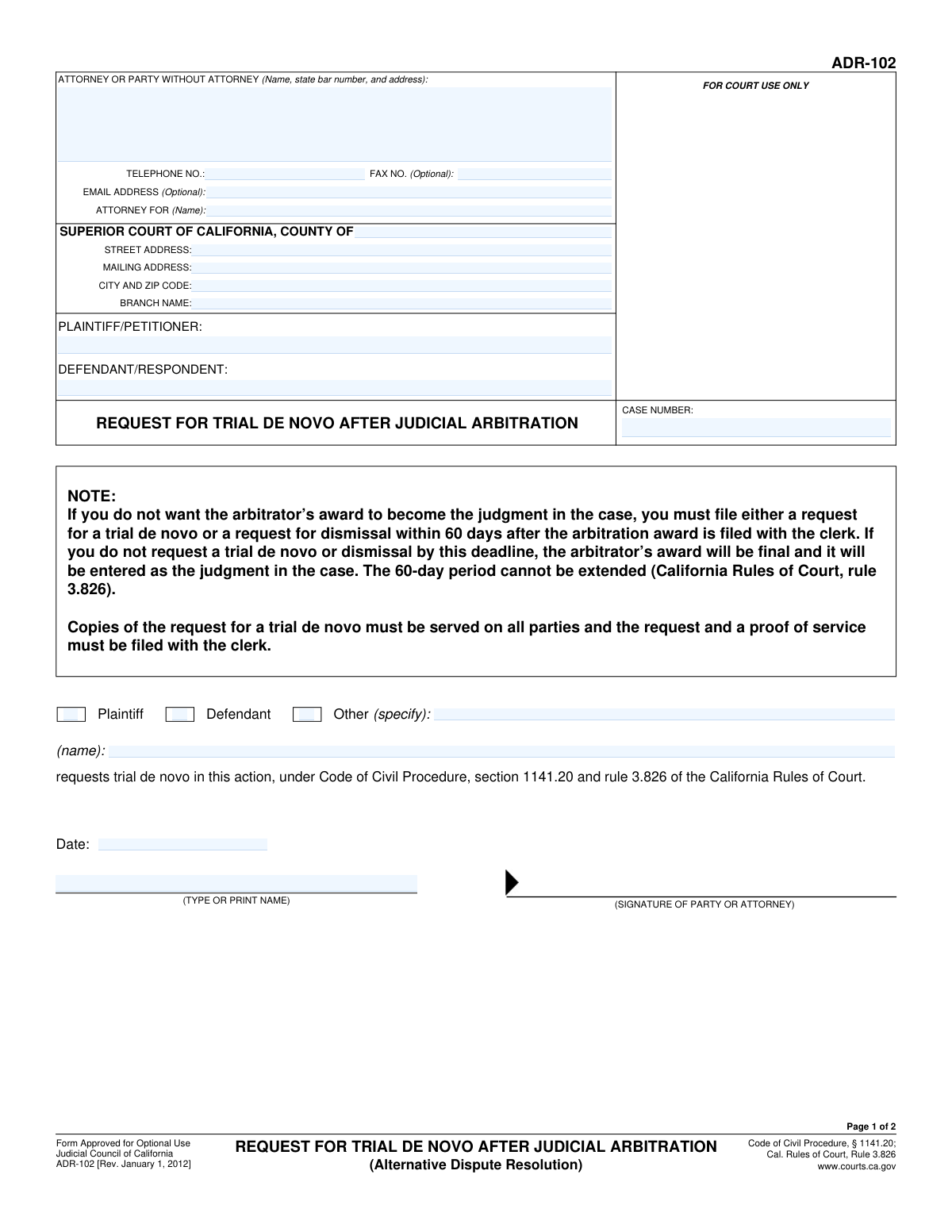
Yes! You can use AI to fill out Form ADR-102, Request for Trial De Novo After Judicial Arbitration

Form ADR-102, Request for Trial De Novo After Judicial Arbitration, is a legal document filed in the Superior Court of California by a party dissatisfied with an arbitrator's award in a judicial arbitration case. Filing this form effectively rejects the arbitration award and moves the case forward to a new trial in court, where the case will be heard as if the arbitration never occurred. Today, this form can be filled out quickly and accurately using AI-powered services like Instafill.ai, which can also convert non-fillable PDF versions into interactive fillable forms.
Our AI automatically handles information lookup, data retrieval, formatting, and form filling.
It takes less than a minute to fill out ADR-102 using our AI form filling.
Securely upload your data. Information is encrypted in transit and deleted immediately after the form is filled out.

Form specifications

Form name: Form ADR-102, Request for Trial De Novo After Judicial Arbitration
Number of fields: 44
Number of pages: 2
Language: English
main-image

Instafill Demo: How to fill out PDF forms in seconds with AI

How to Fill Out ADR-102 Online for Free in 2026

Are you looking to fill out a ADR-102 form online quickly and accurately? Instafill.ai offers the #1 AI-powered PDF filling software of 2026, allowing you to complete your ADR-102 form in just 37 seconds or less.
Follow these steps to fill out your ADR-102 form online using Instafill.ai:
  1. 1 Navigate to Instafill.ai and upload or select Form ADR-102, Request for Trial De Novo After Judicial Arbitration.
  2. 2 Provide the court and case information, including the county, court address, and case number.
  3. 3 Enter the information for the plaintiff/petitioner and defendant/respondent.
  4. 4 Indicate which party is requesting the trial de novo and provide the requester's name and attorney information.
  5. 5 Complete the Proof of Service section, detailing how and when the document was served to the other parties involved.
  6. 6 Review all entered information for accuracy, then date and provide the signatory's printed name before signing.
  7. 7 Download, print, and file the completed ADR-102 form with the appropriate court and serve it on the other parties.

Our AI-powered system ensures each field is filled out correctly, reducing errors and saving you time.

Why Choose Instafill.ai for Your Fillable ADR-102 Form?

Speed

Complete your ADR-102 in as little as 37 seconds.

Up-to-Date

Always use the latest 2026 ADR-102 form version.

Cost-effective

No need to hire expensive lawyers.

Accuracy

Our AI performs 10 compliance checks to ensure your form is error-free.

Security

Your personal information is protected with bank-level encryption.

Frequently Asked Questions About Form ADR-102

This form is used to formally ask the court for a new trial after a judicial arbitration decision has been made. Filing it effectively rejects the arbitrator's award and returns the case to the court's trial calendar.

Any party in a lawsuit (plaintiff, defendant, or other) who is not satisfied with the outcome of their case's judicial arbitration must fill out this form to proceed with a trial in court.

You will need the court case number, the full names of all parties, and the specific court branch address. For the Proof of Service section, you'll need the details of how and when the other party was notified.

The Proof of Service is a mandatory section where you declare under penalty of perjury that you have legally notified the other parties in the case that you are requesting a new trial. The form cannot be accepted by the court without it.

Service by mail involves sending the documents via the U.S. Postal Service, while personal service means an individual physically hands the documents to the person being served. You must select the method used and fill out the corresponding details.

The declarant is the person who actually mailed or hand-delivered the form to the opposing party. This individual must be at least 18 years old and not a party to the case.

Your case number is the unique identifier for your lawsuit and can be found at the top of any documents previously filed with or received from the court for this case.

No, if you do not have an attorney, you can leave the 'Attorney For' and 'State Bar Number' fields blank. You will simply provide your own information in the 'Attorney or Party Information' section.

Yes, there are very strict deadlines for filing this request after an arbitration award is served. You must check the California Rules of Court or consult an attorney to ensure you file on time, as missing the deadline can make the arbitration award final.

You must file the completed form with the clerk of the Superior Court where your case is being heard. Be sure to use the correct street and branch address as listed on your other case documents.

Yes, services like Instafill.ai use AI to auto-fill form fields accurately and save time. This can help reduce errors by populating information like your name, address, and case details from a saved profile.

To fill this form online, you can upload the PDF to Instafill.ai. The platform's AI will make the document interactive, allowing you to type your answers directly into the fields or use the auto-fill feature to complete it quickly.

If you have a non-fillable or 'flat' PDF, you can use a service like Instafill.ai. Their technology can convert the document into an interactive, fillable form that you can easily complete and save on your computer.

No, the form fields for Fax Number and Email Address are marked as optional. While providing them can be helpful for communication, you are not required to fill them in.

Compliance ADR-102
Validation Checks by Instafill.ai

1
Case Number Consistency
This check ensures that the 'Case Number' entered at the top of the form is identical to the 'Case Number' entered in the footer section (ADR-102). Case numbers are critical for correctly filing and associating documents with the proper legal proceeding. If the numbers do not match, the form could be misfiled or rejected, causing significant delays.
2
Exclusive Requester Selection
Validates that exactly one of the requester checkboxes ('Plaintiff', 'Defendant', or 'Other') is selected. This is important to clearly and unambiguously identify the party initiating the request for a trial de novo. If zero or more than one box is checked, the identity of the requester is unclear, and the court cannot process the request.
3
Conditional 'Other Requester' Details
This rule checks that the 'Other Requester Details' text field is filled out if and only if the 'Other' checkbox is selected. This field is necessary to specify the identity of a requester who is not the primary plaintiff or defendant. Failure to provide this detail when 'Other' is checked makes the request incomplete, while filling it without checking 'Other' creates confusing and extraneous information.
4
Exclusive Proof of Service Method
Ensures that exactly one method of service, either 'Mail' or 'Personal Service', is selected in the Proof of Service section. The method of service dictates which subsequent fields must be completed and has specific legal requirements. Selecting both or neither creates ambiguity and results in an incomplete or invalid proof of service.
5
Completeness of Mail Service Details
If the 'Mail' checkbox is selected as the proof of service method, this validation ensures all related fields are completed, including the declarant's affirmation, the name of the person served, the full mailing address, date, and place of mailing. Each piece of information is legally required to prove service by mail was properly executed. An incomplete section will invalidate the proof of service.
6
Completeness of Personal Delivery Details
If 'Personal Service' is checked, this rule verifies that all personal delivery fields are filled, including the name of the person served, the delivery address, and the specific date and time of delivery. These details are essential for creating a legally sufficient record of personal service. Missing information would render the proof of service defective and potentially void.
7
Chronological Date Validation for Service and Declaration
This check verifies that the 'Declaration Date' is on or after the 'Mailing Date' or 'Delivery Date'. A person cannot legally declare under penalty of perjury that an act of service was completed before it has actually occurred. This logical check prevents invalid submissions and ensures the integrity of the legal declaration process.
8
State Bar Number Format and Requirement
This validation ensures that if the 'Attorney For' field is filled, the 'State Bar Number' field is also filled and contains only numeric digits. This is crucial for verifying the credentials and good standing of the legal counsel submitting the form. An invalid or missing bar number for a representing attorney will lead to the form's rejection.
9
Requester Name and Party Consistency
This check ensures the 'Requester Name' matches the name of the party selected in the requester checkboxes. For example, if 'Plaintiff' is checked, the 'Requester Name' must match the 'Plaintiff or Petitioner Name' field. This cross-field validation confirms the identity of the filing party and prevents errors or fraudulent filings.
10
Exclusive Mail Deposit Method
Within the 'Mail Service Details' section, this rule ensures that only one of the two checkboxes ('Deposited Sealed Envelope with USPS' or 'Placed Envelope for Collection') is selected. These describe two distinct and mutually exclusive methods for entering an item into the mail stream. Selecting both would be a logical contradiction, making the declaration of service unclear.
11
California County Validation
This check validates that the 'County' field in the Court Information section contains the name of a valid California county. This can be done by comparing the input against a predefined list of all 58 California counties. Using a valid county name is essential for jurisdiction and ensuring the document is filed in the correct Superior Court.
12
Date Format Validation
Ensures that all date fields on the form ('Date', 'Mailing Date', 'Delivery Date', 'Declaration Date') are entered in a valid, recognizable format (e.g., MM/DD/YYYY). Consistent and correct date formatting is fundamental for legal documents, as dates determine deadlines, statutes of limitations, and the sequence of events. An invalid format would make the date ambiguous and could lead to rejection.
13
Completeness of Court Address
This validation confirms that the full court address, including 'Street Address', 'City and Zip Code', and 'Branch Name', is provided. This information is mandatory for identifying the specific court location where the case is being heard. Incomplete court information could result in the document being sent to the wrong location or being rejected by the clerk's office.

Common Mistakes in Completing ADR-102

Entering an Incomplete or Incorrect Case Number

Users often mistype the case number or omit required prefixes, suffixes, or year indicators, leading to the document being misfiled or rejected by the court clerk. This can cause significant delays and may even result in missed deadlines. To avoid this, carefully double-check the case number against official court documents and ensure it is entered identically in both the header and body of the form.

Providing Incorrect Court Branch Information

In counties with multiple courthouses, filers frequently list the main county courthouse instead of the specific branch where the case is being heard. This error causes the document to be sent to the wrong location, resulting in filing delays or the document being returned. Always verify the correct street address and specific 'Branch Name' for your case on the court's website before filling out this section.

Inconsistent or Abbreviated Party Names

Filers sometimes use abbreviations, initials, or slight variations of the plaintiff's or defendant's names throughout the form. The names must match the official court record exactly in all sections, including the caption and the proof of service. Inconsistencies can lead to filing rejections as the clerk cannot confirm the parties involved.

Failing to Clearly Identify the Requester

A common oversight is neglecting to check the 'Plaintiff', 'Defendant', or 'Other' box to specify who is requesting the trial de novo. If 'Other' is selected, users often forget to provide the required details in the 'Other Requester Details' field. This ambiguity forces the court to guess the filer's identity, which can lead to rejection of the form.

Submitting an Incomplete Proof of Service by Mail

The 'Proof of Service by Mail' section is complex and frequently filled out incorrectly. Common errors include not checking the 'Mail Service Affirmation' box, failing to specify how the envelope was deposited (e.g., 'Deposited with USPS' or 'Placed for Collection'), or omitting the date and place of mailing. An incomplete proof of service can invalidate the service, forcing the party to re-serve the documents and potentially miss critical deadlines.

Omitting the Time of Personal Delivery

When completing the 'Personal Delivery Details', filers often provide the date but forget to include the specific time of delivery. The time can be legally significant for establishing when service was officially completed and for calculating response deadlines. Failing to include it can create grounds for the opposing party to challenge the validity of the service.

Mismatched Declaration and Service Dates

Users may incorrectly enter the same date for the service and the declaration, even if they occurred on different days. The 'Mailing Date' or 'Delivery Date' must reflect the actual day of service, while the 'Declaration Date' must be the date the server signed the form, which legally cannot be before the date of service. This discrepancy can invalidate the proof of service.

Omitting the Attorney's State Bar Number

Attorneys filling out the form on behalf of a client sometimes forget to include their State Bar number in the 'Attorney or Party Information' section. This number is a required identifier for legal professionals, and its absence can lead to the court rejecting the filing or questioning the attorney's standing. This simple oversight can cause unnecessary delays in processing the document.

Improperly Completed Declaration

The declaration on the Proof of Service must be signed by the person who actually performed the service, not the attorney or party unless they served it themselves. Filers also forget to enter the declarant's name and the date of signing. An improper or incomplete declaration renders the Proof of Service invalid, which is a critical and often fatal error for a filing. AI-powered tools like Instafill.ai can help prevent this by using smart fields and validation rules to ensure all required declaration fields are completed.

Leaving the 'Short Title' Field Blank

Many filers, unsure of what to write, leave the 'Short Title' field blank. This field is meant for a shortened case name (e.g., 'Smith v. Jones') for easy identification. While not always a fatal error, its absence makes document management harder for the court and may lead to the form being returned for completion. If the form is a non-fillable PDF, tools like Instafill.ai can convert it into an interactive version, making fields like this easier to complete correctly.
Saved over 80 hours a year

“I was never sure if my IRS forms like W-9 were filled correctly. Now, I can complete the forms accurately without any external help.”

Kevin Martin Green

Your data stays secure with advanced protection from Instafill and our subprocessors

Robust compliance program

Transparent business model

You’re not the product. You always know where your data is and what it is processed for.

ISO 27001, HIPAA, and GDPR

Our subprocesses adhere to multiple compliance standards, including but not limited to ISO 27001, HIPAA, and GDPR.

Security & privacy by design

We consider security and privacy from the initial design phase of any new service or functionality. It’s not an afterthought, it’s built-in, including support for two-factor authentication (2FA) to further protect your account.

Fill out ADR-102 with Instafill.ai

Worried about filling PDFs wrong? Instafill securely fills form-adr-102-request-for-trial-de-novo-after-judicial-arbitration forms, ensuring each field is accurate.