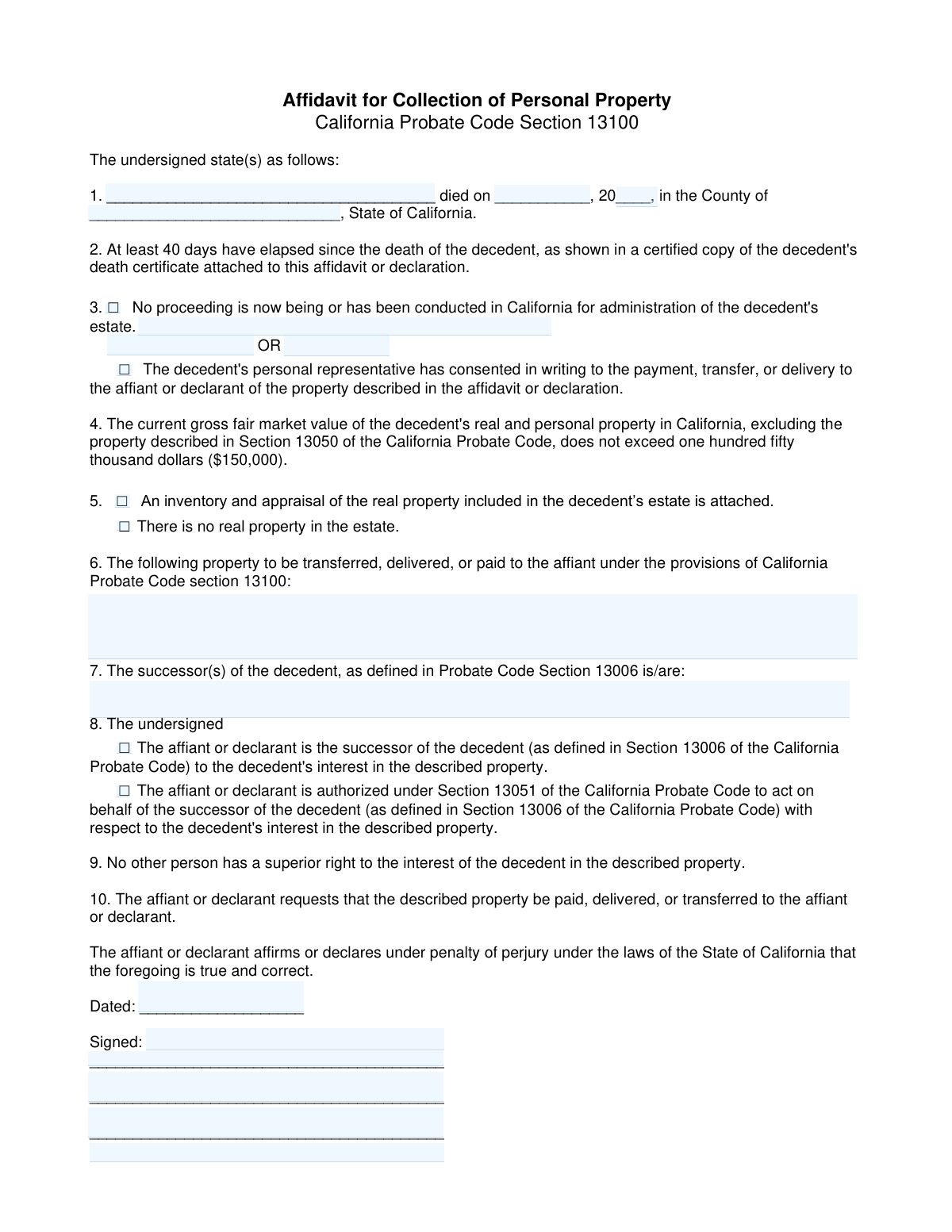
Yes! You can use AI to fill out Affidavit for Collection of Personal Property California Probate Code Section 13100

This affidavit is a legal document used in California by the successors of a deceased person to claim personal property from banks, financial institutions, or other holders. It allows for the transfer of assets without going through the formal, often lengthy, probate court process, provided the total value of the decedent's California estate is below a specific threshold. Today, this form can be filled out quickly and accurately using AI-powered services like Instafill.ai, which can also convert non-fillable PDF versions into interactive fillable forms.
Our AI automatically handles information lookup, data retrieval, formatting, and form filling.
It takes less than a minute to fill out California Probate Code Section 13100 using our AI form filling.
Securely upload your data. Information is encrypted in transit and deleted immediately after the form is filled out.

Form specifications

Form name: Affidavit for Collection of Personal Property California Probate Code Section 13100
Number of pages: 2
Language: English
Categories: probate forms, Section 8 forms, California probate forms, SEC forms, property forms
main-image

Instafill Demo: How to fill out PDF forms in seconds with AI

How to Fill Out California Probate Code Section 13100 Online for Free in 2026

Are you looking to fill out a CALIFORNIA PROBATE CODE SECTION 13100 form online quickly and accurately? Instafill.ai offers the #1 AI-powered PDF filling software of 2026, allowing you to complete your CALIFORNIA PROBATE CODE SECTION 13100 form in just 37 seconds or less.
Follow these steps to fill out your CALIFORNIA PROBATE CODE SECTION 13100 form online using Instafill.ai:
  1. 1 Navigate to Instafill.ai and upload or select the Affidavit for Collection of Personal Property form.
  2. 2 Use the AI assistant to input the decedent's full name, date of death, and county of death.
  3. 3 Answer questions about the decedent's estate, such as whether probate proceedings are underway and confirming the estate's value is under the legal limit.
  4. 4 Provide a detailed description of the property to be collected and list the names of all legal successors.
  5. 5 Declare your status as the successor or authorized representative and electronically sign the affidavit.
  6. 6 Review the auto-filled document for accuracy, then download the completed form to have it notarized.
  7. 7 Submit the notarized affidavit to the institution holding the decedent's property.

Our AI-powered system ensures each field is filled out correctly, reducing errors and saving you time.

Why Choose Instafill.ai for Your Fillable California Probate Code Section 13100 Form?

Speed

Complete your California Probate Code Section 13100 in as little as 37 seconds.

Up-to-Date

Always use the latest 2026 California Probate Code Section 13100 form version.

Cost-effective

No need to hire expensive lawyers.

Accuracy

Our AI performs 10 compliance checks to ensure your form is error-free.

Security

Your personal information is protected with bank-level encryption.

Frequently Asked Questions About Form California Probate Code Section 13100

This form is used in California to collect a deceased person's personal property without going through a full probate court process. It is intended for small estates valued at $150,000 or less.

You can use this form if you are the legal successor to the decedent's property, at least 40 days have passed since their death, and the total value of their California estate does not exceed $150,000.

You must wait at least 40 days after the decedent's death before you can use this form to collect their property. This waiting period is a legal requirement.

You are required to attach a certified copy of the decedent's death certificate. If the estate includes any real property, you must also attach an inventory and appraisal of that property.

Generally, no. However, you may use it if the decedent's personal representative (the person appointed by the court) has given you written consent to collect the specific property listed in the affidavit.

This refers to the total value of all the decedent's real and personal property in California on the date of death, before subtracting any debts. Certain assets, like those held in joint tenancy, are excluded from this calculation.

A successor is a person entitled to the property under the decedent's will or, if there is no will, by California's laws of intestate succession. This typically includes a surviving spouse, children, or other relatives.

After completing the form, you must sign it in front of a notary public. You then present the notarized affidavit and the death certificate to the institution or person holding the property, such as a bank.

Yes, the affidavit must be notarized. The notary public's acknowledgment verifies the identity of the person signing the document.

If your PDF is a flat, non-fillable image, you can use a service like Instafill.ai to convert it into an interactive, fillable form online. This allows you to type your answers directly into the fields.

Yes, services like Instafill.ai use AI to help auto-fill form fields accurately and efficiently. This can save you time and help prevent common errors when filling out complex forms.

You can use a platform like Instafill.ai to upload the Affidavit for Collection of Personal Property and fill it out digitally. The service guides you through each field to ensure you provide all the necessary information.

Check the first box if you are the direct successor (e.g., the heir) collecting the property. Check the second box if you are legally authorized to act on behalf of the successor, such as being their guardian or conservator.

Compliance California Probate Code Section 13100
Validation Checks by Instafill.ai

1
Verifies 40-Day Waiting Period After Death
This check confirms that the date the affidavit is signed ('Dated' field) is at least 40 days after the decedent's date of death. This is a mandatory legal requirement under California Probate Code Section 13100 to allow time for other potential claims or proceedings to surface. If the affidavit is dated less than 40 days after the death, it is legally invalid and will be rejected.
2
Ensures Decedent's Full Name is Provided
This validation ensures that the 'Decedent full name' field is not empty. Providing the full, legal name of the deceased is critical for accurately identifying the estate and preventing ambiguity or fraud. Failure to provide the name will result in an incomplete and unenforceable affidavit.
3
Validates Date of Death Format and Plausibility
This check verifies that the 'Date of death' (month, day, and year) fields combine to form a valid calendar date that is not in the future. An accurate date of death is fundamental for all subsequent time-based calculations, such as the 40-day waiting period. An invalid or future date would render the entire document logically and legally unsound.
4
Mandatory Selection for Administration Proceedings
This validation ensures that one of the two checkboxes in section 3, regarding the administration of the decedent's estate, has been selected. The affiant must declare whether a probate proceeding is ongoing or if the personal representative has consented. Failing to make this declaration leaves a critical legal status undefined and makes the affidavit incomplete.
5
Conditional Requirement for Probate Proceeding Details
This check enforces a logical rule: if the box for 'The decedent's personal representative has consented' is checked, then the fields for 'Court or county where proceeding was or is being conducted' and either the 'Probate proceeding case number' or 'Alternate identifying information' must be filled. This information is necessary to verify the existence of the proceeding and the authority of the consenting representative. Without these details, the consent cannot be validated.
6
Mandatory Selection for Real Property Status
This validation confirms that one of the two options in section 5, concerning real property in the estate, has been checked. The affiant must state whether an inventory is attached or if no real property exists. This declaration is crucial for establishing the total value of the estate and ensuring it falls within the legal limit for this type of affidavit.
7
Ensures Property to be Transferred is Described
This check verifies that the 'Property to be Transferred' field is not left blank. The entire purpose of the affidavit is to request the transfer of specific property, so a clear and detailed description is essential. An empty field means the affidavit has no actionable request, making it useless.
8
Verifies at Least One Successor is Named
This validation ensures that the 'Successor(s) of the Decedent' field contains at least one name. The affidavit must identify who is legally entitled to inherit the property under California law. If no successor is named, there is no legal basis for transferring the property to anyone.
9
Mandatory Selection of Affiant's Status
This check requires that one of the two checkboxes in section 8 is selected to define the affiant's legal standing. The affiant must declare whether they are the successor themselves or are authorized to act on the successor's behalf. This status is fundamental to the affiant's authority to sign the document and collect the property.
10
Validates Affiant Signature Date Logic
This validation ensures the 'Dated' field is a valid date that is on or before the 'Acknowledgment date' from the notary section. The affiant must sign the document before or on the same day it is notarized. A signature date after the notary date is a logical impossibility and would invalidate the notarization and the affidavit.
11
Affiant Contact Information Completeness
This check verifies that the affiant's printed name, full mailing address, and telephone number are all provided. This contact information is essential for the holder of the property (e.g., a bank) to communicate with the affiant, verify their identity, and resolve any issues. Missing information can cause significant delays or rejection of the request.
12
Validates Affiant Telephone Number Format
This check ensures the 'Affiant Telephone Number' field contains a number in a valid format (e.g., 10 digits with an optional country code). A properly formatted number is necessary for successful communication with the affiant. An invalid format could prevent contact and hinder the processing of the affidavit.
13
Notary and Affiant Name Consistency
This validation cross-references the 'Person Who Appeared — Name' field in the Acknowledgment section with the 'Printed Name of Affiant' field. These names must match exactly to confirm that the person who signed the affidavit is the same person whose identity was verified by the notary. A mismatch indicates a critical failure in the notarization process and invalidates the affidavit.
14
Notary Information Completeness
This check ensures all fields within the Acknowledgment section, including the notary's name, title, signature, and seal information, are completed. A proper and complete notarization is a legal requirement that attests to the identity of the signatory. Incomplete notary information renders the affidavit legally void.

Common Mistakes in Completing California Probate Code Section 13100

Filing Before the 40-Day Waiting Period

Section 2 of the affidavit requires that at least 40 days have passed since the decedent's death. People often miscalculate the days or file prematurely out of urgency, which automatically invalidates the affidavit. This results in an immediate rejection by the property holder, forcing the affiant to wait the correct amount of time and refile the entire document. To avoid this, carefully count 40 full days starting from the day after the date of death before signing and submitting the form.

Providing an Inadequate Property Description

In Section 6, filers often use vague descriptions like 'bank account' or 'personal belongings' because they don't realize the level of specificity required. Financial institutions and other entities will reject an affidavit with a vague description because they cannot identify the exact asset to be transferred. To prevent rejection and delays, list the full name of the institution, the account type, the complete account or serial number, and the exact balance or description of the property.

Miscalculating the Gross Fair Market Value

This affidavit is only valid if the decedent's California estate value is under the statutory limit (currently $150,000), as stated in Section 4. A common error is underestimating the value by forgetting assets or using an incorrect valuation, such as the purchase price instead of the current fair market value. If the true value exceeds the limit, the affidavit is void, and using it can be considered perjury, necessitating a more complex formal probate process.

Forgetting to Include Necessary Attachments

The form requires several critical attachments, including a certified copy of the death certificate (Section 2) and potentially a real property appraisal (Section 5) or written consent from a personal representative (Section 3). Filers frequently overlook these attachments, leading to an incomplete submission that will be rejected. This causes significant delays and requires a complete resubmission. To prevent this, create a checklist of all required documents based on the boxes you check and ensure they are all attached before submitting.

Incorrectly Stating the Estate's Administration Status

Section 3 requires the affiant to declare whether a probate proceeding for the decedent's estate exists. Mistakenly checking 'No proceeding is now being or has been conducted' when one actually exists is a serious error that constitutes perjury and invalidates the affidavit. This can have severe legal consequences. Before completing this section, it is critical to verify with the superior court in the relevant county whether any probate case has been filed for the decedent.

Failing to List All Legal Successors

Section 7 requires listing all successors to the decedent's property as defined by the California Probate Code. Filers may not fully understand the legal definition of a 'successor' or may unintentionally omit other eligible heirs, such as siblings or distant relatives. This can lead to legal disputes among family members and future challenges to the property transfer. It is crucial to correctly identify all legal successors according to the decedent's will or intestate succession laws before completing this section.

Signing the Affidavit Before Meeting the Notary

The affiant's signature must be acknowledged by a Notary Public, which means the affiant must sign in the notary's presence or confirm to the notary that the signature is theirs. A frequent mistake is signing the document at home and then taking the pre-signed document to be notarized, which can lead a notary to refuse to complete the acknowledgment. This invalidates the notarization and the affidavit itself. Always wait to sign the document until you are physically present before the notary public.

Mismatching Decedent's Name or Date of Death

The decedent's full legal name and date of death in Section 1 must exactly match the information on the certified death certificate. People may use a common nickname instead of a legal name or transpose numbers in the date, creating a discrepancy. Any inconsistency will cause the holder of the property to question the affidavit's validity and reject it. AI-powered form filling tools like Instafill.ai can help prevent these data entry errors by ensuring consistency across fields and documents.

Confusing Affiant and Successor Roles

Section 8 asks the signer (affiant) to define their legal standing—either as the direct successor or as someone authorized to act on the successor's behalf. People often get confused and check the wrong box, misrepresenting their authority to collect the property. This error can invalidate the affidavit and potentially create legal liability for the affiant. Carefully read the relevant Probate Code sections to understand your role and select the correct option.

Not Attaching the Real Property Appraisal When Required

If the decedent's estate includes real property, Section 5 requires an inventory and appraisal to be attached. A common mistake is checking the box indicating the appraisal is attached but then failing to include the actual document. This makes the affidavit incomplete and will result in its rejection. Since this form is often a non-fillable PDF, tools like Instafill.ai can convert it to a fillable version and help you manage a checklist of required attachments to ensure nothing is missed.
Saved over 80 hours a year

“I was never sure if my IRS forms like W-9 were filled correctly. Now, I can complete the forms accurately without any external help.”

Kevin Martin Green

Your data stays secure with advanced protection from Instafill and our subprocessors

Robust compliance program

Transparent business model

You’re not the product. You always know where your data is and what it is processed for.

ISO 27001, HIPAA, and GDPR

Our subprocesses adhere to multiple compliance standards, including but not limited to ISO 27001, HIPAA, and GDPR.

Security & privacy by design

We consider security and privacy from the initial design phase of any new service or functionality. It’s not an afterthought, it’s built-in, including support for two-factor authentication (2FA) to further protect your account.

Fill out California Probate Code Section 13100 with Instafill.ai

Worried about filling PDFs wrong? Instafill securely fills affidavit-for-collection-of-personal-property-california-probate-code-section-13100 forms, ensuring each field is accurate.