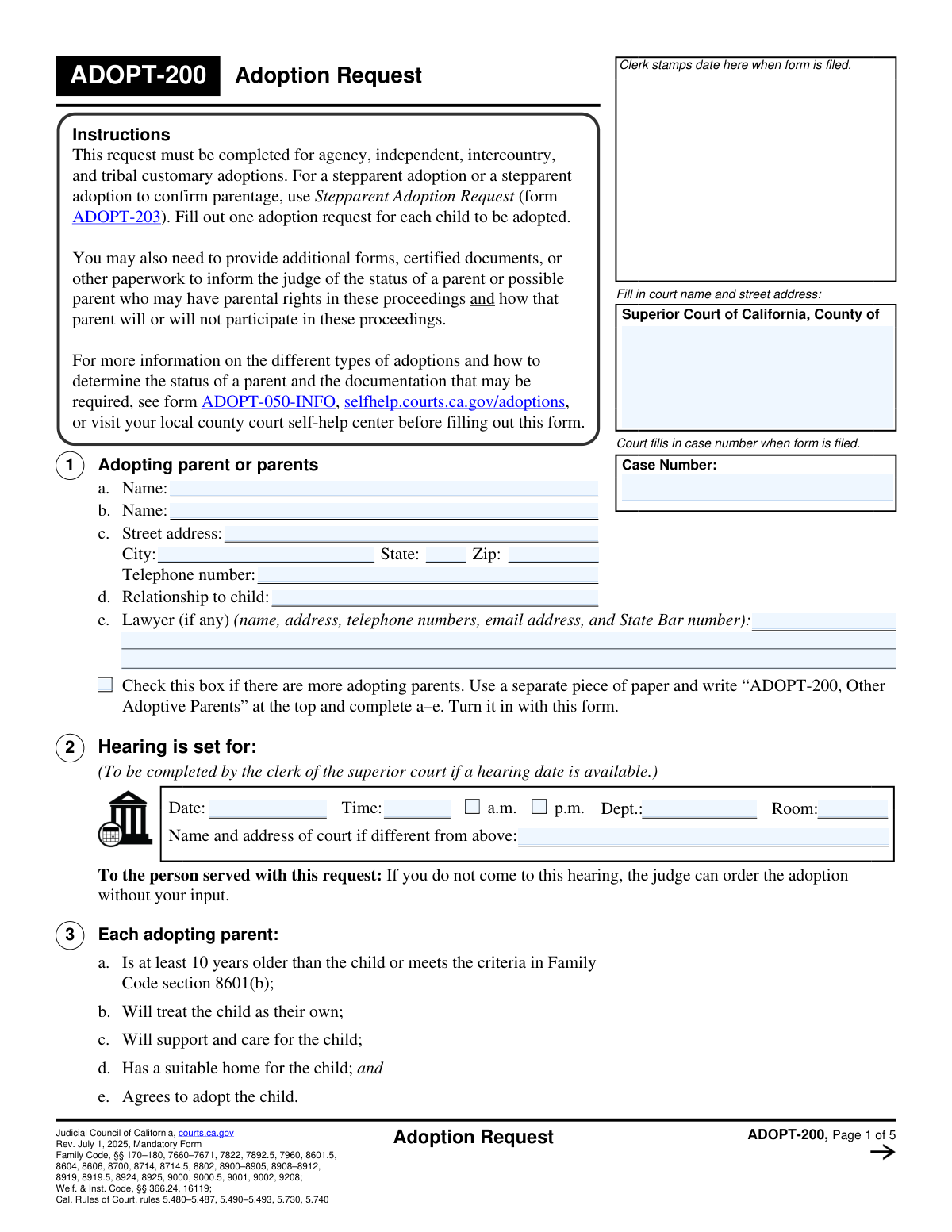
Yes! You can use AI to fill out Judicial Council of California Form ADOPT-200, Adoption Request
Form ADOPT-200, Adoption Request, is the legal document filed with a California Superior Court to formally ask for the approval of an adoption. It is used for various types of adoptions, including agency, independent, and intercountry, and provides the court with critical information about the child and the prospective parents. This form is the first step in creating a legal parent-child relationship and is essential for the court to review and grant the adoption. Today, this form can be filled out quickly and accurately using AI-powered services like Instafill.ai, which can also convert non-fillable PDF versions into interactive fillable forms.
ADOPT-200 is part of the
California court forms, California judicial forms and Judicial Council forms categories on Instafill.
Our AI automatically handles information lookup, data retrieval, formatting, and form filling.
It takes less than a minute to fill out ADOPT-200 using our AI form filling.
Securely upload your data. Information is encrypted in transit and deleted immediately after the form is filled out.
Form specifications
| Form name: | Judicial Council of California Form ADOPT-200, Adoption Request |
| Number of fields: | 126 |
| Number of pages: | 1 |
| Language: | English |
Instafill Demo: How to fill out PDF forms in seconds with AI
How to Fill Out ADOPT-200 Online for Free in 2026
Are you looking to fill out a ADOPT-200 form online quickly and accurately? Instafill.ai offers the #1 AI-powered PDF filling software of 2026, allowing you to complete your ADOPT-200 form in just 37 seconds or less.
Follow these steps to fill out your ADOPT-200 form online using Instafill.ai:
- 1 Navigate to Instafill.ai and upload or select the ADOPT-200 form.
- 2 Provide the full names, contact information, and relationship to the child for all adopting parents in Section 1.
- 3 Indicate the county of filing in Section 4 and the specific type of adoption (e.g., Agency, Independent) in Section 5.
- 4 Enter detailed information about the child in Section 6, including their name, date of birth, and placement date.
- 5 Complete the sections regarding legal guardianship (Section 7), the Indian Child Welfare Act (ICWA) inquiry (Section 8), and any information specific to your adoption type.
- 6 State your requests to the court in Section 14, then carefully review the entire form for accuracy before each adopting parent signs and dates the declaration in Section 16.
- 7 Download the completed form and file it with the appropriate Superior Court of California, ensuring all necessary attachments are included.
Our AI-powered system ensures each field is filled out correctly, reducing errors and saving you time.
Why Choose Instafill.ai for Your Fillable ADOPT-200 Form?
Speed
Complete your ADOPT-200 in as little as 37 seconds.
Up-to-Date
Always use the latest 2026 ADOPT-200 form version.
Cost-effective
No need to hire expensive lawyers.
Accuracy
Our AI performs 10 compliance checks to ensure your form is error-free.
Security
Your personal information is protected with bank-level encryption.
Frequently Asked Questions About Form ADOPT-200
The ADOPT-200 form, or Adoption Request, is a mandatory California Judicial Council form used to begin the legal process for an agency, independent, intercountry, or tribal customary adoption. It formally asks the court to approve the adoption and establish a legal parent-child relationship.
Prospective adoptive parents who are pursuing an agency, independent, intercountry, or tribal customary adoption in California must fill out this form. It is not for stepparent adoptions, which require form ADOPT-203.
No, the instructions clearly state that you must complete and file a separate Adoption Request (ADOPT-200) for each child you wish to adopt.
You will need to provide the child's name, date and place of birth, gender, current address, and the date they were placed in your care. For children 12 or older, you must also state whether they consent to the adoption.
An agency adoption is facilitated by a licensed public or private agency. An independent adoption is arranged directly between the birth parents and adoptive parents. An intercountry adoption involves adopting a child from another country.
This section (Section 8) is to ensure compliance with federal law protecting Native American children. You must conduct an inquiry to see if the child has Native American heritage and attach the required forms, such as the Indian Child Inquiry Attachment (ICWA-010(A)).
You may need to attach other documents, such as a copy of the Independent Adoption Placement Agreement, Letters of Guardianship, or a Contact After Adoption Agreement. The specific documents required will depend on your type of adoption.
You should file the form in the Superior Court of the California county where the adopting parents live, the child lives, or an involved adoption agency is located, as detailed in Section 4 of the form.
After you file the form, the court clerk will set a hearing date. The adoption process will then proceed, which may include investigations, a home study, and additional court proceedings before the adoption is finalized.
If you have a non-fillable PDF, you can use a service like Instafill.ai. It can convert flat PDFs into interactive, fillable forms that you can easily complete on your computer.
Yes, services like Instafill.ai use AI to help you fill out complex forms like the Adoption Request. The AI can accurately auto-fill your information into the correct fields, which saves time and helps prevent errors.
Simply upload the ADOPT-200 form to the Instafill.ai platform. The service will make the document interactive, allowing you to type directly into the fields or use the AI to auto-fill your information before you download or print the completed form.
This is a voluntary, legally enforceable agreement between the adoptive parents and the child's birth relatives that specifies terms for future contact, such as visits or sharing information. If such an agreement exists, it must be attached to your Adoption Request.
Compliance ADOPT-200
Validation Checks by Instafill.ai
1
Requires at least one adopting parent
This check ensures that the name field for at least the first adopting parent (Section 1a) is filled out. An adoption request cannot proceed without at least one prospective parent being identified. If this field is empty, the form is incomplete and cannot be processed, as there is no petitioner.
2
Validates selection of a single adoption type
This validation ensures that exactly one primary adoption type (Agency, Independent, or Intercountry) is selected in Section 5. Selecting zero types leaves the nature of the petition ambiguous, while selecting multiple types is contradictory. A failed validation would require the user to clarify the single, correct adoption path being pursued.
3
Ensures agency name is provided for agency-related adoptions
This check is conditional. If 'Agency' (Section 5a) or 'Intercountry' (Section 5c) is selected as the adoption type, the corresponding agency name field must be filled. This information is critical for the court and other bodies to identify and communicate with the correct facilitating organization. Failure to provide the name would halt processing until the information is supplied.
4
Validates child's date of birth is a valid past date
This check verifies that the child's date of birth (Section 6c) is entered in a valid date format (e.g., MM/DD/YYYY) and that the date is in the past. An adoption can only be requested for a person who has already been born. An invalid format or a future date would prevent the system from calculating the child's age for other legal checks and would be rejected.
5
Requires consent status for children 12 or older
This validation performs a logical check based on the child's date of birth (Section 6c). If the calculated age of the child is 12 years or older, the question regarding the child's consent to the adoption (Section 6f) must be answered 'Yes' or 'No'. California law requires the consent of a child of this age, so this information is mandatory for the petition to be legally sufficient.
6
Ensures dependent child case information is complete
This is a conditional check on Section 6i. If the 'Yes' box is checked, indicating the child is a dependent of the court, then the 'Juvenile Case No.' and 'County' fields must be filled. This information is essential for the court to locate the related dependency case file, which is legally intertwined with the adoption proceedings. Missing this information would prevent the consolidation or proper review of the child's legal history.
7
Requires guardianship details if a guardian exists
This validation triggers if 'Yes' is selected in Section 7, indicating the child has a legal guardian. If so, the date the guardianship was ordered, the county, and the case number must all be provided. This is necessary to establish the legal standing of the guardian and to ensure they are properly notified and involved in the proceedings as required by law. An incomplete section would render the petition deficient.
8
Verifies at least one reason for the county of filing is selected
This check ensures that at least one checkbox is marked in Section 4, 'County of filing'. The selection justifies why the petition is being filed in this specific court's jurisdiction, which is a fundamental legal requirement. Without a valid reason for venue, the court may not have the authority to hear the case, leading to dismissal or transfer.
9
Validates placement date is logically after birth date
This check ensures the 'Date child was placed in the physical care of the adopting parent' (Section 6g) is a valid date that occurs on or after the child's date of birth (Section 6c). A placement date before the child was born is a logical impossibility and indicates a data entry error. Correcting this ensures the timeline of events presented to the court is accurate and credible.
10
Requires U.S. entry date for intercountry re-adoptions
This is a conditional validation for Section 12c. If the box for 'intercountry re-adoption' is checked, the 'Date the child entered the United States' field becomes mandatory. This date is a key piece of evidence for establishing jurisdiction and the timeline of the re-adoption process in California. The form cannot be properly evaluated without this date.
11
Validates backdating request for adoption order
This check applies if the user requests to backdate the adoption order by checking box 14b. The associated date field must be filled with a valid date that is in the past. This ensures that the request is complete and provides a specific, reviewable date for the judge to consider. An empty or invalid date makes the request in 14b meaningless.
12
Ensures at least one parent signature and date is present
This validation confirms that at least the first signature block in Section 16 contains the printed name of an adopting parent and a signature date. The dated signature is a declaration under penalty of perjury that the information is true and correct. A missing signature or date invalidates the entire petition, as it has not been legally attested to by the petitioner.
13
Validates phone number format
This check ensures that the telephone number provided in Section 1c follows a standard format (e.g., (XXX) XXX-XXXX or XXXXXXXXXX). A valid phone number is crucial for the court, attorneys, and agencies to be able to contact the adopting parents. An invalid format could lead to communication breakdowns and delays in the adoption process.
14
Checks for logical consistency in adoption type sub-selections
This validation ensures that if a primary adoption type is chosen in Section 5, a corresponding sub-type (e.g., 'Relative' or 'Nonrelative' for an Independent adoption) is also selected. This level of detail is required to correctly categorize the adoption and apply the appropriate legal standards and procedures. Failure to select a sub-type leaves the application incomplete and ambiguous.
Common Mistakes in Completing ADOPT-200
Applicants often use this form (ADOPT-200) for a stepparent adoption, but the instructions explicitly state that form ADOPT-203 must be used for that purpose. This mistake happens due to overlooking the specific instructions at the top of the form. Using the wrong form will lead to an automatic rejection by the court clerk, causing significant delays and requiring the entire process to be restarted with the correct paperwork.
Section 8 requires attaching specific Indian Child Welfare Act (ICWA) forms, such as ICWA-010(A). Many filers overlook this or are unaware of the strict legal requirements, assuming it can be handled later. Failure to conduct the proper inquiry and attach the completed forms will bring the adoption proceedings to a halt, as courts cannot proceed without ensuring ICWA compliance, leading to major delays and potential legal complications.
Section 4 provides several criteria for determining the correct county for filing, and applicants often choose the wrong one, for instance, by defaulting to their county of residence when the child was freed for adoption in another. This is a critical jurisdictional error that can lead to the case being dismissed. The applicant would then have to pay new filing fees and start the entire process over in the correct county, wasting months of time and effort.
The form asks for the 'Child’s name before adoption' in Section 6a and the 'child's new name' in Section 6j. A common error is to enter the new name in both fields or mix them up. This creates ambiguity in the legal record and can cause problems with issuing a new birth certificate and other official documents. It is crucial to accurately provide the child's current legal name and the intended new name in their respective fields.
If a child is a dependent of the court (in foster care), Section 6i requires the Juvenile Case Number and County. Filers often leave this blank, not realizing its importance or not having the information readily available. Without this number, the court cannot link the adoption petition to the existing dependency case, which is a legal necessity. This omission will stop the case from moving forward until the information is provided and the cases are properly linked.
When adopting siblings, parents may try to list all children on a single Adoption Request form to save time. However, the instructions clearly state, 'Fill out one adoption request for each child to be adopted.' Submitting one form for multiple children will result in the filing being rejected, forcing the parents to resubmit separate, complete packets for each child, thereby delaying the legal process for the entire family.
The distinction between 'Agency', 'Independent', and 'Intercountry' adoption in Section 5 is crucial, yet filers can easily get confused and check the wrong box or forget to include the agency's name. This mistake mischaracterizes the entire legal basis for the adoption. It can lead to the wrong statutes being applied, incorrect follow-up procedures, and will likely require filing an amended petition, causing unnecessary delays and confusion.
For independent adoptions, Section 11b notes that a copy of the Independent Adoption Placement Agreement is required. Applicants may file the ADOPT-200 form without this critical attachment, assuming it can be submitted later. This results in an incomplete filing, and the court cannot proceed with the case until this foundational document, which proves the birth parents' consent, is officially submitted.
In Section 16, all adopting parents must personally sign and date the form. It is a frequent mistake for one parent to forget to sign, or for the signature dates to be missing or incorrect. An unsigned or improperly dated form is legally invalid and will be immediately rejected by the court clerk, requiring the form to be corrected and refiled. AI-powered form filling tools like Instafill.ai can help prevent this by flagging empty signature fields before submission.
Section 14b allows for requesting the adoption order to be backdated, but filers often misunderstand its purpose or enter an invalid date. People may request a date earlier than when parental rights were terminated, which is not legally permissible. This can lead to the request being denied or scrutinized by the judge, potentially delaying the finalization of the adoption. This section should only be used for specific legal reasons, such as inheritance rights, and with a valid date.
Saved over 80 hours a year
“I was never sure if my IRS forms like W-9 were filled correctly. Now, I can complete the forms accurately without any external help.”
Kevin Martin Green
Your data stays secure with advanced protection from Instafill and our subprocessors

Robust compliance program
Transparent business model
You’re not the product. You always know where your data is and what it is processed for.
ISO 27001, HIPAA, and GDPR
Our subprocesses adhere to multiple compliance standards, including but not limited to ISO 27001, HIPAA, and GDPR.
Security & privacy by design
We consider security and privacy from the initial design phase of any new service or functionality. It’s not an afterthought, it’s built-in, including support for two-factor authentication (2FA) to further protect your account.
Fill out ADOPT-200 with Instafill.ai
Worried about filling PDFs wrong? Instafill securely fills judicial-council-of-california-form-adopt-200-adoption-request forms, ensuring each field is accurate.