Fill out California judicial forms
with AI.
California judicial forms are the standardized documents required for conducting business within the state’s Superior Court system. This category covers a vast range of legal matters, including family law, small claims, civil litigation, and probate proceedings. Because the California court system relies on these specific templates to maintain consistency and ensure due process, using the correct form is essential for anyone looking to file a lawsuit, respond to a petition, or request a court order. Whether you are dealing with a Request for Order (FL-300) in a domestic case or filing a Petition for Probate (DE-111) to manage a decedent’s estate, these documents serve as the formal communication between you and the judiciary.
By continuing, you acknowledge Instafill's Privacy Policy and agree to get occasional product update and promotional emails.
About California judicial forms
Typically, these forms are needed by self-represented litigants, legal professionals, and executors who must provide the court with accurate financial disclosures, proof of service, or case cover sheets. For instance, tenants facing eviction often use the Answer—Unlawful Detainer (UD-105) to protect their rights and assert defenses, while small claims litigants use specialized forms to document their claims and service details. Navigating these requirements can be daunting, but tools like Instafill.ai use AI to fill these forms in under 30 seconds, ensuring your data is handled accurately and securely. By automating the data entry process, you can focus on the substance of your legal matter rather than the tedious details of manual paperwork.
Every form on this page can be completed without typing. Instafill is form filling software that reads a PDF and fills it for you — including flat and scanned documents that carry no fillable fields at all.
Forms in This Category
The forms in this category have a median Form Complexity Index of 42/100 (Basic), measured across 84 forms by field count, input difficulty, length, conditional logic and structure. See how it is calculated.
- Enterprise-grade security & data encryption
- 99%+ accuracy powered by AI
- 1,000+ forms from all industries
- Complete forms in under 60 seconds
How to Choose the Right Form
Navigating the California court system requires specific Judicial Council forms tailored to your legal matter. Use the following groupings to identify the correct paperwork for your case.
Family Law and Financial Disclosures
If you are involved in a divorce, custody, or support case, these forms are essential for requesting orders and disclosing finances:
- Judicial Council of California Form FL-300 (Request for Order): Use this to ask the court for a new order or to change an existing one regarding child custody, visitation, or support.
- Judicial Council of California Form FL-150 (Income and Expense Declaration): This is a mandatory disclosure for any case involving money, such as child or spousal support. You must sign this under penalty of perjury.
Probate and Estate Administration
When managing the affairs of a deceased person, the following forms initiate and track the probate process:
- Judicial Council of California Form DE-111 (Petition for Probate): This is the primary form used to start a probate proceeding and request the appointment of an executor or administrator.
- Judicial Council of California Form DE-120 (Notice of Hearing): Use this to legally notify heirs and interested parties about upcoming court dates.
- Inventory and Appraisal (Form DE-160/GC-040): Use this alongside the DE-161/GC-041 Attachment to list and value the assets within the estate.
Small Claims and Civil Litigation
Small claims cases have specific procedural forms for service and judgments:
- Judicial Council of California Form SC-120 (Defendant’s Claim): Use this if you have been sued in small claims court but believe the plaintiff actually owes you money.
- Judicial Council of California Form SC-104 (Proof of Service): Required to prove to the court that you successfully delivered the legal papers to the other party.
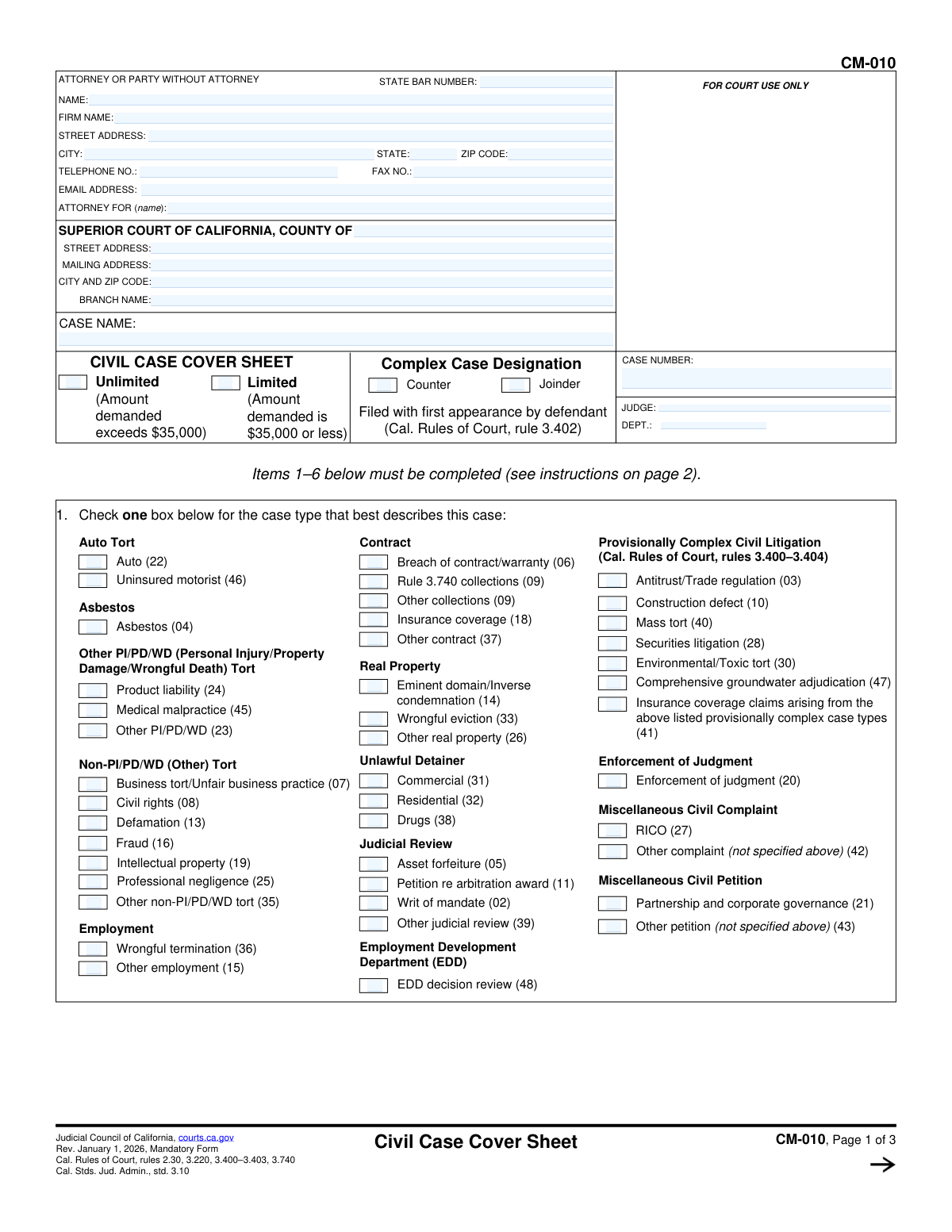
- Civil Case Cover Sheet (Form CM-010): A mandatory filing for almost all new civil lawsuits to help the court categorize the case.
Evictions and Restraining Orders
- Judicial Council of California Form UD-105 (Answer—Unlawful Detainer): This is the critical form for tenants to file to defend against an eviction lawsuit.
- Judicial Council of California Form UD-150: Use this to request a trial date once the initial eviction papers have been filed and answered.
- CLETS-001 (Confidential Information): Required when filing for restraining orders to ensure law enforcement can identify the parties involved.
Form Comparison
| Form | Purpose | Who Files It | When to Use |
|---|---|---|---|
| Judicial Council of California Form FL-300, Request for Order | Request family law orders (custody, support, property, fees) | Either spouse/parent in a family law case | When seeking new or modified family court orders |
| Judicial Council of California Form FL-150, Income and Expense Declaration | Disclose income, expenses, and assets for support matters | Either party in family law support proceedings | When requesting or contesting child/spousal support or fees |
| Judicial Council of California Form DE-111, Petition for Probate | Initiate formal probate of a decedent's estate | Executor, administrator, or interested person | When opening probate after someone's death |
| Judicial Council of California Form SC-104, Proof of Service (Small Claims) | Document that small claims documents were properly served | Third-party server (not a party to the case) | After serving small claims papers on the opposing party |
| Judicial Council of California Form SC-105, Request for Court Order and Answer (Small Claims) | Request a court order and provide written answer in small claims | Any party in an existing small claims case | When seeking or responding to an order mid-case |
| Judicial Council of California Form SC-108, Request to Correct or Cancel Judgment and Answer (Small Claims) | Correct clerical error or cancel small claims judgment | Any party in a small claims case | Within 30 days of mailed Notice of Entry of Judgment |
| Judicial Council of California Form SC-120, Defendant's Claim and ORDER to Go to Small Claims Court | File a counterclaim against the plaintiff in small claims court | Defendant in a small claims case | When defendant wants to sue the plaintiff back in same case |
| Civil Case Cover Sheet (Judicial Council of California Form CM-010) | Classify civil case type and complexity for court routing | Plaintiff filing the first paper in a civil case | Must be filed with the initial document in most civil cases |
| Judicial Council of California Form TR-205, Request for Trial by Written Declaration | Contest a traffic citation via written statement to the court | Defendant cited for a traffic violation | When electing written trial instead of appearing in person |
| Judicial Council of California Form DE-120, Notice of Hearing—Decedent's Estate or Trust | Notify interested persons of a scheduled probate hearing | Personal representative or petitioner in probate case | Before any probate hearing requiring statutory notice |
| Inventory and Appraisal Attachment (Judicial Council of California Form DE-161, GC-041) | Itemize and record appraised values of estate property | Personal representative or conservator/guardian | When listing assets as part of probate inventory process |
| CLETS-001, Confidential Information for Law Enforcement | Provide confidential party details for law enforcement database | Protected person seeking a restraining order | Submitted with restraining order paperwork for CLETS entry |
| Judicial Council of California Form SER-001, Request for Sheriff to Serve Court Papers | Request sheriff/marshal to serve court documents on a party | Any party needing law enforcement to serve papers | When arranging official service through county sheriff/marshal |
| Judicial Council of California Form UD-105, Answer—Unlawful Detainer | Respond to eviction complaint and assert tenant defenses | Tenant/defendant in an unlawful detainer case | After receiving an unlawful detainer complaint from landlord |
| Judicial Council of California Form ADOPT-210, Adoption Agreement | Record adopting parents' agreement and required consents | Adopting parent(s) in an adoption proceeding | During adoption proceedings to formalize legal commitments |
| Inventory and Appraisal (Judicial Council of California) (Form DE-160/GC-040) | Formally list and value estate or conservatorship assets | Personal representative, conservator, or guardian | When submitting court-required inventory during administration |
| Judicial Council of California Form JUD-100, Judgment | Memorialize final civil court judgment and amounts awarded | Court/clerk; prepared by prevailing party's attorney | After court issues final judgment in a civil case |
| Judicial Council of California Form UD-150, Request/Counter-Request to Set Case for Trial—Unlawful Detainer | Request court schedule unlawful detainer case for trial | Plaintiff or defendant in an unlawful detainer case | After appearance requirements met, to set trial date |
Tips for California judicial forms
Many California judicial forms, such as the Income and Expense Declaration (FL-150), require a signature under penalty of perjury. Double-check all financial figures and dates against your records to ensure accuracy, as errors can damage your credibility with the judge or lead to legal sanctions.
The court generally cannot move forward without proof that the other party was notified according to strict legal rules. Ensure you use the correct Proof of Service form, like SC-104 for small claims or DE-120 for probate, and file it by the court’s deadline to prevent your hearing from being rescheduled.
Forms like the Inventory and Appraisal (DE-160) or Request for Order (FL-300) often require additional pages or evidence to be valid. Label every attachment clearly with the case number and form title to ensure the clerk and judge can easily navigate your filing without losing key information.
AI-powered tools like Instafill.ai can complete these complex California forms in under 30 seconds with high accuracy. Your data stays secure during the process, making it a practical and reliable time-saver for individuals managing multiple court documents simultaneously.
Certain documents, like the CLETS-001 for restraining orders, are handled as confidential and are not part of the public court record. Be careful not to include sensitive identifying information on public-facing pleadings unless specifically required, to protect your privacy throughout the litigation.
When starting a new civil lawsuit, you must include the Civil Case Cover Sheet (CM-010) with your first filing. This form is mandatory for the court to properly categorize and route your case; failing to include it can result in your paperwork being rejected or potential sanctions.
Frequently Asked Questions
These are standardized legal documents used across all Superior Courts in California to ensure consistency and legal compliance. They cover a wide range of legal issues, including family law, small claims, probate, and civil litigation, and are designed to be used by both attorneys and self-represented litigants.
Forms are generally categorized by their prefix: 'FL' for Family Law, 'DE' for Decedents' Estates (Probate), 'SC' for Small Claims, and 'UD' for Unlawful Detainer (Eviction). You should select a form based on the specific action you want the court to take, such as starting a case, responding to a lawsuit, or requesting a specific order.
Most forms must be filed with the Clerk of the Superior Court in the county where your legal matter is located. Many California courts now support or require electronic filing (e-filing), though some jurisdictions still require physical copies to be submitted in person or by mail.
Yes, AI tools like Instafill.ai can be used to fill out these forms in under 30 seconds. The AI accurately extracts data from your source documents and places it directly into the correct fields on the official Judicial Council PDFs, minimizing manual entry errors.
While manually completing complex documents like the Income and Expense Declaration (FL-150) can take hours, using an AI-powered service like Instafill.ai allows you to generate a completed form in less than 30 seconds. This process automates the data mapping from your personal records to the court's requirements.
Mandatory forms must be used for the legal task they describe and usually feature the word 'Adopted' in the bottom left corner. Optional forms, which often say 'Approved,' are provided for convenience, but the court may also accept a custom-drafted legal pleading that meets California Rules of Court requirements.
Many initial filings, such as a Petition for Probate or a Defendant's Claim in Small Claims, require a filing fee that varies by case type and county. If you are unable to afford the cost, you can usually file a Request to Waive Court Fees alongside your other documents.
A Proof of Service (such as Form SC-104) is a document that confirms to the court that the other party in the case was legally notified of the proceedings. The court generally cannot make a ruling or hold a hearing until a valid Proof of Service has been filed to show that due process was followed.
Certain forms, such as the CLETS-001 for restraining orders, are specifically designed to be confidential and are not placed in the public court file. For other forms, you must be careful not to include sensitive data like full Social Security numbers unless the form specifically requests it or provides a way to keep it private.
Incorrect information can lead to the court clerk rejecting your filing or a judge denying your request. Because many of these forms are signed under penalty of perjury, it is essential to double-check all details for accuracy before submission.
Yes, this category includes essential probate forms like the Petition for Probate (DE-111) and Inventory and Appraisal (DE-160). These documents are used to initiate the court-supervised process of distributing a deceased person's assets and reporting the value of the estate.
Deadlines vary significantly depending on the case type; for example, an Answer to an Unlawful Detainer (UD-105) must typically be filed within 5 days of service, while other civil responses may allow 30 days. You should always check the summons or notice served with the papers to determine your specific deadline.
Glossary
- Form Complexity Index
- Instafill’s 0–100 measure of how much effort a form takes to complete, calculated deterministically from the form’s own structure rather than estimated. It combines the number of fillable fields (the largest factor), how difficult those fields are to complete based on their type, the number of pages that contain fields, the amount of conditional “fill-only-if” logic, and how many sections the form is divided into, then adds modifiers for tables and repeating lists, bundled instruction pages, and dense page layouts. A higher score means the form is harder to fill out by hand. The forms in this category have a median Form Complexity Index of 42/100 (Basic). See exactly how it is calculated.
- Judicial Council
- The policymaking body of the California courts that creates the standardized, mandatory forms used in all Superior Courts across the state.
- Proof of Service
- A formal document signed under penalty of perjury that proves to the court that legal papers were delivered to the other party according to the law.
- Unlawful Detainer
- The technical legal term for an eviction lawsuit, used when a landlord seeks to regain possession of a property and remove a tenant.
- Probate
- The court-supervised legal process of identifying a deceased person's assets, paying their final debts, and distributing the remaining property to heirs.
- CLETS (California Law Enforcement Telecommunications System)
- A statewide computer network used by law enforcement to track and enforce restraining orders and other protective court mandates.
- Ex Parte
- A request for a court order made by one party without providing the usual standard notice to the other side, typically used for emergencies.
- Letters (Probate)
- Official court documents that grant an individual the legal authority to manage a deceased person's estate, such as Letters Testamentary or Letters of Administration.
- Substituted Service
- A method of serving legal papers by leaving them with a competent adult at the recipient’s home or business and then mailing a follow-up copy.