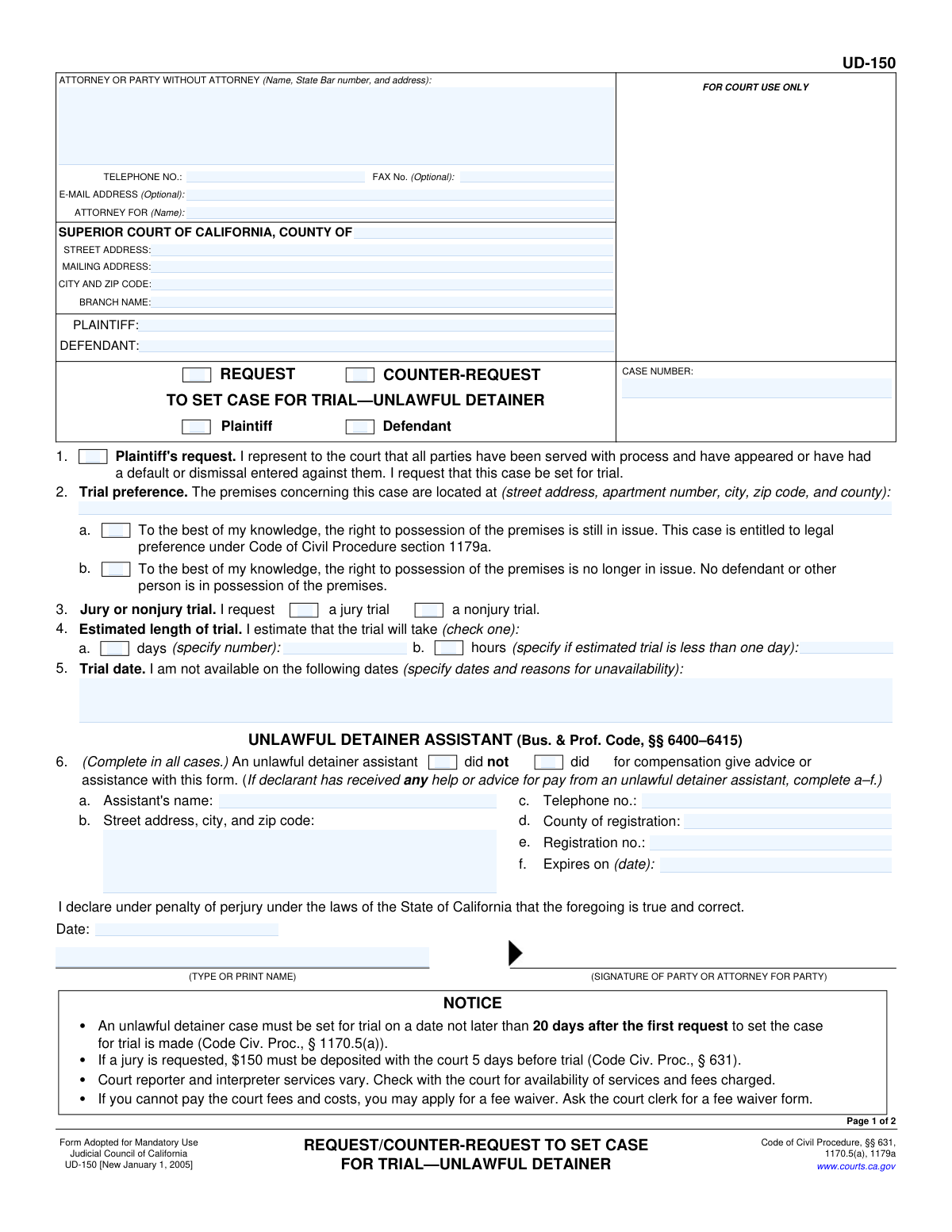
Yes! You can use AI to fill out Judicial Council of California Form UD-150, Request/Counter-Request to Set Case for Trial—Unlawful Detainer

Form UD-150 is the official California Judicial Council request (or counter-request) to have an unlawful detainer case scheduled for trial, including whether possession is still at issue, whether a jury is requested, estimated trial length, and dates of unavailability. It also includes a Proof of Service by Mail section to document that the request was properly mailed to the other parties, which is typically required for filing. Because unlawful detainer matters move quickly and have statutory timing and fee requirements, completing this form accurately helps avoid delays and procedural problems. Today, this form can be filled out quickly and accurately using AI-powered services like Instafill.ai, which can also convert non-fillable PDF versions into interactive fillable forms.
Our AI automatically handles information lookup, data retrieval, formatting, and form filling.
It takes less than a minute to fill out UD-150 using our AI form filling.
Securely upload your data. Information is encrypted in transit and deleted immediately after the form is filled out.

Form specifications

Form name: Judicial Council of California Form UD-150, Request/Counter-Request to Set Case for Trial—Unlawful Detainer
Number of pages: 2
Language: English
Categories: California court forms, Judicial Council forms, eviction forms, unlawful detainer forms
main-image

Instafill Demo: filling out a legal form in seconds

How to Fill Out UD-150 Online for Free in 2026

Are you looking to fill out a UD-150 form online quickly and accurately? Instafill.ai offers the #1 AI-powered PDF filling software of 2026, allowing you to complete your UD-150 form in just 37 seconds or less.
Follow these steps to fill out your UD-150 form online using Instafill.ai:
  1. 1 Go to Instafill.ai and upload the UD-150 PDF (or search/select “UD-150 Request/Counter-Request to Set Case for Trial—Unlawful Detainer”).
  2. 2 Enter case and court details (case number, county, court addresses/branch) and identify the parties (plaintiff and defendant).
  3. 3 Choose the filing type and filing party (Request vs. Counter-Request; Plaintiff vs. Defendant) and confirm service/appearance status as stated in the form.
  4. 4 Complete trial-setting details: indicate whether possession is still in issue, provide the premises address for trial preference, select jury or nonjury, and estimate trial length (days or hours).
  5. 5 List any dates you are unavailable for trial and provide brief reasons, as required by the form.
  6. 6 Complete the Unlawful Detainer Assistant section (indicate whether any paid assistant helped; if yes, enter the assistant’s registration details), then add the date, printed name, and signature information.
  7. 7 Fill out the Proof of Service by Mail section (server eligibility, server address, mailing method, date/place mailed, recipients’ names/addresses), then generate a final, court-ready PDF for printing/e-filing and retain copies for your records.

Our AI-powered system ensures each field is filled out correctly, reducing errors and saving you time.

Why Choose Instafill.ai for Your Fillable UD-150 Form?

Speed

Complete your UD-150 in as little as 37 seconds.

Up-to-Date

Always use the latest 2026 UD-150 form version.

Cost-effective

No need to hire expensive lawyers.

Accuracy

Our AI performs 10 compliance checks to ensure your form is error-free.

Security

Your personal information is protected with bank-level encryption.

Frequently Asked Questions About Form UD-150

UD-150 is used to ask the court to set an unlawful detainer (eviction) case for trial. It can be filed as a request or a counter-request by either the plaintiff or the defendant.

Either party may file it: the plaintiff (landlord) or the defendant (tenant/occupant). You must indicate whether it is a “Request” or “Counter-Request” and whether the filing party is the plaintiff or defendant.

The notice on the form states the court must set the trial date no later than 20 days after the first request to set the case for trial is made (Code Civ. Proc., § 1170.5(a)). Actual scheduling can vary by court, so confirm with the clerk.

Yes. The form includes a Proof of Service by Mail section that must be completed by the person who mailed the documents, and you file the UD-150 along with the completed proof of service.

No. If you are representing yourself, someone else who is over 18 and not a party to the case must mail the papers and sign the Proof of Service by Mail.

You’ll need the case number, the names of the plaintiff and defendant, and the court’s county and address/branch information. You also provide attorney or party contact details (phone required; fax/email optional).

Check “still in issue” if you believe possession of the premises is still being disputed. Check “no longer in issue” if, to your knowledge, no defendant or other person is in possession of the premises anymore.

Enter the full location of the rental premises involved in the unlawful detainer case, including street address, apartment/unit number, city, ZIP code, and county. This helps the court identify the property tied to the trial preference.

Check the box for the type of trial you are requesting: jury or nonjury. If you request a jury, the form’s notice states a $150 deposit must be paid to the court 5 days before trial (Code Civ. Proc., § 631).

If you expect the trial to take one or more full days, check “days” and write the number of days. If you expect it to take less than one day, check “hours” and write the estimated number of hours.

Use the “Trial date” section to list specific dates and the reasons you are unavailable. Be as specific as possible so the court can avoid setting trial on those dates.

An unlawful detainer assistant is a registered service provider who may help for compensation (Bus. & Prof. Code, §§ 6400–6415). You must complete this section in all cases by checking whether you did or did not receive paid assistance, and if you did, you must fill in the assistant’s details (name, address, registration info, and expiration).

It is the declaration showing UD-150 was mailed to all required recipients. The person who mailed the form (over 18 and not a party) completes and signs it, including the mailing date, city/state, and the names/addresses of everyone served.

You can continue the list on a separate attachment or use form MC-025 (Attachment to Proof of Service by Mail). Indicate on the form that the list is continued on an attachment.

Yes—AI tools can help reduce errors and save time by auto-filling fields from your case details; services like Instafill.ai can do this accurately. Typically, you upload the UD-150 PDF to Instafill.ai, answer a guided set of questions (case number, parties, trial type, estimates, service details), and the system fills the form for you to review, download, and file/serve.

If the PDF isn’t fillable, you can still complete it by printing and handwriting or using a tool that converts it. Instafill.ai can convert flat, non-fillable PDFs into interactive fillable forms so you can type directly into the fields before printing or e-filing.

Compliance UD-150
Validation Checks by Instafill.ai

1
Case Number present and matches California court case-number format
Validate that the Case Number field is not blank and conforms to the expected format used by the selected county/court (often a year + case type code + sequence, with specific separators). This is critical for correct filing, routing, and docket association. If the case number is missing or malformed, the submission should be rejected or flagged for manual review because it may be filed into the wrong case or not filed at all.
2
Court venue fields complete and internally consistent (County, addresses, branch)
Check that County, Street Address (or Mailing Address), City/ZIP, and Branch Name are provided and that the City/ZIP is plausible for the stated county. This ensures the request is directed to the correct Superior Court location and prevents misdelivery or rejection by the clerk. If inconsistent (e.g., ZIP not in county) or incomplete, block submission or require correction before filing.
3
Party names (Plaintiff/Defendant) required and non-placeholder
Ensure Plaintiff and Defendant names are present, not identical, and not generic placeholders (e.g., 'TBD', 'Unknown', 'N/A'). Accurate party identification is essential for docket matching and service validation. If missing or invalid, the form should fail validation because the court cannot reliably associate the request with the correct parties.
4
Attorney/Party identity block completeness (name + address) and State Bar number rules
Validate that the 'Attorney or Party Without Attorney' section includes a full name and complete mailing address (street, city, state, ZIP). If a State Bar number is provided, enforce numeric format and expected length (commonly 5–6 digits) and disallow it when the filer indicates they are a party without an attorney (if that distinction is captured). If these checks fail, the submission should be rejected because the court needs a valid contact/representation record.
5
Contact information format validation (phone required; fax/email optional)
Require Telephone Number and validate it as a US phone number (10 digits with optional punctuation and optional country code). If Fax Number is provided, validate it using the same phone rules; if Email Address is provided, validate it against a standard email pattern and disallow obvious invalids (missing '@', invalid domain). If formatting fails, prompt correction because the court and parties rely on these fields for scheduling and notices.
6
Filing type selection is exclusive: Request vs Counter-Request
Enforce that exactly one of 'Request' or 'Counter-Request' is checked, not both and not neither. This classification affects how the court treats the filing and may impact statutory timing and calendaring. If the selection is ambiguous, the system should block submission and require the filer to choose one.
7
Filing party selection is exclusive and consistent with request language
Require exactly one filing party checkbox (Plaintiff or Defendant) and ensure it aligns with the narrative/attestation section used (e.g., if 'Plaintiff’s request' attestation is checked, the filing party should be Plaintiff). This prevents contradictory filings that can cause clerk rejection or require hearings to clarify. If inconsistent, fail validation and require the filer to correct the party role or the attestation selection.
8
Premises possession status is mutually exclusive and required
Validate that exactly one of 'Premises Possession Still In Issue' or 'Premises Possession No Longer In Issue' is checked. These statements drive trial preference and the court’s understanding of whether possession remains contested. If both or neither are selected, the submission should be rejected because the court cannot properly calendar or prioritize the matter.
9
Trial preference premises location completeness and address structure
Require the premises location and validate that it includes street address, city, ZIP code, and county; if an apartment/unit is applicable, ensure it is captured in the address line. This is important because unlawful detainer venue and trial preference relate to the property location. If incomplete or missing key components (e.g., no ZIP/county), the system should require correction before acceptance.
10
Trial type selection is exclusive: Jury vs Nonjury
Enforce that exactly one of 'Jury Trial' or 'Nonjury Trial' is checked. Trial type affects scheduling, fees (jury deposit), and courtroom resources. If both or neither are selected, block submission because the court cannot set the case for the correct type of trial.
11
Estimated trial length selection and numeric bounds (days vs hours)
Require the filer to choose either 'days' or 'hours' and ensure the corresponding numeric field is provided while the other is blank. Validate that the number is a positive integer (or allow one decimal for hours if your system supports it) and within reasonable bounds (e.g., days 1–30, hours 1–8/10) to catch entry errors like '0' or '1000'. If invalid, fail validation because trial setting depends on a credible time estimate.
12
Unavailability dates entry format and required reason pairing
If any unavailability is provided, validate that each entry includes a valid date (or date range) and a non-empty reason; also ensure dates are not impossible (e.g., 02/30) and are not in the distant past relative to the signature date. This helps the court set trial within statutory timelines while respecting legitimate conflicts. If dates are malformed or reasons missing, require correction to avoid scheduling disputes and continuances.
13
Unlawful Detainer Assistant (UDA) selection is exclusive and triggers conditional required fields
Require exactly one checkbox for 'did' or 'did not' receive compensated help from an unlawful detainer assistant. If 'did' is selected, enforce completion of assistant name, address, telephone, county of registration, registration number, and expiration date; if 'did not' is selected, those fields should be blank. If the conditional requirements are not met, fail validation because UDA disclosures are legally required when applicable.
14
UDA registration details format (phone, registration number, expiration date not expired)
When UDA details are required, validate the assistant telephone number format, ensure the registration number follows expected numeric/alphanumeric constraints, and validate the expiration date as a real date. Additionally, flag if the expiration date is before the form signature date, as that may indicate an invalid or outdated registration. If any check fails, reject or route to manual review to ensure statutory compliance.
15
Signature block completeness and date validity (both pages where applicable)
Require the declaration Date and the Typed/Printed Name, and ensure a signature is captured (electronic signature indicator or uploaded signature image, depending on system). Validate that the date is a valid calendar date and not after the submission date (or outside allowed e-filing rules). If missing or invalid, the filing should be rejected because an unsigned/undated declaration is not properly executed under penalty of perjury.
16
Proof of Service by Mail completeness and logical consistency (server eligibility, method, mailing details, recipients)
Validate that the server is not a party and is over 18 (require explicit confirmation), and that the server address is provided. Enforce that exactly one service method (US Mail deposit vs business collection) is selected, and require Mailing Date and Mailing Place (city and state) in valid formats. Also require at least one recipient name and complete mailing address (including ZIP), or require the Continuation Attachment flag if recipients exceed the available lines; if any of these fail, the proof of service should be rejected because service is essential to proceed with trial setting.

Common Mistakes in Completing UD-150

Missing or incorrect case number on one or both pages

People often enter the case number on page 1 but forget to repeat it on page 2 (Proof of Service), or they transpose digits/letters from other filings. Courts may reject the filing or misfile it, which can delay getting a trial date in a time-sensitive unlawful detainer case. Always copy the case number exactly as it appears on prior court notices and ensure it is filled in on every page that asks for it. AI-powered tools like Instafill.ai can auto-populate the case number consistently across pages and flag mismatches.

Checking the wrong filing type (Request vs. Counter-Request) and/or wrong filing party

Filers sometimes check both boxes, or they select “Request” when they are actually responding to the other side’s request (a counter-request), or they mark the wrong party (Plaintiff/Defendant). This creates confusion about who is asking for the trial setting and can lead to clerk questions, rejection, or delays. Check only the box that matches your procedural posture and ensure the “Plaintiff”/“Defendant” filer box matches the caption. Instafill.ai can guide selection logic so mutually exclusive boxes aren’t both selected.

Making the ‘all parties served/appeared/default/dismissal’ representation when it isn’t true

A common mistake is requesting a trial date before service is complete or before all parties have appeared or had default/dismissal entered, often due to misunderstanding the requirement. If the statement is inaccurate, the court may refuse to set trial, require corrective filings, or the opposing party may challenge the request. Verify service status and the docket (appearances, defaults, dismissals) before signing under penalty of perjury. Instafill.ai can prompt a checklist of prerequisites to reduce the risk of premature filing.

Selecting the wrong possession-status option (still in issue vs. no longer in issue)

Filers sometimes check the wrong box because they confuse “possession still in issue” with whether rent is owed or whether the tenant has moved out. Checking the wrong status can affect how the court treats urgency and trial preference and may create credibility issues if later contradicted. Confirm whether anyone is still in possession and whether possession is actually disputed before selecting 1(a) or 1(b). Instafill.ai can add validation prompts to clarify the meaning of each option before you commit.

Incomplete premises location for trial preference (missing county, ZIP, or unit number)

People frequently provide only a street address or omit the apartment/unit number, ZIP code, or the county where the premises are located. In unlawful detainer matters, the premises address is central to venue and trial preference, and missing details can trigger clerk rejections or follow-up requests. Enter the full address exactly as used in the complaint: street, unit, city, ZIP, and county. Instafill.ai can standardize address formatting and flag missing components.

Requesting a jury trial without understanding the deposit requirement and timing

Some filers check “jury trial” without realizing a $150 deposit is required at least 5 days before trial, or they assume the request alone is sufficient. Failure to timely deposit can result in losing the jury right or last-minute scrambling that delays proceedings. Only request a jury if you intend to comply with the deposit requirement and calendar the deadline immediately. Instafill.ai can surface deadline reminders and ensure the selection aligns with required follow-up steps.

Estimated trial length left blank or internally inconsistent (days vs. hours)

A frequent error is checking both “days” and “hours,” checking one but not providing the number, or giving an unrealistic estimate that doesn’t match the issues. The court uses this estimate for scheduling; missing or inconsistent entries can delay setting trial or lead to an unsuitable time slot. Check only one option and provide a specific numeric estimate (e.g., “4 hours” if less than one day). Instafill.ai can enforce mutually exclusive choices and require a number when a box is checked.

Unavailability dates provided without reasons or with vague/unclear dates

Filers often list “not available next week” or provide dates without reasons, or they use ambiguous formats that can be misread (e.g., 03/04/26). The court may ignore vague unavailability, increasing the chance of a trial date you cannot attend and potential sanctions or continuance motions. Provide specific dates and a brief reason for each (e.g., “02/28/2026 – out-of-state medical appointment”). Instafill.ai can standardize date formats and prompt for a reason when a date is entered.

Unlawful Detainer Assistant section completed incorrectly or left incomplete

People sometimes check “did” but fail to fill out a–f, or they leave the entire section blank because they think it doesn’t apply. This section is mandatory in all cases, and incomplete disclosures can cause rejection or require amendment, especially when assistance was provided for compensation. Always check either “did not” or “did,” and if “did,” complete every assistant detail (name, address, registration county/number, expiration). Instafill.ai can conditionally reveal and require the a–f fields only when “did” is selected.

Proof of Service by Mail signed by a party or otherwise invalid server

Self-represented litigants commonly mail the documents themselves and sign the Proof of Service, not realizing the server must be over 18 and not a party to the case. An invalid proof of service can lead to the filing being rejected or the service being challenged, delaying the trial setting. Use a non-party adult to mail the documents and have that person complete and sign the Proof of Service. Instafill.ai can highlight eligibility rules and prevent selecting the filer as the server.

Proof of Service missing method details, mailing date/place, or recipient addresses

Another common issue is failing to check 3(a) or 3(b), leaving 3(c) blank (date/place mailed), or listing recipients without complete addresses (missing ZIP, firm name, or suite). Incomplete service details can invalidate service and force re-service and re-filing, which is costly in a fast-moving unlawful detainer timeline. Ensure one service method is checked, the mailing date and city/state are filled in, and every recipient’s name and full mailing address is listed (use MC-025 if needed). Instafill.ai can validate that all required service fields are completed and format addresses consistently.
Saved over 80 hours a year

“I was never sure if my IRS forms like W-9 were filled correctly. Now, I can complete the forms accurately without any external help.”

Kevin Martin Green

Your data stays secure with advanced protection from Instafill and our subprocessors

Robust compliance program

Transparent business model

You’re not the product. You always know where your data is and what it is processed for.

ISO 27001, HIPAA, and GDPR

Our subprocesses adhere to multiple compliance standards, including but not limited to ISO 27001, HIPAA, and GDPR.

Security & privacy by design

We consider security and privacy from the initial design phase of any new service or functionality. It’s not an afterthought, it’s built-in, including support for two-factor authentication (2FA) to further protect your account.

Fill out UD-150 with Instafill.ai

Worried about filling PDFs wrong? Instafill securely fills judicial-council-of-california-form-ud-150-requestcounter-request-to-set-case-for-trialunlawful-detainer-1 forms, ensuring each field is accurate.