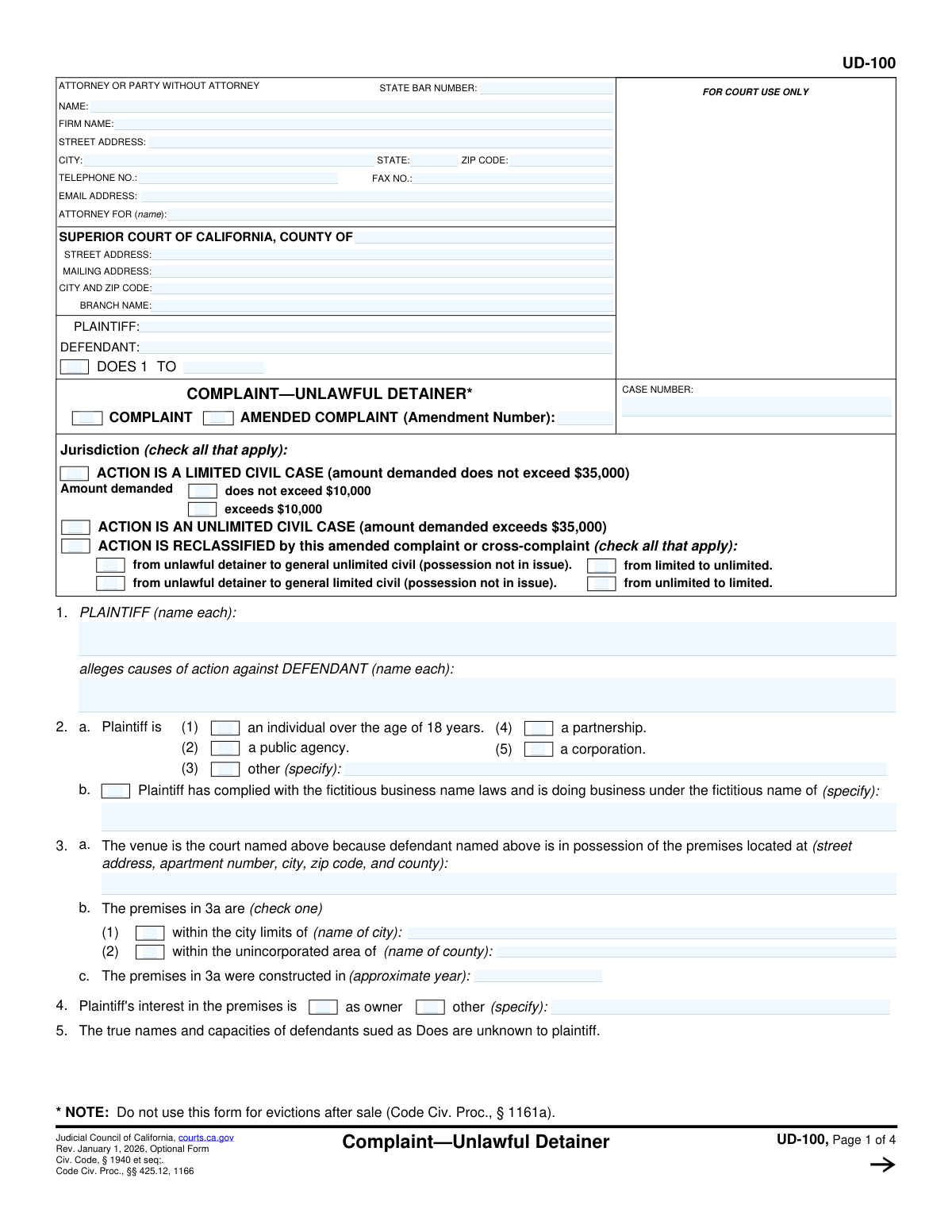
Yes! You can use AI to fill out Judicial Council of California Form UD-100, Complaint—Unlawful Detainer
The California Form UD-100, Complaint—Unlawful Detainer, is the official court document a plaintiff (landlord) files to initiate a legal action to remove a defendant (tenant) from a rental property. It details the basis for the eviction, such as failure to pay rent or violation of lease terms, and formally asks the court to grant possession of the property back to the landlord. Today, this form can be filled out quickly and accurately using AI-powered services like Instafill.ai, which can also convert non-fillable PDF versions into interactive fillable forms.
Our AI automatically handles information lookup, data retrieval, formatting, and form filling.
It takes less than a minute to fill out UD-100 using our AI form filling.
Securely upload your data. Information is encrypted in transit and deleted immediately after the form is filled out.
Form specifications
| Form name: | Judicial Council of California Form UD-100, Complaint—Unlawful Detainer |
| Number of pages: | 4 |
| Language: | English |
| Categories: | Judicial Council forms, California judicial forms, unlawful detainer forms |
Instafill Demo: How to fill out PDF forms in seconds with AI
How to Fill Out UD-100 Online for Free in 2026
Are you looking to fill out a UD-100 form online quickly and accurately? Instafill.ai offers the #1 AI-powered PDF filling software of 2026, allowing you to complete your UD-100 form in just 37 seconds or less.
Follow these steps to fill out your UD-100 form online using Instafill.ai:
- 1 Navigate to Instafill.ai and upload or select the California Form UD-100.
- 2 Provide the court and case information, along with your details as the plaintiff.
- 3 Enter the defendant's name(s) and the full address of the property involved in the dispute.
- 4 Detail the rental agreement terms, the reason for the eviction, and information about the notice that was served to the tenant.
- 5 Complete the sections regarding rental assistance, damages requested (like past-due rent), and any claims for attorney fees.
- 6 Use the AI to review all entered information for completeness and accuracy, then electronically or manually sign and date the verification section.
- 7 Download the completed form to file with the appropriate California Superior Court and serve on the defendant.
Our AI-powered system ensures each field is filled out correctly, reducing errors and saving you time.
Why Choose Instafill.ai for Your Fillable UD-100 Form?
Speed
Complete your UD-100 in as little as 37 seconds.
Up-to-Date
Always use the latest 2026 UD-100 form version.
Cost-effective
No need to hire expensive lawyers.
Accuracy
Our AI performs 10 compliance checks to ensure your form is error-free.
Security
Your personal information is protected with bank-level encryption.
Frequently Asked Questions About Form UD-100
This form is used by a landlord (plaintiff) to begin an eviction lawsuit against a tenant (defendant) in California. It is filed with the court after the tenant has been served with a proper notice to vacate and has not moved out.
The plaintiff is the landlord, property owner, or property manager who is filing the lawsuit. The defendant is the tenant or any other person occupying the property who the landlord wants to evict.
Yes, this form should not be used for evictions after a property has been sold, such as in a foreclosure. A different legal process and different forms are required for those situations.
For most residential cases, you must attach a copy of the written rental agreement (Exhibit 1), a copy of the notice you served to the tenant (Exhibit 2), and proof of service of that notice (Exhibit 3).
A limited civil case is for when the total money you are demanding (like back rent and damages) is $35,000 or less. An unlimited case is for when the amount demanded exceeds $35,000.
In Item 6b, you will check the box for an 'oral' agreement. In Item 6f, you can specify that a written agreement is not attached because the agreement was verbal.
This section is legally required to show the court whether the tenancy is subject to the statewide 'just cause' eviction law. If it is, you must state the valid reason for the eviction as defined by the Act.
This section is required in all cases based on non-payment of rent. You must disclose to the court whether you have received or applied for any rental assistance funds on behalf of the tenant.
Requesting forfeiture asks the court to formally cancel the rental agreement. This prevents the tenant from being able to 'cure the breach' (for example, by paying all rent due) to stop the eviction after a judgment.
After filing the UD-100, you must have it and a summons legally served on the defendant. The defendant then has a limited time, typically five days, to file a formal response with the court.
Yes, services like Instafill.ai use AI to help you accurately auto-fill form fields with your saved information, which saves time and helps reduce the chance of errors.
You can use a service like Instafill.ai to upload the form, complete it in an interactive online format, and securely save your data for use on other court forms.
If you have a non-fillable or 'flat' PDF, you can upload it to a platform like Instafill.ai. The service can convert the document into an interactive, fillable form that you can easily complete online.
Compliance UD-100
Validation Checks by Instafill.ai
1
Jurisdiction and Amount Demanded Consistency
This check ensures the selected jurisdiction aligns with the total monetary amount demanded in the complaint. For example, if 'LIMITED CIVIL CASE' is selected, the total damages requested in section 20 must not exceed $35,000. This is crucial for filing in the correct court and avoiding procedural delays or dismissal.
2
Conditional Requirement for Tenant Protection Act Details
Validates that section 8, concerning termination cause, is only completed if item 7b ('is subject to the Tenant Protection Act of 2019') is checked. This prevents the submission of irrelevant or contradictory information. If this rule is violated, it could confuse the court and weaken the plaintiff's case.
3
Logical Date Sequence for Notice Service and Expiration
Ensures the 'notice expired' date in item 9b(1) is chronologically after the notice service date provided in item 10a. A notice cannot expire before it has been served. An incorrect date sequence would invalidate the notice period, which is a fundamental requirement for an unlawful detainer action.
4
Completeness of 'Other (specify)' Fields
This validation verifies that whenever a checkbox for 'other (specify)' is selected (e.g., in items 2a, 4, 6a, 6b), the corresponding text field is not empty. This is important for providing the court with complete and specific information required to understand the case. Failure to specify details can lead to the complaint being deemed insufficient.
5
State Bar Number Requirement for Attorneys
Checks that if an attorney's name is entered in the 'ATTORNEY OR PARTY WITHOUT ATTORNEY' section, the 'STATE BAR NUMBER' field is also filled with a validly formatted number. This is a mandatory requirement for attorneys filing on behalf of a client. An omission or invalid number can lead to rejection of the filing by the court clerk.
6
Venue and Premises County Match
This check confirms that the county listed for the property in item 3a matches the county of the Superior Court selected in the form's header. The case must be filed in the correct venue, which is typically the county where the property is located. A mismatch will result in the case being filed in the wrong jurisdiction, causing it to be rejected or transferred.
7
Completeness of Rental Assistance Declarations
Verifies that a selection has been made for all four mandatory declarations regarding rental assistance in item 11. This information is required in all actions based on nonpayment of rent. Incomplete information can halt the case proceedings, especially if the plaintiff later seeks a default judgment.
8
Conditional Requirement for Unlawful Detainer Assistant Information
Ensures that if the plaintiff indicates they 'did' receive paid help from an unlawful detainer assistant in item 22, all sub-fields (a through f) are completed. This information is required by the Business and Professions Code for consumer protection. Failure to provide these details when required is a violation and can result in penalties.
9
Damages Consistency Between Sections 8 and 20
Validates that if an amount for waived rent or relocation assistance is requested in item 20f, it matches the amount specified in item 8b. This ensures consistency in the financial claims made in the complaint. Discrepancies can create confusion and may require an amendment to the complaint.
10
Past-Due Rent Consistency
This check ensures the 'past-due rent' amount requested in item 20c is identical to the 'amount of rent due' stated in item 13. This consistency is vital for a clear and accurate claim for damages. A mismatch could call the plaintiff's accounting into question and delay judgment.
11
Attachment Verification for Written Agreement
If item 6e is checked, indicating a copy of the written agreement is attached as Exhibit 1, this validation confirms that a corresponding file has been uploaded. The Code of Civil Procedure requires the agreement to be attached for residential properties in most cases. Missing this required exhibit can be grounds for the court to reject the complaint.
12
Mutually Exclusive Jurisdiction Selection
This rule ensures that a user can only select one primary jurisdiction type: either 'ACTION IS A LIMITED CIVIL CASE' or 'ACTION IS AN UNLIMITED CIVIL CASE', but not both. These categories are mutually exclusive and define the court's procedural track. Allowing both to be selected would make the filing ambiguous and subject to rejection.
13
Limited Civil Case Sub-Option Requirement
If 'ACTION IS A LIMITED CIVIL CASE' is checked, this validation ensures that one of the two sub-options ('does not exceed $10,000' or 'exceeds $10,000') is also selected. This further clarifies the amount in dispute, which is important for court classification and filing fees. An incomplete selection makes the jurisdictional claim unclear.
14
Construction Year Format and Validity
Validates that the 'approximate year' of construction entered in item 3c is a valid four-digit year and is not a year in the future. This data can be relevant to the applicability of certain building codes or rent control ordinances. An invalid or nonsensical year could lead to incorrect assumptions by the court.
15
Conditional Date Requirement for Prior Notice
This check verifies that if item 9a(7) ('3-day notice to quit under Civil Code, § 1946.2(c)') is selected, the associated date field for the 'Prior required notice' is filled. This specific type of notice requires a prior notice to have been served, and the date is essential proof of compliance. Omitting this date would render the notice claim incomplete and legally insufficient.
Common Mistakes in Completing UD-100
This form explicitly requires attaching a copy of the written rental agreement (Exhibit 1) and the eviction notice (Exhibit 2). Filers often overlook these requirements, assuming the information in the form is sufficient. Failing to include these mandatory attachments is a critical error that can lead to the court clerk rejecting the filing or the case being dismissed upon a challenge from the defendant.
Plaintiffs frequently fail to name every individual plaintiff (all property owners) and every defendant (all adult tenants on the lease) in the caption and in Item 1. Using vague terms like 'et al.' is insufficient and can prevent the court from issuing a judgment that is enforceable against an unnamed occupant. It is crucial to list the full legal names of all parties involved to ensure the final judgment covers everyone.
Items 7 and 8, concerning the Tenant Protection Act, are a common source of fatal errors due to their complexity. Plaintiffs may incorrectly claim an exemption without specifying the legal basis, or if the tenancy is covered, they may fail to properly document the 'just cause' for eviction and any required rent waivers or relocation payments. An error in these sections can invalidate the entire eviction proceeding, forcing the plaintiff to start over.
Item 10 requires a precise description of how the eviction notice was served, and mistakes are common. A filer might check 'personal service' when they actually used 'substitute service' (leaving it with another person) or 'posting and mailing.' An inaccurate description of the service method or date can render the notice legally invalid, which is a complete defense for the tenant and requires the landlord to serve a new notice.
The amount of rent demanded in the 3-day notice must be identical to the 'past-due rent' alleged in Item 13 and the amount requested in Item 20c. People often make calculation errors or include late fees improperly, creating discrepancies. Any inconsistency gives the defendant a strong basis to challenge the validity of the notice and the complaint, potentially causing the case to be dismissed.
The plaintiff must personally sign and date the verification on page 4, declaring the complaint's contents are true under penalty of perjury. Forgetting this signature or having an attorney sign this specific section (when a separate attorney verification form is required) makes the complaint defective. An unverified complaint can be challenged and dismissed, causing significant delays.
Plaintiffs must correctly identify the case as a 'limited' or 'unlimited' civil case based on the total amount of damages demanded. A common mistake is miscalculating the amount or misunderstanding the thresholds ($10,000 and $35,000). Filing in the wrong jurisdiction requires a motion to reclassify the case, resulting in additional fees and months of delay.
In Item 20 ('Plaintiff Requests'), filers must check every box for the specific relief they are seeking, such as possession, costs, past-due rent, attorney fees, and forfeiture of the lease. It is a frequent oversight to miss one or more of these boxes. If a box is not checked, the court may not grant that part of the request, meaning the plaintiff could lose the right to recover their attorney fees or other costs.
Item 11 requires the plaintiff to declare whether they have received or applied for rental assistance, which is a critical part of modern unlawful detainer actions. People may misunderstand the questions or provide inaccurate information about funds received or applications pending. A mistake in this section can jeopardize the case and expose the plaintiff to penalties for making a false statement to the court.
Self-represented plaintiffs often leave the top-left caption box incomplete, omitting their full address, phone number, or email. This information is not optional; it is required for the court and the defendant to serve official documents. Missing contact details can cause critical notices to be misdirected and lead to significant procedural delays. AI-powered tools like Instafill.ai can help prevent this by ensuring all required fields are completed with validated information.
Saved over 80 hours a year
“I was never sure if my IRS forms like W-9 were filled correctly. Now, I can complete the forms accurately without any external help.”
Kevin Martin Green
Your data stays secure with advanced protection from Instafill and our subprocessors

Robust compliance program
Transparent business model
You’re not the product. You always know where your data is and what it is processed for.
ISO 27001, HIPAA, and GDPR
Our subprocesses adhere to multiple compliance standards, including but not limited to ISO 27001, HIPAA, and GDPR.
Security & privacy by design
We consider security and privacy from the initial design phase of any new service or functionality. It’s not an afterthought, it’s built-in, including support for two-factor authentication (2FA) to further protect your account.
Fill out UD-100 with Instafill.ai
Worried about filling PDFs wrong? Instafill securely fills judicial-council-of-california-form-ud-100-complaintunlawful-detainer forms, ensuring each field is accurate.