Yes! You can use AI to fill out CLETS-001, Confidential Information for Law Enforcement (Judicial Council of California)
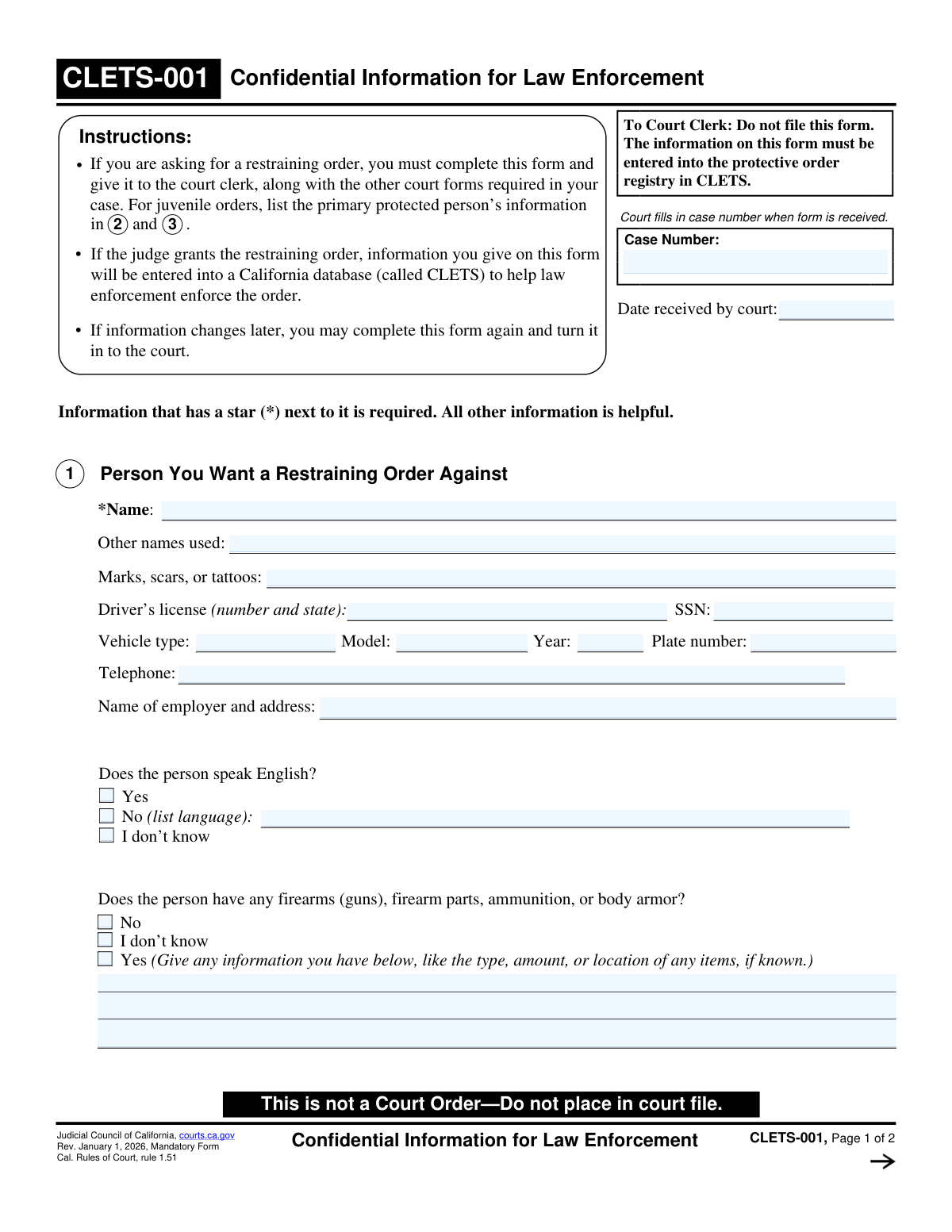
CLETS-001 (Confidential Information for Law Enforcement) is a mandatory California Judicial Council form submitted with restraining order paperwork to provide law enforcement with key identifying details about the restrained person and protected parties. If the judge grants the restraining order, the information is entered into the California Law Enforcement Telecommunications System (CLETS) to help officers identify the parties and enforce the order, including outside the immediate court setting. The form is confidential and is not filed in the public court file; instead, the clerk uses it for CLETS entry, and it can be resubmitted if information changes. Today, this form can be filled out quickly and accurately using AI-powered services like Instafill.ai, which can also convert non-fillable PDF versions into interactive fillable forms.
Our AI automatically handles information lookup, data retrieval, formatting, and form filling.
It takes less than a minute to fill out CLETS-001 using our AI form filling.
Securely upload your data. Information is encrypted in transit and deleted immediately after the form is filled out.
Form specifications
| Form name: | CLETS-001, Confidential Information for Law Enforcement (Judicial Council of California) |
| Number of pages: | 2 |
| Filled form examples: | Form CLETS-001 Examples |
| Language: | English |
| Categories: | Judicial Council forms, California judicial forms, law enforcement forms |
Instafill Demo: filling out a legal form in seconds
How to Fill Out CLETS-001 Online for Free in 2026
Are you looking to fill out a CLETS-001 form online quickly and accurately? Instafill.ai offers the #1 AI-powered PDF filling software of 2026, allowing you to complete your CLETS-001 form in just 37 seconds or less.
Follow these steps to fill out your CLETS-001 form online using Instafill.ai:
- 1 Go to Instafill.ai and upload the CLETS-001 PDF (or select CLETS-001 from the form library).
- 2 Let the AI detect and map the form fields, then confirm you are completing CLETS-001 for a restraining order case (noting any special case type such as juvenile, if applicable).
- 3 Enter court case details as available (case number if known) and review the “date received by court” field (often left for the clerk, depending on local instructions).
- 4 Complete Item 1 with identifying information about the person you want a restraining order against (name, aliases, physical identifiers, SSN/driver’s license if known, vehicle details, employer, language, and any firearms/ammunition/body armor information).
- 5 Complete your information (Item 3) including your name, age, date of birth, gender designation, race, language/English proficiency, and a contact telephone number as requested.
- 6 List additional protected people in Item 4 (names, gender, race, dates of birth), and if needed, use Instafill.ai to generate and attach an “Item 4” continuation page for extra individuals.
- 7 Run Instafill.ai’s validation checks for required (*) fields, then download/print the completed form for submission to the court clerk with your other restraining order forms (and save a copy for your records).
Our AI-powered system ensures each field is filled out correctly, reducing errors and saving you time.
Why Choose Instafill.ai for Your Fillable CLETS-001 Form?
Speed
Complete your CLETS-001 in as little as 37 seconds.
Up-to-Date
Always use the latest 2026 CLETS-001 form version.
Cost-effective
No need to hire expensive lawyers.
Accuracy
Our AI performs 10 compliance checks to ensure your form is error-free.
Security
Your personal information is protected with bank-level encryption.
Frequently Asked Questions About Form CLETS-001
CLETS-001 provides identifying information to law enforcement so a restraining order can be entered into the California Law Enforcement Telecommunications System (CLETS) and enforced accurately. It is not itself a restraining order.
If you are asking the court for a restraining order, you must complete CLETS-001 and submit it with the other required restraining order forms in your case. For juvenile orders, you list the primary protected personâs information in items 2 and 3.
Noâthis form is confidential and the instructions say: âTo Court Clerk: Do not file this form.â You give it to the clerk so the information can be entered into the CLETS protective order registry.
Fields marked with an asterisk (*) are required. Common required items include the restrained personâs name, your name, your age, and required details for any additional protected people (such as name and gender).
Provide what you know and leave unknown items blankâmost of those fields are âhelpfulâ but not required. Any extra identifying details (like tattoos, employer, or vehicle plate) can help law enforcement enforce the order correctly.
Check âYes,â âNo,â or âI donât know.â If you check âNo,â write the language the person speaks in the space provided.
Check âNo,â âI donât know,â or âYes.â If you check âYes,â include any details you have (type, amount, and where the items may be located), even if the information is incomplete.
Your date of birth helps law enforcement identify you and can be entered into a federal database if the restraining order is granted, which may help enforcement outside California. The form notes that if your information is not in the federal database, the order may be harder to enforce out of state.
Check the box indicating you have more people to list, then attach a separate sheet labeled âItem 4â at the top. Include each additional personâs identifying information (name, gender, and any other requested details).
You can complete CLETS-001 again and turn in the updated form to the court. This helps ensure the CLETS entry stays accurate for enforcement.
The case number is the court-assigned number for your restraining order case. The form indicates the court fills in the case number when the form is received, but if you already have a case number, you can include it to avoid delays.
Timing can vary by court, but the form is designed to be entered into the CLETS protective order registry after the judge grants the restraining order. If youâre concerned about timing, ask the clerk how your court handles CLETS entry and updates.
YesâAI form-filling services like Instafill.ai can help auto-fill fields based on the information you provide, reducing errors and saving time. You should still review everything carefully because this form contains sensitive identifying details.
Upload the CLETS-001 PDF to Instafill.ai, answer the guided questions (names, identifying details, languages, firearms info, and protected people), and let the AI map your answers into the correct fields. Then review the completed form, download it, and submit it to the court clerk with your other restraining order paperwork.
If the PDF is âflatâ (non-fillable), Instafill.ai can convert it into an interactive fillable form and then auto-fill the fields. This can help you avoid printing and handwriting the form, while still producing a clean, readable submission.
Compliance CLETS-001
Validation Checks by Instafill.ai
1
Required fields present: Respondent Name, Your Name, and Your Age
Verify that all starred/required fields are provided, at minimum including Respondent Name, Your Name, and Your Age. These are essential identifiers for CLETS entry and for associating the confidential record to the correct parties. If any required field is missing or blank (including whitespace-only), the submission should be rejected and the user prompted to complete the missing required fields.
2
Case Number format and presence when provided by court
Validate that the Case Number is present when the workflow indicates the court has assigned/entered it, and that it matches the courtâs expected case-number pattern (e.g., allowed characters, separators, and length). This prevents mis-association of confidential data with the wrong case and reduces downstream reconciliation work. If the case number is missing when required or fails format rules, flag for clerk review or block submission depending on the stage of intake.
3
Date Received by Court is a valid date and not in the future
Check that the Date Received by Court is a real calendar date in an accepted format (month/day/year) and is not later than today. This date is used for court processing timelines and audit trails. If invalid or future-dated, the system should reject the value and require correction or route to clerk verification.
4
Date of Birth fields use valid MM/DD/YYYY and represent plausible dates
For all DOB fields (Your DOB and each protected personâs DOB), validate MM/DD/YYYY formatting, valid month/day combinations (including leap years), and a plausible year range (e.g., not before 1900 and not after today). Accurate DOBs improve matching in state/federal law enforcement databases and reduce false matches. If a DOB fails validation, require correction or allow blank only if the field is optional for that person.
5
Age is a whole number and consistent with Your Date of Birth (if provided)
Ensure Age is an integer (no decimals, no text) within a reasonable range (e.g., 0â120). If Your Date of Birth is provided, compute the age and confirm it is consistent within an acceptable tolerance (e.g., off by at most 1 year depending on whether the birthday has occurred this year). If inconsistent, prompt the filer to correct either Age or DOB to avoid inaccurate identification in CLETS.
6
SSN format validation (if provided) and disallow obvious invalid values
If an SSN is entered for the respondent, validate it is exactly 9 digits (optionally allowing dashes in the pattern ###-##-####) and reject known invalid patterns (e.g., all zeros, 123456789). SSN is a high-value identifier and incorrect entries can cause misidentification or failed database matching. If invalid, the system should not accept the SSN and should request correction or removal.
7
Driver’s license number and issuing state validation (paired fields)
If a driverâs license is provided, require both the license number and the issuing state, and validate the state as a valid US state/territory abbreviation. Optionally apply state-specific license number length/character rules if supported. If either component is missing or the state is invalid, flag the entry because incomplete DL data reduces enforcement utility and can cause CLETS entry errors.
8
Vehicle information consistency: Year numeric and dependent fields coherence
If Vehicle Year is provided, validate it is a 4-digit year within a plausible range (e.g., 1900 through next calendar year). If Plate Number is provided, require at least Vehicle Type or Model to avoid an orphaned plate entry with no context, and ensure Year is not provided without any vehicle descriptor. If these checks fail, prompt for missing related vehicle details or clear inconsistent entries.
9
License plate number character set and length validation
Validate the License Plate Number uses an allowed character set (typically AâZ, 0â9, and limited separators like spaces or hyphens) and is within a reasonable length (e.g., 2â10 characters after trimming). This reduces data-entry errors that can prevent successful vehicle identification by law enforcement. If invalid, reject the plate value and require correction.
10
Telephone number format validation for respondent and filer
For each telephone field, validate it contains a plausible phone number (e.g., 10 digits for US numbers, optionally allowing +1, parentheses, spaces, and hyphens) and is not obviously invalid (e.g., too short). Reliable contact numbers support service/enforcement and follow-up. If invalid, require correction or allow blank only if the phone field is optional in the workflow.
11
English proficiency selection is mutually exclusive and language required when 'No'
For both the respondent and filer English proficiency questions, ensure exactly one option is selected among Yes / No / I donât know (where applicable). If 'No (list language)' is selected, require the corresponding Language field to be non-empty and reasonably formatted (letters/spaces, not just punctuation). If multiple options are selected or language is missing when required, block submission until corrected to avoid incomplete communication needs in enforcement.
12
Firearms/ammunition/body armor selection is mutually exclusive and details required when 'Yes'
Ensure only one checkbox is selected among No / I donât know / Yes for firearms-related possession. If 'Yes' is selected, require the details field to contain meaningful information (minimum length and not just 'N/A'), because the form explicitly requests type/amount/location if known. If the selection is inconsistent or details are missing when required, prompt for correction to support officer safety and proper order enforcement.
13
Protected persons (Item 4) entries require Name and Gender together per listed row
For each protected person row that has any data entered, require at least the starred fields for that row: Name and Gender. This prevents partial person records that cannot be reliably entered into CLETS or matched during enforcement. If a row is partially filled (e.g., DOB without Name), the system should require completion of the required fields or clear the row.
14
Gender field validation: allowed values and single selection for filer
Validate that protected personsâ Gender entries are within allowed designations (e.g., M, F, X/nonbinary, or an approved text value if free-text is permitted) and are not blank when required. For the filerâs gender checkboxes (M/F/X), ensure at most one is selected to avoid ambiguous coding. If invalid or multiple selections occur, require correction before acceptance.
15
Additional protected people attachment indicator consistency
If the 'more people to list' checkbox is selected, require an attachment indicator/metadata (e.g., uploaded file or confirmation that an 'Item 4' page is included) in the submission package. This ensures the court and CLETS entry staff receive the complete list of protected persons. If the checkbox is selected but no attachment is present, flag the submission as incomplete and prevent finalization until resolved.
16
Cross-person duplication and role conflict checks (respondent vs protected/filer)
Check for obvious duplicates or conflicts where the Respondent Name matches the filerâs name or a protected personâs name (exact or near-exact match), which may indicate data entry in the wrong field. While some cases could legitimately involve similar names, this is a high-risk error that can misdirect enforcement actions. If a potential conflict is detected, require user confirmation and/or route to clerk review before CLETS entry.
Common Mistakes in Completing CLETS-001
People often assume every blank must be completed and enter a guessed case number or todayâs date, even though the form states the court fills in the case number when received and records the received date. Incorrect entries can cause clerical confusion, mismatching documents, or delays in getting the information entered into CLETS. Leave these fields blank unless your court specifically instructs you to complete them using the exact case number from filed paperwork. AI-powered tools like Instafill.ai can flag âcourt useâ fields and help prevent accidental entries.
A very common error is listing only a first name, a nickname, or a misspelled name for the person you want restrained. Law enforcement relies on accurate identifiers to match the restrained person in databases, and a partial/incorrect name can make service and enforcement harder or lead to mistaken identity issues. Use the respondentâs full legal name as it appears on ID or official records, and add middle name/initial if known. Instafill.ai can help standardize name formatting and reduce typos by validating against your source data.
People often skip aliases, maiden names, or alternate spellings because they think itâs optional or theyâre unsure what counts. Missing alternate names can prevent law enforcement from finding the correct person in CLETS or connecting related records, reducing enforceability. Include any known prior legal names, nicknames used publicly, and common misspellings, separated clearly (e.g., commas). Instafill.ai can prompt for common alias patterns and ensure consistent formatting.
Respondentsâ SSNs and driverâs license numbers are frequently entered with missing digits, transposed numbers, or without the issuing state, especially when copied from memory. Bad identifiers can cause database mismatches and make it harder for law enforcement to confirm identity quickly. If known, copy exactly from a reliable source and include the driverâs license state abbreviation (e.g., CA) with the number; if unknown, leave blank rather than guessing. Instafill.ai can validate expected formats (digit counts, state codes) and catch common transpositions.
Many people put the car make (e.g., Toyota) in âVehicle type,â or they omit the year/model, or they enter an incomplete plate (missing a character or using O/0 incorrectly). Incomplete or misfiled vehicle data reduces the usefulness of the record for identification and enforcement in the field. Enter âtypeâ as car/truck/motorcycle (or similar), âmodelâ as the model name (e.g., Camry), âyearâ as a 4-digit year, and the plate exactly as shown (including all letters/numbers). Instafill.ai can enforce field-by-field structure and normalize plate/year formats.
A common mistake is checking both âYesâ and âNo,â or checking âNoâ but leaving the language blank, because people rush through checkbox sections. This can lead to incorrect assumptions about interpretation needs and can slow service or enforcement if language assistance is required. Select only one option (Yes / No / I donât know), and if âNo,â clearly write the language(s) spoken. Instafill.ai can prevent mutually exclusive checkbox conflicts and require the language field when âNoâ is selected.
People sometimes check âYesâ for firearms/ammunition/body armor but leave the details area blank, or they check multiple options (e.g., both âNoâ and âI donât knowâ). Missing details can reduce officer safety and limit the courtâs and law enforcementâs ability to enforce firearm-related restrictions effectively. Choose only one checkbox, and if âYes,â provide any known specifics (type, quantity, location, make/model/serial if known) even if incomplete. Instafill.ai can prompt for minimum helpful details and block contradictory selections.
Because the form includes telephone fields in different sections, people sometimes enter their own number in the respondentâs telephone field or forget the area code. Wrong contact information can hinder service attempts, follow-up by law enforcement, or court communication. Double-check which section you are in (respondent vs. your information) and enter a complete 10-digit number with area code. Instafill.ai can label and validate phone fields to reduce misplacement and formatting errors.
Applicants often enter an age that doesnât match the date of birth, or they write DOB in a nonstandard format (e.g., day/month/year) despite the form specifying month/day/year. Inconsistencies can trigger clerical questions, slow entry into CLETS, or create identity matching problemsâespecially because DOB affects federal database entry and out-of-state enforceability. Enter DOB as MM/DD/YYYY and ensure the age matches your current age as of today. Instafill.ai can auto-calculate age from DOB and enforce the correct date format.
People frequently leave required fields blank for protected persons (especially gender), or they run out of space and forget to check the âmore peopleâ box and attach a separate sheet labeled âItem 4.â Missing or incomplete protected-person details can prevent those individuals from being properly included in the CLETS entry, weakening protection and enforcement. For each protected person, provide full name and gender (M/F/X/nonbinary as applicable), plus DOB and race if known; if more than four, attach an additional page clearly labeled âItem 4.â Instafill.ai can generate properly labeled continuation sheets and ensure required fields are completed for each person.
Despite the bold warnings (âDo not file this formâ and âThis is not a Court Orderâ), some filers include it with documents intended for the public court file or upload it incorrectly in e-filing systems. That can risk exposing sensitive identifying information and may require corrective action by the clerk, delaying CLETS entry. Follow the instruction to provide it to the clerk for CLETS entry but not as a publicly filed document, and confirm local submission procedures. If youâre using an AI-powered tool like Instafill.ai, it can help package forms correctly and flag confidentiality handling steps; if you only have a flat non-fillable PDF, Instafill.ai can convert it into a fillable version to reduce handling errors.
Saved over 80 hours a year
âI was never sure if my IRS forms like W-9 were filled correctly. Now, I can complete the forms accurately without any external help.â
Kevin Martin Green
Your data stays secure with advanced protection from Instafill and our subprocessors

Robust compliance program
Transparent business model
Youâre not the product. You always know where your data is and what it is processed for.
ISO 27001, HIPAA, and GDPR
Our subprocesses adhere to multiple compliance standards, including but not limited to ISO 27001, HIPAA, and GDPR.
Security & privacy by design
We consider security and privacy from the initial design phase of any new service or functionality. Itâs not an afterthought, itâs built-in, including support for two-factor authentication (2FA) to further protect your account.
Fill out CLETS-001 with Instafill.ai
Worried about filling PDFs wrong? Instafill securely fills clets-001-confidential-information-for-law-enforcement-judicial-council-of-california forms, ensuring each field is accurate.



