Fill out law enforcement forms
with AI.
Law enforcement forms serve as the critical infrastructure for public safety and legal administration. This category covers a variety of essential documents used to record interactions, manage officer credentials, and facilitate the flow of confidential information between judicial systems and police departments. Because these forms often carry legal weight or impact personal safety, maintaining accuracy and completeness is paramount for both the individuals filing them and the agencies processing the data.
By continuing, you acknowledge Instafill's Privacy Policy and agree to get occasional product update and promotional emails.
About law enforcement forms
The users of these forms range from retired officers applying for LEOSA identification to citizens providing identifying information for protective orders, such as the CLETS-001 in California. These documents are typically required during significant life events—such as transitioning out of active duty or seeking legal protection—where the stakes for timely and correct submission are high. By providing clear, standardized formats, these forms help ensure that law enforcement has the necessary details to identify parties, enforce court orders, and uphold public safety standards.
To streamline this process, tools like Instafill.ai use AI to fill these forms in under 30 seconds, handling sensitive data accurately and securely to save time during critical situations.
Every form on this page can be completed without typing. Instafill is form filling software that reads a PDF and fills it for you — including flat and scanned documents that carry no fillable fields at all.
Forms in This Category
The forms in this category have a median Form Complexity Index of 51/100 (Moderate), measured across 10 forms by field count, input difficulty, length, conditional logic and structure. See how it is calculated.
- Enterprise-grade security & data encryption
- 99%+ accuracy powered by AI
- 1,000+ forms from all industries
- Complete forms in under 60 seconds
How to Choose the Right Form
Navigating law enforcement paperwork requires precision, whether you are a former officer or a citizen seeking legal protection. Use the following guide to identify the specific document required for your situation.
For Retired or Former Officers
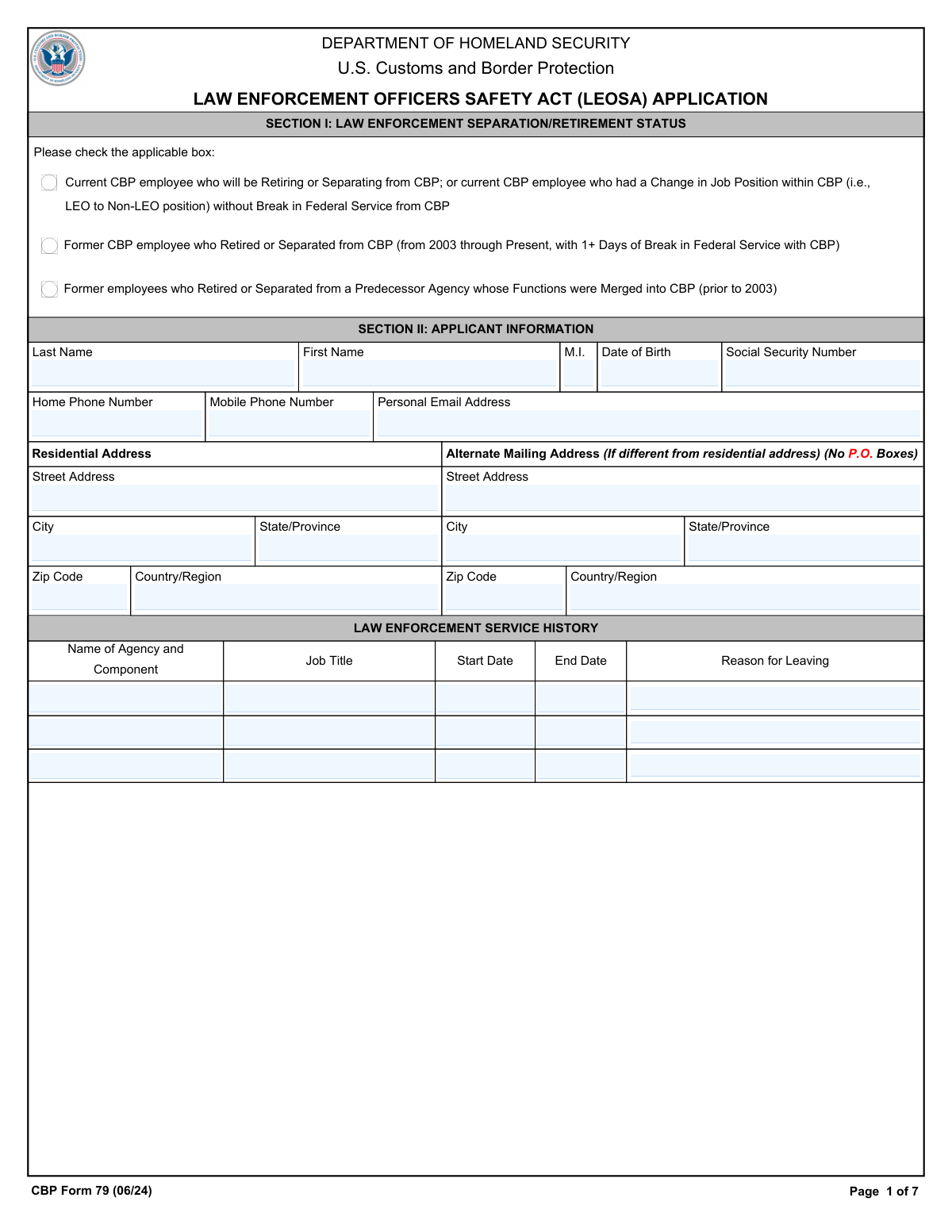
If you are a retired or former law enforcement professional, your primary document in this category is Form 79, Law Enforcement Officers Safety Act Application.
- Use Case: Use this form to apply for a LEOSA Photographic Identification card.
- Why it matters: This ID is essential for officers who wish to legally carry concealed firearms across state lines under the Law Enforcement Officers Safety Act. It ensures all federal legal requirements are documented so you can maintain your credentials post-retirement.
For Civil Protection and Restraining Orders
In the state of California, the most critical law enforcement document for civil safety is CLETS-001, Confidential Information for Law Enforcement. This form is mandatory when filing for a restraining order through the Judicial Council of California.
- Identifying Information: You must use this form to provide the court with physical descriptions, vehicle details, and employer information for the restrained person.
- Enforcement: Filing this allows the court to enter data into the California Law Enforcement Telecommunications System (CLETS). Without an accurate CLETS-001, police may have difficulty identifying parties or enforcing the order outside of the immediate court setting.
- Updates: If the restrained person moves, changes their appearance, or buys a new car, you should resubmit an updated version of this form to ensure law enforcement has current data for your safety.
Quick Selection Tips
- Applying for concealed carry as a veteran officer? Select Form 79.
- Filing for a protective order in California? Select CLETS-001.
- Concerned about privacy? Note that CLETS-001 is strictly confidential and is not filed in public court records, keeping your sensitive identifying information secure while still making it accessible to officers on the street.
Form Comparison
| Form | Primary Purpose | Who Files It | Confidentiality Level |
|---|---|---|---|
| Form 79, Law Enforcement Officers Safety Act Application | Apply for photographic identification to carry concealed firearms legally after law enforcement retirement. | Former or retiring law enforcement officers meeting specific federal legal requirements. | Standard administrative application used for identification and background verification purposes. |
| CLETS-001, Confidential Information for Law Enforcement (Judicial Council of California) | Provide identifying details for entry into the California Law Enforcement Telecommunications System registry. | Parties submitting restraining order paperwork to help officers identify and enforce the order. | Strictly confidential; not included in public court files to protect the parties involved. |
Tips for law enforcement forms
Accuracy is critical when providing physical descriptions, dates of birth, and social security numbers. Law enforcement uses these specific identifiers to distinguish individuals in databases like the California Law Enforcement Telecommunications System (CLETS), ensuring orders are enforced against the correct person.
Many law enforcement forms, such as the CLETS-001, are kept separate from public court records to protect sensitive data. Ensure you are aware of which documents are marked as confidential so you can provide necessary identifying information without it becoming part of the public case file.
AI-powered tools like Instafill.ai can complete these law enforcement forms in under 30 seconds with high accuracy. This is a significant time-saver for those managing multiple filings, and you can rest assured that your sensitive data stays secure during the automated process.
If identifying details like a vehicle's license plate or a workplace address change, submit an updated form immediately. Keeping this information current ensures that officers have the most accurate data for serving legal papers or identifying parties during field interactions.
Forms like the LEOSA application often require specific proof of service or retirement credentials. Having these documents scanned and ready before you start will help you complete the application smoothly and prevent delays in your photographic identification request.
Handwritten forms are prone to transcription errors when clerks enter data into police registries. Filling out these forms digitally ensures that every character is clear, reducing the risk of law enforcement failing to identify a subject due to illegible handwriting.
Frequently Asked Questions
Law enforcement forms are used for a variety of administrative and legal processes, such as applying for retired officer firearm permits or providing identifying data for protective order registries. These documents ensure that police agencies have the accurate, standardized information necessary to enforce laws and maintain public safety.
Form 79 is intended for former or retiring law enforcement officers who wish to apply for a Law Enforcement Officers Safety Act (LEOSA) Photographic Identification. This identification allows qualified retired officers to carry concealed firearms legally across state lines, provided they meet specific legal and training requirements.
The CLETS-001 is a mandatory form that provides the court with specific identifying details about the restrained person and the protected parties. This information is entered into the California Law Enforcement Telecommunications System, which allows officers in the field to quickly verify and enforce the terms of the order.
Yes, AI tools like Instafill.ai can be used to fill out these forms accurately and efficiently. The AI can extract data from your source documents and place it into the correct fields, ensuring that sensitive information is transcribed correctly without manual typing errors.
Using AI-powered automation, you can complete complex law enforcement forms in under 30 seconds. Services like Instafill.ai streamline the process by automatically identifying where information needs to go, significantly reducing the time spent on paperwork.
Many of these forms, particularly the CLETS-001, are strictly confidential and are not filed in the public court record. They are used exclusively by court clerks and law enforcement agencies for database entry and identification purposes to protect the privacy of the parties involved.
Submission requirements depend on the specific form; for example, application forms for retired officers are usually sent to the issuing police agency, while restraining order data forms are submitted to the court clerk. You should always verify the specific filing instructions provided by your local jurisdiction or the agency handling your request.
If there are significant changes to the information provided—such as a change in address, employment, or vehicle details—you should typically resubmit an updated version of the form. Keeping this information current is essential for law enforcement to effectively identify parties and enforce legal orders.
You will generally need to provide full names, dates of birth, physical descriptions, social security numbers, and sometimes vehicle or employer information. This high level of detail is necessary to ensure that law enforcement officers can accurately identify individuals during background checks or field encounters.
These forms provide the data needed to populate law enforcement databases, which officers access during stops or investigations. Having accurate information on file helps officers quickly determine the validity of a concealed carry permit or the specific terms of a restraining order.
Glossary
- Form Complexity Index
- Instafill’s 0–100 measure of how much effort a form takes to complete, calculated deterministically from the form’s own structure rather than estimated. It combines the number of fillable fields (the largest factor), how difficult those fields are to complete based on their type, the number of pages that contain fields, the amount of conditional “fill-only-if” logic, and how many sections the form is divided into, then adds modifiers for tables and repeating lists, bundled instruction pages, and dense page layouts. A higher score means the form is harder to fill out by hand. The forms in this category have a median Form Complexity Index of 51/100 (Moderate). See exactly how it is calculated.
- CLETS
- The California Law Enforcement Telecommunications System, a secure network used by agencies to access and share criminal history, vehicle records, and restraining order data.
- Restrained Person
- The individual who is legally prohibited by a court order from contacting, approaching, or harassing specific individuals named in the order.
- Protected Person
- The individual or individuals whom the court has granted legal protection from another party through a restraining or protective order.
- LEOSA
- The Law Enforcement Officers Safety Act, a federal law that allows qualified active and retired law enforcement officers to carry concealed firearms across state lines.
- Service of Process
- The formal delivery of legal documents, such as a restraining order, to the restrained person to ensure they have official notice of the court's requirements.
- Protective Order Registry
- A centralized database where law enforcement stores active restraining orders to ensure they can be verified and enforced across different jurisdictions.
- Citizen Complaint
- A formal document filed by a member of the public alleging misconduct, excessive force, or unprofessional behavior by a law enforcement officer or agency.
- Photographic Identification
- A specific credential issued to retired officers that proves their former status and eligibility to carry a firearm under federal LEOSA regulations.