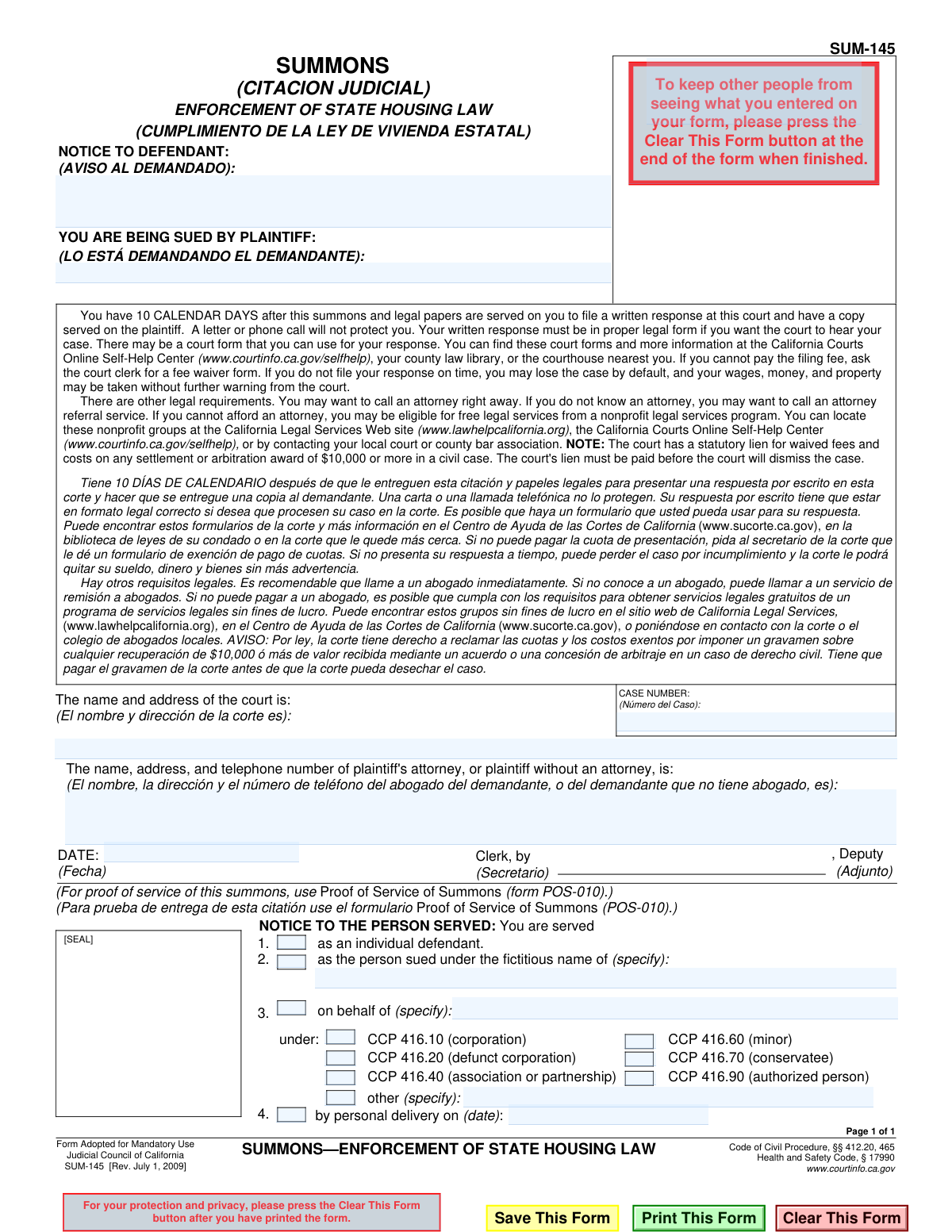
Yes! You can use AI to fill out Form SUM-145, Summons—Enforcement of State Housing Law

Form SUM-145, Summons—Enforcement of State Housing Law, is a mandatory California Judicial Council form used to officially notify a defendant that a lawsuit has been filed against them concerning violations of state housing regulations. It is a critical legal document that initiates the legal process, informing the recipient of the lawsuit and the strict 10-day deadline to file a formal response with the court to avoid a default judgment. Today, this form can be filled out quickly and accurately using AI-powered services like Instafill.ai, which can also convert non-fillable PDF versions into interactive fillable forms.
SUM-145 is part of the California court forms, California state forms and law enforcement forms categories on Instafill.
Our AI automatically handles information lookup, data retrieval, formatting, and form filling.
It takes less than a minute to fill out SUM-145 using our AI form filling.
Securely upload your data. Information is encrypted in transit and deleted immediately after the form is filled out.

Form specifications

Form name: Form SUM-145, Summons—Enforcement of State Housing Law
Number of fields: 27
Number of pages: 1
Language: English
main-image

Instafill Demo: How to fill out PDF forms in seconds with AI

How to Fill Out SUM-145 Online for Free in 2026

Are you looking to fill out a SUM-145 form online quickly and accurately? Instafill.ai offers the #1 AI-powered PDF filling software of 2026, allowing you to complete your SUM-145 form in just 37 seconds or less.
Follow these steps to fill out your SUM-145 form online using Instafill.ai:
  1. 1 Navigate to Instafill.ai and upload or select the SUM-145 form.
  2. 2 Provide the court's name and address, the case number, and the plaintiff's information.
  3. 3 Enter the full name of the defendant being sued.
  4. 4 Specify how the defendant is being served by checking the appropriate box (e.g., as an individual, on behalf of a corporation).
  5. 5 Use the AI assistant to review all entered information for accuracy and completeness, ensuring all required fields are filled correctly.
  6. 6 Securely download or print the completed SUM-145, ready for filing with the court and for formal service to the defendant.

Our AI-powered system ensures each field is filled out correctly, reducing errors and saving you time.

Why Choose Instafill.ai for Your Fillable SUM-145 Form?

Speed

Complete your SUM-145 in as little as 37 seconds.

Up-to-Date

Always use the latest 2026 SUM-145 form version.

Cost-effective

No need to hire expensive lawyers.

Accuracy

Our AI performs 10 compliance checks to ensure your form is error-free.

Security

Your personal information is protected with bank-level encryption.

Frequently Asked Questions About Form SUM-145

This form is a legal notice, called a summons, informing you that you are being sued for allegedly violating California's state housing laws. It officially starts the lawsuit and requires you to formally respond to the court.

You received this summons because a plaintiff (the person or entity suing) has filed a legal case against you in court. They are claiming that you have not complied with specific state housing regulations.

You have 10 calendar days after the summons and legal papers are served on you to file a written response with the court. The clock starts ticking the day you receive the documents.

If you do not file a response within the 10-day deadline, you may lose the case by default. This could allow the court to take your wages, money, and property without further warning.

No, a phone call or an informal letter is not a valid legal response and will not protect you. You must file a formal written response using the proper court forms to have your case heard.

The plaintiff (the party initiating the lawsuit) or their attorney fills out this form to be issued by the court. As the defendant, you receive the completed form and must then prepare and file a separate response form.

These boxes specify in what capacity you are being sued. For example, you could be served as an individual, or on behalf of a corporation, partnership, or as the guardian of a minor.

You can ask the court clerk for a fee waiver form. If you meet the eligibility requirements, the court may waive the fees required to file your response.

You can find the necessary court forms and other information at the California Courts Online Self-Help Center, your county law library, or the courthouse where the case was filed.

You may be eligible for free legal services from a nonprofit legal aid organization. You can find these groups through the California Legal Services website or by contacting your local bar association.

Yes, services like Instafill.ai use AI to help you accurately auto-fill the fields on your response forms. This can save you time and help reduce errors before you file with the court.

You can use a service like Instafill.ai to complete your legal forms online. Simply upload the correct PDF form, and the tool will make it easy to type in your information before printing.

If you have a flat, non-fillable PDF, you can use a tool like Instafill.ai to instantly convert it into an interactive, fillable form. This allows you to type your answers directly into the document for a clean, professional appearance.

The POS-010 form is completed by the person who delivered the summons to you. It serves as proof to the court that you were properly notified of the lawsuit, and it is not a form that you, the defendant, need to fill out.

Compliance SUM-145
Validation Checks by Instafill.ai

1
Case Number Presence and Format
This check verifies that the 'CASE NUMBER' field is not empty and conforms to the standard format used by the court jurisdiction. The case number is the primary identifier for the legal action and is essential for all filing and tracking purposes. A missing or incorrectly formatted case number would cause the document to be rejected by the court clerk, halting the legal process.
2
Plaintiff/Attorney Information Completeness
Validates that the block for the plaintiff's or plaintiff's attorney's information contains a name, a full mailing address, and a telephone number. This information is legally required to inform the defendant and the court who is bringing the action and where to send legal correspondence. Incomplete information can render the summons defective and may be grounds for dismissal.
3
Court Name and Address Presence
Ensures that the name and address of the court where the lawsuit is filed are clearly stated. This is critical information for the defendant, as it tells them where they must file their formal written response. Failure to provide the correct court location would make it impossible for the defendant to respond, violating their due process rights.
4
Plaintiff Name Required
This check confirms that the 'YOU ARE BEING SUED BY PLAINTIFF' field is filled in with the legal name of the suing party. The defendant has a fundamental right to know who is suing them. A summons without a named plaintiff is legally invalid and fails to properly initiate a lawsuit.
5
Defendant Name Required
Verifies that the 'NOTICE TO DEFENDANT' field contains the name of the individual or entity being sued. This is the most crucial piece of information for establishing jurisdiction over the party being summoned. An incorrect or missing defendant name means the summons is not directed at anyone in particular and is therefore unenforceable.
6
Exclusive Service Capacity Selection
This validation ensures that only one of the primary checkboxes under 'NOTICE TO THE PERSON SERVED' is selected (e.g., 'as an individual', 'on behalf of', 'fictitious name'). A person is served in a single, specific legal capacity for a given action. Selecting multiple options creates ambiguity that could invalidate the service of process.
7
Fictitious Name Specification if Checked
If the checkbox 'as the person sued under the fictitious name of' is selected, this check ensures the corresponding text field specifying that name is filled out. The law requires the specific fictitious name or 'DBA' to be identified for the service to be valid against a business operating under that name. A blank field makes the designation incomplete and legally insufficient.
8
Conditional Requirement for 'On Behalf Of' Specification
When the 'on behalf of' checkbox is selected, this validation confirms that the accompanying text field specifying the entity (e.g., corporation name) is completed. It is not enough to serve an agent; the summons must clearly state the principal entity being sued. Omitting the entity's name creates a fatal defect in the summons.
9
Legal Status Selection for 'On Behalf Of' Service
If service is made 'on behalf of' an entity, this check ensures one of the sub-options specifying the entity's legal status (e.g., CCP 416.10 for corporation) is also selected. The Code of Civil Procedure (CCP) dictates different service requirements for different entity types. This specification is necessary to prove the method of service was legally proper.
10
Personal Delivery Date Validity and Format
This check validates that the 'by personal delivery on (date)' field contains a complete and valid date in a standard format (e.g., MM/DD/YYYY). The date of service is legally critical as it starts the 10-day countdown for the defendant's response. An invalid or ambiguous date could lead to disputes over filing deadlines and potential default judgments.
11
Personal Delivery Date Cannot Be in the Future
This validation ensures the date of personal delivery is not set to a future date. Service of a summons is a past event at the time of filing proof of service. A future date is a logical impossibility and indicates a significant data entry error that must be corrected for the document to be credible.
12
Service Method Indication
Ensures that at least one checkbox in the 'NOTICE TO THE PERSON SERVED' section is selected to indicate the capacity in which the defendant was served. The form is incomplete without specifying how the defendant is being brought into the lawsuit. This information is fundamental to proving that legal service was properly achieved.

Common Mistakes in Completing SUM-145

Incorrectly Identifying the Defendant

Filers often misspell the defendant's name or list the wrong legal entity, such as naming an individual instead of their trust or corporation. This is a critical error because a summons must be directed to the correct legal party to be valid. An incorrect defendant name can lead to the case being dismissed, forcing the plaintiff to start over.

Filing with the Incorrect Court

The plaintiff may enter the name and address of the wrong court, for example, one in a different county from where the property is located. Filing in the wrong jurisdiction, or venue, can cause significant delays or lead to the case being dismissed entirely. Always verify the correct courthouse based on the specifics of the case before filling out this section.

Incomplete Plaintiff or Attorney Information

This mistake involves leaving the plaintiff's or their attorney's name, address, or phone number field incomplete or with typos. This prevents the defendant and the court from being able to send required notices or communicate with the filing party. Such an error can stall the legal process and may even be grounds for the court to reject the filing.

Misinterpreting the 10-Day Response Deadline

Although not a data entry error, the most severe mistake a defendant can make is misunderstanding the form's instructions. The summons clearly states a formal written response must be filed with the court within 10 calendar days and that 'a letter or phone call will not protect you.' Ignoring this and failing to file a proper response can result in losing the case by default, allowing the court to seize wages and property.

Omitting the Date of Service

The process server, who fills out the bottom portion of the form, may forget to enter the date in the 'by personal delivery on (date)' field. This date is legally crucial as it starts the 10-day countdown for the defendant's response. Without a specified date of service, it's impossible to enforce the response deadline, potentially invalidating the service and requiring the plaintiff to serve the papers again.

Neglecting to File the Separate Proof of Service Form (POS-010)

The summons explicitly instructs the user to file a separate 'Proof of Service of Summons (form POS-010).' A common oversight is assuming that the service information filled out on the summons itself is sufficient. Failing to file the completed POS-010 form with the court means there is no official record that the defendant was properly served, which will halt the case's progress.

Incorrectly Marking How the Defendant Was Served

The process server may check the wrong box in the 'NOTICE TO THE PERSON SERVED' section, for instance, marking 'as an individual defendant' when they actually served an agent for a corporation. This section must accurately reflect who was served and in what capacity. An error here can support a motion to quash service, causing major delays and added costs for the plaintiff.

Failing to Specify the Entity Being Sued

When serving a business or other organization, the filer might check a box like 'CCP 416.10 (corporation)' but forget to write the full name of the corporation in the 'on behalf of (specify)' field. This creates ambiguity about which legal entity is being sued. To be valid, the form must clearly state both the type of entity and its specific legal name.

Using Illegible Handwriting

When filling out a printed form by hand, illegible writing is a frequent problem that can render the document invalid. If the court clerk cannot read the names, addresses, or other critical information, they may reject the filing or enter the data incorrectly into the court system. To prevent this, it is best to use a fillable PDF or an AI-powered tool like Instafill.ai to ensure all entries are clear and legible.

Improperly Filling a Non-Fillable PDF Version

Users often download a 'flat' or non-fillable PDF of the form and attempt to add text, resulting in misaligned and unprofessional entries. This can make the document difficult to read and may lead to its rejection by the court clerk. If a form is only available as a flat PDF, tools like Instafill.ai can convert it into an easily fillable version, ensuring a clean and accurate submission.
Saved over 80 hours a year

“I was never sure if my IRS forms like W-9 were filled correctly. Now, I can complete the forms accurately without any external help.”

Kevin Martin Green

Your data stays secure with advanced protection from Instafill and our subprocessors

Robust compliance program

Transparent business model

You’re not the product. You always know where your data is and what it is processed for.

ISO 27001, HIPAA, and GDPR

Our subprocesses adhere to multiple compliance standards, including but not limited to ISO 27001, HIPAA, and GDPR.

Security & privacy by design

We consider security and privacy from the initial design phase of any new service or functionality. It’s not an afterthought, it’s built-in, including support for two-factor authentication (2FA) to further protect your account.

Fill out SUM-145 with Instafill.ai

Worried about filling PDFs wrong? Instafill securely fills form-sum-145-summonsenforcement-of-state-housing-law forms, ensuring each field is accurate.

Related forms by category

California court forms Judicial Council of California Form SC-105, Request for Court Order and Answer (Small Claims), Judicial Council of California Form SC-120, Defendant’s Claim and ORDER to Go to Small Claims Court (Small Claims), Judicial Council of California Form SER-001, Request for Sheriff to Serve Court Papers, Judicial Council of California Form SER-001, Request for Sheriff to Serve Court Papers, Affidavit for Collection of Personal Property California Probate Code Section 13100, Form POS-040, Proof of Service—Civil, Declaration of Facts of Death (California Superior Court), declaration-of-marriage-for-court-proceeding-california-family-law, ADOPT-200, Adoption Request, ADOPT-200, Stepparent Adoption Request, ADOPT-210, Adoption Agreement, ADOPT-310, Contact After Adoption Agreement, Judicial Council of California Form ADOPT-200, Adoption Request, Form ADR-107, Mediation Attendance Sheet, Form ADR-110, Order Appointing Referee, Form ADR-109, Stipulation or Motion for Order Appointing Referee, Form ADR-102, Request for Trial De Novo After Judicial Arbitration, Form ADR-108, Referee's Report (Code Civ. Proc., §§ 638, 639), Form ADR-106, Petition to Confirm, Correct, or Vacate Contractual Arbitration Award, Form ADR-104, Rejection of Award and Request for Trial After Attorney-Client Fee Arbitration · + 557 more →
California state forms Judicial Council of California Form DE-111, Petition for Probate (Probate—Decedents Estates), Judicial Council of California Form DE-111, Petition for Probate (Probate—Decedents Estates), DS 1891, Applicant/Vendor Disclosure Statement (State of California Department of Developmental Services), DL 142, Request for Cancellation or Surrender of a Driver License or Identification Card (State of California Department of Motor Vehicles), Judicial Council of California Form DE-120, Notice of Hearing—Decedent's Estate or Trust, Judicial Council of California Form DE-120, Notice of Hearing—Decedent's Estate or Trust, Murrieta Police Department Citizen Complaint Form (California Penal Code § 148.6 Advisory Statement), California Department of Social Services, Sworn Statement, State of California Department of Transportation California Civil Rights Laws Certification, State of California Department of Transportation Darfur Contracting Act Certification, Form DOT ADM-0077, State of California Department of Transportation, Contract Requirements, State of California Department of Transportation Subcontractor List, State of California Department of Transportation, Certified DVBE Summary, Bidder Declaration GSPD-05-105, State of California Level of Care Rate Determination Protocol Matrix, State of California Accessible Form, State of California Form SOC 321, Request for Order and Consent - Paramedical Services, State of California Darfur Contracting Act Certification, State of California Department of Veterans Affairs COMMERCIALLY USEFUL FUNCTION (CUF) CERTIFICATION FORM, Form ADR-100, Statement of Agreement or Nonagreement · + 47 more →
law enforcement forms Form 79, Law Enforcement Officers Safety Act Application, CLETS-001, Confidential Information for Law Enforcement (Judicial Council of California), CLETS-001, Confidential Information for Law Enforcement (Judicial Council of California), CLETS-001, Confidential Information for Law Enforcement (Judicial Council of California), Florida Supreme Court Approved Family Law Form 12.902(d), Uniform Child Custody Jurisdiction and Enforcement Act (UCCJEA) Affidavit, Florida Supreme Court Approved Family Law Form 12.941(a), Petition for Enforcement of Out-of-State Custody Decree and for Order to Pick Up Minor Child(ren), Form CLETS-001, Confidential Information for Law Enforcement, TCOLE Personal History Statement for Texas Law Enforcement, Form CLETS-002, Confidential Information for Law Enforcement—Criminal