
Yes! You can use AI to fill out Florida Supreme Court Approved Family Law Form 12.902(d), Uniform Child Custody Jurisdiction and Enforcement Act (UCCJEA) Affidavit
Don't type 174 fields by hand. Tell our AI about yourself, or upload a document you already have, and it fills every field in seconds. You check it, then download, print or sign.
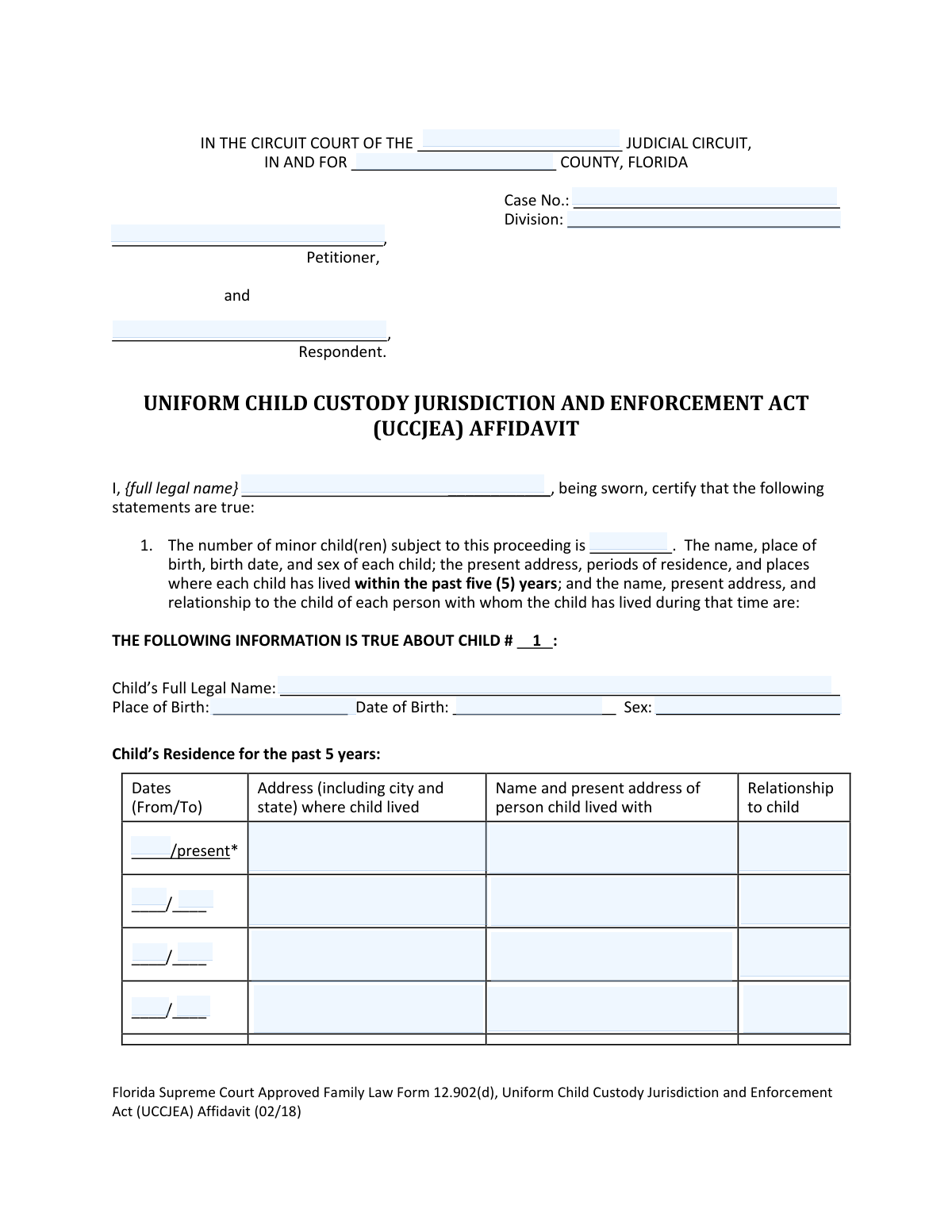
The AI does the filling. You just check it.
No typing into boxes, nothing to install.
What this form asks for
The AI fills all of it, from your answers or your documents.
The AI checks your answers before you download
14 checks built for this form, so a wrong date or a missing answer is caught before anyone else sees it.
This check verifies that the number entered in the 'Number of minor child(ren)' field matches the number of individual child information sections that are completed. This is crucial for ensuring the affidavit is complete and accurately reflects all children subject to the proceeding. A mismatch would lead to an incomplete or inaccurate legal declaration, potentially delaying the case.
This validation calculates the child's age using the 'Date of Birth' and the current date to confirm they are a minor (under 18 years old). The UCCJEA affidavit specifically applies to minor children, so providing information for an adult would be incorrect and could lead to the form's rejection. This ensures the form's scope is correctly applied.
This check examines the 'From/To' dates for each child's residence history to ensure they are in reverse chronological order and do not have overlapping time periods. Correct chronological data is essential for the court to establish jurisdiction by determining the child's home state. Errors in the timeline could lead to jurisdictional challenges and complicate the case.
This validation ensures that the listed residences for each child collectively cover the entire five-year period preceding the filing date. The UCCJEA requires a complete five-year history to determine jurisdiction properly. Gaps in this history can render the affidavit insufficient and may require the filer to amend the document, causing delays.
This check ensures that if the user selects 'I HAVE participated...' in Section 2, they must provide all required details (Name of child, Type of proceeding, Court and state, Date of order). Failing to provide these specifics makes the declaration incomplete and prevents the court from understanding the full litigation history. The form would be considered deficient if the explanation is missing.
This validation triggers if the user checks 'I HAVE THE FOLLOWING INFORMATION...' in Section 3, requiring them to fill out the details of the pending case, including the case number. This information is critical for preventing conflicting court orders and ensuring judicial efficiency. Omitting these details after indicating their existence would result in an incomplete and potentially misleading affidavit.
And 8 more checks
- Ensures Non-Party Details are Provided When Acknowledged
- Validates Date Format for All Date Fields
- Enforces 'Choose Only One' Rule for Sections 2, 3, 4, and 5
- Requires Full Details for Nonlawyer Assistance
- Verifies Affiant Name Matches Petitioner or Respondent
- Ensures Certificate of Service is Fully Completed
- Validates Logic for Child's Present Residence Entry
- Ensures All Case Header Fields are Populated
Let AI fill out your Form 12.902(d)
No typing. Every field filled in seconds, checked, ready to sign.
How to Fill Out Form 12.902(d) Online for Free in 2026
What the AI walks you through.
- Navigate to Instafill.ai and upload your Form 12.902(d) or select it from their template library.
- Provide the court and case information, including the judicial circuit, county, case number, and the names of the petitioner and respondent.
- Enter your personal information as the affiant and state the number of minor children involved in the proceeding.
- For each child, provide their full name, date and place of birth, and a detailed five-year residence history, including addresses, dates, and the names of persons the child lived with.
- Answer the questions regarding your participation in any past or pending custody, time-sharing, or visitation proceedings in any state or country.
- Disclose information about any other individuals (not a party to the case) who have or claim custody or visitation rights, and detail any existing child support orders.
- Review the completed affidavit for accuracy, then sign the form in the presence of a notary public or deputy clerk before filing it with the court.
Common Mistakes in Completing Form 12.902(d)
The ones the AI is built to catch.
Incomplete 5-Year Child Residence History
Missing Present Address for 'Person Child Lived With'
Confusing Past vs. Pending Court Cases
Failure to Disclose All Persons with Custody Claims
Forgetting the Separate 'Notice of Confidential Information' Form
Signing the Affidavit Without a Notary
Incorrectly Handling Confidential Addresses for Safety
Leaving Mandatory Checkbox Sections Blank
Incomplete or Incorrect Certificate of Service
Using Informal Names Instead of Full Legal Names
Failing to Use the Correct Form Version
Frequently Asked Questions About Form 12.902(d)
Is it really free for 7 days?
Can I fill other forms too?
How do I cancel?
How does the AI fill out Form 12.902(d)?
What happens to my information?
How complex is Form 12.902(d) to fill out?
What is the purpose of the UCCJEA Affidavit, Form 12.902(d)?
Do I need to fill out this form if the other parent and I agree on custody?
What information do I need to list for my child's 5-year residence history?
What do I do after I complete the form?
Am I required to file this form electronically?
How can I protect my address if I am a victim of domestic violence?
What other form must be filed with this affidavit?
What does the 'continuing duty to advise this Court' in Section 6 mean?
What should I do if I don't know the details of a past court case mentioned in the form?
Can an AI tool help me fill out this form?
How can I fill out this UCCJEA Affidavit online?
The PDF form I downloaded isn't fillable. What can I do?
What happens if a nonlawyer helps me fill out this form?
Get your Form 12.902(d) filled out by AI
$0 today. Cancel before Nov 4 and you pay nothing.
Other forms like this one
court forms: Form Summons, Supreme Court of New York, Form SC-100, Plaintiff's Claim and ORDER to Go to Small Claims Court, Form AO 240, Application to Proceed in District Court Without Prepaying Fees or Costs, Form AO 239, Application to Proceed in District Court Without Prepaying Fees or Costs, Affidavit for Service by Publication/Posting (Circuit Court of Cook County, Illinois) (CCG 0013 A/B), Petition for Leave to Proceed In Forma Pauperis (Court of Common Pleas of Lehigh County, Pennsylvania, Civil Division), In Forma Pauperis Affidavit/Petition (AOPC 622A) – Pennsylvania Magisterial District Court, Judicial Council of California Form SC-105, Request for Court Order and Answer (Small Claims), SC-120, Defendant’s Claim and ORDER to Go to Small Claims Court (Small Claims), SC-105, Request for Court Order and Answer (Small Claims), Judicial Council of California Form SC-120, Defendant’s Claim and ORDER to Go to Small Claims Court (Small Claims), In Forma Pauperis Affidavit Petition (AOPC 622A) — Pennsylvania Magisterial District Court, Florida Supreme Court Approved Family Law Form 12.901(b)(3), Petition for Dissolution of Marriage with No Dependent or Minor Child(ren) or Property (02/18), Illinois Supreme Court Approved Form E-O 3500.3, Eviction Order, Form P3 (Rule 25-3(2)) — Affidavit of Applicant for Grant of Probate or Grant of Administration with Will Annexed (Short Form) (Supreme Court of British Columbia), Form SC-100, Plaintiff’s Claim and ORDER to Go to Small Claims Court, Designation of Record on Appeal (Civil) (Maricopa County Justice Courts, Arizona) (Form APP 8150-702), FW-003, Order on Court Fee Waiver (Superior Court), Judicial Council of California Form SER-001, Request for Sheriff to Serve Court Papers, FW-003, Order on Court Fee Waiver (Superior Court)
family law forms: Form 12.902(b), Family Law Financial Affidavit (Short Form), Florida Supreme Court Approved Family Law Form 12.901(b)(3), Petition for Dissolution of Marriage with No Dependent or Minor Child(ren) or Property (02/18), Form FL-170, Declaration for Default or Uncontested Dissolution or Legal Separation (Family Law), Form FL-100, Petition—Marriage/Domestic Partnership (Family Law), declaration-of-marriage-for-court-proceeding-california-family-law, Florida Family Law Rules of Procedure Form 12.910(a), Summons: Personal Service on an Individual, Florida Supreme Court Approved Family Law Form 12.941(a), Petition for Enforcement of Out-of-State Custody Decree and for Order to Pick Up Minor Child(ren), Florida Supreme Court Approved Family Law Form 12.970(a), Petition for Temporary Custody by Extended Family, Form FL-110, Summons (Family Law), Form FL-120, Response—Marriage/Domestic Partnership (Family Law), ADOPT-200, Adoption Request, ADOPT-200, Stepparent Adoption Request, ADOPT-210, Adoption Agreement, ADOPT-310, Contact After Adoption Agreement, Adoption Assistance Program Nonrecurring Adoption Expense Agreement and Claim, Adoption Request (Stepparent), Adoption and Safe Families Act (ASFA) Survey, Florida Family Law Rules of Procedure Form 12.900(b), Notice of and Consent to Limited Appearance, Florida Family Law Rules of Procedure Form 12.900(d), Termination of Limited Appearance, Florida Family Law Rules of Procedure Form 12.900(e), Acknowledgment of Assistance by Attorney
law enforcement forms: Form 79, Law Enforcement Officers Safety Act Application, CLETS-001, Confidential Information for Law Enforcement (Judicial Council of California), CLETS-001, Confidential Information for Law Enforcement (Judicial Council of California), CLETS-001, Confidential Information for Law Enforcement (Judicial Council of California), Florida Supreme Court Approved Family Law Form 12.941(a), Petition for Enforcement of Out-of-State Custody Decree and for Order to Pick Up Minor Child(ren), Form CLETS-001, Confidential Information for Law Enforcement, TCOLE Personal History Statement for Texas Law Enforcement, Form CLETS-002, Confidential Information for Law Enforcement—Criminal, Form SUM-145, Summons—Enforcement of State Housing Law
UK court forms: Form Summons, Supreme Court of New York, Form SC-100, Plaintiff's Claim and ORDER to Go to Small Claims Court, Form AO 240, Application to Proceed in District Court Without Prepaying Fees or Costs, Form AO 239, Application to Proceed in District Court Without Prepaying Fees or Costs, Affidavit for Service by Publication/Posting (Circuit Court of Cook County, Illinois) (CCG 0013 A/B), Petition for Leave to Proceed In Forma Pauperis (Court of Common Pleas of Lehigh County, Pennsylvania, Civil Division), In Forma Pauperis Affidavit/Petition (AOPC 622A) – Pennsylvania Magisterial District Court, Judicial Council of California Form SC-105, Request for Court Order and Answer (Small Claims), SC-120, Defendant’s Claim and ORDER to Go to Small Claims Court (Small Claims), SC-105, Request for Court Order and Answer (Small Claims), Judicial Council of California Form SC-120, Defendant’s Claim and ORDER to Go to Small Claims Court (Small Claims), In Forma Pauperis Affidavit Petition (AOPC 622A) — Pennsylvania Magisterial District Court, Florida Supreme Court Approved Family Law Form 12.901(b)(3), Petition for Dissolution of Marriage with No Dependent or Minor Child(ren) or Property (02/18), Illinois Supreme Court Approved Form E-O 3500.3, Eviction Order, Form P3 (Rule 25-3(2)) — Affidavit of Applicant for Grant of Probate or Grant of Administration with Will Annexed (Short Form) (Supreme Court of British Columbia), Form SC-100, Plaintiff’s Claim and ORDER to Go to Small Claims Court, Designation of Record on Appeal (Civil) (Maricopa County Justice Courts, Arizona) (Form APP 8150-702), FW-003, Order on Court Fee Waiver (Superior Court), Judicial Council of California Form SER-001, Request for Sheriff to Serve Court Papers, FW-003, Order on Court Fee Waiver (Superior Court)
affidavit forms: Affidavit for Collection of Personal Property California Probate Code Section 13100, Form I-864, Affidavit of Support Under INA, Form DS-5507, Affidavit of Physical Presence, Form 12.902(b), Family Law Financial Affidavit (Short Form), Form E, Affidavit of Personal Service, Form I-361, Affidavit of Financial Support, Form EX550, Affidavit (Order to attend for questioning/suspended committal order), Form CJA-23, Financial Affidavit, Affidavit and Representations Regarding Next of Kin (Preference Beneficiary Affidavit) (The Hartford) – Form LC-7086-17, Affidavit for Service by Publication/Posting (Circuit Court of Cook County, Illinois) (CCG 0013 A/B), In Forma Pauperis Affidavit/Petition (AOPC 622A) – Pennsylvania Magisterial District Court, In Forma Pauperis Affidavit Petition (AOPC 622A) — Pennsylvania Magisterial District Court, Form P3 (Rule 25-3(2)) — Affidavit of Applicant for Grant of Probate or Grant of Administration with Will Annexed (Short Form) (Supreme Court of British Columbia), Uniform Domestic Relations Form – Affidavit 1 AFFIDAVIT OF BASIC INFORMATION, INCOME, AND EXPENSES, TIAA Brokerage Durable Power Of Attorney Affidavit Of Full Force And Effect, Form L-4260, Property Transfer Affidavit, Affidavit - Supporting Documents Not Attached to Eviction Complaint, Missouri Motion and Affidavit in Support of Request to Proceed As a Poor Person, Form AOC-SP-300, Petition And Affidavit/Affirmation For Involuntary Commitment, Form 35.1A: Affidavit (child protection information)
family court forms: Form 12.995(c), Safety-Focused Parenting Plan, Florida Supreme Court Approved Family Law Form 12.901(b)(3), Petition for Dissolution of Marriage with No Dependent or Minor Child(ren) or Property (02/18), Form N161, Appellant’s notice (All appeals except small claims track appeals and appeals to the Family Division of the High Court), Form N161, Appellant's Notice (All appeals except small claims track appeals and appeals to the Family Division of the High Court), declaration-of-marriage-for-court-proceeding-california-family-law, Florida Supreme Court Approved Family Law Form 12.941(a), Petition for Enforcement of Out-of-State Custody Decree and for Order to Pick Up Minor Child(ren), Florida Supreme Court Approved Family Law Form 12.970(a), Petition for Temporary Custody by Extended Family, Adoption Request (Stepparent), Florida Family Law Rules of Procedure Form 12.900(b), Notice of and Consent to Limited Appearance, Florida Family Law Rules of Procedure Form 12.900(d), Termination of Limited Appearance, Florida Family Law Rules of Procedure Form 12.900(e), Acknowledgment of Assistance by Attorney, Florida Family Law Rules of Procedure Form 12.900(g), Agreement Limiting Representation, Florida Family Law Rules of Procedure Form 12.900(h), Notice of Related Cases, Florida Family Law Rules of Procedure Form 12.901(a), Joint Petition for Simplified Dissolution of Marriage, Form 12.902(b), Family Law Financial Affidavit (Short Form), Florida Family Law Rules of Procedure Form 12.902(c), Family Law Financial Affidavit (Long Form), Florida Family Law Rules of Procedure Form 12.902(e), Child Support Guidelines Worksheet, Florida Supreme Court Approved Family Law Form 12.902(f)(1), Marital Settlement Agreement for Dissolution of Marriage with Dependent or Minor Child(ren), Florida Supreme Court Approved Family Law Form 12.902(f)(2), Marital Settlement Agreement for Dissolution of Marriage with Property but No Dependent or Minor Child(ren), Florida Supreme Court Approved Family Law Form 12.902(i), Affidavit of Corroborating Witness
florida court forms: Form 12.995(c), Safety-Focused Parenting Plan, Florida Supreme Court Approved Family Law Form 12.901(b)(3), Petition for Dissolution of Marriage with No Dependent or Minor Child(ren) or Property (02/18), Florida Supreme Court Approved Family Law Form 12.941(a), Petition for Enforcement of Out-of-State Custody Decree and for Order to Pick Up Minor Child(ren), Florida Supreme Court Approved Family Law Form 12.970(a), Petition for Temporary Custody by Extended Family, Florida Family Law Rules of Procedure Form 12.900(b), Notice of and Consent to Limited Appearance, Florida Family Law Rules of Procedure Form 12.900(d), Termination of Limited Appearance, Florida Family Law Rules of Procedure Form 12.900(e), Acknowledgment of Assistance by Attorney, Florida Family Law Rules of Procedure Form 12.900(a), Disclosure from Nonlawyer, Florida Family Law Rules of Procedure Form 12.910(a), Summons: Personal Service on an Individual, Form 12.902(b), Family Law Financial Affidavit (Short Form), Florida Supreme Court Approved Family Law Form 12.902(f)(1), Marital Settlement Agreement for Dissolution of Marriage with Dependent or Minor Child(ren), Florida Supreme Court Approved Family Law Form 12.903(c)(1), Answer to Petition and Counterpetition for Dissolution of Marriage with Dependent or Minor Child(ren), Florida Supreme Court Approved Family Law Form 12.902(l), Affidavit of Income for Child Support, Florida Supreme Court Approved Family Law Form 12.903(b), Answer to Petition for Dissolution of Marriage, Florida Supreme Court Approved Family Law Form 12.902(i), Affidavit of Corroborating Witness, Florida Supreme Court Approved Family Law Form 12.902(f)(2), Marital Settlement Agreement for Dissolution of Marriage with Property but No Dependent or Minor Child(ren), Florida Family Law Rules of Procedure Form 12.902(c), Family Law Financial Affidavit (Long Form), Florida Family Law Rules of Procedure Form 12.902(e), Child Support Guidelines Worksheet, Florida Family Law Rules of Procedure Form 12.900(h), Notice of Related Cases, Florida Family Law Rules of Procedure Form 12.900(g), Agreement Limiting Representation
child custody forms: Form 12.995(c), Safety-Focused Parenting Plan, Form FL-341(E), Child Custody and Visitation (Parenting Time) Application Attachment, Florida Supreme Court Approved Family Law Form 12.941(a), Petition for Enforcement of Out-of-State Custody Decree and for Order to Pick Up Minor Child(ren), Form DV-105, Request for Child Custody and Visitation Orders (Domestic Violence Prevention), Form DV-140, Child Custody and Visitation Order (Domestic Violence Prevention), Form FL-105/GC-120, Declaration Under Uniform Child Custody Jurisdiction and Enforcement Act (UCCJEA), form-fl-105gc-120-declaration-under-uniform-child-custody-jurisdiction-and-enforcement-act-uccjea-1, Uniform Child Custody Jurisdiction Enforcement Act Affidavit, Florida Supreme Court Approved Family Law Form 12.905(a), Supplemental Petition to Modify Parental Responsibility, Visitation or Parenting Plan / Time-Sharing Schedule and Other Relief, Florida Supreme Court Approved Family Law Form 12.995(a), Parenting Plan, Form DV-305, Request to Change Child Custody and Visitation Orders (Domestic Violence Prevention), Form ICWA-030, Notice of Child Custody Proceeding for Indian Child (Indian Child Welfare Act), Form FL-260, Petition for Custody and Support of Minor Children, Form FL-270, Response to Petition for Custody and Support of Minor Children, Affidavit Regarding Minor Children (Superior Court of Arizona in Maricopa County), Joint Legal Decision-Making Education Order, Sole Legal Decision-Making Education Order, Exhibit: Out-of-State Party Declaration (Form FM-OSP-302), Standard Possession Order, Counter-Petition to Modify the Parent-Child Relationship
Let AI fill out your Form 12.902(d)
Your trial starts once a card is added. You pay nothing before Nov 4.
Our AI already knows this form, all 174 fields of it. Skip the typing: tell it about yourself, or upload what you have, and it fills the whole form in seconds.
- AI fills every field on all 8 pages, tables and checkboxes included
- No typing into boxes: answer a few questions, or upload a document you already have, an old copy of this form, a photo of a document
- The AI checks the answers; you review and change anything before you download
- Download the finished PDF, print it, or sign it online
- Encrypted, and never used to train AI
Cancel before Nov 4 and you pay nothing.
A card is needed to start the trial. Cancel in two clicks from your account.
Terms · Privacy