Fill out court forms
with AI.
Court forms are the essential building blocks of any legal proceeding, providing the standardized structure required for the judicial system to function effectively. This category covers a broad spectrum of legal documentation, from initial summons and complaints to final judgments and enforcement orders. These documents are critical because they ensure that all parties—including the judge, the plaintiff, and the defendant—have a clear, documented record of the facts and requests at hand. Proper documentation is not just a formality; it is a procedural requirement that protects your due process rights and keeps your case moving through the court system.
By continuing, you acknowledge Instafill's Privacy Policy and agree to get occasional product update and promotional emails.
About court forms
Typically, these forms are needed by individuals navigating small claims, family law disputes, or civil litigation. For example, a person in California might use Form SC-100 to resolve a financial dispute, while someone in Pennsylvania might file probate forms or guardianship forms to manage the affairs of a loved one. Additionally, many users rely on AOC (Administrative Office of the Courts) forms to request fee waivers or to document the service of process. Whether you are a landlord filing an eviction order or a petitioner seeking a divorce, using the correct, state-specific form is necessary to ensure your request is legally valid and recognized by the clerk.
Managing these documents manually can be time-consuming and prone to errors, but tools like Instafill.ai use AI to fill these forms in under 30 seconds, handling your data accurately and securely to streamline the filing process.
Every form on this page can be completed without typing. Instafill is form filling software that reads a PDF and fills it for you — including flat and scanned documents that carry no fillable fields at all.
Forms in This Category
The forms in this category have a median Form Complexity Index of 55/100 (Moderate), measured across 57 forms by field count, input difficulty, length, conditional logic and structure. See how it is calculated.
- Enterprise-grade security & data encryption
- 99%+ accuracy powered by AI
- 1,000+ forms from all industries
- Complete forms in under 60 seconds
How to Choose the Right Form
Navigating court procedures requires selecting the correct paperwork for your specific jurisdiction and legal needs. Use the categories below to identify the form that matches your current situation.
Small Claims Court (California)
If you are involved in a small claims case in California, your choice depends on your role in the lawsuit:
- To start a case: Use Form SC-100 (Plaintiff's Claim and ORDER to Go to Small Claims Court). If your case involves more than two plaintiffs or defendants, you must also attach Form SC-100A.
- To countersue: If you are the defendant and want to sue the plaintiff back, file Form SC-120 (Defendant’s Claim and ORDER).
- To request a specific order: Use Form SC-105 to ask the judge for a specific ruling or to provide a formal answer to a request made by the other party.
Fee Waivers and Financial Hardship
If you cannot afford court filing fees, you can request to proceed "In Forma Pauperis" (IFP). The form you need depends on the court level and location:
- Federal Courts: Use Form AO 240 or Form AO 239 for U.S. District Court cases.
- California State Courts: Use Form FW-003 (Order on Court Fee Waiver) to receive the court's decision on your waiver request.
- Pennsylvania Courts: Use In Forma Pauperis Affidavit/Petition (AOPC 622A) for Magisterial District Courts or the specific Lehigh County IFP Petition for the Court of Common Pleas.
Evictions and Service of Process
Landlord-tenant disputes and the notification of legal actions require precise documentation:
- Illinois Evictions: Start the process with the Illinois Circuit Court Eviction Summons (Form E-S 3507.3) and finalize the case with the Illinois Eviction Order (Form E-O 3500.3).
- Serving Papers: In California, use Form SER-001 to request that a Sheriff serve your court papers. In Cook County, Illinois, use the Affidavit for Service by Publication (CCG 0013 A/B) if the defendant cannot be located for personal service.
Specialized Filings and Appeals
- Appeals: Use Form N161 (Appellant’s Notice) for civil appeals in England and Wales, or the Designation of Record on Appeal (Form APP 8150-702) for Maricopa County, Arizona.
- Family and Probate: Use Florida Family Law Form 12.901(b)(3) for a simplified dissolution of marriage, or Form P3 for probate applications in the Supreme Court of British Columbia.
Form Comparison
| Form | Purpose | Who Files It | When to Use |
|---|---|---|---|
| Form TR-205, Request for Trial by Written Declaration | Contest a traffic citation in writing | Traffic citation defendant | When unable or unwilling to appear in court |
| Form 1, Order to Show Cause | Request emergency family court relief | Petitioner in custody/visitation dispute | Urgent child welfare or parental rights matters |
| Form FL-300, Request for Order | Request or modify family law court orders | Either party in a California family law case | Initiating or changing custody, support, or property orders |
| Form FL-150, Income and Expense Declaration | Disclose finances for support determinations | Either party in California family law case | Child/spousal support or attorney fee proceedings |
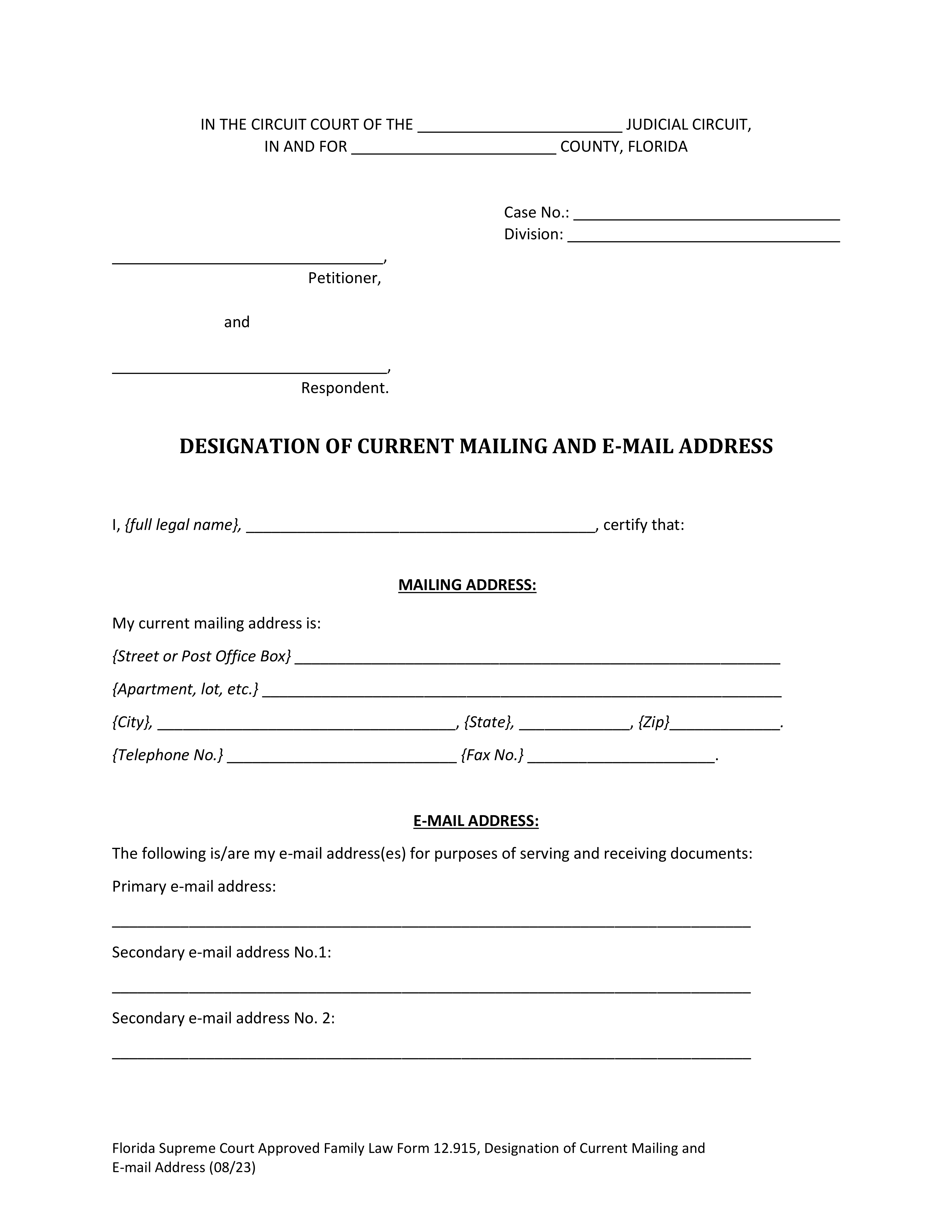
| Form 12.915, Designation of Current Mailing and E-mail Address | Notify court of current contact address | Any party in a Florida family law case | When address changes or case is initiated |
| Form UCS-840C, Request for Judicial Intervention Commercial Division Addendum | Assign case to NY Commercial Division | Plaintiff or filing party in commercial dispute | When case meets Commercial Division requirements |
| Form CIV-GP-124-i, Notice of Motion | Notify court and parties of motion request | Any party in NYC Civil Court case | When seeking a specific court order or relief |
| Form Order to Show Cause, Application in Support | Request emergency bankruptcy court relief | Movant in bankruptcy proceedings | When urgent relief is needed from bankruptcy court |
| Form Summons, Supreme Court of New York | Initiate a lawsuit and notify defendant | Plaintiff filing a civil lawsuit | At the start of a New York Supreme Court case |
| Form SC-100, Plaintiff's Claim and ORDER to Go to Small Claims Court | File a small claims lawsuit in California | Plaintiff suing for up to $12,500 | When initiating a small claims court case |
| Form EX550, Affidavit (Order to attend for questioning/suspended committal order) | Document service of court orders | Person serving the court order | After serving an order to attend or committal order |
| Form AO 136, Certificate of Good Standing | Verify attorney's authorization to practice | Attorney in U.S. District Court | When attorney eligibility needs to be confirmed |
| Form OAO 154, Substitution of Attorney | Record change of legal representation | Party changing attorneys in federal court | When replacing an attorney in a U.S. District Court case |
| Form AO 458, Appearance of Counsel | Record attorney's appearance in federal case | Attorney representing a party in federal court | When entering appearance in U.S. District Court |
| Form 108, Statement of Intention | Declare plans for secured debts in bankruptcy | Individual filing Chapter 7 bankruptcy | During Chapter 7 bankruptcy proceedings |
| Form AO 85A, Notice, Consent, and Reference of a Dispositive Motion | Consent to magistrate judge handling motions | All parties in a U.S. District Court case | When parties agree to magistrate judge involvement |
| Form AO 88, Subpoena to Appear and Testify | Command a witness to appear and testify | Attorney or party in a civil action | When witness testimony is needed at hearing or trial |
| Form AO 240, Application to Proceed in District Court Without Prepaying Fees or Costs | Request fee waiver in federal district court | Financially unable litigant | When filing in federal court without funds for fees |
| Form AO 239, Application to Proceed in District Court Without Prepaying Fees or Costs | Request fee waiver in federal district court | Financially unable litigant | When filing in federal court without funds for fees |
| Form AO 241, Petition for Relief From a Conviction or Sentence | Challenge state conviction or sentence federally | Individual in state custody | When seeking habeas corpus relief under 28 U.S.C. § 2254 |
| Judicial Council of California Form FL-300, Request for Order | Request or modify California family law orders | Either party in California family law case | Initiating, modifying, or requesting emergency orders |
| Judicial Council of California Form FL-150, Income and Expense Declaration | Financial disclosure for support proceedings | Either party in California family law case | Support, fee, or financial order hearings |
| Affidavit for Service by Publication/Posting (Circuit Court of Cook County, Illinois) (CCG 0013 A/B) | Support alternate service when defendant unavailable | Plaintiff unable to personally serve defendant | When defendant cannot be located or served personally |
| Petition for Leave to Proceed In Forma Pauperis (Court of Common Pleas of Lehigh County, Pennsylvania, Civil Division) | Request civil court fee waiver in Pennsylvania | Financially unable plaintiff or petitioner | When unable to afford Lehigh County civil court costs |
| In Forma Pauperis Affidavit/Petition (AOPC 622A) – Pennsylvania Magisterial District Court | Request fee waiver in PA magisterial court | Financially unable litigant in PA district court | When filing in Pennsylvania Magisterial District Court |
| AOC-SP-200, Petition for Adjudication of Incompetence and Application for Appointment of Guardian or Limited Guardian | Initiate NC incompetency and guardianship proceeding | Petitioner seeking guardianship over another person | When respondent may lack capacity to manage affairs |
| 2420 - Served by Publication/Posting Forcible Detainer - Notice by Posting (CCM 0086) | Provide court-authorized eviction notice by posting | Plaintiff in Cook County eviction case | When defendant cannot be served personally in eviction |
| Form JS 44 (Rev. 08/18), Civil Cover Sheet | Classify and initiate federal civil case filing | Plaintiff filing in U.S. District Court | When filing initial complaint in federal civil court |
| Judicial Council of California Form DE-111, Petition for Probate (Probate—Decedents Estates) | Initiate California probate for decedent's estate | Executor, administrator, or interested party | When opening formal probate after a death |
| SC-108, Request to Correct or Cancel Judgment and Answer (Small Claims) | Correct or cancel a small claims judgment | Party in California small claims case | Within 30 days of judgment notice mailing |
| Judicial Council of California Form SC-105, Request for Court Order and Answer (Small Claims) | Request a court order in small claims case | Any party in a California small claims case | Before trial or after judge's decision in small claims |
| SC-120, Defendant's Claim and ORDER to Go to Small Claims Court (Small Claims) | File a counterclaim against plaintiff in small claims | Defendant in California small claims case | When defendant wants to sue plaintiff in same case |
| Judicial Council of California Form DE-111, Petition for Probate (Probate—Decedents Estates) | Initiate California probate for decedent's estate | Executor, administrator, or interested party | When opening formal probate after a death |
| Judicial Council of California Form SC-104, Proof of Service (Small Claims) | Document service of small claims court papers | Person who served small claims documents | After serving documents on opposing party |
| Judicial Council of California Form SC-108, Request to Correct or Cancel Judgment and Answer (Small Claims) | Correct clerical error or cancel wrong-law judgment | Party in California small claims case | Within 30 days of small claims judgment notice |
| SC-105, Request for Court Order and Answer (Small Claims) | Request court order in small claims proceeding | Any party in a California small claims case | Before or after trial in small claims court |
| Judicial Council of California Form SC-120, Defendant's Claim and ORDER to Go to Small Claims Court (Small Claims) | File defendant's counterclaim in small claims | Defendant in California small claims case | When defendant has claim against plaintiff in same case |
| Civil Case Cover Sheet (Judicial Council of California Form CM-010) | Classify new civil case for court processing | Plaintiff filing first paper in CA Superior Court | When initiating a civil case in California Superior Court |
| Civil Case Cover Sheet (Judicial Council of California Form CM-010) | Classify civil case type and complexity | Plaintiff or certain defendants in CA Superior Court | At the start of a California Superior Court civil case |
| In Forma Pauperis Affidavit Petition (AOPC 622A) — Pennsylvania Magisterial District Court | Request fee waiver in PA magisterial court | Financially unable plaintiff or petitioner | When unable to afford Pennsylvania district court fees |
| Judicial Council of California Form TR-205, Request for Trial by Written Declaration (Trial by Written Declaration—Traffic) | Request written traffic trial in California | Traffic citation defendant in California | When contesting a traffic ticket without appearing in court |
| Florida Supreme Court Approved Family Law Form 12.901(b)(3), Petition for Dissolution of Marriage with No Dependent or Minor Child(ren) or Property (02/18) | Initiate Florida divorce with no children or assets | Spouse filing for dissolution of marriage | Simple divorce with no children, property, or support |
| Illinois Supreme Court Approved Form E-O 3500.3, Eviction Order | Finalize eviction and grant possession to plaintiff | Illinois Circuit Court (issued by judge) | After eviction case is decided by default or trial |
| Form P3 (Rule 25-3(2)) — Affidavit of Applicant for Grant of Probate or Grant of Administration with Will Annexed (Short Form) (Supreme Court of British Columbia) | Support BC probate or administration with will grant | Applicant for estate grant in BC Supreme Court | When applying for probate or administration in BC |
| Form FL-170, Declaration for Default or Uncontested Dissolution or Legal Separation | Support default or uncontested divorce judgment | Petitioner in California dissolution case | When case proceeds by default or is uncontested |
| Judicial Council of California Form DE-120, Notice of Hearing—Decedent's Estate or Trust | Notify interested persons of probate hearing | Personal representative or petitioner in CA probate | When a hearing is scheduled in a probate proceeding |
| Form DE-160/GC-040, Inventory and Appraisal (Declaration of Representative/Guardian/Conservator or Small Estate Claimant and Declaration of Probate Referee) | List and appraise estate or conservatorship assets | Personal representative, guardian, or conservator | During California probate or conservatorship administration |
| Inventory and Appraisal Attachment (Judicial Council of California Form DE-161, GC-041) | Itemize individual estate assets with appraised values | Personal representative or conservator in CA probate | As attachment to DE-160/GC-040 inventory form |
| Form SC-100, Plaintiff's Claim and ORDER to Go to Small Claims Court | Initiate a California small claims lawsuit | Plaintiff filing a small claims case | When suing in California small claims court |
| Designation of Record on Appeal (Civil) (Maricopa County Justice Courts, Arizona) (Form APP 8150-702) | Identify documents for civil appellate record | Party filing a civil appeal in Maricopa County | When appealing a civil judgment in Arizona justice court |
| FW-003, Order on Court Fee Waiver (Superior Court) | Document court's decision on fee waiver request | Court clerk or judge (issued by court) | After reviewing a California court fee waiver application |
| Certificate of Service (Civil Court Claim) | Certify that court documents were properly served | Party or representative who served documents | After serving documents in a civil court proceeding |
| Form N349, Application for Third Party Debt Order | Recover judgment debt from third-party account holder | Judgment creditor in UK civil proceedings | When enforcing a judgment against debtor's bank funds |
| Form CC 381, Notice of Hearing on Petition for Personal Protection Order | Notify respondent of PPO hearing in Michigan | Court clerk (served on respondent) | When a PPO petition hearing has been scheduled |
Tips for court forms
Most court documents, including affidavits and small claims filings, require a signature under oath. Double-check all dates, names, and dollar amounts before signing, as inaccuracies can lead to legal penalties or the immediate dismissal of your case.
Filing a form with the clerk is often just the first step; you must also legally notify the other party. Use specific forms like the Certificate of Service or Request for Sheriff to Serve Court Papers to document that you have followed the court's strict notification requirements.
AI-powered tools like Instafill.ai can complete complex court forms in under 30 seconds with high accuracy. Your data stays secure during the process, providing a practical and fast solution for those managing multiple filings or tight court deadlines.
If you cannot afford the costs of filing, look for 'In Forma Pauperis' or 'Application to Proceed Without Prepaying Fees' forms. These allow you to submit a financial affidavit to the court to request a waiver of standard filing and administrative fees.
Standard forms often have limited space for listing all involved parties or details. Always check if your filing requires attachments, such as Form SC-100A for additional defendants, to ensure the court record is complete and accurate.
Ensure that the spelling of names, contact information, and case numbers are identical on every document submitted for a single matter. Even minor discrepancies between a Summons and an Eviction Order can cause significant administrative delays.
When filing an Appellant’s Notice, you must identify specific orders and transcripts to include in the record. Use a Designation of Record form to clearly list which documents the higher court needs to review to avoid your appeal being rejected for missing information.
Frequently Asked Questions
Court forms are standardized legal documents used to initiate lawsuits, respond to claims, or request specific actions from a judge. They ensure that all necessary information is provided to the court in a structured format that meets local procedural and legal requirements.
The correct form depends on your specific legal issue, such as an eviction, a small claims dispute, or a probate matter, as well as your geographic jurisdiction. You should review the form titles and descriptions provided in this category or consult your local clerk of court to ensure you are using the version required by your local rules.
Yes, AI tools like Instafill.ai can fill out various court forms in under 30 seconds. These systems are designed to accurately extract data from your source documents and place it into the correct fields, helping to minimize manual entry errors.
If you are unable to afford the costs of filing a lawsuit, you can submit an 'In Forma Pauperis' affidavit or a fee waiver application. These forms require you to disclose your financial status so the court can determine if you qualify to proceed without prepaying filing fees or court costs.
Completed forms are typically filed with the clerk of the court in the specific county or district where the legal matter is being heard. Depending on the court's rules, you may be able to file your documents in person, via mail, or through an electronic filing (e-filing) portal.
Service of process is the formal procedure used to notify a defendant that a legal action has been started against them. Many forms in this category, such as Summons or Proof of Service documents, are used to prove to the court that the other party was properly notified according to the law.
When using AI-powered platforms like Instafill.ai, most court forms can be completed in under 30 seconds. The AI automates the process by identifying relevant information from your uploaded documents and mapping it to the appropriate sections of the court PDF.
No, court forms are usually specific to a particular jurisdiction, such as a specific state in the US or a specific province in Canada. It is critical to select the form that corresponds to the court where your case is actually located, as different regions have different statutory requirements.
Errors on court forms can lead to the court rejecting your filing, which may cause you to miss important legal deadlines. Because many of these documents are signed under penalty of perjury, it is essential to ensure that all information, including party names and claim amounts, is entirely accurate.
Many of these forms are designed for 'pro se' litigants, meaning individuals who are representing themselves without an attorney. While the forms provide a structured way to present your case, you may still wish to consult with a legal professional for complex matters like probate or appeals.
A summons is an official notice that informs a person they are being sued and provides instructions on how to respond. A complaint or 'claim' is the document that outlines the specific facts of the case and the legal reasons why the plaintiff believes they are entitled to relief.
You should use a defendant's claim form, such as the SC-120, if you have been sued in small claims court but believe the plaintiff actually owes you money related to the same incident. This allows both claims to be heard at the same time by the judge.
Glossary
- Form Complexity Index
- Instafill’s 0–100 measure of how much effort a form takes to complete, calculated deterministically from the form’s own structure rather than estimated. It combines the number of fillable fields (the largest factor), how difficult those fields are to complete based on their type, the number of pages that contain fields, the amount of conditional “fill-only-if” logic, and how many sections the form is divided into, then adds modifiers for tables and repeating lists, bundled instruction pages, and dense page layouts. A higher score means the form is harder to fill out by hand. The forms in this category have a median Form Complexity Index of 55/100 (Moderate). See exactly how it is calculated.
- Service of Process
- The formal delivery of legal documents, such as a summons or complaint, to a party involved in a lawsuit to ensure they are legally notified of the action. A 'Proof of Service' is the document filed with the court to confirm this delivery occurred correctly.
- In Forma Pauperis (IFP)
- A Latin phrase meaning 'in the character of a pauper,' referring to a request for the court to waive filing fees and costs for an individual who cannot afford them due to financial hardship.
- Affidavit
- A written statement of facts that is voluntarily made and confirmed by an oath or affirmation, typically signed in the presence of a notary public or other authorized official.
- Summons
- An official notice issued by a court that informs a person they are being sued and provides instructions on when and where they must appear or respond to the claim.
- Probate
- The legal process overseen by a court to settle a deceased person's estate, which includes validating a will, paying debts, and distributing assets to heirs.
- Dissolution of Marriage
- The legal term used in many court systems for a divorce, which is the formal legal ending of a marriage contract.
- Appellant
- The party who appeals a lower court's decision to a higher court, seeking to have the original judgment overturned or modified.
- Garnishment
- A legal procedure where a court orders a third party, such as an employer or a bank, to withhold money from a debtor's wages or account to pay off a debt or judgment.