Yes! You can use AI to fill out Petition for Letters of Administration (New York Surrogate's Court)
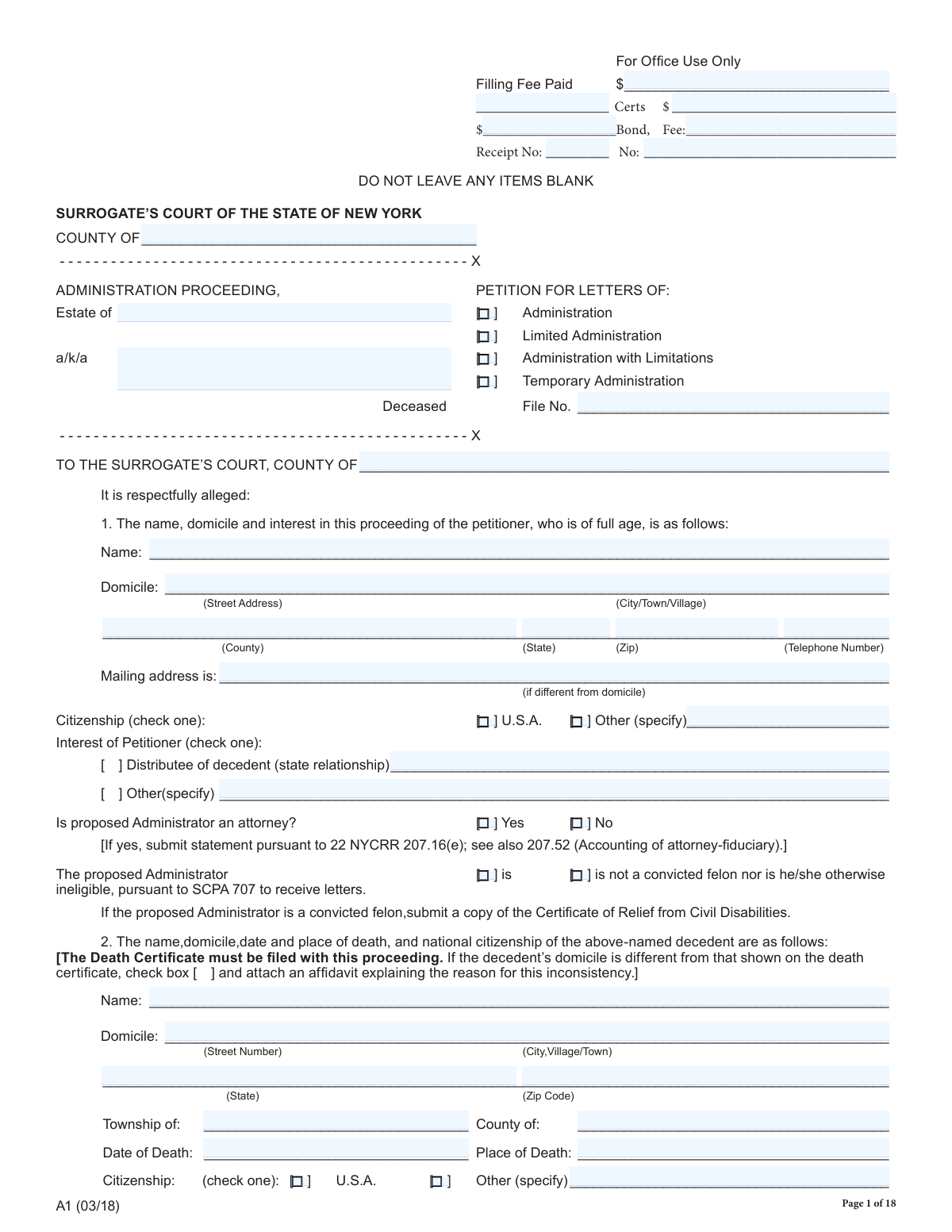
The Petition for Letters of Administration is a legal document filed in the New York Surrogate's Court to initiate the process of settling an estate when a person dies without a valid will (intestate). It requests the court to appoint a legal representative, known as an administrator, to collect assets, pay debts, and distribute the remaining property to the legal heirs. Today, this form can be filled out quickly and accurately using AI-powered services like Instafill.ai, which can also convert non-fillable PDF versions into interactive fillable forms.
Our AI automatically handles information lookup, data retrieval, formatting, and form filling.
It takes less than a minute to fill out A1 using our AI form filling.
Securely upload your data. Information is encrypted in transit and deleted immediately after the form is filled out.
Form specifications
| Form name: | Petition for Letters of Administration (New York Surrogate's Court) |
| Number of pages: | 4 |
| Language: | English |
| Categories: | court forms, New York court forms, New York forms, UK court forms |
Instafill Demo: How to fill out PDF forms in seconds with AI
How to Fill Out A1 Online for Free in 2026
Are you looking to fill out a A1 form online quickly and accurately? Instafill.ai offers the #1 AI-powered PDF filling software of 2026, allowing you to complete your A1 form in just 37 seconds or less.
Follow these steps to fill out your A1 form online using Instafill.ai:
- 1 Navigate to Instafill.ai and upload or select the New York Petition for Letters of Administration form.
- 2 Provide the petitioner's personal information, including name, address, citizenship, and interest in the estate.
- 3 Enter the decedent's full name, domicile, date and place of death, and citizenship.
- 4 Detail the estimated value of the decedent's personal and real property, gross rental income, and any existing rights of action or legal claims.
- 5 List all surviving distributees (heirs) as required by law, including their names, relationship to the decedent, addresses, and citizenship.
- 6 Specify the type of letters you are petitioning for (e.g., Administration, Limited Administration) and any other specific relief you are requesting from the court.
- 7 Review all the information auto-filled by the AI for accuracy, then sign and date the petition before filing it with the correct county's Surrogate's Court.
Our AI-powered system ensures each field is filled out correctly, reducing errors and saving you time.
Why Choose Instafill.ai for Your Fillable A1 Form?
Speed
Complete your A1 in as little as 37 seconds.
Up-to-Date
Always use the latest 2026 A1 form version.
Cost-effective
No need to hire expensive lawyers.
Accuracy
Our AI performs 10 compliance checks to ensure your form is error-free.
Security
Your personal information is protected with bank-level encryption.
Frequently Asked Questions About Form A1
This form is used to ask the New York Surrogate's Court to appoint an Administrator to manage the estate of a person who died without a valid will (intestate). The Administrator is responsible for collecting assets, paying debts, and distributing the remaining property to the legal heirs.
The petition is typically filed by a person who is a legal heir (distributee) of the decedent, such as a spouse, child, or other close relative. Other interested parties, like creditors, may also file in certain circumstances.
Full Administration grants broad powers to manage the entire estate. Limited Administration restricts the administrator's authority to specific tasks, like pursuing a lawsuit, while Temporary Administration is a short-term appointment to handle urgent matters until a permanent administrator is named.
You must file an official copy of the decedent's Death Certificate with this petition. If the proposed administrator is an attorney or has a felony conviction, additional statements or certificates are also required.
If the domicile on the death certificate is incorrect, you must check the box in Section 2 and attach a separate affidavit explaining the discrepancy and providing the correct domicile information.
You should not include any assets that were jointly held, held in trust for another person, or had a named beneficiary, such as a life insurance policy or a retirement account payable to someone specific.
Distributees are the legal heirs who are entitled to inherit the decedent's property under New York State law. You must list all surviving relatives in the order of priority outlined in Section 6, providing their name, relationship, address, and citizenship.
You must list any infants (minors) or persons under a disability in Section 7b. You will also need to attach the applicable supplemental schedules (A, B, C, and/or D) to provide more information about their circumstances.
Yes, it may be possible to serve as administrator even with a felony conviction. You must indicate this on the form and submit a copy of your Certificate of Relief from Civil Disabilities for the court's consideration.
If you have a non-fillable PDF, you can use a service like Instafill.ai to convert it into an interactive, fillable form. This allows you to easily type your information directly into the fields.
Yes, services like Instafill.ai use AI to help you auto-fill forms like this one accurately and efficiently. This can save you time and help reduce errors by extracting information from your documents to populate the correct fields.
To fill out this form online, you can upload it to a platform like Instafill.ai. The service will make the form fillable, and you can type your answers, save your progress, and download the completed document.
A 'right of action' refers to a potential lawsuit the decedent was entitled to file, or one that arises from their death, such as a personal injury or wrongful death claim. You must briefly describe any such claims on the form.
No, the form explicitly states 'DO NOT LEAVE ANY ITEMS BLANK'. If a section does not apply to your situation, you should write 'None' or 'N/A' as appropriate.
Compliance A1
Validation Checks by Instafill.ai
1
Mandatory Petition Type Selection
This check ensures that the petitioner has selected at least one type of administration from the four available options: Administration, Limited Administration, Administration with Limitations, or Temporary Administration. This selection is fundamental to the petition's purpose, defining the scope of authority being requested from the court. If no selection is made, the form is incomplete and cannot be processed, as the court would not know what type of letters to consider issuing.
2
Petitioner Information Completeness
Verifies that all fields in Section 1 for the petitioner's details (Name, Domicile street address, City/Town/Village, County, State, Zip, and Telephone Number) are filled. The form explicitly states 'DO NOT LEAVE ANY ITEMS BLANK'. This information is critical for court records, official notices, and communication. A failure would halt processing until the petitioner provides the missing information.
3
Date of Death Validity
This validation confirms that the 'Date of Death' in Section 2 is a valid, fully-formatted date (e.g., MM/DD/YYYY) and that the date is in the past. It prevents typographical errors and logically impossible dates, such as a future date of death. An invalid or future date would render the petition invalid, as administration proceedings can only commence after a person has died.
4
Conditional Citizenship Specification
Checks that if the 'Other' box for citizenship is checked for either the petitioner (Section 1) or the decedent (Section 2), the corresponding text field to specify the country of citizenship is not empty. This is required for determining jurisdiction and potential international legal implications. If the box is checked but the specification is missing, the submission is considered incomplete.
5
Conditional Interest Specification
Ensures that if the petitioner checks 'Distributee of decedent' or 'Other' for their interest in the proceeding (Section 1), the corresponding line for specifying the relationship or interest is filled out. This information establishes the petitioner's legal standing to file the petition. Failure to specify the interest means the petitioner's right to bring the action is not established on the face of the document.
6
Administrator Felony Status Declaration
Validates that one of the two options in Section 1 regarding the proposed administrator's felony status ('is' or 'is not a convicted felon') has been selected. This is a mandatory declaration under SCPA 707 to determine eligibility. Leaving this blank would require clarification from the petitioner, as it directly impacts the qualification of the proposed administrator.
7
Required 'NONE' or Content for Specific Fields
This check verifies that fields such as 'rights of action' (Section 3d) and 'outstanding debts' (Section 8) are not left blank. The form instructions require the user to write 'NONE' if there are no items to list. This validation ensures an explicit declaration is made, preventing ambiguity about whether the petitioner simply forgot to fill out the section or if there are truly no debts or rights of action.
8
Logical Hierarchy of Surviving Relatives
Performs a logical check on the survivor information in Section 6 to ensure it follows the form's specific instructions. If a number of survivors is listed for a certain class (e.g., 'c. Mother/Father'), the validation confirms that all prior classes (e.g., 'a. Spouse', 'b. Child') are marked 'No', and all subsequent classes are marked 'X'. This rule is crucial for correctly identifying the legal distributees according to intestacy law (EPTL 4-1.1).
9
Consistency Between Survivor Count and Distributee List
This validation cross-references the number of survivors listed in each category of Section 6 with the number of individuals detailed in Section 7 (Distributees). For example, if Section 6 indicates there are two surviving children, Section 7 should list two individuals with the relationship of 'child' or similar. A mismatch indicates a significant error in identifying the necessary parties to the proceeding.
10
Relief Request and Administrator Name Consistency
Ensures that if a checkbox is marked in the 'WHEREFORE' clause to request a specific type of Letters (e.g., 'Letters of Administration'), the corresponding line to name the proposed administrator is filled out. Requesting letters without nominating a person to receive them is an incomplete request. The form submission would be rejected pending the naming of a proposed fiduciary.
11
Real Property Description Requirement
This check ensures that if a monetary value greater than zero is entered in Section 3(b) for 'estimated gross value of the decedent’s real property', then the 'brief description of each parcel' field must not be empty. The description is necessary to identify the specific asset being referenced. Without it, the valuation is meaningless and the court cannot properly assess the estate's assets.
12
Attorney Status Declaration
Validates that the petitioner has selected either 'Yes' or 'No' for the question 'Is proposed Administrator an attorney?'. This is a required declaration because an affirmative answer triggers a separate requirement to submit a statement pursuant to 22 NYCRR 207.16(e). An omission here leaves the court unable to determine if all required documentation has been filed.
13
County Name Validation
Verifies that the 'County' name provided at the top of the form is a valid, existing county within the State of New York. This is essential for ensuring the petition is filed in the correct jurisdiction, as the Surrogate's Court's authority is county-based. An incorrect or misspelled county could lead to misfiling and significant delays.
14
Numeric Format for Estate Values
This validation ensures that the monetary value fields in Section 3 (personal property, real property, and gross rent) contain only valid numeric characters, commas, and a decimal point. This prevents text or invalid entries from being submitted. Correct formatting is essential for the court to accurately assess the size of the estate, which determines the filing fee and whether a bond is required.
Common Mistakes in Completing A1
Petitioners often misunderstand which assets to include, mistakenly listing jointly held accounts, life insurance policies with named beneficiaries, or assets held in trust. These are non-probate assets and should be excluded, as the form specifically requests the value of property passing by 'intestacy'. Including them inflates the estate's value, leading to incorrect filing fees, unnecessarily high bond requirements, and potential rejection of the petition.
A critical error is omitting legally entitled distributees (heirs) as defined by New York's intestacy laws (EPTL 4-1.1). This often happens when petitioners forget to include non-marital children, descendants of a predeceased relative (like children of a deceased sibling), or adopted-out relatives. This omission can invalidate the entire proceeding, as all necessary parties must be notified, and can lead to future legal challenges to the estate's administration.
This section has very specific instructions that are frequently missed: state the 'number' of survivors in a class, write 'No' for all prior classes with no survivors, and 'X' for all subsequent classes. People often just put checkmarks or names, which does not comply with the court's requirement for a clear, hierarchical summary of heirs. This mistake can cause the clerk to return the form for correction, delaying the proceeding.
The form explicitly states 'DO NOT LEAVE ANY ITEMS BLANK' at the top, and specific fields like Section 3(d) for legal claims and Section 8 for debts instruct the user to write 'NONE' if not applicable. Many filers leave these sections empty, assuming blank means none. This leads to ambiguity and can cause the court to reject the petition for being incomplete, requiring the filer to amend and resubmit.
Petitioners may list a domicile for the decedent that differs from the address on the official death certificate, often due to a recent move or hospitalization before death. The form requires that if these differ, an affidavit explaining the inconsistency must be attached. Forgetting this affidavit will cause the court to halt the process and demand clarification, as the decedent's final domicile is crucial for establishing the court's jurisdiction.
Simply stating a relationship like 'Niece' or 'Cousin' is insufficient; the court requires a clear line of descent. The petitioner must show how the person is related, for example, 'Daughter of Jane Doe, the decedent's predeceased sister.' Failing to provide this detailed lineage makes it impossible for the court to verify that the person is a legal distributee, leading to requests for more information and delays.
The 'WHEREFORE' clause is where the petitioner formally asks the court to take action, yet it is often overlooked. People forget to check the box for the type of letters they want (e.g., Administration) or fail to write in the name of the proposed administrator. An incomplete request section renders the petition ineffective, as the court has not been formally asked to grant any specific relief.
A petitioner's 'domicile' is their fixed, permanent, and principal home, which is a legal requirement for establishing residency. Filers sometimes incorrectly enter a P.O. Box or a temporary mailing address in the domicile field. This can create confusion and raise questions about the petitioner's eligibility or the proper venue for the proceeding, potentially slowing down the appointment process.
This complex petition often requires additional documents based on the answers provided, which are easily missed. For example, if the proposed administrator is an attorney, a specific statement is required; if they are a convicted felon, a Certificate of Relief is needed; if there are non-marital children, an Order of Filiation may be necessary. Overlooking these requirements results in an incomplete filing that will be returned by the court clerk.
Since this form is often provided as a non-fillable PDF, petitioners may fill it out by hand, leading to illegible handwriting, misaligned text, or incorrect date formats. This makes it difficult for the court clerk to accurately enter the data and can lead to rejection. To avoid this, it's best to use a tool like Instafill.ai that can convert flat PDFs into fillable forms, ensuring all entries are typed, clean, and properly formatted.
Saved over 80 hours a year
“I was never sure if my IRS forms like W-9 were filled correctly. Now, I can complete the forms accurately without any external help.”
Kevin Martin Green
Your data stays secure with advanced protection from Instafill and our subprocessors

Robust compliance program
Transparent business model
You’re not the product. You always know where your data is and what it is processed for.
ISO 27001, HIPAA, and GDPR
Our subprocesses adhere to multiple compliance standards, including but not limited to ISO 27001, HIPAA, and GDPR.
Security & privacy by design
We consider security and privacy from the initial design phase of any new service or functionality. It’s not an afterthought, it’s built-in, including support for two-factor authentication (2FA) to further protect your account.
Fill out A1 with Instafill.ai
Worried about filling PDFs wrong? Instafill securely fills petition-for-letters-of-administration-new-york-surrogates-court forms, ensuring each field is accurate.